






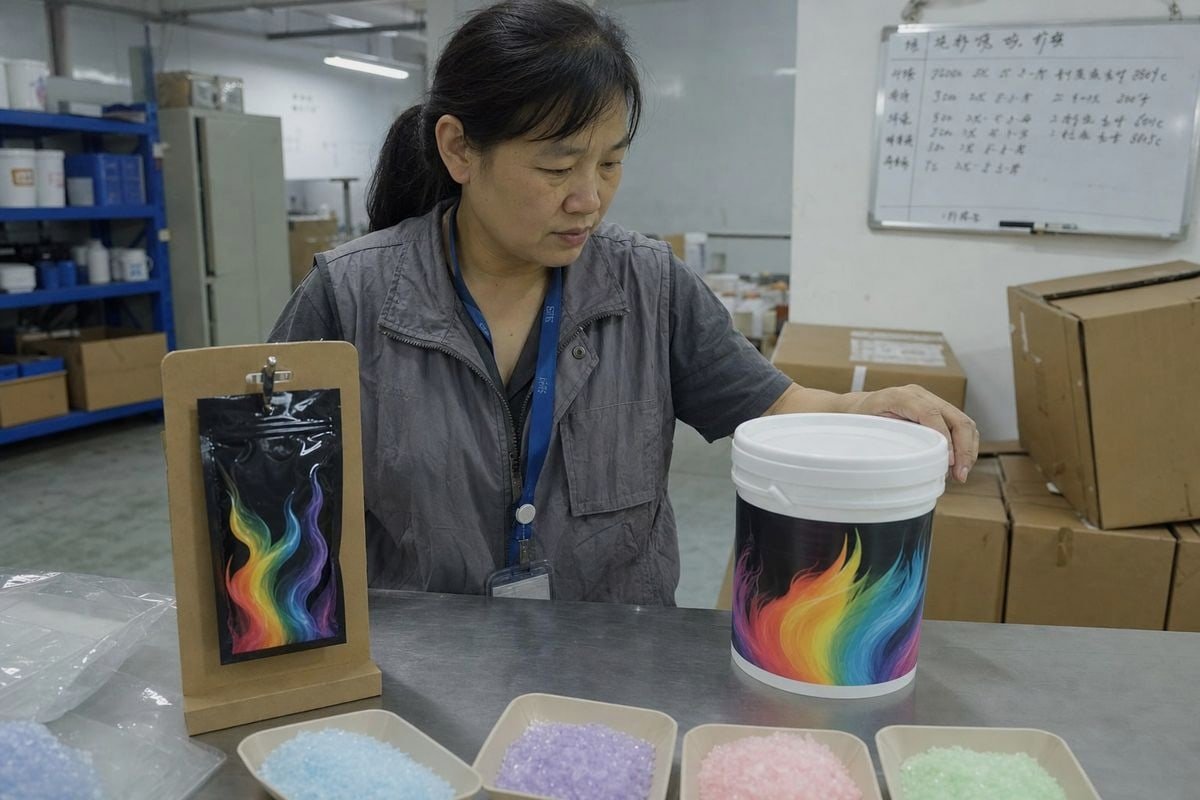
Requesting both retail hanging card and bulk bucket packaging for Magic Fire Powder confuses many buyers. On our production line, vague dual-packaging requests cause delays, wrong quotes, and mismatched branding.
To request both retail hanging card and bulk bucket packaging for Magic Fire Powder, ask your supplier for two separate SKUs of the same formula: a peg-ready carded pouch for stores and a resealable HDPE bucket for wholesale. Quote each SKU separately for dimensions, labeling, MOQ, and lead time.
That is the short answer. The details matter more. Below, I walk through MOQ structure, branding alignment, compliance labeling, and how dual packaging affects lead time and shipping costs.
What MOQ do I need to order both hanging card and bulk bucket packaging together?
Last spring, a German distributor asked our team for both formats in one order. His first worry was hitting two separate minimums. We solved it with one shared powder MOQ.
Most suppliers accept a Total Mass MOQ for dual packaging: one combined minimum based on total powder weight, typically 300–500 kg, split freely between hanging card units and buckets. Each packaging format then carries its own smaller print-run minimum, usually 1,000–3,000 cards and 200–500 buckets.

The minimum order quantity question is really two questions stacked together. One MOQ covers the powder itself. The other covers the packaging materials. When you understand this split, negotiation becomes much easier.
Our color flame packets use the same base formula whether they end up in a 25g foil sachet stapled to a header card or loose inside a 5kg bucket. So the powder production run 1 is one batch. That is why we, and most experienced factories, agree to a Total Mass MOQ. You order, say, 500 kg of Magic Fire Powder in total. Then you decide the split: perhaps 70% into retail sachets and 30% into buckets.
Why packaging minimums exist separately
Printed header cards run on offset presses. Presses have setup costs, so printers set minimums around 1,000–3,000 pieces. Buckets with custom labels have their own label print minimum. Neither minimum is about the powder. Keep these numbers separate in your inquiry, and your quote will come back cleaner.
A realistic MOQ structure
| Artikel | Typische MOQ | Anmerkungen |
|---|---|---|
| Total powder (combined) | 300–500 kg | Shared across both formats |
| Retail hanging card units | 000–3.000 Stück | Driven by card print run |
| Bulk buckets | 200–500 pcs | Driven by label and bucket sourcing |
| Trial order (first-time buyers) | Negotiable | We often lower this for sampling |
For a first order, ask directly: "Can we split one powder MOQ across two packaging SKUs?" In our experience exporting to 30+ countries, most serious factories say yes. If a supplier insists on two full, separate MOQs with no flexibility, that is usually a sign you are talking to a trading company, not the actual factory.
Can I use the same private-label branding across both packaging formats?
A UK fireplace brand once sent us artwork designed only for a hang card, then asked us to "just shrink it" for the bucket. It did not work. Scaling branding across formats takes planning, not resizing.
Yes, you can run one private-label brand identity across both formats. Provide your supplier with a master brand file — logo, colors, fonts, and flame imagery — and request adapted layouts: a portrait header card for peg display and a wraparound or front-panel bucket label with the same visual system.

Private label manufacturing works best when you treat both packages as one brand family 2 with two jobs. The hanging card sells on emotion at the shelf. The bucket sells on trust and utility in a warehouse or pro-user setting. Our OEM/ODM team handles this split every month, and the process is straightforward when the buyer supplies the right assets.
What to send your supplier
- Vector logo files (AI or EPS format).
- Exact color codes (Pantone or CMYK).
- Brand fonts, or permission to substitute close matches.
- Any required retailer elements, like barcodes or store SKU codes.
- Your market's mandatory warning text, if you already have approved wording.
From there, the factory design team adapts the artwork. The retail hanging card gets bold flame graphics, a die-cut hang hole, and a product photo showing the colored-flame effect — the elements that drive impulse purchases at a Verkaufsdisplay. The bucket gets the same logo and colors, but with larger usage instructions 3, batch coding space, and a cleaner information hierarchy.
Design priorities by format
| Element | Retail hanging card | Bulk bucket |
|---|---|---|
| Primary goal | Shelf visibility, impulse buy | Trust, durability, dosing info |
| Logo placement | Top center, above hang hole | Front panel, large |
| Imagery | Colored flame photo, gradient graphics | Simplified brand mark |
| Text focus | Short benefit claims | Instructions, scoop dosage, batch code |
| Finish | Gloss laminated 18pt–24pt card | Waterproof pressure-sensitive label |
One practical tip from our sampling room: always request a combined sample kit with both formats side by side. Colors print differently on coated paperboard than on plastic bucket labels. Seeing both together before mass production prevents the mismatched-shade problem that frustrates retail buyers most. We include this step as standard in our custom branding options for outdoor living supplies brands.
How do I make sure warning labels and compliance markings meet my market's regulations on both formats?
Compliance is the topic our EU buyers raise before price, every single time. After 17+ years shipping fire pit additives to Germany, France, and the US, we have learned that labeling errors stop shipments faster than any quality issue.
Ask your supplier for a material safety data sheet, CE marking where applicable, and SGS or Intertek test reports covering the exact formula. Then confirm the retail card carries consumer warning text and the bulk bucket carries full GHS hazard communication, since bulk chemical storage triggers stricter labeling.
The key insight is that the two formats face different regulatory lenses. A 25g sealed sachet on a hanging card is treated as a consumer product. A 5kg bucket of loose powder can be treated as workplace chemical storage in some jurisdictions. That difference changes what must appear on the label.
Consumer retail card requirements
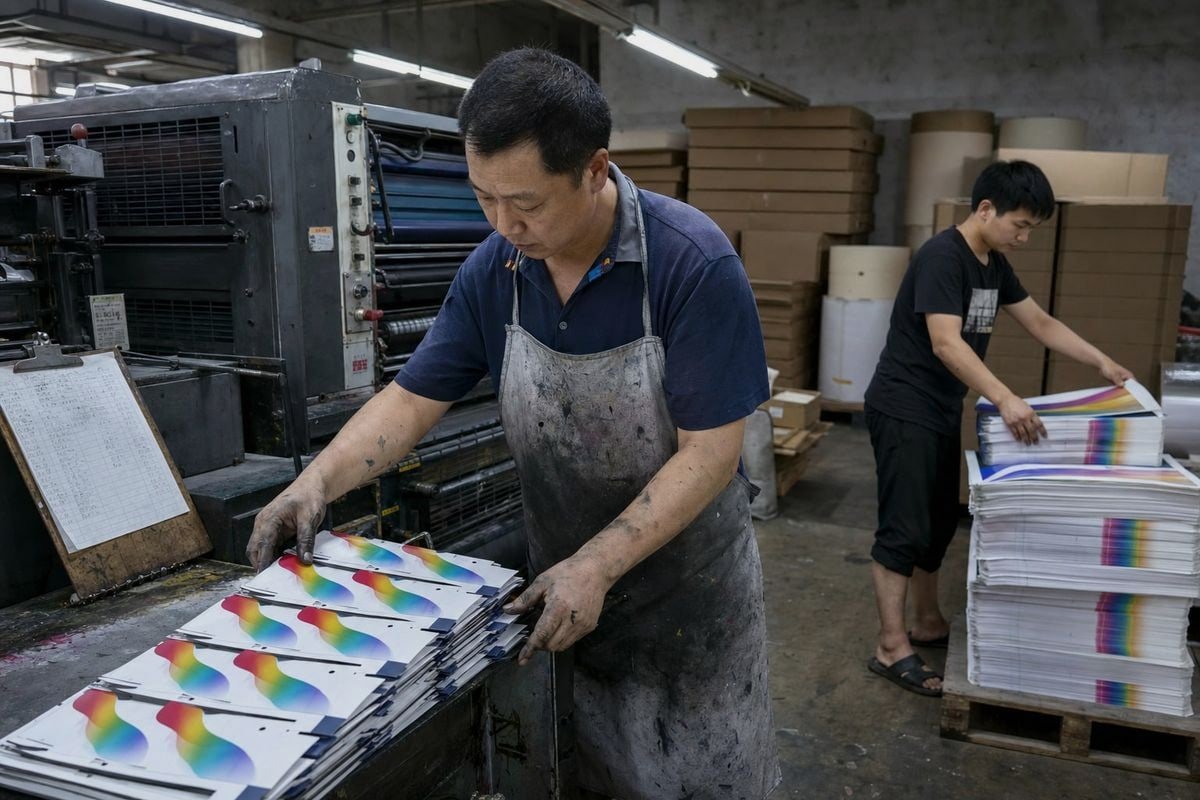
For the hanging card, most markets require: clear usage instructions, age restriction wording, "keep away from children" text, distance-from-flame guidance, and country-of-origin marking. In the EU, you also need an EU responsible-person address on the pack. Our factory prints these directly onto the header card during the offset run, so there is no sticker-over-sticker patchwork that retail sourcing teams reject.
Bulk bucket requirements
The bucket needs more. GHS-compliant hazard communication 4 is the standard framework: signal words, Gefahrenpiktogramme 5 if applicable, precautionary statements, and supplier identification. Because professional users may store buckets in warehouses, workplace safety rules apply. We also recommend batch numbers and production dates on every bucket, which supports traceability and simplifies Bestandsverwaltung 6 on your end.
Documentation checklist to request
| Dokument | Größenspezifisch? | Wer braucht es |
|---|---|---|
| Sicherheitsdatenblatt 7 | Formula composition, handling | Zoll, Einzelhändler, Versicherer |
| CE / relevant conformity marks | Product safety compliance | EU retail channels |
| SGS- oder Intertek-Testbericht | Third-party verification | Große Einzelhandels-Beschaffungskanäle |
| GHS-compliant bucket label proof | Workplace hazard communication | Distributors, pro users |
| ISO 9001 / BSCI-Zertifikate | Factory quality and ethics | Retail audits |
One buyer objection we hear: "Can't the supplier just handle compliance for me?" Partly, yes. We supply the test reports, MSDS, and compliant label templates. But final legal responsibility in your market sits with the importer. So review our label proofs with your local compliance advisor before approving print. That one review cycle, done early, has saved several of our long-term partners from costly relabeling at destination ports.
Will combining two packaging types affect my production lead time and shipping costs?
Here is the trade-off I weigh with every dual-format quote: two packaging lines add a few days of coordination, but combining both SKUs in one container almost always cuts the total landed cost per unit.
Combining formats adds roughly 5–10 days to lead time because card printing and bucket labeling run in parallel but finish at different speeds. However, shipping costs usually drop, since dense buckets and light carded units mix efficiently in one container, improving volume-to-weight utilization.

Let me break this down the way our planning team does, because the numbers surprise many first-time buyers of wholesale campfire accessories.
Lead time: where the days actually go
The powder batch itself is not the bottleneck. One production run covers both SKUs. The variable is packaging convergence. Header cards need artwork approval, plate making, printing, lamination, and die-cutting. Buckets need label printing plus bucket procurement and lid fitting. These streams run in parallel at our Ningbo facility, but the slower stream sets the ship date.
A typical timeline looks like this:
- Artwork approval for both formats: 3–5 days.
- Powder production and QC batch testing: 10–12 days.
- Card printing and sachet carding: 12–15 days, parallel.
- Bucket labeling, filling, and sealing: 8–10 days, parallel.
- Final inspection and consolidated loading: 2–3 days.
Total: roughly 30–35 days versus 25 days for a single format. Approve both artworks on the same day, and the gap shrinks further.
Shipping: why mixing formats helps
Carded retail units are light but bulky. They fill cubic space before they hit weight limits. Buckets are the opposite: dense and stackable. Loading both together balances the container. On several mixed shipments to the US and Australia, our buyers reached better container utilization than either format alone would allow. We also palletize buckets on the container floor and stack retail master cartons above them, which protects the display-ready cards from crush damage.
One caution: HDPE buckets with airtight gasket lids add unit weight, so air freight for buckets rarely makes sense. Plan bulk formats for sea freight, and reserve air only for urgent retail card replenishment.
Schlussfolgerung
Requesting retail hanging card and bulk bucket packaging for Magic Fire Powder works best as two clearly specified SKUs sharing one powder MOQ, unified branding, format-specific compliance labels, and one consolidated shipment.
Fußnoten
1. Authoritative definition of production runs in manufacturing contexts. ↩︎
2. Explains the concept of maintaining a consistent brand family across products. ↩︎
3. Government guidelines on consumer product labeling and usage instructions. ↩︎
4. OSHA defines GHS hazard communication standards referenced for bulk chemical labeling requirements. ↩︎
5. Official OSHA guide to GHS-compliant hazard pictograms for chemical labeling. ↩︎
6. Industry leader explanation of inventory management and traceability. ↩︎
7. Standard reference for chemical safety documentation requirements. ↩︎



 English
  Spanish
  German
  French
  Arabic
  Portuguese
Diskutieren Sie mit