






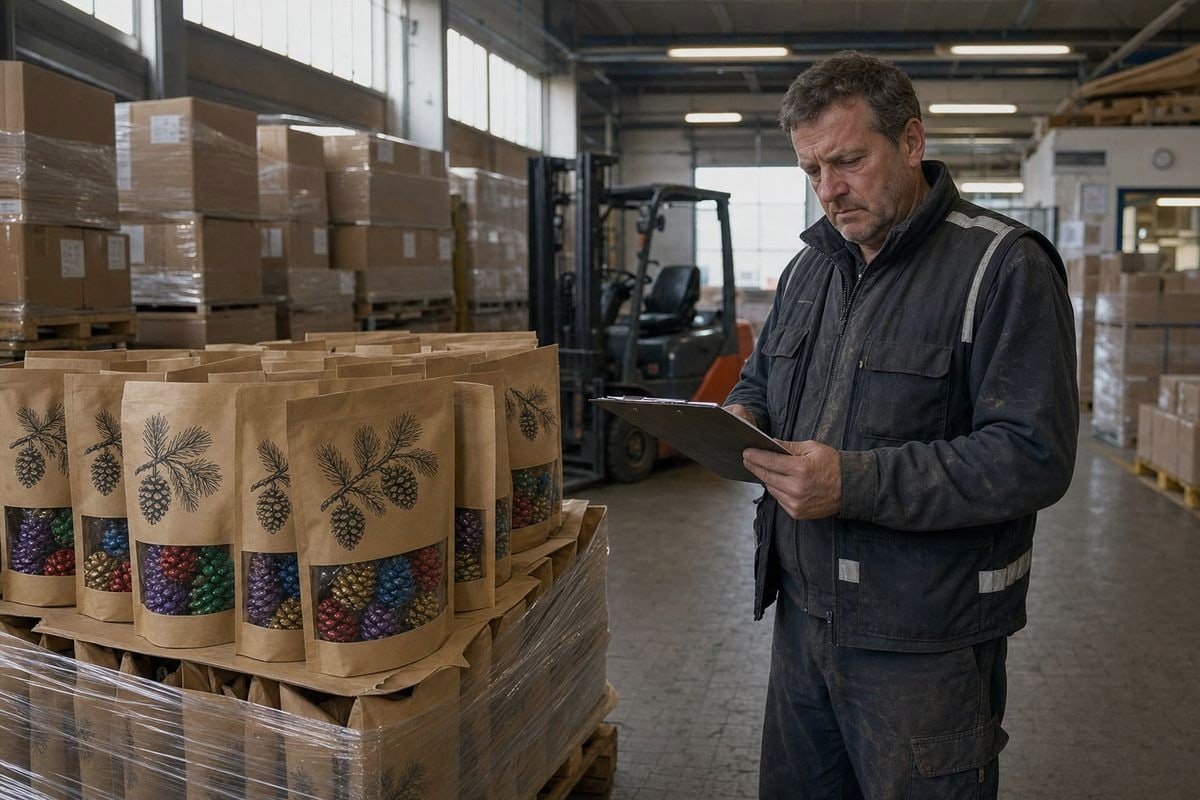
EPR packaging registration 1 confuses many buyers of our color-flame pinecones. They order a great product, then customs or a marketplace blocks it over packaging paperwork nobody warned them about.
To complete EPR packaging registration for imported fireplace pine cones, register as a producer in each country where you sell, declare every packaging component by material and weight, pay the registration or scheme fee, and file recurring packaging data reports on time.
The key point is simple. EPR applies to your packaging, not the pine cones themselves. Below, I walk through registration, fee calculation, material declarations, and how a factory like ours supports your paperwork.
What EPR Packaging Registration Steps Should I Follow for My Fireplace Pine Cone Imports?
A German distributor once asked us to hold a full container of color-flame pinecones at our Ningbo facility. His EPR registration number had not arrived, and Amazon had frozen his listings until he submitted it.
Follow five steps: confirm the countries where you place packaging on the market, identify yourself as the obligated producer or importer, register on each national portal or with a compliance scheme, upload packaging data by material and weight, then pay the fee to activate registration.

The single biggest mistake I see buyers make is guessing their obligation from the product name. Pine cones sound like a raw natural product. But once we pack them into a kraft stand-up pouch, a burlap drawstring sack, or a retail display box, you are placing packaging on the market. That packaging is what triggers EPR.
Step 1: Confirm who the obligated party is
In most systems, the first business to place packaged goods on the national market carries the duty. If you import our pinecones into the UK under your own brand, that is usually you. If a 3PL or dropshipping partner supplies the packaged product to the end user, liability can shift to that entity instead. Check this before you assume anything.
Step 2: Register in each market separately
There is no single EU-wide registration. A French registration does not cover Germany or the Netherlands. Amazon now enforces this directly: sellers must submit an EPR registration number through Account Health for every country where they introduce packaging.
Step 3: Prepare and submit your data
Here is the typical workflow for the UK, which many of our buyers use as a model:
| Schritt | Aktion | Where |
|---|---|---|
| 1 | Create an account | Report Packaging Data service |
| 2 | Enter company details (address, turnover, packaging activities) | Online portal |
| 3 | Fill CSV templates with packaging data | Downloaded templates |
| 4 | Upload and submit | Portal |
| 5 | Receive fee notice and pay | Regulator invoice |
Note the UK thresholds: businesses with turnover over £1 million handling more than 25 tonnes of packaging annually must register with the Environment Agency 2 or the relevant national regulator. Smaller importers face lighter duties, but registration deadlines still apply. Reporting runs twice yearly, covering January–June and July–December, with submission deadlines typically in April and October. Missing them risks penalties and platform enforcement.
How Do I Calculate the EPR Fees for My Pine Cone Packaging Before Ordering?
Before we quote a private-label pinecone order, we send buyers a full packaging weight breakdown. One UK client told me this single spreadsheet cut his compliance prep time from weeks to a day.
Calculate EPR fees by listing every packaging component, weighing each by material type, multiplying tonnage by your jurisdiction's published material rates, then adding the fixed registration fee, such as £1,216 for UK small producers or £631 through a compliance scheme.
Fee models are not a flat annual tax. That is a misconception I correct on almost every compliance call. Most schemes combine a fixed registration charge with variable fees based on packaging weight, material composition, and increasingly, recyclability. DEFRA 3 in the UK publishes material rates annually and updates them each compliance period. So your fee changes as your packaging choices change.
Break down a typical pinecone order
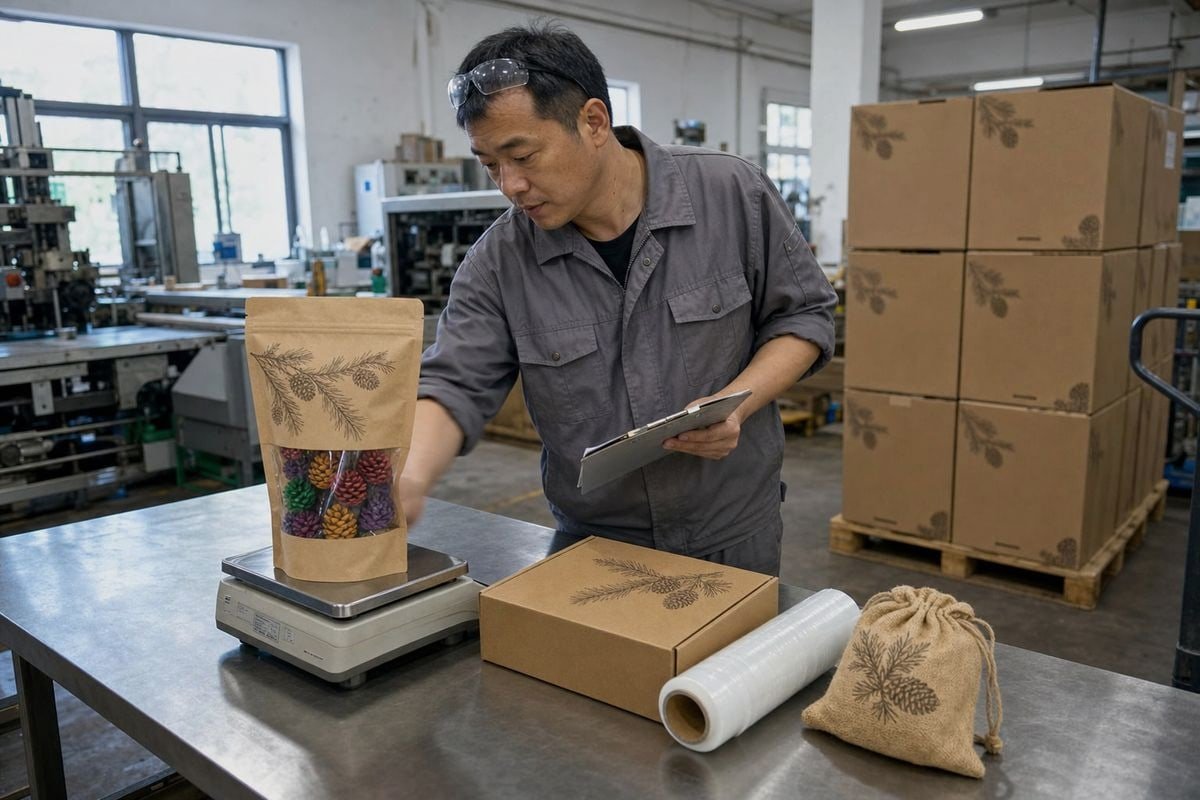
Take one of our common retail formats: color-flame pinecones in a kraft stand-up pouch with a clear window, shipped in corrugated master cartons on wrapped pallets. Here is how the calculation logic works:
| Packaging component | Kategorie | Material | What you report |
|---|---|---|---|
| Kraft pouch with window | Primary | Paper + plastic film | Weight per unit × units sold |
| Burlap-Kordelzugbeutel | Primary | Natural fiber 4 (jute/linen) | Weight per unit × units sold |
| Retail display box | Secondary | Cardboard | Weight per box × boxes |
| Master shipping carton | Secondary/Tertiary | Corrugated paper | Weight × carton count |
| Pallet, stretch wrap, straps | Tertiary | Wood + plastic | Total transport packaging weight |
Account for jurisdiction differences
The fee structure changes sharply by market. UK small producers pay £1,216 direct or £631 via a compliance scheme. India's centralized plastic packaging portal reportedly uses registration tiers of ₹10,000, ₹20,000, or ₹50,000 based on annual plastic waste generation, plus an annual processing fee of around 25% of the registration fee — verify these figures on the official portal before budgeting. EU and US state schemes typically charge eco-fees or PRO fees per tonne per material rather than one universal charge.
One more caution from experience: pinecone sales are highly seasonal, peaking in winter and holiday periods. Plan your import volumes against the reporting windows. A single large pre-Christmas shipment can push you past a "large producer" threshold mid-cycle and change your entire fee tier.
Which Packaging Materials and Labels Must I Declare to Stay EPR Compliant in My Target Markets?
Our packaging line in Ningbo runs three main formats for pinecones: kraft pouches, burlap sacks, and printed display boxes. Each one carries a different declaration profile, and we design with that in mind.
Declare every material that leaves your warehouse with the product: primary packaging around the pine cones, secondary retail or shipping boxes, and tertiary pallets and stretch wrap. Classify each by material — paper, plastic, wood, natural fiber — and apply required recycling and warning labels per market.

Buyers often assume only the retail bag counts. It does not. Regulators want the full picture, from the inner pouch to the pallet strapping. If you miss the tertiary layer, your reported tonnage will be wrong, and corrections after a deadline are painful.
Classify by packaging level and material
| Ebene | Example for pinecones | Typical material | Declaration note |
|---|---|---|---|
| Primary | Stand-up pouch, mesh net, burlap sack | Kraft paper, jute, PE film | Highest scrutiny; consumer-facing |
| Secondary | Retail display box, gift box | Cardboard | Counts even if the retailer discards it |
| Tertiary | Master carton, pallet, wrap | Corrugated, wood, LDPE | Often forgotten but reportable |
Watch the mixed-material trap
A kraft pouch with a clear plastic window is a composite. Some schemes want it reported by dominant material; others require a split. Our burlap sacks with jute ties are simpler — natural fiber generally sits in a favorable fee category. Fireplace pine cones are frequently packed in biodegradable mesh nets or paper bags already, and switching fully to recyclable or compostable materials can place you in a lower fee tier as eco-modulated rates roll out. Fee modulation tied to recyclability is expanding across 2025–2026, so packaging design is now a cost decision, not just a branding one. Early adoption of recycled-content materials can lock in lower tiers before full rollout.
Labels are part of compliance too
Color-flame products also need correct warning labels, usage instructions, and market-specific recycling symbols such as France's Triman logo 6. We print these directly on custom packaging for our OEM clients so the declared materials and the printed marks match what customs and regulators actually see.
Can My Manufacturer Help Me Prepare EPR Documentation and Test Reports for Customs Clearance?
Over 17 years of exporting fire-starting goods to more than 30 countries, we have learned that the buyers who clear customs fastest are the ones who ask us for documentation before the order ships, not after it lands.
Yes. A capable manufacturer supplies packaging specifications with exact material weights, SGS or Intertek test reports, CE documentation, commercial invoices, and packing lists — everything you need to complete EPR declarations and clear customs, though the registration itself remains your legal responsibility as importer.

Let me be direct about the division of labor. Your factory cannot register for EPR on your behalf in your market. The obligated party is the business placing packaging on the market — usually you, the importer or brand owner. But a real factory can remove almost all of the data-gathering burden, which is where most delays actually happen.
What we prepare for our buyers
For every color-flame pinecone order, we can provide a documentation pack that maps directly onto EPR reporting fields. It includes a per-unit packaging weight sheet broken down by material, the master carton and pallet specifications, and our ISO 9001 and BSCI certificates. Because compliance is a hard requirement for our client base, we run SGS- und Intertek-Tests 7 and hand over the reports so you can answer safety questions from customs without a second round of lab work.
Warum Fertigungstiefe hier wichtig ist
EPR reporting punishes inconsistency. If batch one ships in an 18-gram pouch and batch three ships in a 24-gram pouch because your supplier changed materials without telling you, your declared data is wrong. Our production lines hold packaging specs batch to batch, so the numbers you registered in April still match what lands in October. For Private-Label-Käufer, we also print warning labels, barcodes, and recycling marks to your market's requirements, so the physical product, the paperwork, and your EPR declaration all tell the same story.
My advice: request the packaging data sheet at the sampling stage. It costs nothing and lets you calculate your EPR fees before you commit to a purchase order.
Schlussfolgerung
EPR packaging registration for imported fireplace pine cones comes down to the packaging, not the product. Register per market, declare every material, calculate fees by weight, and lean on your factory's documentation to file accurately and on time.
Fußnoten
1. Background concept explaining the broader extended producer responsibility framework behind packaging rules. ↩︎
2. Official UK regulator referenced for packaging registration thresholds and enforcement. ↩︎
3. Official UK regulator publishing packaging EPR material rates and fees. ↩︎
4. General reference on natural fiber materials like jute used in packaging. ↩︎
5. DEFRA is the UK authority publishing annual packaging material rate data. ↩︎
6. French government site explaining the mandatory Triman recycling label requirement. ↩︎
7. Authoritative testing body referenced for product safety and compliance reports. ↩︎



 English
  Spanish
  German
  French
  Arabic
  Portuguese
Diskutieren Sie mit