






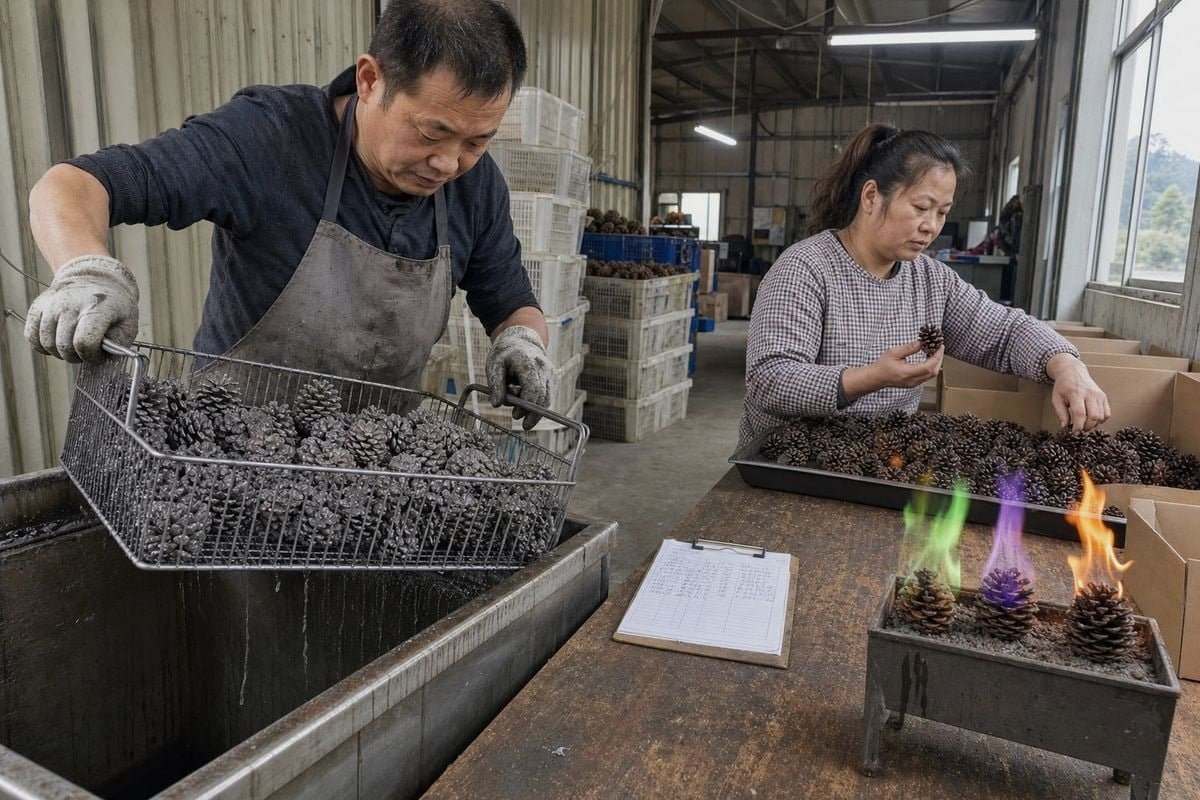
Accelerant content in fireplace pine cones confuses many buyers flash-point risks 1. On our production line, I have seen importers order batches that burned fast but showed weak, muddy color — a costly mistake.
Accelerant content affects color in fireplace pine cones only indirectly. The visible color comes from metal-salt colorants absorbed into the cone, not the accelerant itself. However, the wax-to-colorant ratio controls when and how strongly those colors appear during combustion.
Let me break this down properly. The chemistry is simple once you separate the accelerant from the colorant Sojawachs 2. I will cover ratios, safety, batch consistency, and eco-friendly options below.
What accelerant ratio gives me the most vivid and consistent flame colors in my pinecones?
During a trial run for a German fireplace distributor last year, our team tested six wax-to-colorant ratios side by side. The difference between the best and worst batch was dramatic.
The most vivid flame colors come from a moderate accelerant ratio — roughly 30–40% paraffin wax to 60–70% metal-salt-treated cone by treatment weight. Too much wax delays color onset because the accelerant burns off before the metal ions vaporize into visible flame.
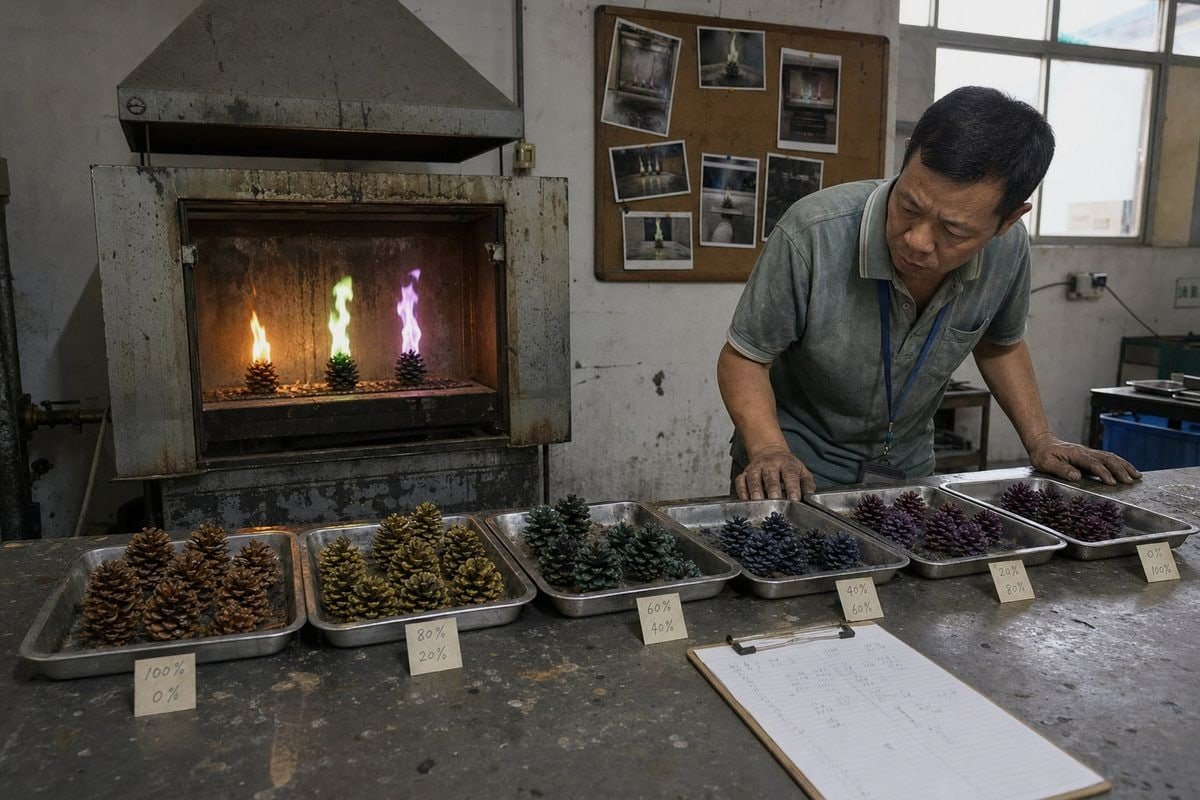
Here is the key thing to understand. The pine cone is a fuel carrier. The wax is the accelerant and binder. The metal salts are the color source. Get the ratio wrong, and one component fights the other two.
Why the ratio matters so much
Metal ions emit light at characteristic wavelengths when heated der Flammenemissionsspektroskopie 3. Kupferverbindungen 4 give green and blue-green. Sodium gives yellow. Strontium and lithium give red. Potassium gives lilac and purple. But those ions need enough heat and enough time in the flame to glow. If the accelerant layer is too thick, the fire spends its first minutes burning plain wax. The buyer's customer sees an orange flame and assumes the product failed. If the accelerant layer is too thin, the cone struggles to ignite and the color appears weakly or unevenly.
We also weigh a trade-off between two dipping methods. Mixing accelerant and colorant into a single dipping solution gives faster, more uniform color ignition across the cone surface, but a shorter total burn. Sequential layering — salt soak first, full dry, then wax dip — gives a longer burn with delayed color onset.
| Ratio Approach | Color Onset | Color Vividness | Brenndauer |
|---|---|---|---|
| High wax, low colorant | Slow (delayed) | Muted | Long |
| Balanced (30–40% wax) | Schnell | Vivid, consistent | Medium-long |
| Low wax, high colorant | Sofort | Strong but uneven | Kurz |
| Single mixed dip | Fastest, uniform | Stark | Kürzer |
Cone species matters too. Dense, tightly closed cones absorb less solution and produce duller color than open, porous cones. In our factory, we sort cones by openness before soaking, precisely because a perfect ratio cannot rescue a cone that never absorbed the salts.
Can too much accelerant compromise safety or compliance certifications I need for import?
A UK buyer once asked me why his previous supplier's cones failed an SGS flash-point screening. The answer sat in the formulation: an over-waxed product with solvent residue left from rushed drying.
Yes. Excess accelerant can raise flash-point risks, increase soot and emissions, and trigger failures in SGS or Intertek testing. Over-waxed cones may also fall outside CE-aligned consumer fire-product expectations, blocking import clearance into EU and North American markets.

Compliance is where formulation stops being a lab question and becomes a business question. In our seventeen-plus years exporting to more than thirty countries, I have never seen a serious European or American buyer treat test reports as optional. They are a hard requirement, and accelerant content sits right at the center of what testing labs examine.
What testing labs actually look at
Third-party labs check several accelerant-related parameters. They look at ignition behavior — a cone should light predictably, not flare violently. They look at combustion byproducts, because heavy wax loads produce more soot and can carry incomplete-combustion compounds into indoor air. They look at packaging and warning labels, which must match how the product actually burns. An over-accelerated cone can fail on any of these fronts.
There is a separate chemical danger worth naming. Some low-cost suppliers boost ignition or color intensity using oxidizers such as nitrates, chlorates, or permanganates. These can produce hazardous byproducts when burned indoors. We exclude them entirely from our formulations, and any buyer sourcing fireplace pine cones should demand written confirmation that their supplier does the same.
The compliance checklist I give buyers
- Ask for current SGS or Intertek test reports for the exact SKU, not a similar one.
- Confirm ISO 9001 and BSCI status of the factory itself, not the trading company.
- Verify the formulation excludes nitrates, chlorates, and permanganates.
- Check that warning labels and burn instructions match your destination market's language and rules.
- Request the accelerant percentage in writing so future batches can be audited against it.
Our factory holds ISO 9001, BSCI, and Hausrezepte verwenden Kupfersulfat-Flammenfarbstoff oder Borax-Einweichungen. Diese funktionieren in einer Garage, aber sie erschweren die Einhaltung von Einzelhandelsvorschriften und Versanddeklarationen. Unsere Magic Fire-Formulierungen verwenden umweltfreundliche Materialien ohne schädliche Chemikalien, was die Zollabfertigung und die Akzeptanz im Einzelhandel reibungslos gestaltet. 5 with SGS and Intertek reports available, because our buyers' import paperwork depends on it. A formulation that is safe, moderate in accelerant load, and fully documented clears customs. One that is not becomes stranded inventory.
How do I verify accelerant content stays consistent across large production batches?
The lesson that shaped our QC system came from an early holiday-season order: two containers, same recipe, but one batch dried three days less. The cones burned, but the colors lagged by minutes. Since then, we control drying as tightly as dipping.
Verify consistency through weight-gain checks per cone, controlled soak and dry times, standardized dipping solution concentration, and batch burn tests. Require your supplier to document these controls and provide sample burns from each production batch before shipment approval.

Consistency is the difference between a manufacturer and a workshop. Anyone can make one good cone. Making fifty thousand identical ones is a process problem, and buyers should evaluate suppliers on exactly that.
The variables that drift in mass production
Four things drift if nobody watches them. First, solution concentration: as cones soak, they pull salts out of the bath, so the solution weakens over time unless it is replenished on a schedule. Second, soak duration: a cone soaked four hours absorbs less colorant than one soaked overnight. Third, drying: cones must be fully dry after the salt soak and before wax dipping — incomplete drying traps moisture, weakens ignition, and washes out color. Our standard is multiple days of controlled drying, checked by weight, not by touch. Fourth, wax pickup: dip temperature and dwell time change how much wax each cone carries.
| Kontrollpunkt | What We Measure | Why It Matters for Color |
|---|---|---|
| Soak solution | Salt concentration, replenishment schedule | Determines colorant loading per cone |
| Soak time | Fixed hours per batch | Ensures uniform absorption |
| Trocknen | Weight-based dryness check over multiple days | Wet cones mute color and resist ignition |
| Wax dip | Bath temperature and dwell time | Controls accelerant ratio and color onset timing |
| Brennpunktprüfung | Sample cones per batch, timed color onset | Confirms first sample matches mass production |
What to ask your supplier for
Request a batch record with each shipment: soak times, drying duration, wax bath temperature, and per-cone weight range. Then ask for burn-test video or photos from that specific batch. In our Ningbo facility, we burn samples from every batch and log color onset time and burn duration. This is why the first sample a buyer approves reliably matches what arrives in the container six weeks later. If a supplier cannot show you this paper trail, the vivid sample on your desk proves nothing about the pallets behind it.
Which eco-friendly accelerants should I request to meet my market's chemical safety regulations?
When we developed our current formulation, a Dutch outdoor brand pushed us hard on one question: could every input pass a household-chemical screen? That request reshaped our ingredient list, and it has aged well as EU rules tightened.
Request clean-burning paraffin or plant-based waxes such as soy or vegetable wax as the accelerant, paired with low-toxicity colorants like copper sulfate, potassium chloride, and borax. Avoid petroleum solvents, nitrates, chlorates, permanganates, and any barium- or lead-based compounds entirely.

Eco-friendly does not mean weaker performance. It means choosing inputs that burn clean, handle safely in the warehouse, and pass the chemical scrutiny your market applies. The good news is that the best-performing colorants are already among the safer options.
Matching safe colorants to flame colors
| Flammenfarbe | Recommended Compound | Regulatory Notes |
|---|---|---|
| Mäßig – Korrosion durch Chloride | Kupfersulfat 6 or copper chloride, borax | Widely accepted; copper chloride gives a cleaner green in many burn conditions |
| Gelb | Natriumsalze | Very safe, but sodium dominates — even trace contamination overwhelms other colors |
| Red / pink | Strontiumchlorid 7 or lithium salts | Accepted at consumer levels; strontium needs higher flame heat to show fully |
| Lila / Flieder | Kaliumchlorid | Common food-adjacent salt; low regulatory friction |
| Orange | Calcium-related compounds | Less vivid; often left to the fire's natural color |
Two practical cautions from our lab. First, keep sodium away from every other color line. Sodium's yellow emission is so strong that cross-contamination between soak baths will wash out greens and purples across an entire batch. We run separate tanks and tools per color for exactly this reason. Second, do not chase deep blue. It is the hardest color to hold cleanly because combustion conditions and any sodium trace overpower it; green is the most achievable and visible color for consumer use, and honest suppliers will tell you so.
On the accelerant side, ask for refined, low-odor paraffin or a soy-blend wax with documented purity. Petroleum solvents or alcohol carriers may speed factory drying, but residues raise emissions questions in indoor-use products. Our whole range — the color-flame pinecones, Magic Fire packets, wax-dipped firestarters, and wax torches — uses eco-friendly materials with no harmful chemicals, and we back that with test reports rather than adjectives.
Schlussfolgerung
Weak, delayed colors cost you repeat orders. The fix is formulation discipline: metal salts create the color, moderate wax ratios reveal it, and documented QC keeps every batch identical. Partner with a certified factory, and your fireplace pine cones will perform on the shelf exactly as they did in the sample.
Fußnoten
1. Explains the combustion safety concept referenced regarding excess accelerant testing. ↩︎
2. EPA Safer Choice program relates to eco-friendly, low-toxicity material selection discussed. ↩︎
3. Explains the physics of metal-ion light emission underlying flame coloration chemistry. ↩︎
4. Explains scientific basis for metal-ion flame color emission referenced in text. ↩︎
5. Official EU source clarifying CE marking requirements referenced for import compliance. ↩︎
6. Background on the metal-salt colorant compound used for flame color chemistry. ↩︎
7. Reference for the compound producing red flame emissions discussed in the article. ↩︎



 English
  Spanish
  German
  French
  Arabic
  Portuguese
Diskutieren Sie mit