







A product safety documentation package for fireplace colored pine cones looks simple until customs, a retailer, or a regulator asks for it digital product passport 1. Our factory has seen shipments frozen over one missing page.
A product safety documentation package for fireplace colored pine cones must include a 16-section Safety Data Sheet, chemical composition analysis, flammability testing reports, heavy metal test results, FHSA-compliant precautionary labeling, a Certificate of Compliance, batch traceability records, and a written regulatory classification memo.
That is the short answer. Below, I break down each part of the file, section by section, so you know exactly what to demand before your first bulk order.
What certifications and test reports do I need to include for colored pine cones?
During our 17+ years exporting color-flame products to the US and Europe, the single most common buyer question we receive is not about price. It is about which test reports actually matter.
You need a GHS-aligned Safety Data Sheet, chemical composition analysis with heavy metal content results, flammability testing reports, a toxicological risk assessment, SGS or Intertek third-party test certificates, a Certificate of Compliance, and market-specific documents such as CE marking evidence for the EU.

The first thing to settle is classification. Colored pine cones sit in an awkward spot. Some sellers treat them as harmless home décor. Some regulators may view them as combustible consumer chemicals, closer to firelighters. In the US, the Consumer Product Safety Commission (CPSC) 2 does not automatically treat fireplace accessories as fireworks. However, the composition, intended use, and your marketing claims decide the category. That is why we always recommend that the package opens with a short regulatory classification memo. It states, in plain language, why the product is a fireplace accessory and not a pyrotechnic device.
I raise this because a few buyers have pushed back on us over the years. They argue the product is "just painted pine cones" and paperwork is overkill. Our answer is direct: the metal salts that create the colored flames are chemicals, and hazard communication rules apply to chemicals. Documenting the product as if scrutiny will be high is the cheaper path. Rebuilding a compliance file after a customs hold is the expensive one.
The core documents, in order of priority
| وثيقة | ما تغطيه | Who typically issues it |
|---|---|---|
| صحيفة بيانات السلامة (SDS) | All 16 GHS sections: hazards, first aid, firefighting, storage, disposal | Manufacturer, aligned to actual formula |
| المذيبات البترولية، الفورمالديهايد، المواد الرابطة الاصطناعية | Colorant salts, waxes, coatings, fragrance compounds | Manufacturer plus third-party lab |
| Heavy metal content report | Lead and restricted metals against CPSIA-style limits | SGS, Intertek, or equivalent lab |
| Flammability testing | Burn rate, ignition behavior, no explosive flare-ups | مختبر اختبار معتمد |
| تقييم المخاطر السمية 3 | Combustion fumes, skin and eye irritation potential | Toxicologist or lab partner |
| شهادة الامتثال 4 (CoC) | Declaration that the batch meets applicable rules | الشركة المصنعة أو المستورد |
| Classification memo | Written rationale for the product's regulatory category | Manufacturer with compliance advisor |
One warning from experience: never accept a generic SDS copied from a template. A sample pine-cone SDS in circulation identifies the product loosely as a fragrance compound mixture. Your SDS must match your actual formulation, because hazard statements depend on the exact salt, wax, dye, and coating chemistry. When we prepare SDS files for our color-flame pinecones, the hazard section is written against the tested formula, not a lookalike product.
How do I prove batch-to-batch consistency for my safety documentation package?
A German distributor once returned to us after a bad experience elsewhere: the sample burned beautifully, but the bulk shipment produced weak colors and heavy smoke. That gap is exactly what consistency documentation prevents.
You prove batch-to-batch consistency with lot-numbered production records, incoming raw material certificates, fixed formulation specifications with tolerances, per-batch burn tests, moisture content checks, retained samples from each lot, and a Certificate of Compliance linking each shipment to its test data.
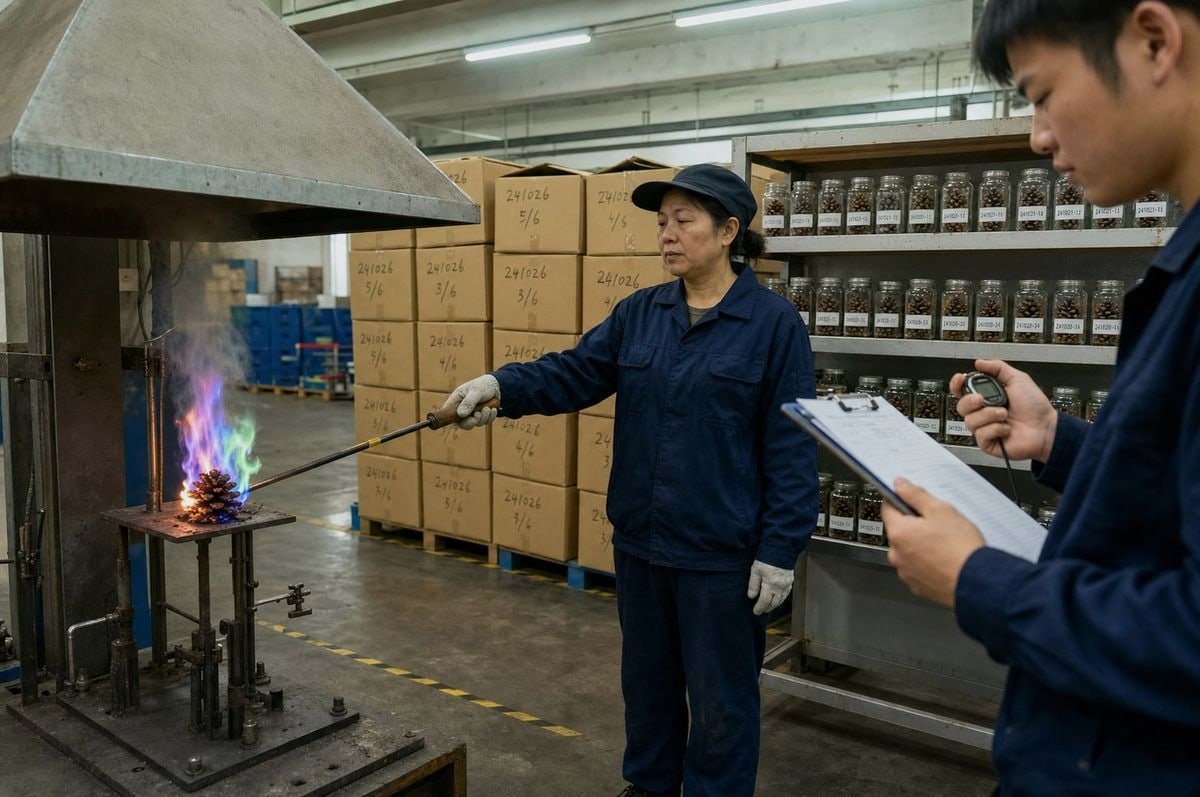
Consistency is where a real factory separates itself from a trading company. On our production lines, every batch of color-flame pinecones carries a lot number that traces back to three things: the raw pine cone source, the treatment chemistry batch, and the coating or wax lot. If any one of those changes, the burn behavior can change. Buyers do not see this complexity from a product photo. They only see it when batch 3 smokes more than batch 1.
A practical consistency system
Here is the process we recommend you require from any supplier, step by step:
- Fixed formulation specification. The exact salt loading, coating weight, and wax type are written down with tolerances. No silent substitutions.
- Incoming material verification. Each delivery of colorant salts and waxes arrives with a supplier declaration and gets checked before use.
- Moisture and drying control. Pine cones are dried to a defined moisture threshold. High moisture causes steam popping and spark hazards, so kiln-drying specifications belong in the file.
- Per-batch burn testing. A sample from every lot is burned. Operators check ignition behavior, flame-color effect, burn duration, smoke output, and residue.
- Retained samples. A sealed sample from each lot is kept for a defined period, so any complaint can be checked against the actual production batch.
- Batch-linked CoC. Each shipment's Certificate of Compliance references the lot numbers and the test reports behind them.
What the batch record should contain
| Record element | لماذا هو مهم |
|---|---|
| Lot number and production date | Enables recall scoping and complaint tracing |
| Raw material supplier declarations | Confirms colorant and wax composition did not drift |
| Moisture content reading | Prevents popping, sparks, and inconsistent ignition |
| Burn test result sheet | Evidence the lot performs like the approved sample |
| Operator and QC sign-off | Accountability inside the factory |
| Retained sample reference | Physical proof kept for disputes |
شهاداتنا وشهادات BSCI تتطلب منا الاحتفاظ بهذه السجلات. لكن الشهادة وحدها لا تكفي - اطلب رؤية السجلات الفعلية، وليس فقط الشهادة. ISO 9001 5 system forces this discipline on every run, and our BSCI audits verify the process is real, not paper theater. The practical benefit for you is simple: the first sample you approve reliably reflects mass-production quality. Ask your supplier to show you a completed batch record from a past order. If they cannot produce one within a day, they are not keeping them.
What warning labels and compliance markings must appear on my packaging?
Label copy is where we spend surprising amounts of time with private-label clients. When we develop custom kraft pouches and drawstring sacks, the warning panel is drafted before the artwork, not after.
Packaging must carry FHSA-style precautionary labeling with a signal word, hazard statements, "Keep Out of Reach of Children," first-aid instructions, use restrictions limiting the product to wood-burning fireplaces and campfires, prohibitions on gas appliances and cooking fires, storage instructions, and batch identification.

بموجب Federal Hazardous Substances Act (FHSA) 6, a consumer chemical product that can irritate skin, eyes, or the respiratory system needs cautionary labeling. Signal words matter here. Depending on your toxicological risk assessment, the label leads with CAUTION or WARNING, followed by the specific hazard statements. Vague labels like "use with care" do not satisfy anyone — not the CPSC, not an EU market surveillance officer, and not a retail buyer's compliance team.
The use-restriction block is the part most sellers get wrong. Marketplace guidance for these products is consistent and strict, and your label should mirror it word for word:
- للاستخدام في wood-burning fireplaces, fire pits, and campfires only, where such products are permitted.
- Do not use in gas or propane fireplaces or gas log sets.
- Do not use for cooking fires, BBQ grills, or any food preparation.
- Add to an established fire; do not use as a fire starter unless tested and labeled for that purpose.
- Do not roast food over the colored flames.
- Supervise use around children and pets. Keep away from heat, sparks, and ignition sources during storage.
- Store in a cool, dry, well-ventilated place in a tightly closed container.
Label elements by market
| عنصر | US requirement basis | EU approach |
|---|---|---|
| Signal word and hazard statements | FHSA cautionary labeling | CLP-aligned GHS statements |
| First-aid text for ingestion, skin, eye contact | FHSA mandatory content | SDS Section 4 mirrored on pack |
| Child-safety statement | "يحفظ بعيدًا عن متناول الأطفال" | Same, in local language |
| Compliance marking | CoC held by importer | CE-related documentation where applicable |
| Batch/lot code | Supports traceability and recalls | Required for market surveillance |
| اللغة | الإنجليزية | Language of each destination country |
One modern addition we increasingly print for clients is a رمز الاستجابة السريعة 7 linking to a digital product passport: batch-specific safety certificates, the SDS, and a short instructional video. Retail sourcing teams like it because it turns the documentation package from a filing cabinet into something a consumer can check in the aisle. Because we handle warning labels, barcodes, and display packaging in-house as part of our OEM/ODM service, the compliance text and the artwork get approved together, which avoids the classic mistake of beautiful packaging with a legally empty warning panel.
How can I get a supplier to provide complete documentation before I place a bulk order?
A lesson I learned early in our export business: the buyers who ask for documents before sending a deposit almost never have compliance problems later. The ones who ask afterward often do.
Request the SDS, third-party test reports, heavy metal results, a sample Certificate of Compliance, and a past batch record before paying any deposit. Verify report numbers directly with the lab, tie documentation deliverables into your purchase contract, and treat refusal or delay as a disqualifying red flag.

Legitimate factories expect this request. At our Ningbo production site, we keep a standing documentation pack for exactly this reason, and we can share SGS or Intertek report numbers that a buyer can verify with the lab directly. A supplier who stalls, sends a watermarked "sample report" for a different product, or promises documents "after the order is confirmed" is telling you something important. Listen to it.
A pre-order documentation checklist
Work through this sequence before committing money:
- Ask for the full pack in writing. SDS, chemical composition analysis, flammability testing report, heavy metal content results, classification memo, and a sample CoC.
- Check the details match. The product name, formulation, and packaging on the reports must match what you are actually buying. A report for color-flame packets does not cover treated pine cones.
- Verify independently. Call or email the issuing lab with the report number. SGS و Intertek 8 both confirm authenticity. This takes ten minutes and filters out most fakes.
- Request a past batch record. This proves the quality system runs in daily production, not just during audits.
- Order a paid trial lot. A flexible MOQ trial order lets you burn-test the product yourself and check that the labels, barcodes, and inserts arrived as specified.
- Put documents in the contract. Make batch-linked test data and the CoC a condition of final payment, and name the required documents explicitly.
- Confirm English-language responsiveness. Compliance questions will come up mid-production. If pre-sale communication is slow, post-sale communication will be worse.
One more point on incentives. A supplier positioned on lowest price has little margin to fund proper testing, and documentation is usually the first corner cut. A supplier positioned as a long-term manufacturing partner treats the compliance file as part of the product. When our clients in the US, Germany, and the UK go through retailer onboarding, the documentation package is what gets them listed — the pine cones themselves are almost the easy part.



 English
  Spanish
  German
  French
  Arabic
  Portuguese
انضم إلى المحادثة