







Getting pellet and biomass stove compliance docs for colored pine cones confuses even experienced importers. I see it weekly on our production floor when buyers send us document requests that mix up fuel standards with décor certifications. Order the wrong paperwork, and customs holds your container. Skip a test report, and a retailer rejects your entire shipment. The fix is knowing exactly which documents apply to this product category — and which do not.
Compliance docs for colored pine cones include a Safety Data Sheet (SDS), SGS or Intertek heavy metal test reports, colorant composition disclosure, and CE-aligned safety labeling. Colored pine cones are decorative fire accessories for open fireplaces and fire pits — not certified pellet stove fuel — so PFI and EPA fuel certifications do not apply.
Let me walk you through what to request, how to verify it, and how long the process really takes. This is the same checklist our export team uses with every new buyer.
What Certifications Do I Need Before Importing Colored Pine Cones for Pellet Stoves?
A buyer from Rotterdam once asked our team for a PFI fuel grade certificate for our color-flame pinecones. We had to stop him before he wasted three weeks chasing the wrong document.
You need a Safety Data Sheet (SDS), heavy metal chemical testing reports, and CE-aligned labeling documentation. You do not need PFI fuel grade standards or EPA certification standards, because colored pine cones are decorative flame products for open fires — not approved fuel for closed pellet stove systems.

This distinction matters more than anything else in this article. Colored pine cones are treated with mineral colorants 1 that produce rainbow flame effects. That treatment automatically excludes them from fuel certification pathways. PFI fuel grade standards govern pellets — their تحليل محتوى الرطوبة 2, ash content percentage, and density. EPA certification standards govern the stoves themselves, including particulate matter emissions 3 limits. Neither framework covers a decorative fire accessory. In our seventeen years exporting to the US, Germany, the UK, and thirty other markets, no customs authority has ever asked us for a fuel certificate for this product. They ask for chemical safety documents instead.
The Documents That Actually Apply
Here is what our compliance file contains for every colored pinecone shipment:
| وثيقة | الغرض | صادر عن |
|---|---|---|
| صحيفة بيانات السلامة (SDS) | Discloses colorant chemistry and handling guidance | Manufacturer, per GHS format |
| Heavy metal test report | Confirms no restricted substances like lead or cadmium | SGS أو Intertek |
| CE-aligned safety labeling | Warning labels, usage restrictions, age guidance | المصنع، تم التحقق منه بواسطة المختبر |
| تقرير تدقيق BSCI 4 | Confirms ethical factory conditions for retail buyers | Third-party auditor |
| ISO 9001 5 شهادة | Proves a documented quality management system | هيئة التصديق |
Why the Pellet Stove Question Keeps Coming Up
Buyers often assume any biomass product needs stove-fuel paperwork. But modern pellet stoves use automated augers, sensors, and catalytic combustors. Metal-salt-treated items can etch ceramic glass and poison catalytic systems, which is why we label our products clearly: open fireplaces, fire pits, and campfires only. Your compliance file should reflect that intended use. If your labeling implies pellet stove compatibility, you create a liability problem that no certificate can fix. Insurance providers may even classify burning treated décor in a pellet stove as negligent operation.
Which Test Reports Should I Request to Prove Compliance With Biomass Stove Standards?
Our QC lab in Ningbo runs internal burn tests on every production batch before we even send samples out for third-party verification. That two-layer approach shapes what I recommend you request.
Request heavy metal chemical testing, colorant composition analysis, an SDS review, and burn-behavior verification from SGS or Intertek. Because colored pine cones are hearth accessories rather than fuel, skip ASTM E2779 testing and EPA emissions reports — those apply to pellet stoves, not decorative flame products.

The test reports you request should map to real risks, not to standards borrowed from a different product category. ASTM E2779 6 testing measures particulate matter emissions from pellet stove appliances during certification. UL 1482 7 listing covers the construction and safety of room heaters. Both are appliance standards. Asking a pinecone supplier for them signals to the supplier — and later to your retail buyers — that your compliance file was built by guesswork. I have seen large retail sourcing channels reject otherwise good products because the documentation stack did not match the product classification.
The Four Reports That Matter
- Heavy metal chemical testing. This is non-negotiable. The report should screen for lead, cadmium, mercury, and hexavalent chromium. Our SGS reports cover this on every batch formula, because traditional flame colorants like copper sulfate raise questions that only lab data can answer.
- Colorant composition disclosure. Your SDS should identify the mineral salts used. Eco-friendly formulations exist — our own products avoid harmful chemicals entirely — but you need the paperwork to prove it, not just a marketing claim.
- Burn-behavior and residue verification. This confirms the product burns predictably in an open hearth and documents ash content percentage and residue characteristics. It supports your air quality compliance position if a local authority ever questions the product.
- Labeling and packaging review. The lab verifies that warning text, intended-use statements, and disposal guidance meet the destination market's rules. For US-bound goods, this includes clear "not for cooking fires" and "open fireplace use only" language.
Matching Reports to Markets
| السوق | Priority Reports | Common Extra Requests |
|---|---|---|
| الولايات المتحدة الأمريكية | SDS, heavy metal screening | Prop 65 assessment, English warning labels |
| ألمانيا / الاتحاد الأوروبي | SDS (CLP format), CE-aligned review | REACH substance screening |
| المملكة المتحدة | SDS, heavy metal screening | UKCA-aligned labeling check |
| كندا / أستراليا | SDS, colorant disclosure | Bilingual or local-format labels |
One more point on creosote. High resin content in natural pine cones can accelerate creosote accumulation in flues if users burn large quantities constantly. A responsible supplier addresses this in usage guidance — recommended quantities per fire — and that guidance belongs in your compliance file too.
How Can I Confirm My Supplier's Factory Actually Matches Their Compliance Documents?
Early in our export history, a German distributor flew to Liuyang unannounced to verify we were a real factory and not a trading company reselling someone else's certificates. He placed his first order the same week. That visit taught us why verification matters so much to serious buyers.
Cross-check the certificate holder's legal name against the factory's business license, verify report numbers directly with SGS or Intertek online, request a live video factory tour, and commission a third-party audit. Matching names, valid report numbers, and visible production lines confirm authenticity.
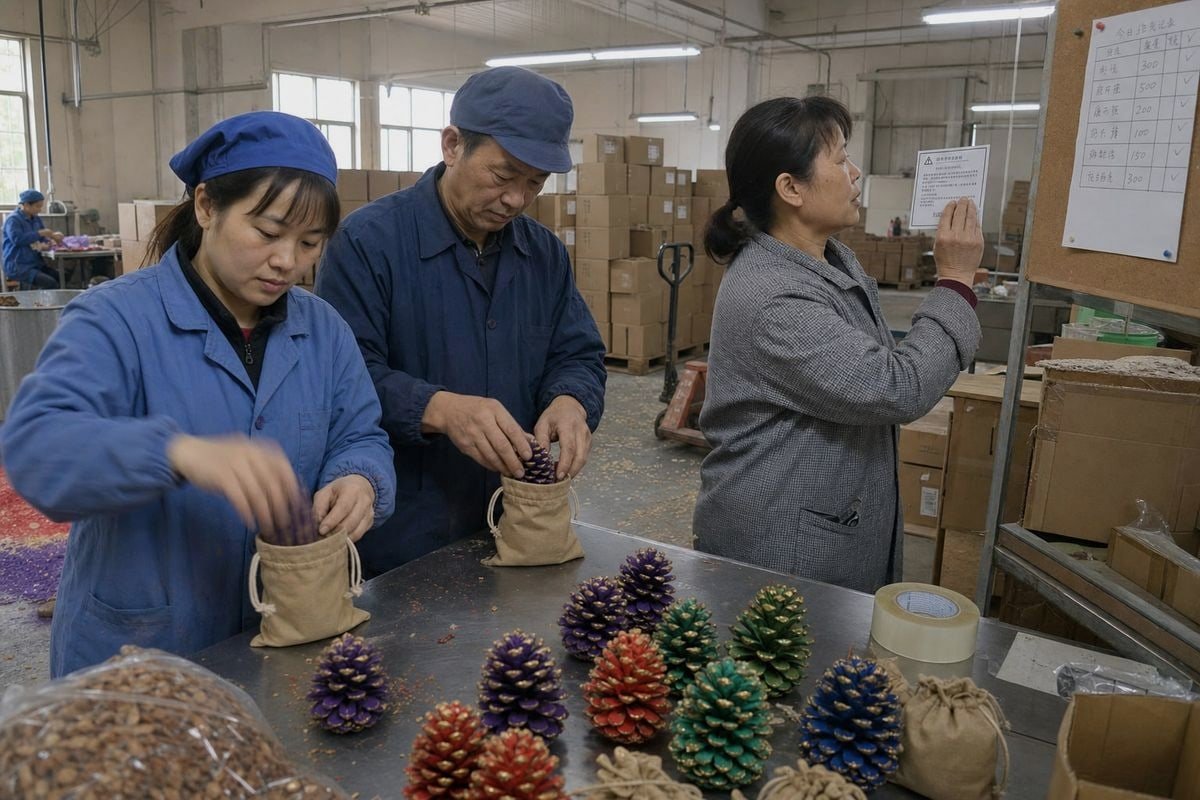
Certificate fraud is the quiet risk in this category. Trading companies sometimes borrow another factory's ISO 9001 or BSCI documents, or present a test report for a formula they no longer use. The document looks real because it is real — it just does not belong to the goods in your container. Verification closes that gap, and it costs far less than a rejected shipment.
اطلب لقطات مخزون على مستوى الموقع.
- Match the legal entities. The company name on the SDS, the test report, the وعقدك. غالبًا ما تستعير شركات التجارة شهادات المصانع. 8, and your proforma invoice should all connect. If the test report names a factory your contact never mentioned, ask why before you pay a deposit.
- Validate report numbers at the source. SGS and Intertek both offer verification channels. Send them the report number and issue date. This takes one email and exposes forged or expired reports immediately.
- Request a live video walkthrough. Ask to see the colorant treatment stations, drying areas, and packing lines in real time. We run these regularly for buyers in the US and Europe; a genuine factory can show its lines on a day's notice. A trading company cannot.
- Check batch-to-batch controls. Ask how the factory ensures the tested formula is the shipped formula. In our case, every batch gets an internal QC record tied to the colorant lot number, so the first sample reliably reflects mass-production quality. If a supplier cannot explain this linkage, their test report only proves what one sample did months ago.
- Commission or reuse a social audit. A BSCI audit report includes the audited address. Confirm it matches the address where your goods are actually produced. Large retail sourcing channels will check this anyway, so do it first.
Red Flags Worth Walking Away From
Watch for test reports older than two years with no renewals, refusal to show production areas on video, certificates issued to unrelated company names, and vague answers about where colorant treatment happens. Any one of these is a conversation. Two or more is a decision.
What's the Typical Timeline for Getting SGS or Intertek Reports Before My Shipment Ships?
Timing trade-offs come up in almost every pre-order call we take. Buyers want fresh test reports, but they also want goods on the water before their retail season. Both are possible — if you sequence the steps correctly.
Expect 2–3 weeks for standard SGS or Intertek chemical testing on colored pine cones, plus 3–5 days for sample logistics and scheduling. Booking testing at deposit stage, in parallel with production, keeps a typical 30–40 day order timeline intact without delaying shipment.

The biggest timeline mistake is treating testing as a final step. If you wait until production finishes to submit samples, you add two to three weeks of dead time while finished goods sit in the warehouse. The smarter sequence runs testing in parallel with production, using either a pre-production sample or the first production units off the line. Our export team defaults to this parallel path unless a buyer's retailer specifically requires testing on final packed goods.
A Realistic Parallel Timeline
| المدة النموذجية | المدة | ماذا يحدث |
|---|---|---|
| Order confirmation and deposit | Day 0 | Formula, packaging, and labeling locked |
| Sample dispatch to lab | Days 1–4 | Pre-production samples couriered to SGS or Intertek |
| Testing window | Days 5–19 | Heavy metal screening, SDS review, colorant analysis |
| الإنتاج | Days 5–30 | Full run under batch QC, same colorant lot as tested samples |
| Draft report review | Days 18–21 | You review draft results; queries resolved with the lab |
| Final report issued | Days 20–24 | Official report delivered before goods finish packing |
| Pre-shipment inspection (optional) | Days 28–32 | Third-party checks packed goods against the tested spec |
| الشحنة | Days 33–40 | Goods ship with a complete compliance file |
What Can Stretch the Timeline
A few things add time, and you should budget for them. New custom formulas — a private-label colorant blend, for example — need a fresh full test rather than a batch confirmation, which can add a week. Peak season at the labs, typically August through October before the Q4 hearth season, can add three to five days to scheduling. And any failed parameter forces a reformulation and retest, which is exactly why we run internal moisture content analysis and chemical checks before samples ever reach the lab. Over seventeen years, that internal gate has kept our third-party pass rate consistent enough that buyers can plan shipping dates with confidence.
One practical tip: ask your supplier whether existing valid reports cover your exact product. If you order our standard color-flame pinecones without formula changes, current SGS reports may already apply, and you save the entire testing window. Custom OEM versions need their own paperwork.
خاتمة
Compliance docs for colored pine cones come down to the right documents — SDS, heavy metal testing, verified factory credentials — requested early and checked against the actual production line.
Get the classification right, and everything else follows. Treat colored pine cones as the decorative hearth accessories they are, demand chemical safety proof rather than fu



 English
  Spanish
  German
  French
  Arabic
  Portuguese
انضم إلى المحادثة