







Supplier-switching risk in transition clauses is something our factory sees from the other side — we are often the new Magic Fire Powder supplier that buyers move production to. Many arrive mid-crisis: the old factory has stopped cooperating, formulas are undocumented, and shelves are about to go empty. That pain is avoidable with the right contract language and a staged handover plan 1.
Address supplier-switching risk by drafting a transition clause that defines a fixed transition period, obligates continued supply at contract prices, mandates transfer of formulas, tooling, and test data, ties final payment to a verified clean handover, and requires the new supplier to pass compliance and pilot-run validation before cutover.
That is the short answer. The rest of this guide breaks it down piece by piece. I will cover the contract clauses, the compliance checks, the formula-transfer steps, and the lead-time protection tactics that actually work in China sourcing.
What contract clauses should I include to protect my business during a supplier transition?
A German distributor once showed me their old supply agreement before moving their color-flame program to our line. It had a termination date — and nothing else. No handover duties, no tooling ownership, no document transfer. That gap cost them four months.
Include a defined transition period with a clear end trigger, continued supply at pre-existing prices, mandatory cooperation on documents and tooling, IP assignment and non-interference clauses, pre-approved reimbursement for transition costs, and a survivability clause keeping these obligations alive until handover is complete.

The core purpose of a transition clause is business continuity management, not just termination mechanics. A termination for convenience right lets you exit, but it does not force the incumbent to keep shipping while you qualify a replacement. You need both. In my experience reviewing buyer contracts before onboarding, the strongest agreements treat the transition as a project with defined deliverables, not a courtesy.
The clauses that matter most
| بند | What it must say | Why it matters in China |
|---|---|---|
| Transition period | Starts on notice; ends when the new supplier passes validation | Prevents open-ended "transitions" the incumbent can stall |
| Continued supply | Incumbent ships at contract prices, no premiums or new conditions | Blocks last-minute price hikes as leverage |
| Document transfer | Formulas, BOMs, specs, test data, upstream supplier lists | Tacit know-how is the biggest single loss point |
| Tooling re-delivery | Molds and dies moved to a neutral third-party warehouse before final notice | Physical possession beats a paper claim |
| تعيين الملكية الفكرية | Buyer owns formulations and processes, even if refined during production | Avoids the "we improved it, so we own it" argument |
| Cost reimbursement | Itemized advance estimates, pre-approval thresholds, a cap | Balanced deals get honored; one-sided ones get fought |
Two China-specific additions deserve emphasis. First, use a bilingual agreement governed by القانون الصيني 2 with arbitration at a body like CIETAC. Foreign court judgments are hard to enforce against mainland factories, so an enforceable local mechanism is your real leverage. Second, register your trademark in China independently and add a non-interference clause penalizing the supplier for filing similar marks during or after the switch. Trademark squatting by an ex-supplier is a real pattern, not a hypothetical.
A pro-supplier objection is fair here: the incumbent should not subsidize your sourcing change indefinitely. Concede the point in the drafting. Limit transition support to reasonable capacity and reimbursable, pre-estimated out-of-pocket costs. A balanced clause is far more likely to be performed without a fight.
How do I verify a new Magic Fire Powder supplier's compliance before switching production?
Compliance questions are the first thing serious buyers put on the table when they approach us — usually before price. After 17 years exporting fire-themed products to 30+ countries, we consider that the correct order of priorities.
Verify compliance by requesting current ISO 9001 and BSCI certificates, product-specific SGS or Intertek test reports, CE documentation for your market, proof of hazardous materials handling procedures, and export license paperwork — then confirm everything with an independent factory audit before signing.

Never accept a certificate PDF at face value. Certificates can be borrowed, expired, or issued to a trading company that does not own the factory. When buyers audit our Ningbo production site, we encourage them to check certificate numbers directly with the issuing body and to match the legal entity name on the certificate against the entity on your contract. If they do not match, you are not buying from a certified factory.
A verification sequence that works
- Document screening. Collect ISO 9001 3, BSCI, CE, and third-party lab reports. Check dates, scopes, and entity names.
- Product-level testing. Send samples from the candidate supplier to SGS or Intertek yourself, under your own account. For a color-flame powder, you need composition, heavy-metal, and combustion-behavior data relevant to your market's rules.
- On-site or third-party audit. Confirm real production lines exist, quality control inspections happen at incoming, in-process, and final stages, and hazardous materials handling is documented — segregated storage, trained staff, and batch records.
- Export paperwork review. Confirm the supplier's export license requirements are covered for your تصنيف المنتج 4 and destination. If any permits are pending, add a regulatory license bridge clause obligating the outgoing supplier to keep its export permits active for roughly 90 days so you never face a total export blackout.
- طلب تجريبي. Place a small trial run before cutover. Flexible MOQs for trial orders are a good sign; a factory that refuses small validation runs is telling you something.
One more compliance-adjacent point. Frame the switch in your notices as a quality-driven, economic decision — plain non-political commercial justification language. It keeps the exit clean and avoids giving anyone grounds to escalate the dispute beyond commerce.
What steps can I take to ensure consistent quality when transferring formulas between manufacturers?
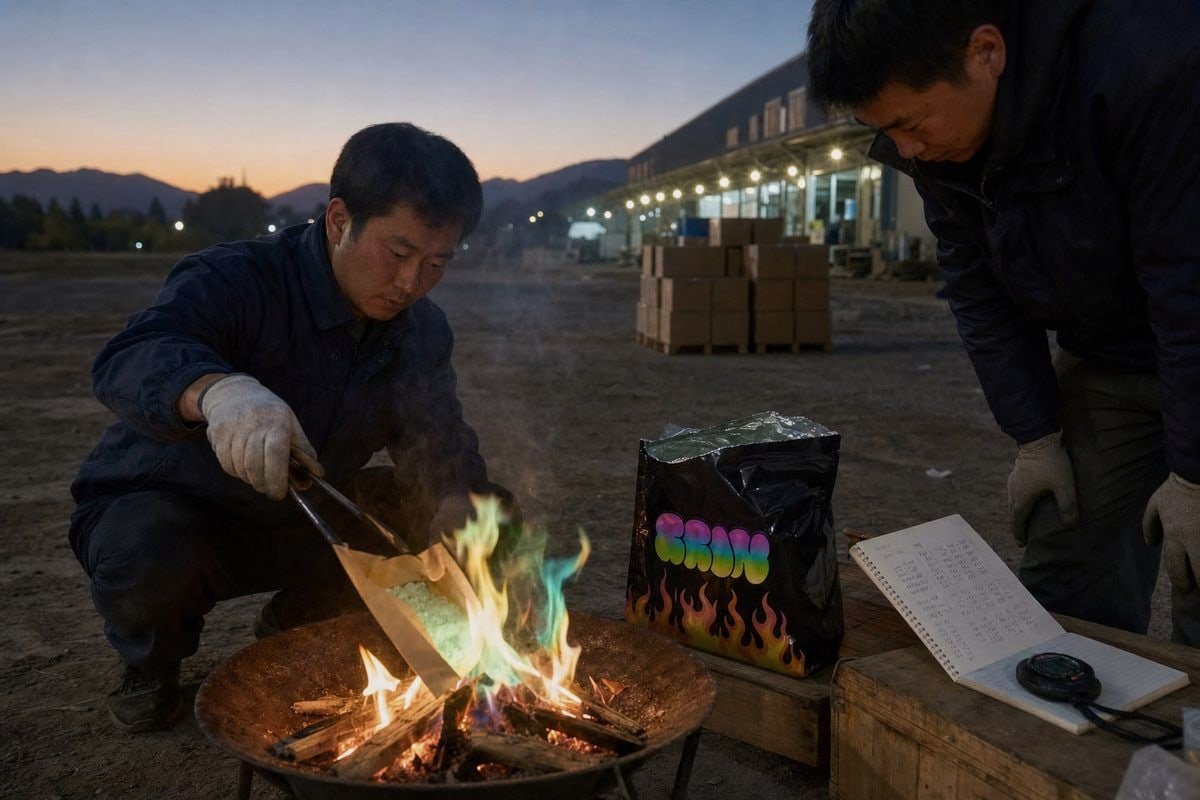
The trade-off we weigh most often during an incoming transfer is speed versus replication accuracy. Buyers want the first purchase order fast. But a color-flame formula behaves differently if raw-input purity shifts even slightly, so we insist on reference-sample matching first.
Ensure consistent quality by securing certified reference samples and precise raw-input purity specifications from the incumbent, transferring complete batch records and test protocols, running side-by-side pilot burns against the reference, and locking a golden-sample standard with the new manufacturer before mass production.

Formula transfer is where intellectual property transfer and quality control meet. The recipe on paper is only half the story. The other half is tacit process knowledge: mixing sequence 5, granule size, drying time, moisture limits, and packaging compatibility. Our production team in Ningbo has rebuilt several third-party formulas over the years, and the projects that go smoothly always start with a complete document package, not a single spec sheet.
The chemical fingerprinting principle
Require the incumbent to hand over certified reference samples 6 of the finished powder plus the purity specs of each raw input. This "chemical fingerprint" lets the new factory replicate the exact flame-colorant effect — the greens, blues, and purples your customers expect — rather than guessing from a generic formula. Also demand upstream supplier identity for raw materials and packaging components. Same recipe plus different raw sources can still equal different flames.
Documents to demand before cutover
| Deliverable | الغرض |
|---|---|
| Full formulation and BOM | Baseline recipe, with IP assignment confirming you own it |
| Raw-input purity specs and supplier list | Enables true replication, not approximation |
| Certified reference samples | Physical benchmark for pilot-run comparison |
| Batch records and traceability logs | Shows real tolerances, not just targets |
| Test protocols and burn-test criteria | Defines what "pass" means objectively |
| Packaging files, artwork, warning labels | Keeps the shelf-ready product identical |
Then validate. Run a pilot batch at the new factory and burn it side by side with the retained reference sample. Compare color intensity, burn duration, and residue. Only after acceptance criteria are met should the contract's "handover completion" event trigger. Tie the incumbent's final payment to a third-party inspection of the last batch and a verified clean handover of all technical documentation — this single mechanism prevents most quality hollowing on the final shipments.
How do I minimize lead-time disruptions when moving my sourcing to a new China-based supplier?
A hard lesson from early in our export history: a buyer once cut over to us with zero safety stock, betting everything on a single validation run. One delayed raw-material shipment nearly emptied their US warehouse. We have recommended overlap inventory ever since.
Minimize lead-time disruption with a phased production overlap: require the incumbent to hold roughly three months of safety stock while the new supplier completes pilot runs, build a buffer stock of three to six months of inventory, and stage the cutover against validation milestones, not calendar dates.
Lead-time risk during a switch comes from three places: the old supplier slowing down, the new supplier ramping up, and logistics gaps in between. A staged plan attacks all three at once. This is also where supply chain diversification pays off long term — buyers who keep even a small secondary source qualified never face a hostage situation again.
A staged cutover timeline
| مرحلة | Duration (typical) | Old supplier | New supplier |
|---|---|---|---|
| Notice and planning | Weeks 1–2 | Receives transition notice; confirms safety-stock build | Receives document package; quotes pilot |
| Overlap production | Months 1–3 | Ships at contract prices; holds ~3 months' safety stock | Runs pilot batches; passes burn and QC validation |
| Cutover | Month 3–4 | Final batch inspected by third party; tooling released | Takes first full production order |
| Exit settlement | Month 4–5 | Transition costs reconciled; documents verified complete | Assumes full volume; buffer stock replenished |
Three practical additions. First, define shipping terms precisely under قواعد التجارة الدولية 2020 7 for both suppliers during the overlap, so freight responsibility never falls into a gap between them. Second, budget for expedited freight as a pre-approved transition cost — one air shipment is cheaper than one empty shelf. Third, make your exit strategy planning explicit in the transition annex: name the cutover criteria, the buffer stock strategy, and who pays for storage.
There is a relationship-based counterargument worth answering: some advisors say active management and transparency with your Chinese partner make hard clauses unnecessary. Good relationships absolutely reduce friction — we build our business on long-term partnerships. But relationships are strongest when the paperwork removes temptation. Write the clause, keep the relationship warm, and you will likely never need to invoke it.
خاتمة
Supplier-switching risk is manageable when contracts, compliance checks, and inventory buffers work together. Draft the clause early, verify the new factory hard, and stage the cutover — then switching becomes routine, not a crisis.
ملاحظات ختامية
1. Explains structured continuity planning principles behind staged supplier handovers. ↩︎
2. Overview of the legal system governing contracts and business operations in mainland China. ↩︎
3. ISO 9001 is the global standard for quality management systems in manufacturing and services. ↩︎
4. The Harmonized System is the global standard for classifying products in international trade. ↩︎
5. Mixing is a unit operation that involves manipulating a heterogeneous physical system to make it more homogeneous. ↩︎
6. Defines certified reference materials used to validate replication accuracy in transfers. ↩︎
7. Incoterms 2020 are the official ICC rules for defining responsibilities in international trade. ↩︎



 English
  Spanish
  German
  French
  Arabic
  Portuguese
انضم إلى المحادثة