






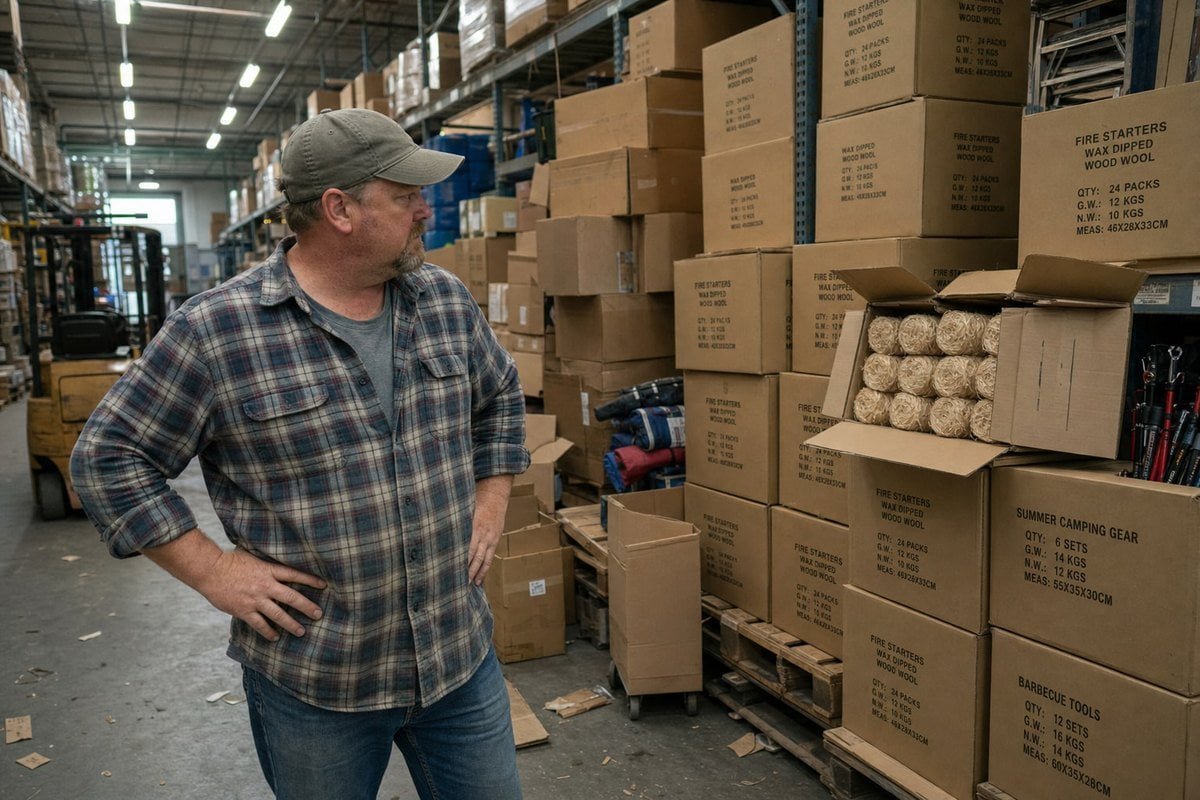
Every spring, buyers tell our factory the same thing: wood fire starter inventory is eating their shelf space. Cash sits frozen in slow stock. Prime shelves stay clogged. Meanwhile, faster summer sellers get squeezed out, margins shrink, and the backroom overflows. The fix is a deliberate off-season reduction plan — and after 17+ years supplying fire-starting goods to 30+ countries, we have helped many partners build exactly that.
To reduce wood fire starter inventory in the off-season, run tiered clearance sales, bundle slow movers with bestsellers, move backstock to vertical storage, negotiate smaller staggered deliveries with your manufacturer, and reforecast demand using 12–24 months of sales history before reordering.
Let me walk you through each lever in detail. We will cover storage, MOQ negotiation, demand forecasting, and private-label bundles. Each section gives you steps you can act on this month.
What Off-Season Storage Options Help Me Protect Unsold Wood Fire Starter Stock?
A distributor in Germany once showed me a pallet of wax-dipped rolls that had fused together in a hot warehouse. Our production team learned a lot from diagnosing that damage.
Store unsold wood fire starters in a cool, dry space below 30°C, off the floor, in sealed original cartons. Use vertical backroom racking to free sales-floor shelf space, rotate stock first-in-first-out, and keep wax-based products away from direct sunlight and heat sources.

Wax and wood-fiber products are durable, but they are not indestructible. In our Ningbo production facility, we control humidity and temperature at every stage, because paraffin softens in heat and wood wool absorbs moisture. Your storage room should follow the same logic. Good storage is the cheapest form of dead stock management 1. It costs far less than markdowns.
Match the Storage Method to the Product Type
Different fire starter formats have different risks. Here is how we advise buyers to handle each one.
| Product Type | Main Off-Season Risk | Best Storage Approach |
|---|---|---|
| Wax-dipped wood rolls | Wax softening and fusing | Cool room, cartons flat, never stacked over 5 high |
| Wood-wool starters | Moisture absorption | Sealed cartons with desiccant, off concrete floors |
| Compressed fiber pucks | Packaging crush damage | Original master cartons on racking, not loose bins |
| Color-flame packets | Print fading, pouch damage | Dark shelving away from sunlight |
Move Backstock Off the Sales Floor
Shelf space optimization starts with a simple rule: the sales floor is for selling, not storing. Keep only display quantities out front. Move everything else to vertical backroom racking. Vertical storage cuts the floor footprint dramatically, and clear zone labels help staff rotate stock and spot aging cartons early.
Protect the Packaging, Not Just the Product
In our experience shipping to the US and Europe, most off-season losses come from packaging wear, not product failure. A crushed retail box is unsellable at full price even if the starter inside works perfectly. So handle cartons carefully, keep them sealed until the next season, and inspect a sample carton every month. This monthly check doubles as a light cycle count, which improves your inventory visibility for the reorder decisions we discuss later.
Can I Negotiate Flexible MOQs or Staggered Deliveries to Avoid Overstocking Before Peak Season?
One trade-off we weigh constantly at our factory is production efficiency versus buyer flexibility. Long runs are cheaper for us, but rigid MOQs quietly push overstock risk onto our customers.
Yes. Most established manufacturers will negotiate lower trial MOQs, blanket orders with staggered shipments, or split-container deliveries. Committing to an annual volume while spreading deliveries across the season lets you hold less stock, reduce inventory carrying costs, and still lock in pricing.

Overstocking usually starts at the purchase order, not on the shelf. If you order a full year of wood fire starters in one August shipment, you guarantee yourself a spring storage problem. The smarter structure is a blanket agreement 2: you commit to a seasonal total, and your supplier ships it in planned waves. We run this model with several long-term distributors, and it improves the inventory turnover ratio 3 on both sides.
Delivery Structures You Can Propose
Here is a comparison of the common ordering structures and what each one does to your shelf space.
| Ordering Structure | Stock Held at Once | Price Leverage | Overstock Risk |
|---|---|---|---|
| Single annual bulk order | Very high | Best unit price | High |
| Blanket order, staggered shipments | Medium | Good — volume is committed | Low–medium |
| Small repeat orders, no commitment | Low | Weakest | Lowest |
| Mixed-SKU consolidated containers | Medium | Good | Low |
How to Open the Negotiation
Come to your supplier with data, not just a request. Share your monthly sell-through by SKU. Then propose a total seasonal volume with two to four delivery windows. In our experience, factories say yes far more often when the annual commitment is clear, because we can schedule production efficiently and you can receive goods in step with demand. Also ask about mixing SKUs in one container — pairing fire starters with firewood accessories or color-flame products fills a container without overloading any single line. Finally, discuss lead times 4 honestly. Our standard production cycle needs advance notice before peak season, so staggered plans must be booked early, not improvised in October.
Ask About Flexibility Clauses
A good staggered agreement includes an adjustment window. For example, you might reserve the right to shift the final shipment by 30 days or resize it by a modest percentage based on early-season sales. Suppliers with genuine manufacturing depth can absorb this. Trading companies often cannot, because they do not control the production schedule.
How Do I Forecast Seasonal Demand So I Don't Overbuy Wood Fire Starters Next Year?
A UK buyer once sent us reorder numbers that simply copied the prior year's peak order. We asked one question — what actually sold through by March? — and the answer cut his order by a third.
Forecast next season using 12–24 months of SKU-level sales history. Calculate monthly sell-through, adjust for weather anomalies and promotions, rank SKUs by velocity, and set reorder quantities to cover expected demand plus modest safety stock — not last year's purchase volume.

Forecasting is where off-season clearance sales stop being an annual emergency and become unnecessary. Most overbuying comes from three habits: copying last year's PO, trusting optimistic winter forecasts, and letting automatic replenishment 5 run unadjusted. Each habit is fixable with basic data discipline.
A Simple Five-Step Forecasting Process
- Pull 12–24 months of sales by SKU. Two years is better because it smooths out one unusual winter.
- Map monthly sell-through. Fire starters typically ramp in autumn, peak in mid-winter, and collapse by spring. Know your exact curve.
- Adjust for noise. Strip out one-off spikes from cold snaps, flash sales, or a competitor's stockout. Those are not baseline demand.
- Run an ABC-style SKU rationalization. Your A items earn prime shelf space and generous stock. Your C items get minimal orders or get cut. Duplicate SKUs competing for the same shopper should be consolidated.
- Set order quantities and timing. Cover forecast demand plus a small safety buffer, then align delivery waves with your ramp-up months, not before them.
Watch the Right Metrics, Not Just Units Sold
Track your inventory turnover ratio per SKU, not just total sales. A starter pack that sells steadily but turns only twice a year may deserve less shelf space than a smaller item turning eight times. Also track shelf productivity — profit per shelf foot — when deciding what earns display space next season. In our factory planning, we do the same at production level: we schedule long runs for proven high-velocity formats and shorter runs for niche items. Your buying should mirror that discipline. Finally, review supplier lead times before you cut too deep. Reducing stock is smart; creating a January stockout because you ignored a multi-week production and shipping window is not.
Should I Ask My Manufacturer About Private-Label Bundles to Move Slow Season Inventory Faster?
When we developed our private-label program in Liuyang, the goal was simple: give distributors a way to sell fire products outside the winter window, not just inside it.
Yes. Private-label bundles pair slow-moving fire starters with high-appeal items — color-flame packets, kindling, or grilling accessories — under your own brand. Bundling raises perceived value, moves off-season stock without deep discounting, and protects margin better than blanket clearance markdowns.

Promotional bundling works because it changes the question in the shopper's mind. A lone box of fire starters in June looks out of season. A branded fire pit kit — starters, kindling sticks, and color-flame packets — looks like a summer evening plan. That is why cross-merchandising with camping gear 6 consistently outperforms straight markdowns for this category. It repositions the product instead of just discounting it.
Bundle Ideas That Actually Sell in the Off-Season
| Bundle Concept | Components | Target Off-Season Shopper |
|---|---|---|
| Campfire Night Kit | Fire starters + color-flame packets + kindling | Campers and RV families |
| BBQ Ignition Pack | Wood-wool starters + wax torch | Grillers avoiding lighter fluid |
| Fire Pit Party Set | Starters + color-flame pinecones | Backyard entertainers |
| Gift-Ready Hearth Box | Premium starters + branded display box | Early holiday and festival gift buyers |
What a Real OEM Partner Should Provide
A true one-stop OEM/ODM supplier should handle the whole bundle build, not just the product inside. That means custom box design, display-ready packaging, warning labels, barcodes, and compliance documentation. For our clients in the US and EU, we supply CE marking 7 and SGS/Intertek test reports with every private-label run, because retail sourcing channels treat certification as a hard gate, not a bonus. Ask your manufacturer for the same. If they hesitate on compliance paperwork, the bundle will stall at the buyer's desk no matter how good it looks.
Timing the Ask
Raise the bundle conversation in early spring. Factories have more production flexibility in the off-season, sampling is faster, and you can test a small private-label run before committing to autumn volume. Our own sampling process is built so the first sample reflects mass-production quality — insist on that standard, because a bundle program only works if batch two matches batch one.
Conclusion
Overstocked wood fire starter inventory drains cash and clogs shelves. Protect stock with smart storage, negotiate staggered deliveries, forecast from real data, and use private-label bundles — then enter next season lean and profitable.
Footnotes
1. Explains the process of handling inventory that is unlikely to be sold. ↩︎
2. Wikipedia entry explaining the procurement process for recurring orders. ↩︎
3. Standard financial metric used to measure how efficiently inventory is managed. ↩︎
4. Defines the duration between the start and completion of a production process. ↩︎
5. Wikipedia page for the industry-standard term for automated stock replenishment. ↩︎



 English
  Spanish
  German
  French
  Arabic
  Portuguese
Join the Conversation