







On our Ningbo production line, one misplaced "Made in China" mark on magic fire powder can hold an entire container at U.S. customs. Delays cost money. Getting placement right prevents that.
For U.S. compliance, "Made in China" on magic fire powder must appear on the immediate retail container — the foil packet the consumer receives — printed in English, legibly, conspicuously, and permanently. If sold in a display box, mark the box too, since consumers see it first.
The rule sounds simple. In practice, it trips up importers all the time. Below, I walk through the documents to check, the durability tests to run, the packet-versus-box question, and the real mistakes I have seen cause customs delays.
What documents do I need to verify a factory's "Made in China" labeling meets US CBP requirements?
A buyer from Texas once asked our team for "proof the label is legal" before his first trial order. That question was smarter than he realized, and I now encourage every importer to ask it.
Request the final label artwork proof showing the origin mark, a pre-shipment photo of the printed packet, the commercial invoice and packing list stating China as origin, the HS Code classification, and third-party test reports such as SGS or Intertek confirming label content.

The legal foundation here is Section 304 of the Tariff Act of 1930 1. It requires every article of foreign origin entering the United States to carry the English name of its country of origin 2. CBP marking requirements flow from that statute. So your document trail needs to prove two things: the mark exists, and it says the right words in the right place.
In our experience exporting to the US for over 17 years, a clean document package settles most CBP questions before they start. Here is what I recommend collecting from any Chinese factory, including ours.
The core document checklist
| Document | What it must show | Why CBP cares |
|---|---|---|
| Label artwork proof | "Made in China" placement, font size, English language marking | Confirms compliant wording before printing |
| Pre-shipment photos | The actual printed packet and display box | Proves the artwork was executed, not just approved |
| Commercial invoice | Country of origin declared as China | Must match the physical marking |
| HS Code classification 3 | Correct tariff heading for flame colorant products | Wrong codes trigger inspections that expose label issues |
| SGS or Intertek reports | Product composition and label verification | Supports both customs and CPSC safety standards 4 questions |
One warning I give every buyer: do not accept artwork that says "Made in PRC." CBP has rejected that abbreviation repeatedly. The mark must read "Made in China" or "Product of China" in full. When we run label proofing at our factory, that is the first checkpoint, because fixing it after printing means scrapping film stock.
Also confirm the factory understands the ultimate purchaser rule 5. The mark must reach the retail consumer, not just the importer. Your documents should show the mark on the unit the shopper actually buys.
How can I confirm the country-of-origin mark won't rub off during shipping and retail handling?
Durability is a trade-off we weigh on every packaging run: glossy high-slip foil looks great on a shelf, but it is the worst surface for a stick-on origin label. That tension shapes how we print.
Require the origin mark to be printed into the packet's primary print cylinder, not applied as a sticker. Then run abrasion, humidity, and transit-simulation checks on samples. A permanent and legible mark must survive ocean freight, warehouse handling, and repeated retail touching.
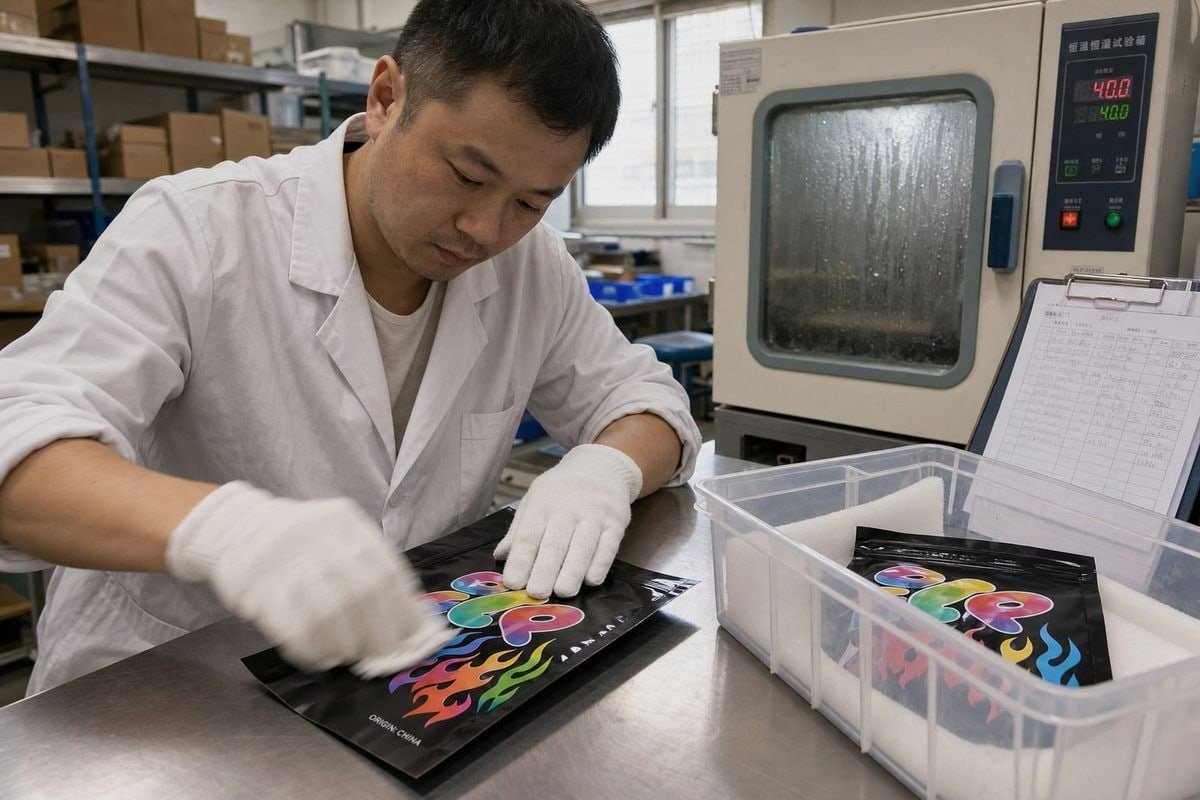
CBP expects the marking to be as permanent as the nature of the container permits. For a flexible foil pouch like our Magic Fire packets, that phrase has a practical meaning: the mark must be part of the printed film itself. Adhesive stickers routinely fail on the high-slip coatings used on fire-powder packets. I have seen sticker-marked shipments arrive at U.S. warehouses with half the labels curled or missing. That is a marking violation waiting to happen.
How to verify permanence before you ship
Here is the simple verification sequence I suggest to buyers:
- Ask how the mark is applied. The only good answer for flexible film is rotogravure 6 or flexo printing integrated into the main artwork. Reject stickers.
- Request a rub test. A basic dry and wet abrasion test on a sample packet shows whether ink lifts. Our QC team runs this on every new film batch.
- Check the heat-seal zones. Small sachets have crimped edges. Printing near the seal can distort or hide the origin text. The mark should sit on the flat back panel, clear of the crinkled border.
- Simulate transit. Put sample packets in a carton, shake and stack them, then inspect. Foil-on-foil friction reveals weak ink fast.
- Photograph retail handling. Pick the packet up casually. If a thumb naturally covers the mark, or the gloss makes it unreadable under store lighting, ask for larger or repositioned text.
Because we control our own production lines rather than brokering through a trading company, we can adjust cylinder artwork between sample and mass production without the mark drifting. Whoever your supplier is, insist that the mass-production packet matches the approved sample exactly. Batch-to-batch consistency is what keeps the mark permanent and legible across every shipment, not just the first one.
Should I request "Made in China" on the packet, the display box, or both for FTC compliance?
A German distributor once asked us to mark only the outer display box to keep the packet artwork "clean." We pushed back, and I will explain why we always advise marking both for the U.S. market.
Request "Made in China" on both the individual packet and the display box. The packet is the immediate container reaching the ultimate purchaser, so CBP requires it there. The display box needs it too, because consumers see the box at the point of sale.

Magic fire powder cannot be marked directly — you cannot print on loose crystals. Under immediate container marking rules, the requirement shifts to the packaging the consumer receives. That is the foil sachet. But most of our U.S. retail programs also use a flip-top counter display box holding twelve or twenty-four packets. Shoppers judge the product by that box before they ever touch a sachet. Country of Origin labeling must therefore be visible during casual handling at the shelf, without opening anything.
There is also a second regime at play. CBP governs the physical import marking. The FTC governs origin claims in marketing. They are related but separate. If your display box carries a U.S. distributor's name and address — and almost every private-label box does — the "Made in China" statement must appear in close proximity to that address, in comparable font size. Otherwise the packaging implies U.S. origin, which raises FTC problems. And never print an unqualified "Made in USA" claim on a Chinese-made product; the FTC's "all or virtually all" standard 7 makes that claim indefensible for goods manufactured in China.
Placement guide by packaging format
| Packaging format | Where to place the mark | Key risk to avoid |
|---|---|---|
| Foil sachet or packet | Back panel, clear of heat seals | Text obscured by crimping |
| Kraft stand-up pouch | Back panel near instructions | Mark hidden under the zip fold |
| Plastic jar or shaker | Wrap-around label or molded plastic | Bottom-stamping deemed not conspicuous |
| Flip-top display box | Back or side panel, near distributor address | Proximity and font-size failures |
| E-commerce listing | Back-of-pack product image | Buyer cannot see origin before purchase |
At our Liuyang headquarters, we build the origin mark into every OEM artwork template — packet, pouch, jar, and box — alongside warning labels and barcodes. One more practical tip: because CPSC safety standards concern flame colorants that could be mistaken for candy, we place the origin mark near the "KEEP OUT OF REACH OF CHILDREN" warning. Grouping the compliance text distinguishes the chemical packet from food and keeps both agencies satisfied at once.
What labeling mistakes have caused customs delays for other importers sourcing color-flame powder from China?
The hardest lesson I learned early in our export history involved a shipment marked only on the master carton. The buyer assumed that was enough. CBP disagreed, and re-marking at a bonded warehouse erased the entire margin on that order.
The most common failures are marking only the outer shipping carton, using "Made in PRC," placing origin text far smaller than a U.S. address, printing over heat-seal areas, using stickers that peel off, and mismatching the invoice origin against the physical mark.
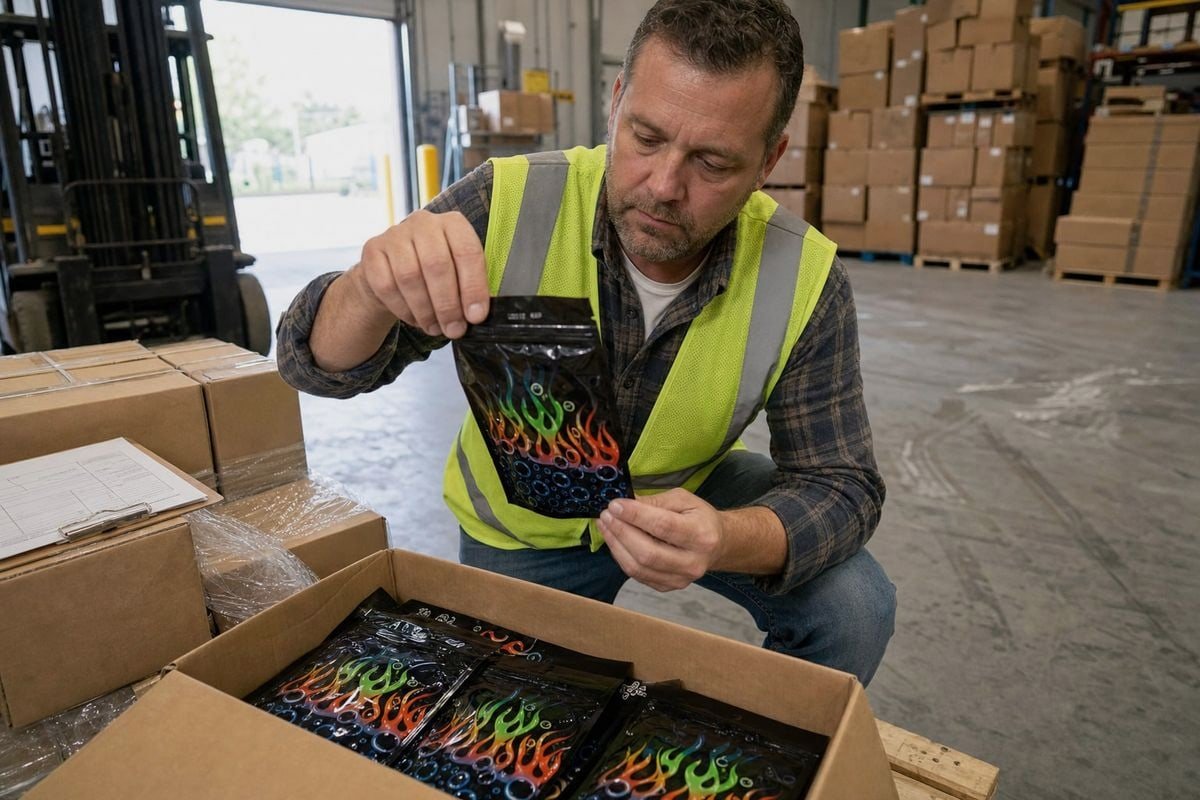
Each of these mistakes maps to a specific rule, so let me break them down the way I explain them to new buyers during sampling calls.
The six failure patterns and their fixes
| Mistake | Why CBP or FTC objects | The fix |
|---|---|---|
| Master carton marked, packets blank | The ultimate purchaser never sees the carton | Print the mark on every retail packet |
| "Made in PRC" or "P.R.C." | Not the English country name required by the Tariff Act of 1930 | Use "Made in China" in full |
| Tiny origin text beside a large U.S. address | Misleads consumers about origin | Comparable size, close proximity |
| Mark printed in the seal zone | Crimping renders it illegible | Move text to the flat back panel |
| Sticker labels on glossy foil | Adhesive fails; mark disappears in transit | Integrate the mark into printed film |
| Invoice says China, product mark missing or contradictory | Documentation mismatch triggers examination | Align paperwork with physical marking |
A few of these deserve extra emphasis. The outer-carton error is the most expensive because it is discovered last. Some sellers believe packaging anywhere in the shipment is always sufficient. That is wrong. Packaging-based marking is acceptable only when the article itself cannot be marked — true for powder — and only on the container that reaches the consumer. A brown export carton does not qualify.
Documentation mismatches cause quieter but frequent delays. If the HS Code classification, invoice, and physical mark tell different stories, CBP examiners slow everything down. And remember that origin marking does not replace other rules: fireplace colorant regulations, hazard warnings, and CPSC safety standards apply on top of customs marking. A correct "Made in China" mark proves origin disclosure, not overall product legality. That is why our export team reviews the full label — origin, warnings, instructions, barcode — as one audit before any container leaves Ningbo, and why we keep SGS and Intertek reports on file for every SKU.
Conclusion
Mark the packet, mark the box, print it into the film, and match your paperwork. Get those four things right, and your magic fire powder clears U.S. customs without drama.
Our team has spent 17+ years building compliant, shelf-ready color-flame products for U.S. and European buyers, backed by ISO 9001 8, BSCI, CE, and SGS/Intertek certification. If you want label artwork that passes CBP review the first time — origin marks, warnings, barcodes, and private-label branding included — we handle all of it as part of every OEM program. Send us your packaging concept, and we will return a compliance-checked proof before you commit to a single carton.
Footnotes
1. Authoritative .edu legal database providing the full text of Section 304 regarding country of origin marking. ↩︎
2. Background concept explaining origin marking terminology used throughout the article ↩︎
3. WTO trade facilitation resource relevant to tariff classification discussed for customs clearance ↩︎
4. Official CPSC regulations page relevant to safety labeling requirements mentioned for flame colorants ↩︎
5. Background on rules of origin concept underlying the ultimate purchaser marking requirement ↩︎
6. Background explanation of the printing technology recommended for permanent origin marking ↩︎
7. Official FTC guidance document explaining the Made in USA labeling standard cited in article ↩︎
8. Stable Wikipedia reference for the ISO 9001 quality management standard, avoiding common 403 access issues. ↩︎



 English
  Spanish
  German
  French
  Arabic
  Portuguese
Join the Conversation