






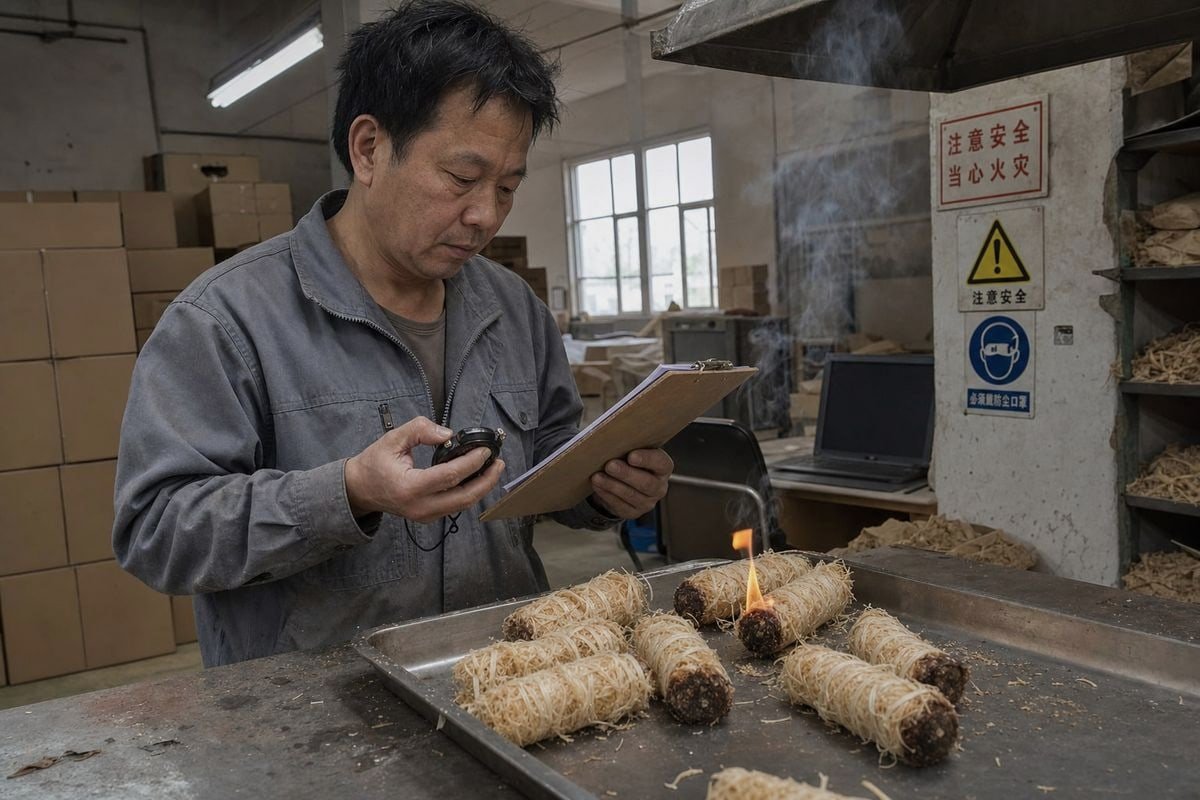
Wood fire starter comparisons fail when buyers trust packaging claims Gestão da qualidade ISO 9001 1. I've watched importers approve samples on our factory floor, then get burned—literally—by inconsistent mass production from other suppliers.
Request certified lab reports (SGS/Intertek, CE), documented burn-time and ignition-speed specs measured under stated conditions, and standardized test videos showing time-stamped burn duration, wet and wind performance, and side-by-side trials—so every wood fire starter comparison uses identical fuel, environment, and criteria.
That answer covers the essentials. Now let me break down each part, based on what actually separates a reliable supplier from a risky one.
What certifications and lab test reports should I ask wood fire starter suppliers to provide?
A German distributor once told me his previous supplier's "certificate" was a photoshopped PDF third-party SGS 2. That conversation shaped how we present our ISO 9001, BSCI, and SGS documentation today.
Ask for ISO 9001 quality management certification, BSCI social audit results, CE marking documentation, and third-party SGS or Intertek test reports covering composition, burn behavior, and safety. Verify report numbers directly with the testing lab before approving any wood fire starter supplier.

Certificates fall into three groups. Each group answers a different question. You need all three before you commit to a container order.
Certificações em nível de fábrica
These prove the supplier can produce consistently. ISO 9001 shows a working quality management system. BSCI shows the factory passed a social compliance audit. Retail chains in the US and Europe often require both. In our experience exporting to 30+ countries, buyers for Home Depot-type channels will not even open a quotation without them.
Product-level test reports
These prove the product itself is safe and honest. Ask for SGS or Intertek reports that confirm the stated composition—for example, a 50% wood fiber and 50% paraffin blend. Reports should also cover chemical-free ingredients, smoke production levels 3, e heavy metal screening 4. If the product targets fireplace or BBQ use, ask whether any food-grade safety considerations apply near cooking surfaces.
Market-entry documentation
Marcação CE 5 matters for the EU. Warning labels, barcodes, and safety text must match destination-market rules. We prepare these as part of our OEM packaging work, and a supplier who cannot discuss them fluently is a red flag.
| Documento | O que prova | Como verificar |
|---|---|---|
| ISO 9001 | Consistent production process | Check certificate registry |
| Auditoria BSCI | Condições éticas de fábrica | Request audit ID and date |
| Relatório SGS/Intertek | Composition, safety, burn data | Confirm report number with the lab |
| Documentação CE | Conformidade com o mercado da UE | Match to product batch |
| Eco-friendly certification | No harmful chemicals | Cross-check tested substances list |
Which burn-time and ignition-speed specs matter most when comparing wood fire starter samples?
When we calibrate wax saturation on our wood roll line, a few grams of paraffin either way shifts burn time by minutes. That tolerance is exactly what your spec sheet should capture.
Prioritize burn time duration (8–15 minutes typical), time to sustained flame in seconds, peak flame height in centimeters, moisture resistance rating, and wind resistance performance. Always demand the test conditions behind each number, because unconditioned specs are just marketing.
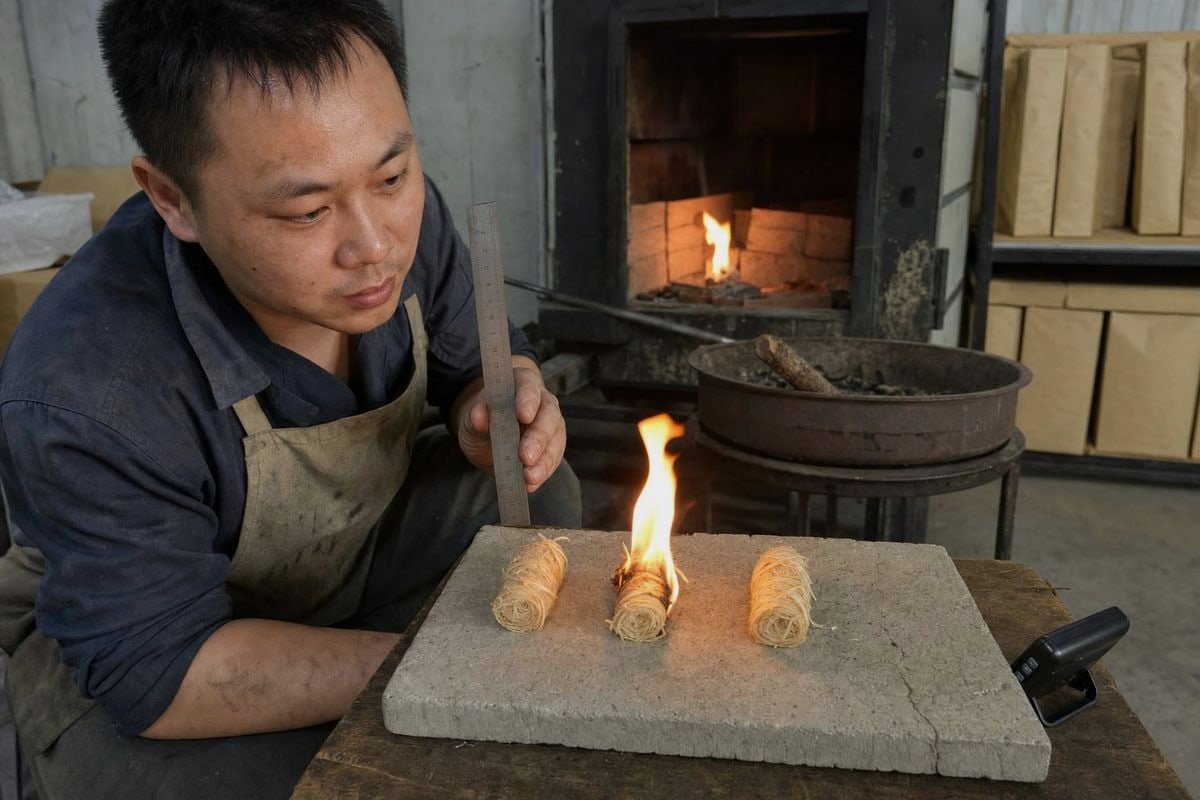
Not all specs carry equal weight. Some predict real-world success. Others just look good on a datasheet. Here is how I rank them when buyers ask.
The specs that predict ignition success
Burn time duration comes first. A starter that flares for 90 seconds rarely lights split hardwood. Most quality wax-and-wood-fiber starters burn 8–12 minutes; premium formats reach 10–15. Second is flame height consistency. A steady 8–10 cm flame transfers more heat to kindling than a brief flare. Third is ignition reliability—how many match strikes it takes to light one unit, averaged over many trials, not one lucky attempt.
The conditional specs
Moisture resistance matters for camping and damp-climate markets. Ask whether the product is waterproof, water-resistant, or untreated. Wind resistance rating matters outdoors; ask at what airflow the flame extinguishes. Shelf life matters for retail; paraffin-based starters store well, but you should still request storage temperature and humidity limits.
| Espec | Good benchmark | Required test condition |
|---|---|---|
| Duração do tempo de queima | 8–15 minutos | Room temp, no wind, stated |
| Time to sustained flame | Abaixo de 10 segundos | Single match, ambient humidity |
| Peak flame height | 8–15 cm | Measured against a ruler |
| Resistência à umidade | Lights after humidity exposure | Exposure time documented |
| Wind resistance rating | Stays lit at stated airflow | Fan speed and distance stated |
| Saída de calor BTU 6 | Comparable per unit weight | Same measurement protocol |
Treat BTU heat output claims carefully. Very high numbers usually come from different protocols across suppliers. Ask how the figure was measured, or ignore it in comparisons.
What should a supplier's demo video actually show before I approve mass production?
Last year a Canadian buyer asked us for one thing before signing: an uncut video of five units from the same batch burning side by side. We filmed it the same afternoon. That request should be standard practice.
Demand uncut, time-stamped videos showing a full time-lapse burn test to extinction, a one-match ignition trial, a wet-recovery test after water exposure, a fan-driven wind test, and multiple units from one batch burning side by side under identical conditions.
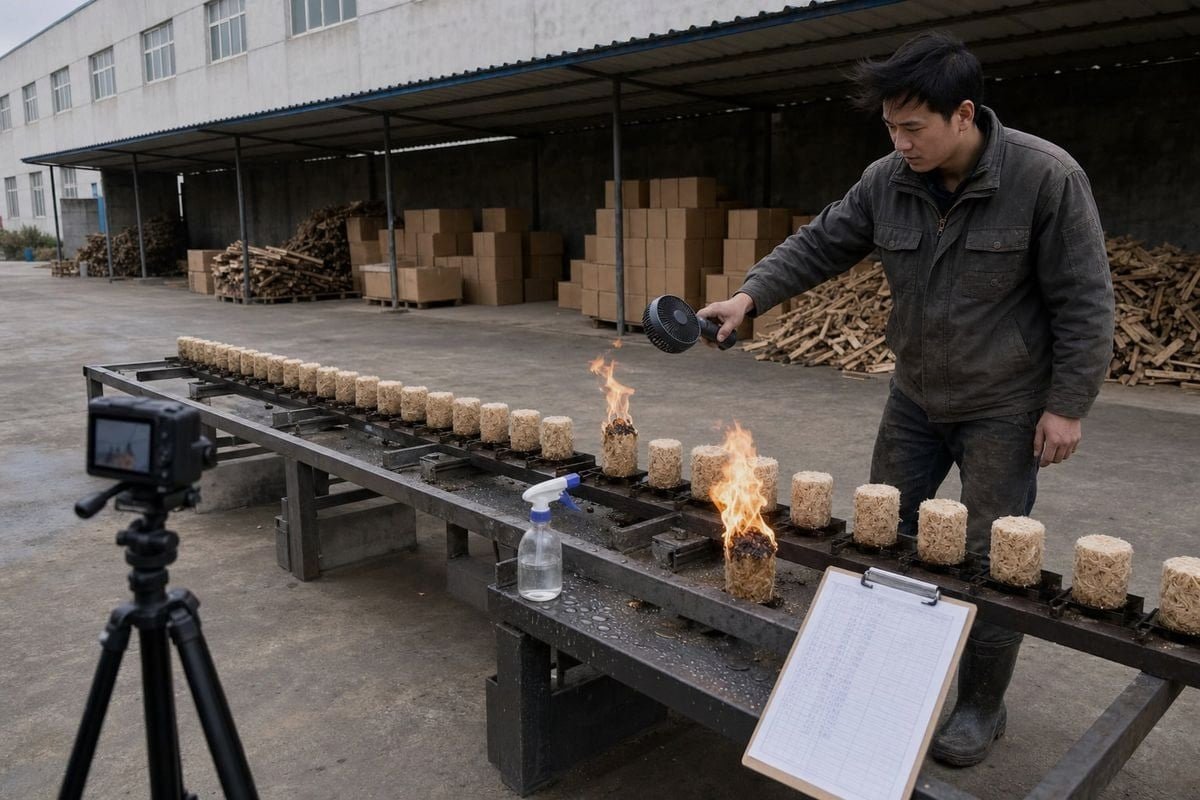
A single highlight clip proves nothing. Anyone can film one successful ignition. What you need is a structured video protocol. Here is the sequence I recommend, in order.
- Batch identification. The video opens with the batch number, date, and units on camera. This ties the footage to the goods you will receive.
- One-match ignition test. Each unit lights from a single standard match. A stopwatch runs on screen. This proves ignition reliability, not luck.
- Full time-lapse burn test. The camera runs uncut from first flame to final ember, with a visible timer. This verifies claimed burn time duration.
- Flame height reference. A ruler or marked board stands behind the flame. You can then compare flame height consistency across suppliers yourself.
- Wet-recovery test. The unit gets dunked or misted, then lit immediately. Pass or fail, plus time to light.
- Wind test. A fan at a stated speed and distance blows across the flame. You see whether heat still transfers to kindling.
- End-result test. The starter ignites a real fuel load—split logs, charcoal, or kindling—and the video shows a self-sustaining fire, not just an initial flare.
- Repeatability. At least three units run through the same tests. Consistency matters more than one perfect take.
Para fireplace-market products, also ask for a cold wood stove start showing how quickly the flame overcomes a cold chimney draft. And for smoke-sensitive indoor markets, request a clean burn segment demonstrating low smoke production levels and minimal sooty residue on a glass surface after burning.
How do I compare wood fire starter quality across different factories using the same test criteria?
The hardest lesson from 17+ years running production lines is this: two samples can look identical and behave completely differently. Only a fixed test protocol exposes the gap.
Create one written protocol—same fuel load, same environment, same ignition method, same timing tools—then test every factory's samples in a single session. Score burn time, ignition reliability, wet and wind performance, and consistency across five units, and record everything on camera.

The biggest comparison mistake is testing samples on different days, with different wood, in different weather. Small changes in humidity or kindling moisture swamp the differences between products. So fix every variable except the starter itself.
Build a one-page scoring sheet
Give every factory's sample the same trials and score them numerically. A simple weighted sheet works better than gut feeling, and it gives you documentation when you negotiate.
| Critério | Peso | How to score |
|---|---|---|
| Duração do tempo de queima | 25% | Average minutes across 5 units |
| Confiabilidade de ignição | 20% | Match strikes needed, averaged |
| Wet performance | 15% | Pass/fail plus recovery time |
| Wind resistance | 15% | Flame survival at fixed fan setting |
| Consistency between units | 15% | Spread between best and worst unit |
| Smoke and residue | 10% | Visual smoke level, glass swab test |
Test the batch, not the sample
One sample tells you about one unit. Five units from the same batch tell you about the factory. Ask each supplier for units pulled randomly from a production run, not hand-picked showcase pieces. On our lines, we hold wax saturation and wood fiber density to tight batch-to-batch tolerances precisely so the first sample honestly represents mass production. A supplier who resists sending random batch units is telling you something.
Match criteria to your end use
Weight the sheet for your market. Fireplace distributors should raise the weighting on smoke, residue, and indoor safety. Camping brands should raise moisture resistance and packability. Charcoal-focused buyers should add a lump-charcoal end-result test. The same five factories can rank differently once you weight for the actual use case—and that is the point.
Conclusão
Vague claims sink comparisons and importers alike. Demand verified certifications, conditioned specs, uncut standardized videos, and one fixed protocol—then choose the wood fire starter that wins under your real conditions.
Notas de rodapé
1. Official ISO reference explaining the quality management standard mentioned as a factory-level certification. ↩︎
2. Official SGS company page verifying the third-party testing lab referenced for certification checks. ↩︎
3. EPA guidance on indoor particulate matter relevant to smoke and residue safety concerns. ↩︎
4. EPA resource on heavy metal exposure relevant to product safety screening tests. ↩︎
5. Background explanation of CE marking requirements referenced for EU market compliance. ↩︎
6. Wikipedia explains the BTU unit used to measure heat output claims in the comparison table. ↩︎



 English
  Spanish
  German
  French
  Arabic
  Portuguese
Participe da conversa