






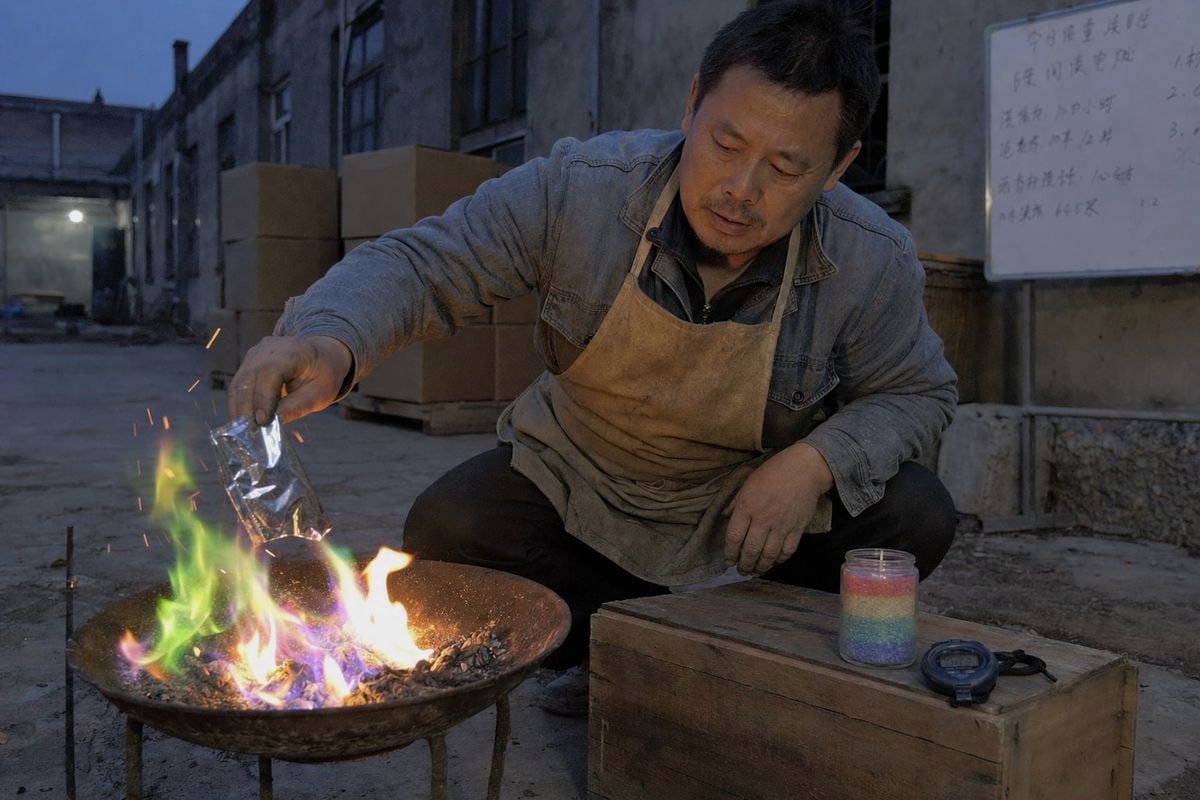
Choosing between magic fire powder and color flame candles is harder than it looks. I have watched buyers on our production line struggle with this exact comparison — and pick wrong, expensively.
Magic fire powder is more cost-effective for most retail and event applications, delivering 30–60 minutes of dramatic colored flames for $1–$2 per packet. Color flame candles cost more per minute of visible color and suit only indoor, small-scale decorative settings.
But sticker price is only one part of the equation. Let me walk you through the real numbers, the compliance costs, and the long-term business case for each product.
What Are the Real Cost Differences Between Magic Fire Powder and Color Flame Candles Per Use?
Last spring, a German distributor asked our team to run a side-by-side cost breakdown before placing his first container order. The results surprised even him, and they shaped how we now advise every new buyer.
Magic fire powder costs roughly $0.02–$0.07 per minute of colored flame, since one $1–$2 packet colors a fire for 30–60 minutes. Color flame candles typically cost $0.30–$1.00 per minute, because novelty variants burn briefly and are priced as premium decorative items.
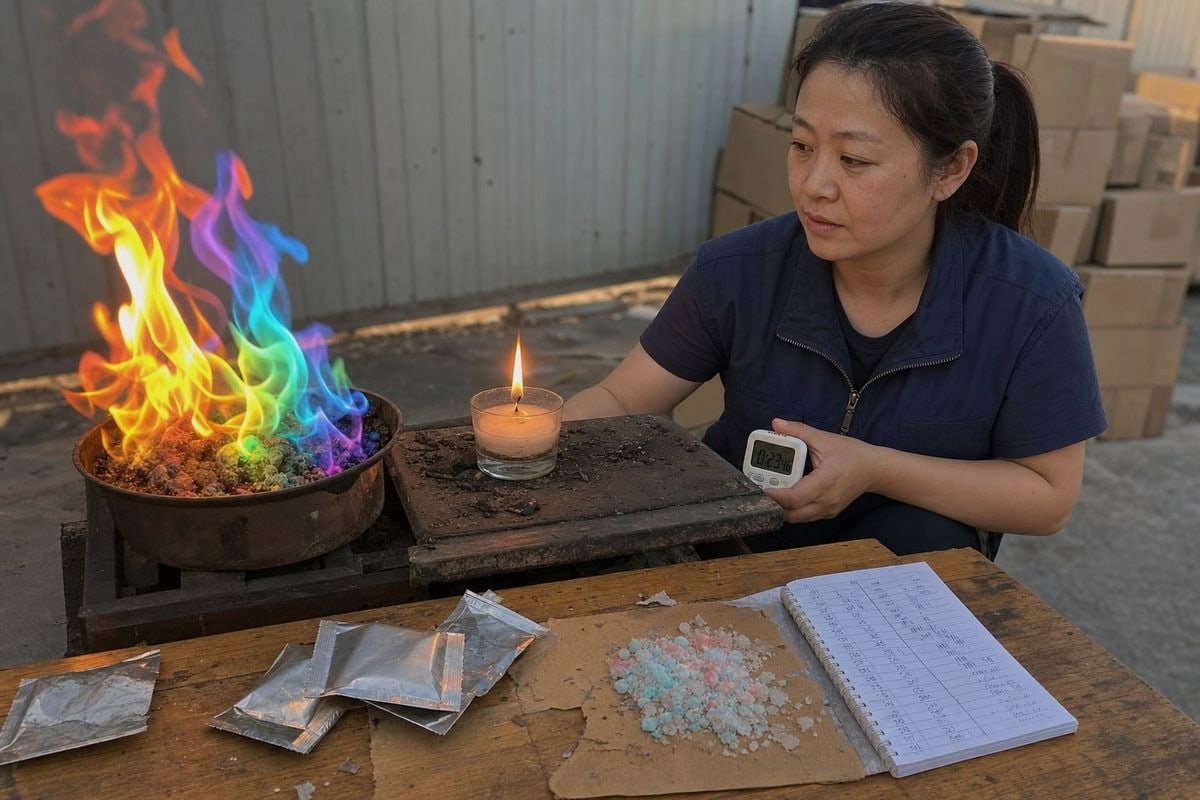
The fairest way to compare these products is not the price tag. It is the price per use comparison — specifically, cost per minute of visible color effect. Here is how the two categories stack up when we run the math the way our export clients do.
| Impulsionador de Custo | Pó Mágico para Fogo | Color Flame Candles |
|---|---|---|
| Typical retail price | $1–$2 per packet | $3–$10 per candle set |
| Active color duration | 30–60 minutos | 5–15 minutes (novelty types) |
| Cost per minute of color | $0.02–$0.07 | $0.30–$1.00 |
| Bulk discount depth | Deep (50-packs under $0.50/unit) | Shallow |
| Visual coverage | Entire fire pit or fireplace | Single small flame |
Why Powder Wins on Raw Efficiency
The math favors powder for one simple reason. A campfire colorant packet uses corantes de sal metálico 1 that spread across an entire burning fire. The visual surface area is huge. A candle produces one small flame, no matter how long it burns. So even when a candle burns longer in total, its cost per impression stays higher.
The Hidden Dependency
To be fair, powder has a dependency. It needs an existing fire. If your customer must buy firewood or maintain a fire pit, that adds context cost. Candles are self-contained. For indoor ambiance where no fire exists, novelty party candles can be the only workable option. But for outdoor bonfire accessories, campfires, and fireplaces — the settings most of our buyers sell into — the powder economics are hard to beat.
Storage Affects Real Cost Too
One more factor matters. Rainbow flame crystals are hygroscopic. If they absorb moisture, they clump and lose potency. That raises the true cost per successful use. This is why our sealed foil sachets and resealable kraft pouches exist — proper packaging protects the margin your customer actually experiences.
How Do Certification and Compliance Costs Factor Into My Total Investment for Each Product?
Compliance is where I have seen the most expensive surprises in this industry. Our factory holds ISO 9001, BSCI, CE, and SGS/Intertek certifications precisely because our US and EU buyers cannot legally shelve products without them.
Certification is a larger hidden cost for color flame candles than for powder, since candles face wick, wax, and fire-safety standards on top of chemical rules. Powder mainly requires chemical composition testing, SDS documentation, and compliant warning labels — costs a certified factory absorbs upfront.

Buyers often underestimate this line item. A cheap uncertified product can become the most expensive purchase you ever make. Customs seizures, retailer delistings, and liability claims all trace back to skipped paperwork. Let me break down what each product category actually demands.
What Powder Products Must Prove
Magic fire powder is regulated primarily as a chemical product 2, not a pyrotechnic. That distinction matters. Genuine pyrotechnic flame effects 3 fall under far stricter explosives regulations. Compliant powder must document its metal salt colorants, exclude restricted substances, and carry clear chemical safety precautions 4 on the packaging. In our experience exporting to 30+ countries, the required file typically includes:
- Full chemical composition disclosure and SDS sheets
- Third-party lab testing (we use SGS and Intertek)
- Heavy metal and restricted substance screening
- Compliant warning labels in destination-market languages
- Correct transport classification for sea and air freight
What Candles Must Prove
Candles look simpler but face layered standards. Fire safety behavior, wick composition 5, wax emissions, and stability requirements all apply — plus additional chemical testing for the colorant system embedded in the wax. Two testing regimes, one product.
| Item de Conformidade | Pó Mágico para Fogo | Color Flame Candles |
|---|---|---|
| Teste de composição química | Necessário | Necessário |
| Fire safety / burn behavior testing | Básico | Extensive |
| Wick and emissions standards | Não aplicável | Necessário |
| Warning label complexity | Moderado | Moderado-Alto |
| Typical buyer testing burden | Low if factory is certified | Higher, dual-category |
The practical takeaway: partner with a factory that already holds the certificates and test reports. When we supply Magic Fire packets, the compliance file travels with the goods. That converts a variable, risky cost into a fixed, predictable one — which is exactly how a purchasing manager wants it.
Which Option Offers Better Long-Term Value for My Retail or Distribution Business?
Seventeen years of export data teaches you patterns. The buyers who reorder most consistently are the ones selling campfire colorant packets through outdoor, BBQ, and fireplace channels — and there are structural reasons why.
Magic fire powder offers stronger long-term value for most distributors: higher margins, deeper bulk discounts, lighter shipping weight, longer shelf life in sealed packaging, and strong seasonal repeat purchases. Candles retain an edge only in indoor décor and giftware channels.

Long-term value is about more than the first purchase order. It is about margin structure, logistics cost, sell-through velocity, and repeat behavior. Let me unpack each.
Margin and Logistics Structure
Powder sachets are light, flat, and dense in value. A single carton holds hundreds of retail units. Candles are heavy, fragile in heat, and bulky. Wax can deform in a hot container crossing the equator — a problem we never face with sealed foil sachets. Freight cost per retail dollar is dramatically lower for powder.
| Business Factor | Pó Mágico para Fogo | Color Flame Candles |
|---|---|---|
| Shipping weight per retail unit | Muito baixo | 1 x 20 pés ou 40 pés |
| Heat sensitivity in transit | Low (sealed sachets) | High (wax deformation risk) |
| Shelf life | Long, if kept sealed and dry | Long |
| Typical retail margin | 1 x 20 pés ou 40 pés | Moderado |
| Repeat purchase behavior | Strong (consumable, seasonal) | Weak–moderate |
| Cross-sell potential | Firestarters, pinecones, torches | Limitado |
Repeat Purchases Drive the Real Value
A candle is often a one-time gift. A powder packet is a consumable. Campers, fire pit owners, and holiday hosts burn through them and come back. Our distributors in the US and Germany see clear seasonal spikes — summer camping and the winter fireplace season — which makes inventory planning predictable.
The Content Marketing Bonus
There is also a modern factor: visual ROI. Rainbow flames across a full bonfire are scroll-stopping content. Retail buyers tell us that user-generated videos of colored campfires drive organic demand in a way a table candle simply cannot. That marketing leverage compounds over time and costs you nothing.
Where Candles Still Win
I will be direct: if your channel is indoor home décor, tabletop gifting, or venues where open fires are banned, novelty party candles fit better. Powder cannot replicate that controlled micro-experience. The honest answer is channel fit — but for outdoor, camping, BBQ, and fireplace distribution, powder is the stronger long-term bet.
Can I Get Flexible MOQs and Private-Label Support to Test Both Products Before Committing?
A UK importer once told me his biggest fear was not price — it was committing a full container to an unproven SKU. That conversation reshaped how we structure trial programs at our Ningbo facility.
Yes. Reputable factories offer trial-friendly MOQs, sample kits with test reports, and full private-label support — custom sachets, kraft pouches, jars, display boxes, barcodes, and warning labels — so you can validate sell-through in your market before scaling to container volumes.

Testing before committing is not a luxury. It is basic risk management, and any serious manufacturing partner should support it. Here is how a sensible trial-to-scale path works, based on how we run OEM/ODM projects.
A Practical Trial Path
- Estágio de amostra. Request samples with the accompanying SGS ou Intertek 6 test reports. Verify color intensity, burn time duration, e packaging quality 7 yourself. Throw a packet into a real fire pit — the copper sulfate-family blues and greens should be vivid, not washed out.
- Pilot order. Start with a flexible MOQ — enough to stock a few test doors or one e-commerce listing. We deliberately keep trial MOQs low because a successful pilot creates a long-term customer.
- Private-label buildout. Once sell-through data looks good, lock in your branding: sachet artwork, flip-top display boxes, jar or kraft-pouch formats, market-specific warning labels, and retail barcodes. Our design team handles this in-house.
- Scale with consistency. This is where manufacturing depth matters. Batch-to-batch quality control means your tenth container burns exactly like your first sample. Buyers who have been burned by trading companies — where the sample and the mass production rarely match — know this is the whole game.
Why Format Flexibility Matters for Testing
Different markets prefer different formats. US campground retailers like single-use sachets. European gift channels prefer display boxes. Some LARP and festival buyers want bulk jars. Because we produce all three, plus complementary color-flame pinecones and wax firestarters, you can test multiple formats in one pilot shipment instead of guessing.
Communication Is Part of the Product
One underrated point: responsive English communication during a trial saves weeks. Quick answers on label revisions, transport classification, and lead times keep your launch calendar intact. Slow suppliers quietly cost you a selling season.
Conclusão
Wrong product choices tie up capital and shelf space. The fix is simple math plus channel fit — and here is what the numbers showed.
Magic fire powder wins the cost-effectiveness contest for most B2B buyers. It delivers dramatic color for pennies per minute, ships light, reorders reliably, and carries a simpler compliance path. Color flame candles hold their ground only in indoor décor and giftware channels, where a controlled small flame is the whole point. Whichever direction fits your market, insist on certified test reports, batch-consistent production, and trial-friendly MOQs before you commit. After 17+ years supplying color-flame products to distributors across 30+ countries, our strongest advice is this: test small, verify compliance early, and scale with a factory partner whose first sample honestly predicts the container that follows.
Notas de rodapé
1. Wikipedia entry explaining how metal salts are used to create different colors in pyrotechnic displays. ↩︎
2. The European Chemicals Agency explains REACH regulations, which govern chemical products sold in the EU market. ↩︎
3. Official NFPA 160 standard for the safe use of flame effects. ↩︎
4. Authoritative OSHA resource for chemical hazard recognition and safety management. ↩︎
5. ASTM F2417 is the standard safety specification for candle products, covering fire safety and wick requirements. ↩︎
6. Official SGS service page for consumer goods testing and certification. ↩︎
7. Wikipedia overview of packaging quality and labeling standards essential for consumer product safety and logistics. ↩︎


 English
  Spanish
  German
  French
  Arabic
  Portuguese
Participe da conversa