






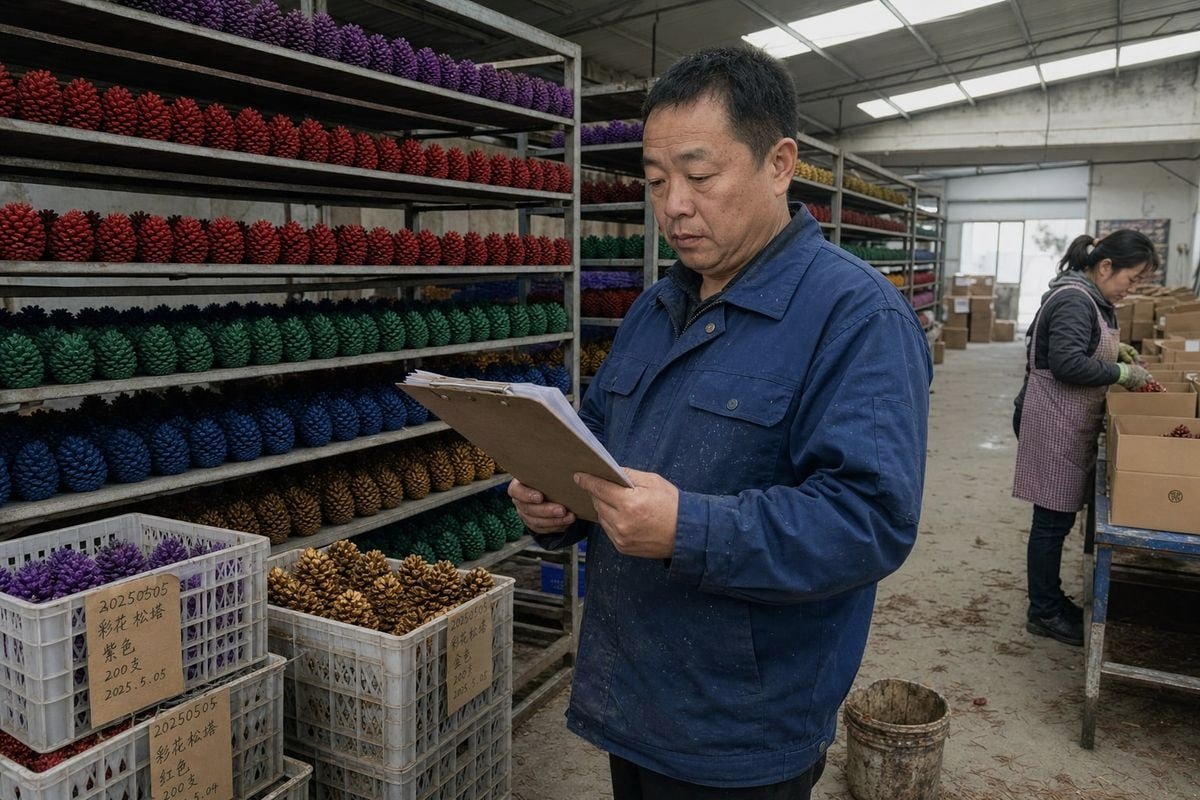
Tracking production progress for colored fireplace pine cones sounds simple until a batch stalls in drying. On our production line, we learned that lesson early — and expensively.
To track production progress for colored fireplace pine cones, request batch-level status reports with stage timestamps, photos at prep, treatment, drying, and packing, plus weekly KPI updates on lead time, yield rate, and on-time ship rate. Flag any drying stage exceeding baseline by 20% as an early delay signal.
That is the short answer. Now let me show you how to build that system in practice, step by step, based on what actually happens inside a color-flame factory.
What tools or reports can I request to monitor my pine cone order in real time?
A German distributor once asked us for daily photos of his drying racks. It felt excessive at first. It ended up saving his Christmas delivery window.
Request a batch tracker with unique batch IDs, stage timestamps, and status labels; weekly production milestone reports; dated photos or short videos from prep, soaking, drying, and packing; plus pre-shipment quality control inspections and factory audit reports before final release.
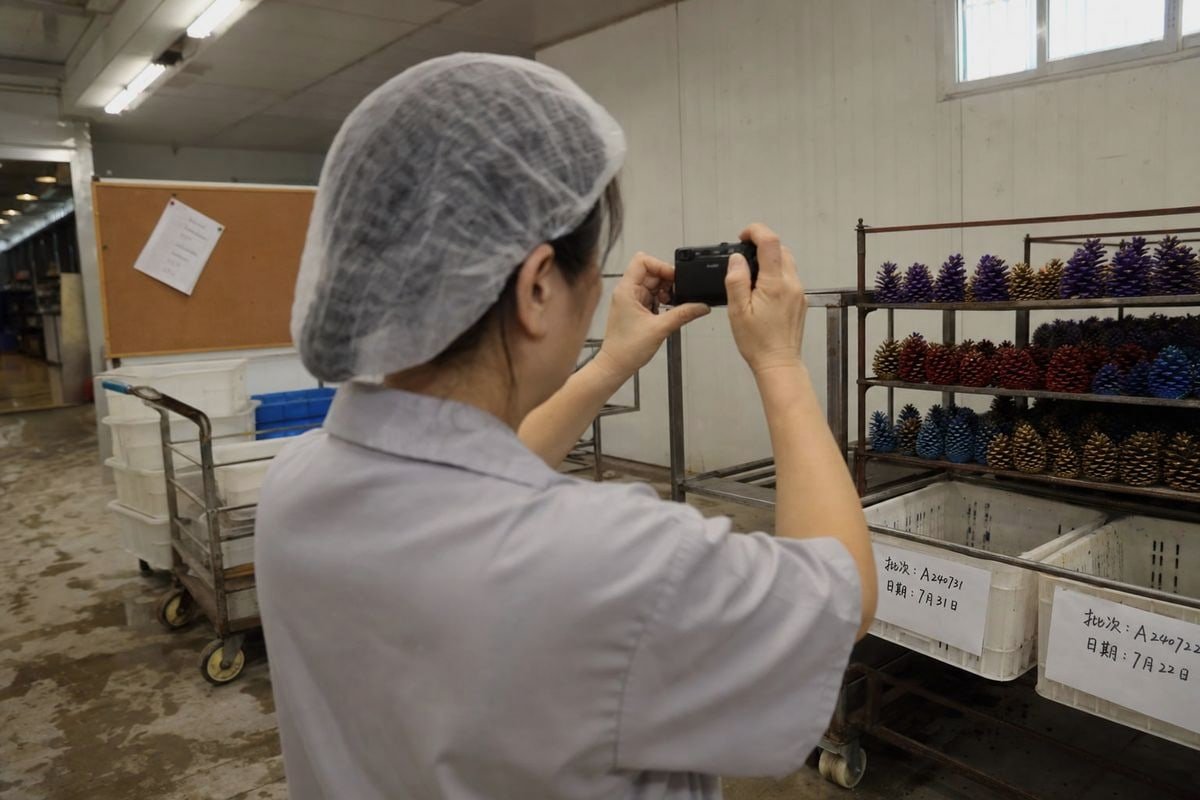
Most buyers over-complicate this. You do not need enterprise software to get real supply chain visibility 1 on a small-batch product. You need a shared spreadsheet, a photo routine, and a supplier willing to use both. At our Ningbo facility, every batch of color-flame pinecones carries a batch ID tied to the production date, the cone source, and the treatment formula. When a buyer asks where their order stands, we answer in one line: batch number, current stage, expected release date.
The core documents worth asking for
Here is what we recommend requesting, in order of importance:
| Tool or Report | O que Mostra | How Often |
|---|---|---|
| Batch tracker spreadsheet | Batch ID, stage status, timestamps | Updated per stage change |
| Photo/video checkpoints | Real product at prep, soak, dry, pack | At each milestone |
| Weekly milestone report | Progress vs. planned schedule | Semanal |
| Pre-shipment inspection report | Yield, coating quality, moisture check | Once, before release |
| Factory audit reports (BSCI/ISO 9001 2) | Baseline capability and compliance | Before ordering |
Why status labels matter
Ask your supplier to use simple statuses: prep complete, in soak, drying, ready for inspection, packed, released. A kanban-style board 3 works well. If your order sits at "drying" for a week longer than promised, you see it immediately — not at the shipping stage. In our experience exporting to 30+ countries, buyers who ask for stage-level statuses catch problems ten days earlier than buyers who only ask "is it shipped yet?" That ten days is often the difference between air freight rescue costs and normal shipping logistics.
How do I identify early warning signs of a potential delay before it impacts my delivery date?
We once traced a two-week slip on a Canadian order back to one humid week in drying. The dip stage was never the problem. It rarely is.
Watch for drying times exceeding baseline by 20% or more, tacky or partially closed cones after the expected cure window, uneven color coverage requiring rework, chemical or wax stock shortages, and vague status updates. These signals appear one to three weeks before a missed ship date.
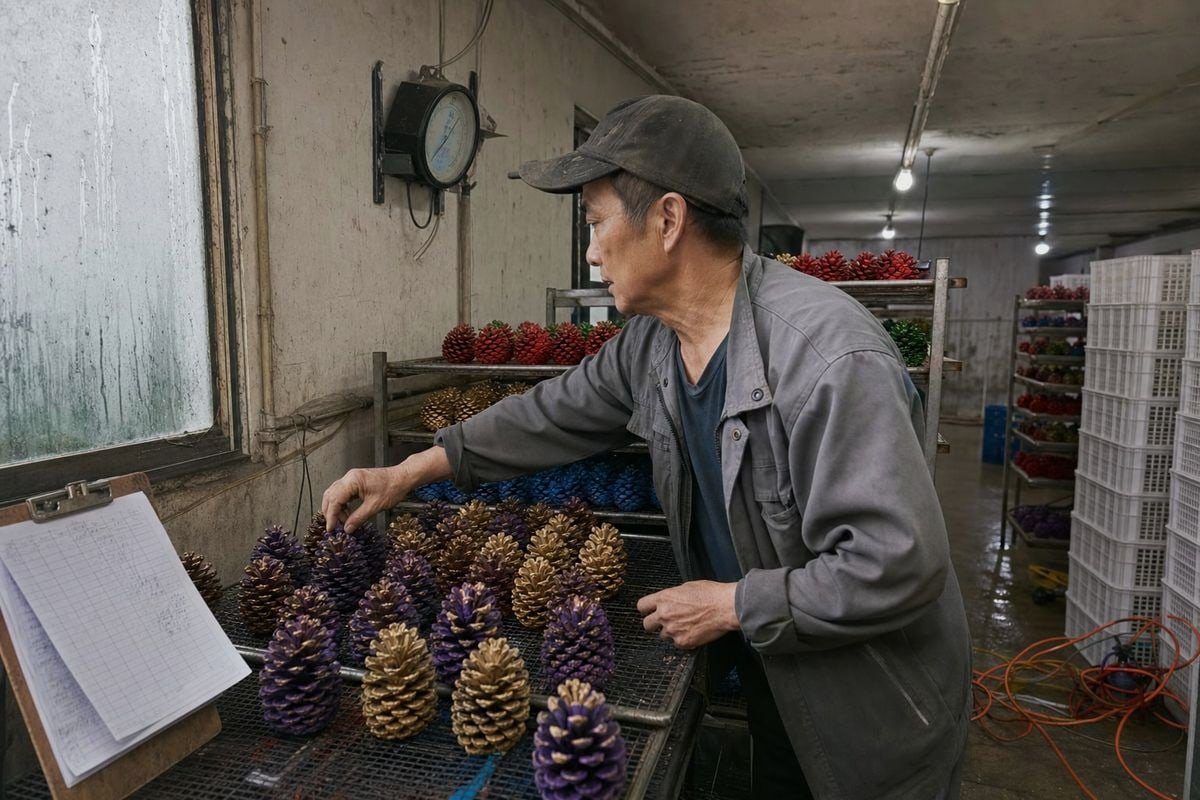
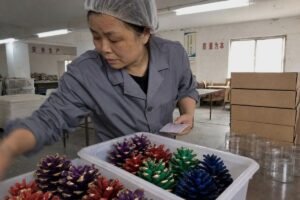
Colored fireplace pine cones are a chemistry-dependent product, not a simple craft item. The production flow runs: raw cone prep 4 (baking or steaming to open cones and remove bugs and sap), mineral-salt treatment or wax dipping, then a multi-day drying and cure phase 5 before inspection and pack-out. Delays almost never come from the dipping itself. They come from incomplete drying, inconsistent absorption, unstable coating, or unplanned rework.
Where delays actually hide, stage by stage
| Etapa | Typical Delay Risk | Early Warning Sign |
|---|---|---|
| Aquisição de matérias-primas | Cone shortage, high-moisture harvest | Supplier delays confirming cone stock |
| Prep (bake/clean) | Cones fail to fully open | Batch photos show closed scales |
| Treatment (soak/dip) | Solution depletion, uneven absorption | Patchy or dull color in photos |
| Drying/cure | Humidity extends dry time | Drying exceeds baseline window |
| Inspeção | High reject rate triggers rework | Yield rate 6 drops below normal |
The rework trap
Rework is the hidden schedule killer. If cones come out of drying with uneven coating, they need re-dipping or full replacement. That restarts the longest stage — drying — for part of the batch. So always ask one direct question in weekly updates: "What percentage of this batch passed first inspection?" A falling yield rate is your clearest supplier performance metric. On our lines, we track drying time variance per batch and flag anything past threshold before the buyer ever has to ask. Also watch raw material procurement upstream: running out of colorant salts, wax, or cones stops everything, so ask suppliers to confirm input inventory when you place the order.
What communication schedule should I set with my supplier to stay updated on production milestones?
Balancing update frequency is a real trade-off we discuss with every new buyer. Too few updates hide problems. Too many bury the signal in noise.
Set a fixed weekly milestone report covering stage status, yield, and schedule variance; require event-triggered alerts within 24 hours for any delay, rework, or material shortage; and schedule three photo checkpoints — after prep, after treatment, and after drying — plus a pre-shipment confirmation call.

A good communication schedule mixes fixed rhythm with exception alerts. The rhythm keeps you informed. The exceptions protect your delivery date. When we onboard a new B2B buyer for color-flame pinecones, we agree on this cadence before production starts, and we put it in writing alongside the order confirmation.
A practical communication cadence
- No momento do pedido: Confirm the full production plan — batch count, treatment method (mineral-salt soak vs. wax dip, since they carry different lead times), promised ship date, and input inventory status.
- Weekly: A short milestone report. One page. Current stage per batch, actual vs. planned dates, first-pass yield, and any risks flagged.
- At each milestone: Dated photos after cone prep, after treatment, and after drying. Photos take five minutes and remove all ambiguity.
- Within 24 hours of any exception: Immediate notice of extended drying, rework, chemical safety standards holds, or shortage of cones, wax, or colorant salts.
- Pre-shipment: Inspection report review and a final call to confirm packing, warning labels, barcodes, and shipping logistics.
Adjust for season
Lead time management gets harder near Q4. Colored fireplace pine cones are a seasonal product, and demand spikes before the holidays strain every drying rack in the industry. During peak season, tighten the weekly report to twice weekly, and build previsão de demanda sazonal 7 into your ordering — place holiday orders months early rather than compressing the supplier's cure windows. A supplier pressured to skip drying time will ship you unstable product. We refuse to do that, and you should be suspicious of any factory that agrees to.
How can I verify that my supplier's progress updates accurately reflect actual factory output?
Early in our export history, a buyer told us bluntly: "Every supplier says 'on schedule' until the week before shipping." He was right, and that conversation changed how we report.
Verify updates by cross-checking dated photos against batch IDs, comparing claimed timelines with realistic process durations, commissioning third-party quality control inspections, reviewing factory audit reports, and asking stage-specific questions only a factory actively running your order can answer accurately.
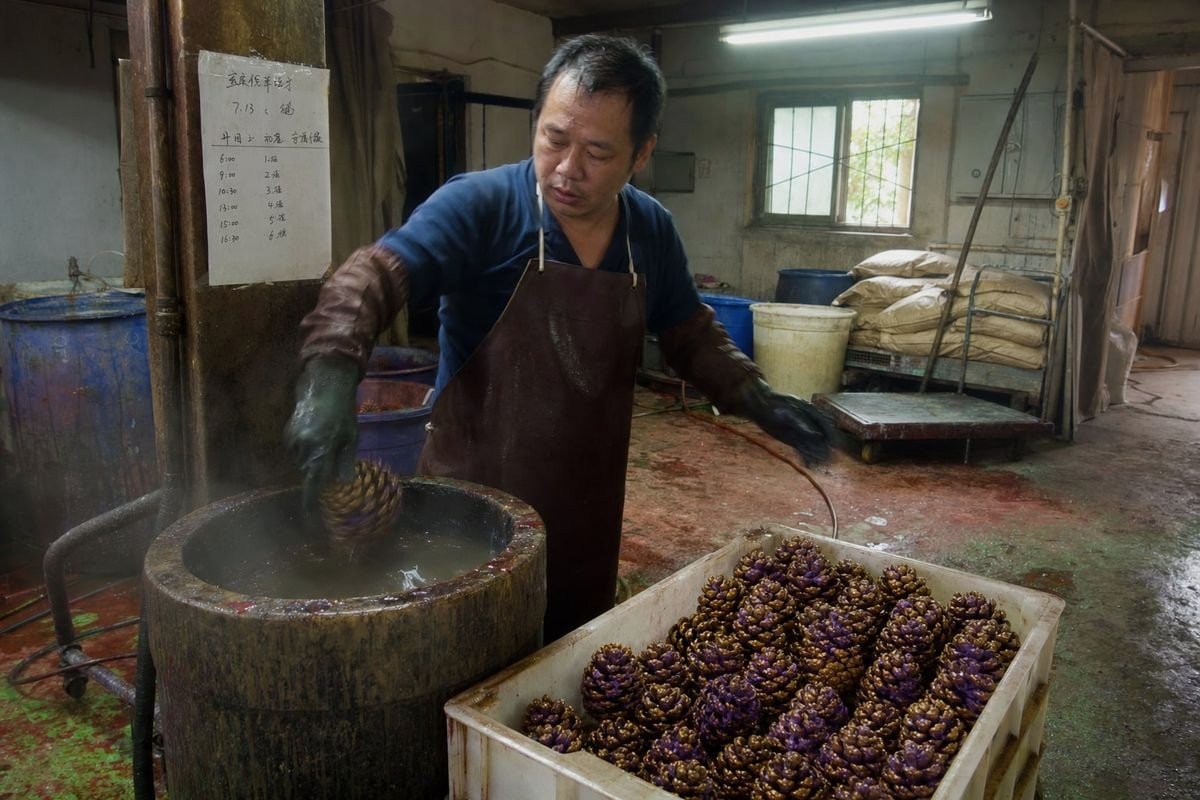
Trust is built on verifiable evidence, not reassuring words. The good news: colored pine cone production leaves a visible trail. Every stage changes what the product physically looks like, so photo evidence is hard to fake and easy to check.
Verification methods compared
| Método | Custo | Reliability | Exposição de Caixa Inicial |
|---|---|---|---|
| Dated photos with batch ID visible | Free | Médio-alto | Every order |
| Video walkthrough of drying racks | Free | 1 x 20 pés ou 40 pés | Larger orders |
| Inspeção de terceiros (tipo SGS/Intertek) | Moderado | Muito alta | First orders, big volumes |
| Plausibility check vs. known process times | Free | 1 x 20 pés, vários produtos | Ongoing sanity check |
| Factory audit reports (ISO 9001, BSCI) | Baixo | 1 x 20 pés ou 40 pés | Qualificação do fornecedor |
The plausibility test
Know the real timeline, and you can spot fiction. Mineral-salt soaking typically runs eight hours to overnight. Drying runs several days, longer in humid weather. So if your supplier claims a batch went from soak to packed in 48 hours, something is wrong — either the update is false, or the cure was cut short and quality will suffer. Both are problems. Ask stage-specific questions: "What was the drying duration for batch 0312?" or "What was the first-pass yield?" Vague answers to specific questions are themselves a warning sign.
Certification as a baseline
A factory holding current ISO 9001 and BSCI certification, with SGS or Intertek test reports on file, has already accepted external scrutiny of its processes and chemical safety standards. That does not replace order-level verification, but it tells you the supplier's reporting culture was built under audit conditions. In our case, batch-to-batch quality control records exist because certification requires them — which means the data you request already exists and costs nothing to share.
Conclusão
Delays surface at shipping only when visibility fails earlier. Track batches by stage, verify with photos and inspections, and choose suppliers whose reporting was built under real audit discipline.
Notas de rodapé
1. Provides a standard definition of visibility in manufacturing and logistics. ↩︎
2. Authoritative Wikipedia entry for the international quality management standard. ↩︎
3. Explains the visual management tool recommended for tracking production stages. ↩︎
4. Provides biological background on pine cones and their natural opening mechanisms. ↩︎
5. Explains the chemical process of hardening or drying treatments applied to products. ↩︎
6. Technical definition of production yield within engineering and manufacturing contexts. ↩︎
7. Comprehensive overview of demand forecasting methods, including seasonal pattern analysis. ↩︎

 English
  Spanish
  German
  French
  Arabic
  Portuguese
Participe da conversa