






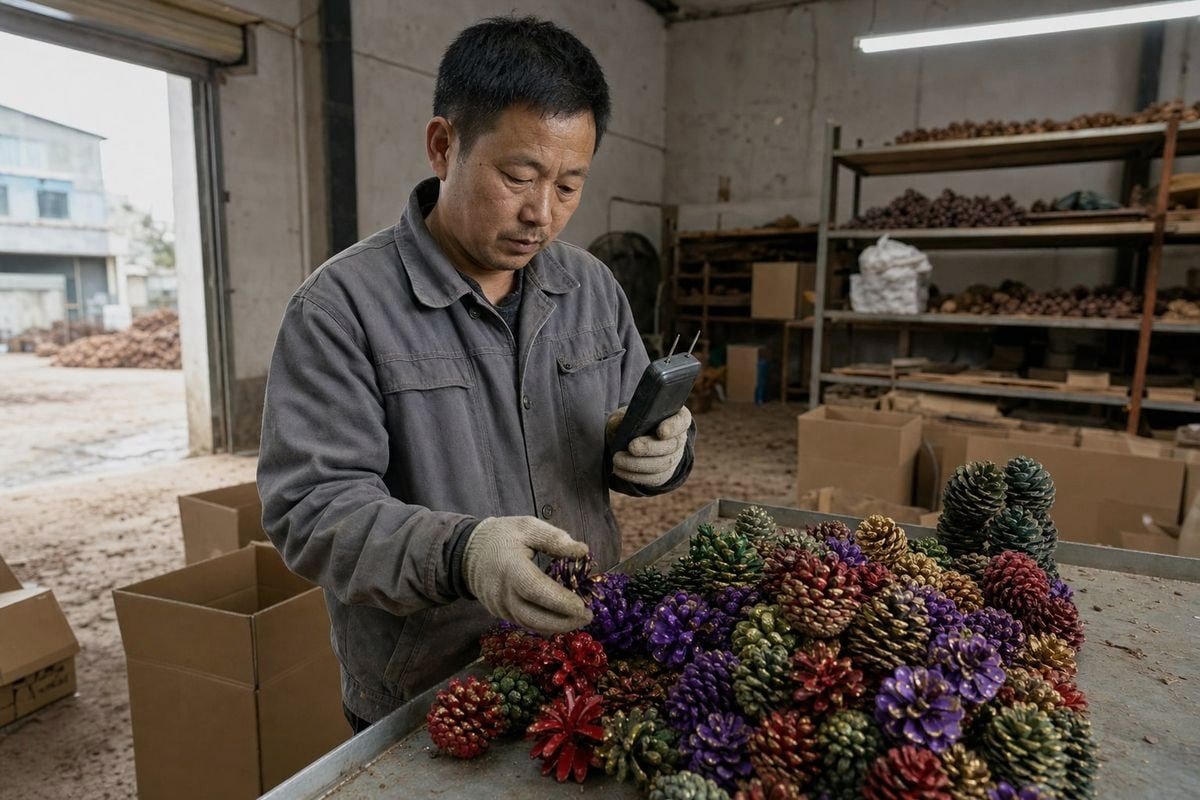
Damp fireplace colored pine cones smolder, smoke, and mute the flame color sais minerais 1. On our production line, we learned this the hard way early on. Buyers lose repeat orders over one bad batch.
Fireplace colored pine cones are dry enough when they are fully open, lightweight, and brittle, snap crisply when a scale bends back, feel dry inside the core, and read below roughly 20% on a moisture meter. If any test fails, keep drying them longer.
That is the short answer. But testing dryness on colored cones is trickier than on plain firewood. The coating hides moisture. Below, I break down each check, why moisture matters, how to verify supplier specs, and how to protect dryness in transit.
What Signs Tell Me My Color-Flame Pine Cones Have the Right Moisture Level Before Shipping?
A few years back, our QC team in Ningbo rejected a full pallet because the cones felt slightly heavy in hand. The meter later confirmed it. Trust the simple signals first.
Properly dried color-flame pine cones show fully open, splayed scales, feel light and stiff, snap with a crisp crack when bent, have no musty smell, and show a hard, cured coating. A moisture meter probe between the scales should read under 20%, ideally lower.
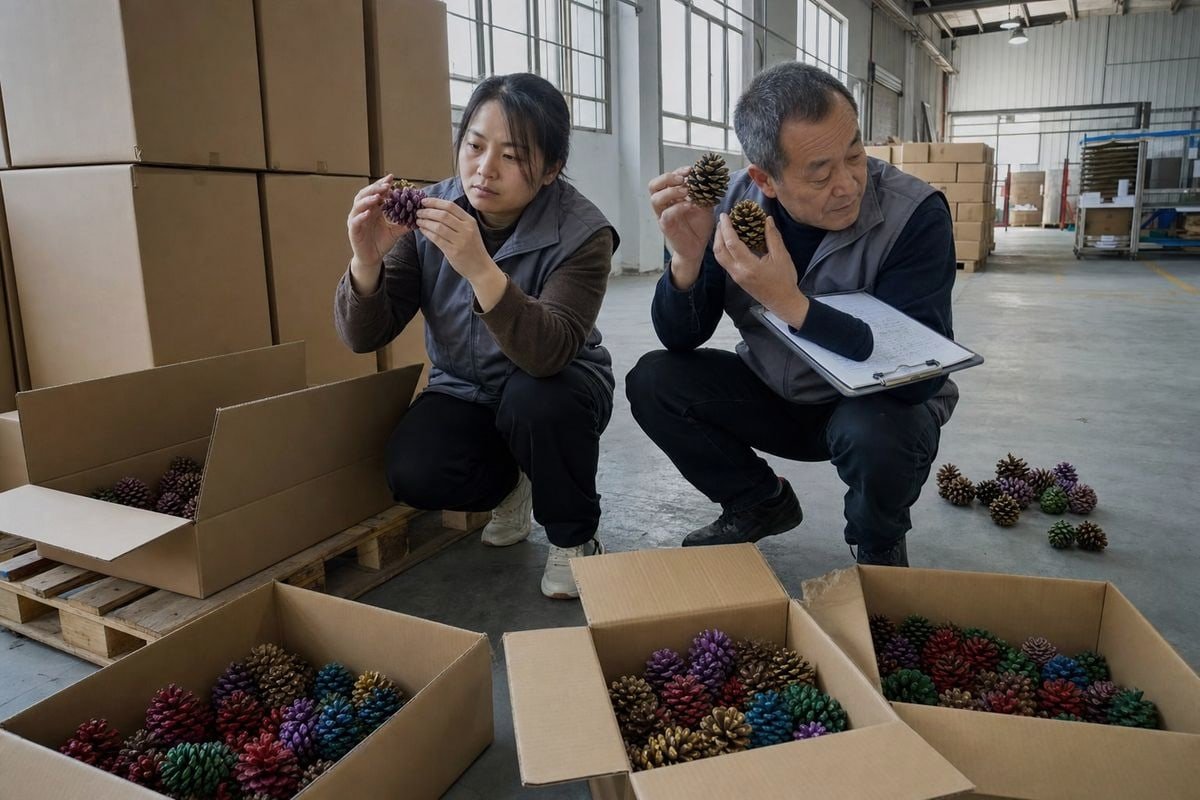
In our pre-shipment inspections, we never rely on one test alone. Moisture varies within a batch, so we always sample several cones from different cartons. Here is the checklist we use, in order of speed.
The Five Quick Field Tests
| Teste | O que Fazer | Pass Sign | Fail Sign |
|---|---|---|---|
| Look | Check the scales | Fully open, splayed outward | Tight or partially closed scales |
| Weigh | Hold the cone in hand | Noticeably light | Heavy, dense feel |
| Snap | Bend a scale backward | Crisp, audible crack | Dobra sem quebrar |
| Sound | Tap two cones together | Sharp, hollow sound | Dull thud |
| Cheiro | Sniff near the base | Little to no scent | Musty, moldy, earthy odor |
Why the Interior Test Matters Most
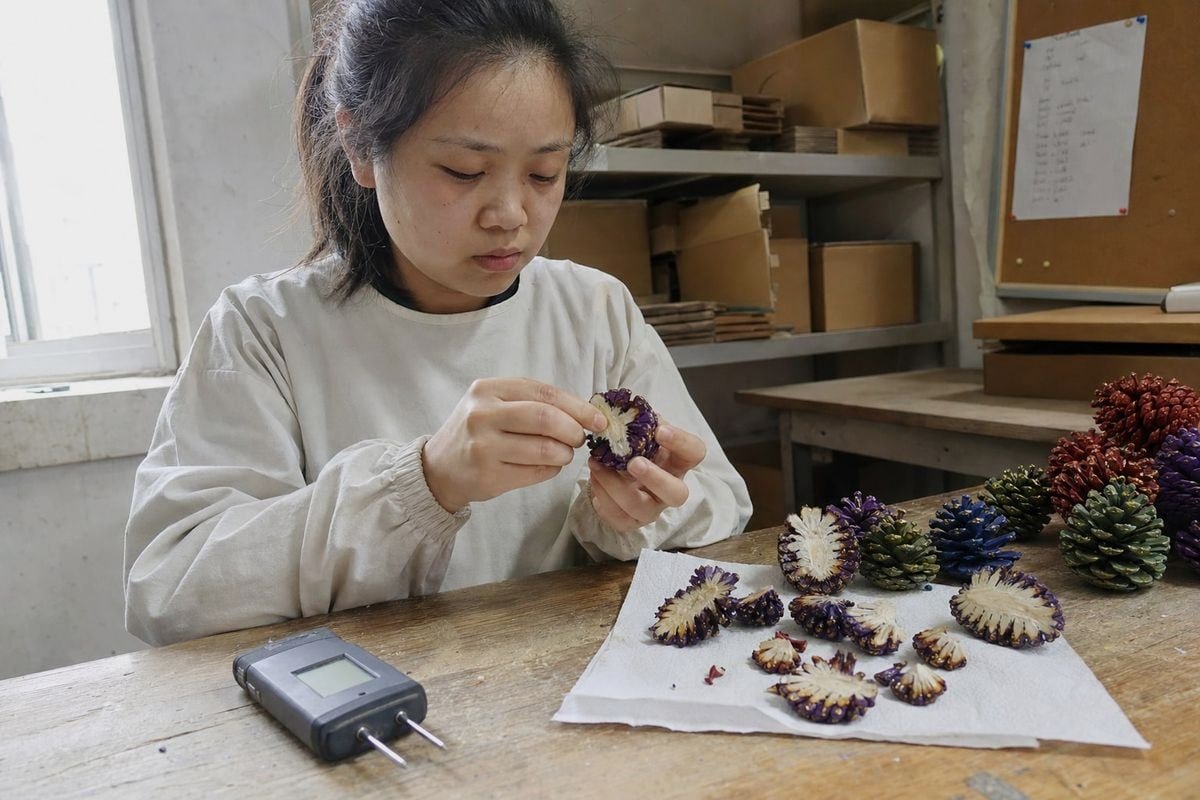
The surface can lie. This is especially true for colored cones, because the wax or mineral-salt coating dries first and can look ready while the woody core still holds water. So we break open sample cones and touch the inner stem. It should feel dry, stiff, and solid throughout. If the base has a slight spring or sponginess when you squeeze it, the cone needs more time.
The Coating Check
For treated cones, run a fingertip over the coating. A fully cured coating feels hard, never tacky. A soft coating seals moisture in and slows the final drying stage. In our workflow, coating cure and core dryness are two separate sign-offs. Both must pass before packing.
The Meter Confirmation
Finally, we insert a moisture meter 2 probe between the scales, near the core. Cones are irregular and thinner than logs, so treat the reading as a best-effort indicator, not a lab-grade standard. Still, it is the most objective tool available, and readings under 20% align with seasoned fire-starting material.
Why Does Moisture Content Matter So Much for Consistent Flame Color and Burn Performance?
When we were developing our Magic Fire pinecone line, one trade-off dominated the discussion: drying time versus throughput. Rushing the dry stage always cost us flame quality downstream.
Moisture directly weakens flame color and burn performance. Damp cones smolder instead of flaring, produce more smoke and soot, ignite slowly, and burn at lower temperatures that mute the mineral-salt color effect. Dry cones ignite fast, burn clean, and show vivid, consistent colors.
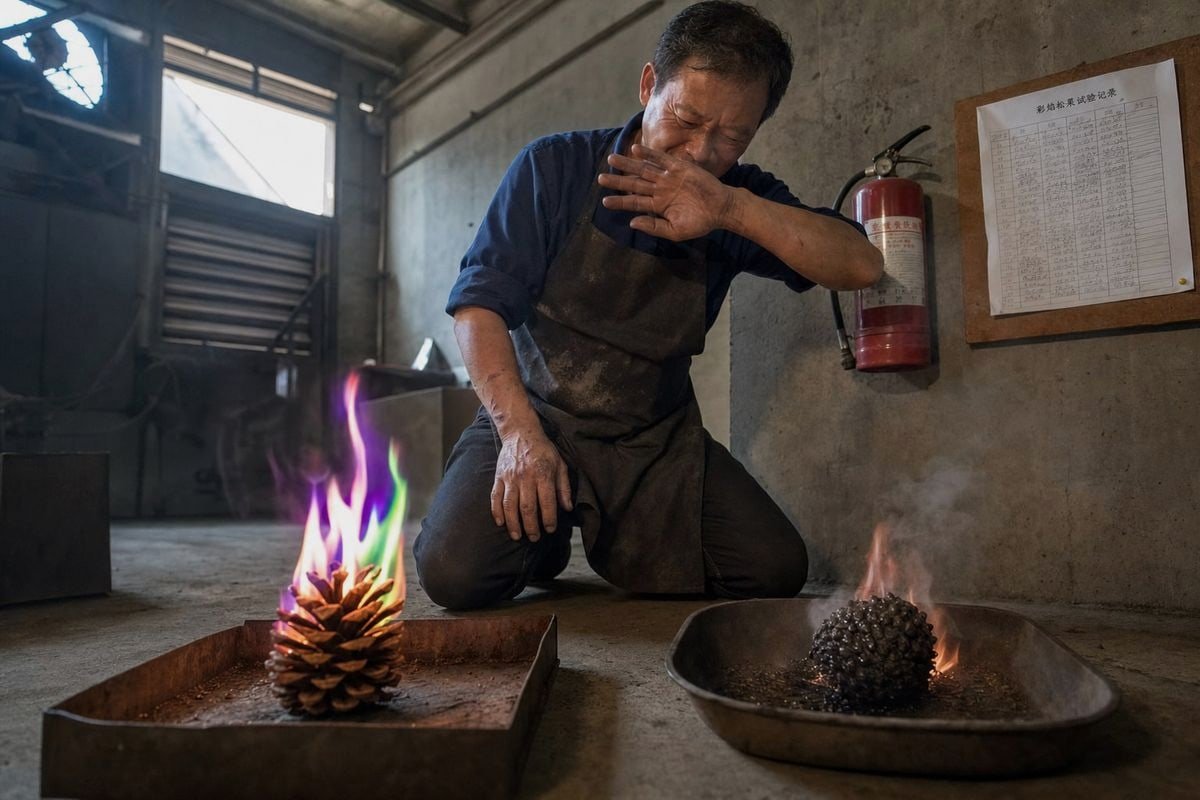
The physics here is simple, and it explains almost every customer complaint we have ever investigated. Water in the cone must evaporate before the cone can burn properly. That evaporation steals heat from the fire. Less heat means a cooler, lazier flame. And a cooler flame changes everything about the color effect.
How Dampness Degrades Each Performance Factor
Color-flame products rely on sais minerais 3 that excite at certain flame temperatures. If moisture drags the flame temperature down, the blues, greens, and purples turn weak or patchy. The customer sees an ordinary orange fire and assumes the product failed. In reality, the product was fine. The moisture was the problem.
| Performance Factor | Dry Cone (Low Moisture) | Damp Cone (High Moisture) |
|---|---|---|
| Ignição | Lights within seconds | Slow, may need relighting |
| Comportamento da chama | Clean, active flaring | Smoldering, weak flame |
| Color effect | Vivid, saturated colors | Muted or invisible colors |
| Smoke | Mínimo | Heavy, gray smoke |
| Resíduo | Cinzas leves | Soot and creosote deposits |
| Consistência | Predictable per cone | Varies cone to cone |
The Brand-Risk Angle for Buyers
Here is the objection I hear from purchasing managers: is a few percent of moisture really worth arguing over? Yes. A retail customer judges the product on one lighting. If that one cone smolders, they leave a one-star review about a "gimmick that doesn't work." Our batch QC exists because moisture failures are invisible on the shelf and brutal after the sale. There is also a soot factor. Indoor fireplace users notice extra smoke immediately, and heavy smoke 4 raises safety and chimney-deposit concerns. So dryness is not just a performance spec. It is a customer-satisfaction spec and, indirectly, a safety spec.
Can I Request Lab Test Reports or Moisture Specs from My Manufacturer to Verify Dryness?
One German distributor once asked us for moisture documentation before his first trial order. Instead of pushing back, we sent our full QC file. He became a long-term account. Documentation builds trust faster than samples alone.
Yes, you can and should request moisture specs and test documentation. A credible manufacturer will provide a stated moisture-content target, batch QC records, and third-party test reports from labs like SGS or Intertek, plus compliance certificates such as ISO 9001, BSCI, and CE.
In our experience exporting to 30+ countries over 17 years, the buyers who ask for documentation up front have the fewest problems later. Do not treat this as an awkward request. Any factory that hesitates is telling you something important about its process.
What to Ask For, and What Each Document Proves
| Documento | O que ele verifica | Sinal de Alerta Se Faltar |
|---|---|---|
| Moisture-content spec sheet | The factory has a defined dryness target | Supplier "dries by feel" only |
| Registros de CQ de lote | Every production run is checked, not just samples | Qualidade inconsistente do lote |
| Relatório de teste SGS ou Intertek | Verificação independente da composição e segurança | Claims without third-party backing |
| Certificado ISO 9001 | A documented, repeatable quality system exists | Ad-hoc production processes |
| CE and BSCI documentation | Market compliance and ethical production | Import or retail listing problems |
How to Read a Moisture Spec Honestly
Be aware of one nuance. There is no single universal moisture number standardized for pine cones. Firewood guidance commonly cites below 20%, and some sources target 8–15% or lower for premium fire-starting material. So a good supplier states its own internal target, explains how it measures it, and shows batch records against that target. That transparency matters more than the exact number. At our factory, moisture checks are part of the same batch-to-batch QC system 5 that covers coating cure and burn testing, because the goal is simple: the mass-production cartons must perform exactly like the approved sample. Ask your supplier to describe that link explicitly. If the answer is vague, request a pre-shipment inspection with moisture readings included. A serious factory will agree without friction, and many, like us, will build it into the standard order process.
How Do I Make Sure Humidity During Shipping and Storage Won't Compromise Dryness After Production?
A lesson we learned shipping to Brazil: a container crossing the equator is a humidity chamber. Cones that left the factory bone-dry can absorb moisture in transit if the packaging is wrong.
Protect dryness with moisture-barrier packaging, desiccant packs inside cartons, and resealable or sealed inner bags. Avoid direct floor contact and damp warehouses, keep storage humidity low, and re-test sample cones with the snap and meter tests before retail distribution.
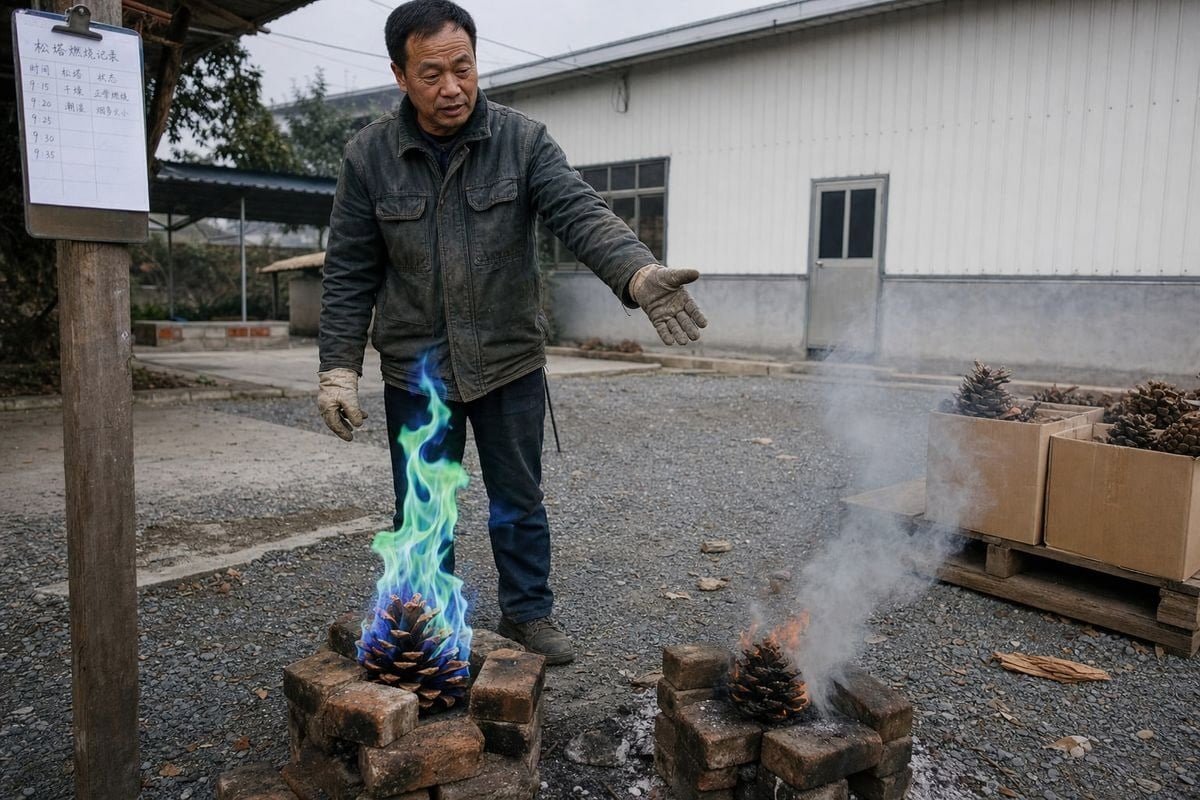
Pine cones are hygroscopic. They pull moisture from the air 6, and their scales can even begin to close again in very humid conditions. That means dryness is not a permanent state achieved at the factory. It is a condition you must protect through the whole supply chain. Here is the sequence we recommend to our distribution partners.
A Step-by-Step Moisture-Protection Plan
- Specify sealed inner packaging at the order stage. Our stand-up resealable pouches and sealed jars exist for exactly this reason. The retail unit itself should be the first moisture barrier.
- Add desiccant to master cartons. Silica gel 7 packs inside each carton absorb the humidity that inevitably enters during packing and transit.
- Line cartons for ocean freight. For long sea routes, especially through tropical zones, a poly liner inside the carton adds a second barrier against container condensation, often called container rain.
- Control the warehouse environment. Store cartons off the concrete floor on pallets, away from exterior walls, in a space with reasonable humidity control. Concrete wicks moisture upward.
- Respect the packaging until sale. Tell retail partners not to open master cartons early or display loose cones in humid areas for long periods.
- Re-test on arrival. Pull a few sample cones from different cartons. Run the snap test, the weight check, and a meter reading. Five minutes of testing protects the whole season's sell-through.
When Cones Absorb Moisture Anyway
If arrival testing fails, do not discard the stock immediately. Spread the cones in a well-ventilated, low-humidity space for one to two weeks, sometimes longer for large cones or damp climates, then re-test. However, discard any cones that show dark patches, mold, or a persistent musty smell. Those are beyond recovery, and no burn product should reach a customer in that condition.
Conclusão
Test fireplace colored pine cones with the look, snap, weight, smell, and interior checks, confirm with a moisture meter, demand documented specs, and protect dryness through packaging and storage.
Notas de rodapé
1. ScienceDirect explains how mineral salts produce colored flames at specific temperatures. ↩︎
2. Wikipedia background on moisture meters supports the objective dryness test described. ↩︎
3. Explains how metal salts produce characteristic flame colors when heated to sufficient temperature. ↩︎
4. EPA Burn Wise program addresses fireplace smoke safety and air quality concerns. ↩︎
5. ISO 9001 defines the quality management systems referenced for batch consistency checks. ↩︎
6. Wikipedia explains hygroscopy, the property causing cones to reabsorb ambient moisture. ↩︎
7. Wikipedia explains silica gel desiccant properties used to protect cones from humidity. ↩︎


 English
  Spanish
  German
  French
  Arabic
  Portuguese
Participe da conversa