






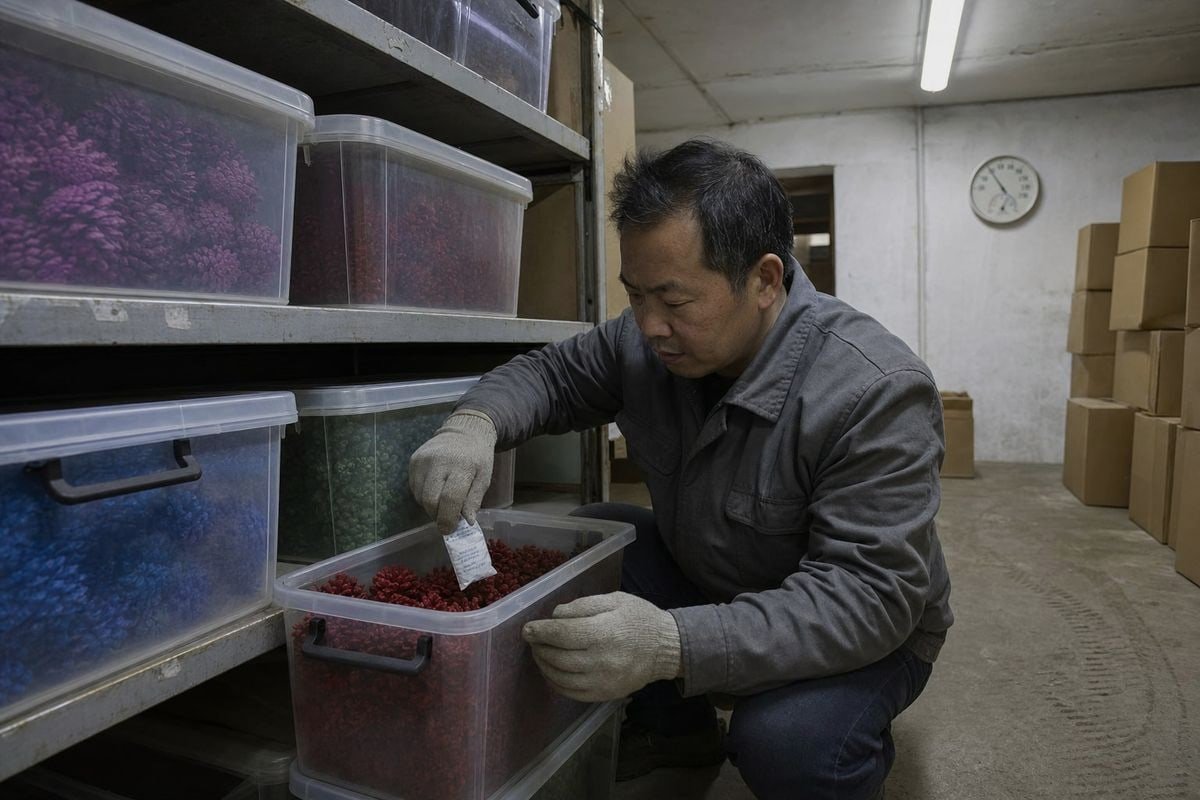
Storing colored pine cones the wrong way quietly kills their flame effect. On our production line, we have seen humidity ruin whole pallets — and we learned how to prevent it.
To store colored pine cones long-term, keep them bone-dry in airtight storage containers with desiccant packets, separated by flame color, in a cool, dark, climate-controlled space away from heat and sunlight. Properly sealed, the metal salt colorants stay potent for two to three years or more.
That is the short answer. Below, I break down each part — the storage conditions, the packaging, the shelf life you can promise customers, and how to train your team. Let's get into it.
What storage conditions best protect the color-flame chemicals in pine cones from losing potency?
During a humid August in Ningbo, one of our early trial batches taught us a hard lesson: the flame-coloring salts in colored pine cones are hygroscopic, and they will pull moisture straight out of the air.
Store colored pine cones at stable room temperature or cooler, below roughly 50% relative humidity, in complete darkness or low light, and away from all heat sources. Moisture control matters most, because damp metal salt colorants weep, migrate, and lose their ability to produce vivid flames.

The flame effect in color-changing pine cones comes from metal salts absorbed into the fibras de madeira 1 — copper compounds for blue and green, cloreto de estrôncio 2 for red, and similar colorants. These salts are chemically stable when dry. The problem starts when humidity rises. The salts attract water, dissolve slightly, and migrate out of the scales. Once that happens, the burn gets weaker and the colors get muddy. No amount of re-drying fully restores the original vibrancy.
The three enemies of chemical stability
In our QC testing over the years, three factors consistently degrade stored cones:
| Ameaça | O que faz | Como controlá-lo |
|---|---|---|
| Umidade | Salts weep, migrate, and dilute; ignition weakens | Sealed containers, sílica gel 3 desiccants, below 50% RH |
| Calor | Accelerates chemical breakdown; can soften wax seals | Store below 25°C / 77°F, away from radiators and stoves |
| Sunlight / UV | Fades exterior color and painted finishes | Dark cabinets, opaque bins, warehouse interiors |
Why moisture is the top priority
Heat and light degrade cones slowly, over months. Moisture can degrade them in days. A single humid weekend in an unsealed carton can noticeably dampen the flame effect. That is why we ship every export batch from our factory with moisture barriers built into the packaging, and why our SGS-verified stability tests focus first on humidity exposure. If you control only one variable in your warehouse, control humidity. Also keep stored cones well away from fireplaces, wood stoves, and any ignition source — wood stove safety rules apply to storage, not just burning.
How can I package colored pine cones to prevent moisture damage during long-term warehousing?
A German distributor once asked us why his repacked stock underperformed our factory-sealed pouches after six months in the same warehouse. The answer was entirely in the packaging.
Package colored pine cones in airtight, resealable moisture-proof bags or HDPE containers with silica gel desiccant packets inside. Remove excess air, avoid compressing the scales, never mix flame colors in one container, and label each package by color and treatment type.
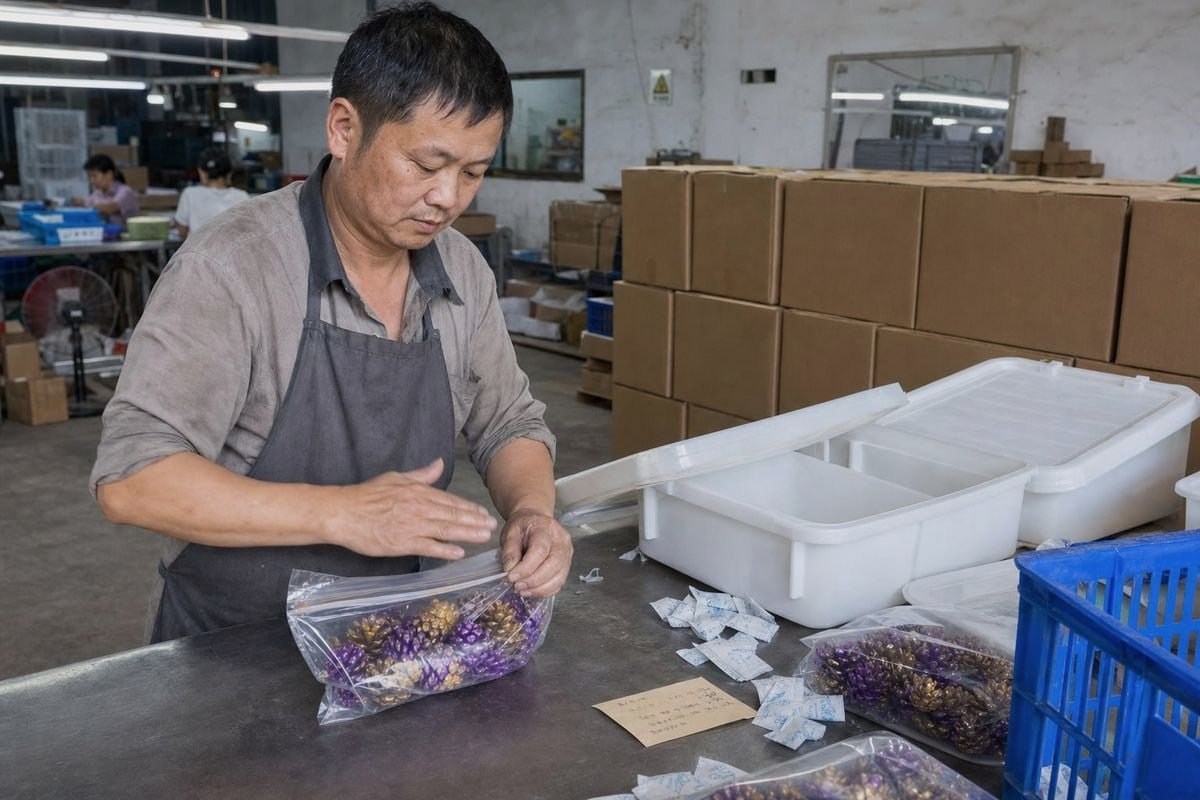
Packaging is where most long-term storage failures happen. Cardboard alone is not enough. Standard cartons breathe, and the salts inside your cones will find that moisture. Here is the layered approach we use for our own export shipments, which you can replicate at warehouse scale.
A four-layer packaging system
- Inner seal. Place cones in resealable moisture-proof bags or stand-up pouches. Press out as much air as possible without crushing the scales — crushed scales shed the concentrated chemical deposits that create the color.
- Desiccant. Drop one or two silica gel packets into each bag. The desiccant counteracts the hygroscopic pull of the salts and keeps internal humidity low.
- Rigid container. Put sealed bags inside HDPE bins 4 or lidded plastic totes rather than bare cardboard. HDPE will not absorb moisture, and the salts cannot leach into or react with it over long-term storage.
- Stacking discipline. Never stack heavy items on top. The scales are delicate, and each one holds part of the flame chemistry.
Packaging options compared
| Packaging method | Proteção contra umidade | proteção contra esmagamento | Melhor caso de uso |
|---|---|---|---|
| Kraft pouch with liner and resealable zip | Bom | Baixo | Retail shelf units |
| Freezer-grade sealed bags plus desiccant | Muito bom | Baixo | Small-batch warehousing |
| HDPE bins with sealed inner bags | Excelente | 1 x 20 pés ou 40 pés | Long-term bulk warehousing |
| Plain cardboard carton | Ruim | 1 x 20 pés, vários produtos | Short-term transit only |
One more nuance from our OEM work: some crafters recommend a paraffin wax dip after treatment to hermetically lock the salts into the wood fibers. This works well for burn-focused products and doubles as an ignition aid, similar to our wax-dipped fireplace fire starters. But heavy decorative sealers are a different story — thick lacquer can interfere with the chemical flame effect. Decide up front whether the product is for display or for burning, and package accordingly. Finally, always keep colors separated. Mixed metal ions cross-contaminate and muddy the resulting fire hues.
What shelf life can I guarantee to my retail customers for color-flame pinecones?
Shelf life is the first question most purchasing managers put to us, usually right after asking about Marcação CE 5 and test reports — and it deserves a precise, honest answer.
Properly dried, factory-sealed color-flame pinecones retain full potency for 24 to 36 months when stored cool, dry, and dark. A conservative retail guarantee is two years from production date, provided packaging stays sealed and cones are kept away from humidity, heat, and sunlight.
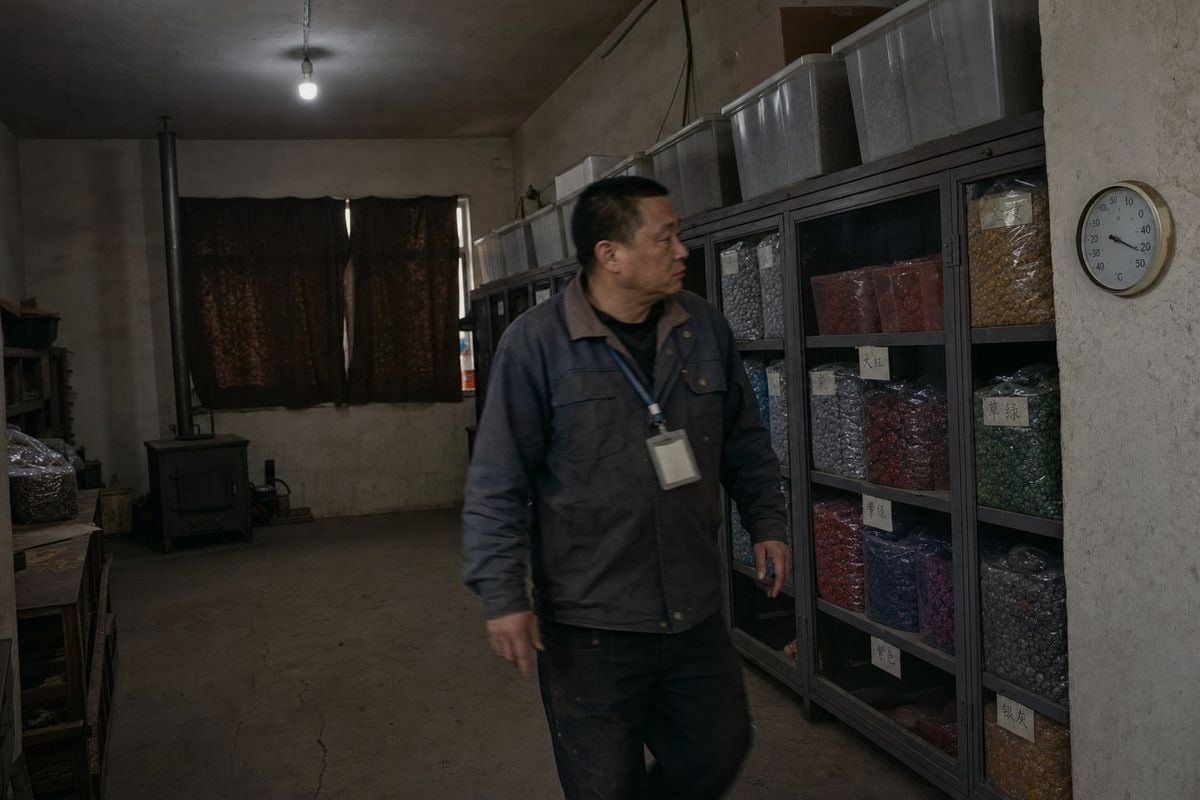
Shelf life for color-changing pine cones is not a fixed number. It is a function of preparation quality, packaging integrity, and storage conditions. Let me break down each factor so you can set a guarantee you will not regret.
What determines real-world shelf life
Preparation matters first. Cones must be fully cured before sealing — in production terms, that means soaking in a saturated colorant solution for 24 to 48 hours for deep absorption, then drying for at least three days until bone-dry. A cone sealed while even slightly damp will mold or weep inside the bag, and no warehouse can save it. This is exactly why factory consistency matters: at our plant, every batch goes through the same controlled drying cycle and moisture check before packing, so the first sample you approve reflects what arrives in every container.
Expectativas realistas de vida útil
| Condição | Expected potency window | Guarantee you can offer |
|---|---|---|
| Factory-sealed, climate-controlled warehouse | 36+ months | 24 months, comfortably |
| Factory-sealed, ordinary indoor storage | 24–36 meses | 18–24 meses |
| Opened packaging, resealed with desiccant | 12–18 months | Advise use within one season |
| Opened, left exposed in humid conditions | Weeks to a few months | No guarantee possible |
Homemade versus factory-made
One objection I hear from buyers: "Craft blogs say homemade cones only last a season — why should I trust a longer claim?" Fair point. DIY cones made with kitchen methods and user-controlled chemistry genuinely are less predictable. Some home recipes use boric acid powder 6 and uncalibrated soak times, and drying is rarely verified. Factory-produced cones with controlled absorption, verified drying, and sealed moisture-proof bags behave very differently. Our SGS e Intertek 7 test documentation exists precisely so you can back your shelf-life claim with third-party evidence rather than hope. Print a production date and a "store cool, dry, sealed" instruction on every retail unit, and your guarantee becomes defensible.
How should I train my staff or customers on proper storage to avoid product complaints or returns?
After seventeen years of exporting to thirty-plus countries, one pattern is clear to me: most returns of color-flame products trace back to storage mistakes after the goods leave the factory — not to the product itself.
Train staff and customers on four rules: keep packaging sealed until use, store in a cool dry dark place, never store near heat or open flame, and never mix flame colors. Print these rules on packaging and reinforce them at every handling stage.
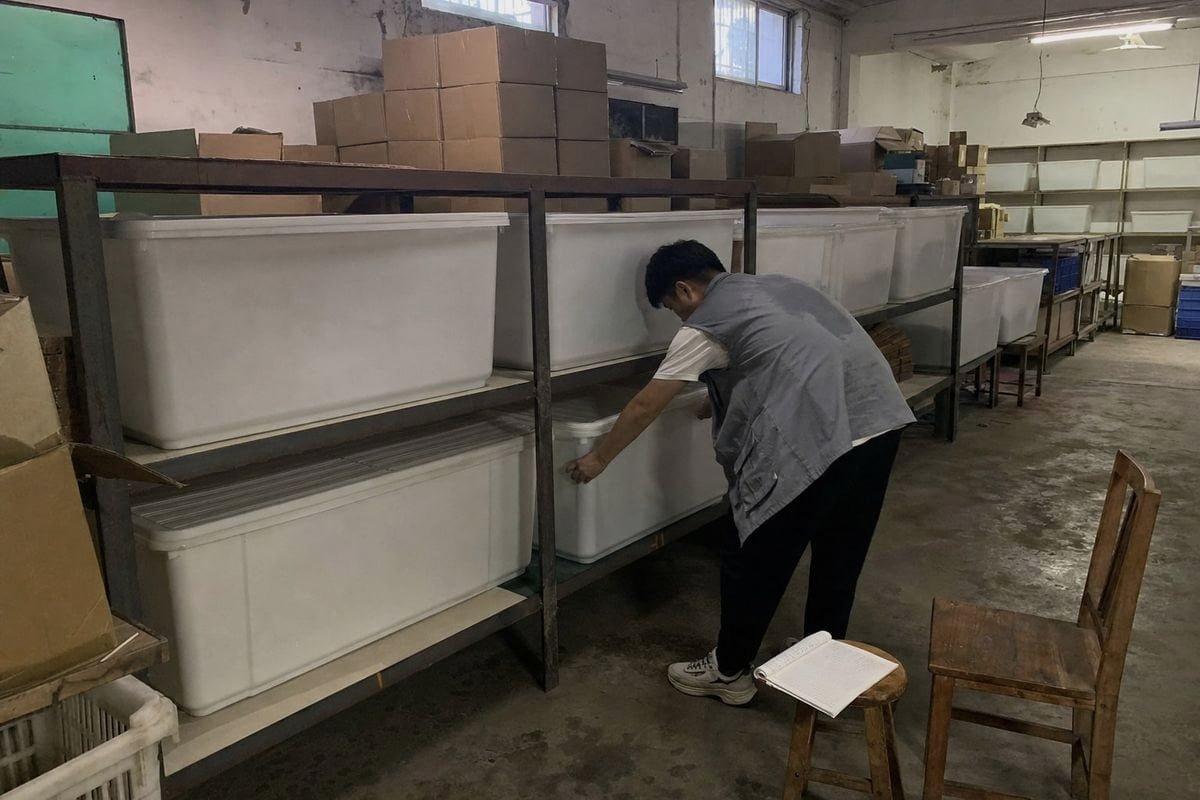
Good training turns storage knowledge into fewer complaints and stronger reviews. The key is to make the rules simple, visible, and repeated. Here is the framework we help our private-label partners build.
Train your warehouse and retail staff
Keep it to a one-page checklist. Staff should know to store cartons off the floor, away from exterior walls, windows, radiators, and loading-dock doors. They should never repack cones into unsealed bins, never mix colors when consolidating stock, and never stack pallets that crush lower cartons. Add a monthly inspection habit: open one sample bag per batch, check for dampness, clumping, odor changes, or insect activity, and log the result. Ten minutes a month catches problems before customers do.
Educate your end customers through packaging
Your packaging is your training tool. Through our OEM/ODM program, we print storage instructions, warning labels, and barcodes directly on custom pouches and display boxes, in the buyer's language. The customer-facing rules should cover:
- Reseal the pouch after each use and keep the desiccant inside.
- Store away from the fireplace, wood stove, and direct sunlight — never on the mantel.
- Use only two or three treated cones per fire, and do not mix different chemical treatments in one burn.
- Mantenha fora do alcance de crianças e animais de estimação.
- Do not burn cones that feel damp; let unused product stay sealed instead.
Close the loop on complaints
When a complaint does arrive, ask three questions: Was the packaging opened? Where was it stored? How long ago? In our experience supporting distributors in the US and Germany, most "weak color" complaints resolve into a storage conversation — and a well-trained retail team turns that conversation into a repeat sale rather than a refund.
Conclusão
Colored pine cones lose their magic only when storage fails. Keep them sealed, dry, dark, and separated by color — and their vivid flames stay reliable for years.
Notas de rodapé
1. Background on wood fiber structure that absorbs the flame-coloring salts. ↩︎
2. Explains the chemical compound used for red flame coloration in pine cones. ↩︎
3. Background on the desiccant used to control moisture in packaging. ↩︎
4. EPA reference on HDPE plastic used for rigid moisture-proof containers. ↩︎
5. Official EU source explaining the CE marking requirement mentioned by buyers. ↩︎
6. Authoritative NIH PubChem database entry providing comprehensive chemical properties and safety data for boric acid. ↩︎
7. Links to the testing and certification body cited for shelf-life verification. ↩︎



 English
  Spanish
  German
  French
  Arabic
  Portuguese
Participe da conversa