






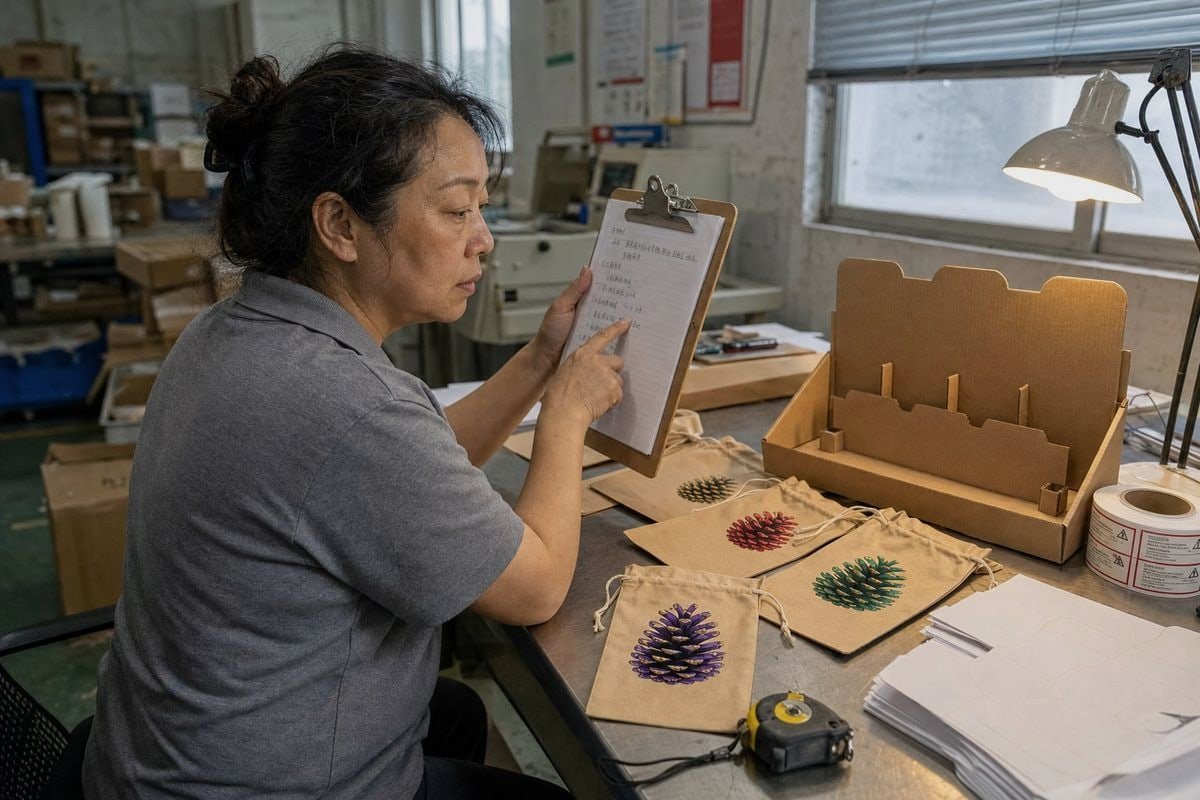
Floor-ready counter display packaging can make or break a seasonal launch. On our production line, we have watched beautiful color-flame pinecones sit unsold simply because the packaging arrived retail-unready.
To request floor-ready counter display packaging for fireplace colored pine cones, send your supplier a written brief covering unit count, display dimensions, dieline artwork, safety warnings, UPC placement, retailer compliance rules, and pack-out method, then approve a physical prototype sample before authorizing bulk production.
That single paragraph is the short answer. The rest of this article breaks down each step, so you can send a complete request the first time and avoid costly rework.
What Details Do I Need to Provide When Requesting Custom Counter Display Packaging?
A buyer from Germany once sent our factory a one-line request: "We need a counter display." Our team had to ask eleven follow-up questions before we could quote accurately.
Provide the product weight and count per unit, units per display, display footprint and height limits, target retail channel, dieline artwork or brand files, required safety warnings, barcode data, material preferences, and your ship-to-display expectations. A complete brief cuts quoting time and prevents structural failures.

The more complete your brief, the faster and more accurate the quote. In our experience exporting fire-starting goods to 30+ countries, incomplete briefs are the single biggest cause of delayed launches. Let me break down what a strong request actually contains.
Start With the Product Matrix
Your supplier cannot engineer a display without knowing what it must hold. Fireplace colored pine cones are irregular, bulky, and surprisingly heavy in volume. A 5 lb bag behaves very differently from a 1 lb gift pouch. Send a product matrix: unit weight, unit dimensions, cone count per bag, and total units per display. This lets the packaging engineer select the correct corrugated flute strength. Too weak, and the tray sags under load. Too strong, and you pay for board you do not need.
Define the Placement: CDU or FSDU
Decide where the display will live before you write the brief. A Counter Display Unit (CDU) sits near the checkout for impulse buy placement. A Free-Standing Display Unit (FSDU) works on the floor near hearth and home accessories. The choice drives every dimension.
| Especificação | Counter Display Unit (CDU) | Free-Standing Display Unit (FSDU) |
|---|---|---|
| Typical footprint | 30–40 cm wide | Quarter or half pallet |
| Altura | Under 45 cm | 120–160 cm |
| Unit capacity | 12–24 pouches | 48–120 pouches |
| Melhor canal | Gift shops, fireplace retailers | Home centers, garden centers |
| Shipping format | Inside a master shipper | Ships as its own pallet unit |
Cover Compliance and Labeling Early
Include your market's warning language in the first brief, not the last. Colored pine cones use produtos químicos corantes de chama 1, so packaging must state wood-burning use only, warn against gas fireplaces, and advise burning one color at a time. For the US, ask whether Prop 65 language 2 applies. Add UPC barcode labeling positions for both the unit and the display case. When we develop displays for retail sourcing channels, buyers who lock these details early avoid the most painful redesigns.
Can I Get Samples of Floor-Ready Displays Before Placing a Bulk Order?
The most expensive mistake I have seen a buyer make was skipping the prototype stage to save two weeks. His displays arrived at a US home center with headers that exceeded the shelf height limit.
Yes. Reputable suppliers provide a white dieline sample first, then a printed prototype with your artwork, and finally a filled pack-out sample showing the display loaded with product. Expect one to three weeks per round, plus a photo or video of the filled display before mass production approval.

Sampling is not a courtesy. It is a quality gate. At our factory in Ningbo, we insist on it even when buyers are in a hurry, because our first sample must reliably reflect mass-production quality. That principle has kept our repeat-order rate high for 17+ years.
The Three-Stage Sampling Process
- White sample (structural). An unprinted dieline cut on a sample table. You check fit, fold, tray strength, and how the pouches sit. This stage catches most structural problems.
- Printed prototype. Your artwork is applied, usually via digital print. You verify colors, warning visibility from all customer angles, and the rainbow-flame graphics that sell the color-changing effect.
- Filled pack-out sample. The display is loaded with real product, packed into its corrugated cardboard shipper 3, and photographed or filmed. This proves the one-touch, ship-to-display concept actually works.
What to Inspect at Each Stage
Verifique o tear-away front panel 4 first. If store staff struggle to open it, the display never gets merchandised properly. Then test the header card. If you sell across autumn and winter, ask for a modular header system so the retailer can swap the seasonal sign and extend the display's life across two selling windows. Finally, drop-test the filled shipper. Fireplace colored pine cones shift during transit, and a display that arrives crushed is worse than no display at all.
One practical tip from our export experience: request the filled sample be shipped to you by courier, not just photographed. Transit is the real test. A display that survives DHL from China will survive your domestic distribution.
What Certifications Should Counter Display Packaging Meet for My Market?
Compliance is the first question serious buyers ask us, usually before price. When we ship color-flame pinecones to the US, Germany, and the UK, the paperwork travels with the pallets, not after them.
Counter display packaging for fireplace colored pine cones should meet ISTA transit-test standards, retailer-specific palletization rules, and market labeling laws, while the product itself should carry SGS or Intertek test reports, CE marking where required, and factory-level ISO 9001 and BSCI certification.

Certification splits into three layers, and buyers often confuse them. The packaging layer, the product layer, and the factory layer each need their own documentation. Miss one layer, and a big-box receiving dock can reject your entire shipment.
The Three Compliance Layers
| Camada | O que Cobre | Typical Requirements |
|---|---|---|
| Embalagem | Display structure and transit safety | ISTA drop and vibration testing, retailer height and footprint limits, recyclable corrugated certification |
| Produto | The colored pine cones themselves | SGS/Intertek chemical test reports, CE marking for EU markets, flame colorant safety data |
| Fábrica | The manufacturer's systems | ISO 9001 quality management, BSCI social compliance audit |
Retailer-Specific Compliance Rules
Major chains publish their own wholesale packaging specifications, and they enforce them strictly. Shipping and palletization requirements 5 typically cover maximum display height, pallet overhang tolerance, label positions, and case-marking formats. Ask your supplier directly: have you shipped displays to this retailer before? A factory that already knows the routing guide saves you chargebacks. Our team keeps compliance files for our main export markets — the US, Germany, UK, France, Netherlands, Poland, Canada, Australia, and Brazil — because each has quirks in labeling language and recycling symbols.
Labeling That Belongs on the Display Itself
The display header and side panels should carry: wood-burning fireplace use only, a bold warning against gas fireplaces (residue can clog pilot and burner orifices), keep away from children and pets, storage guidance, and the burn-one-color-at-a-time instruction. In California-bound shipments, confirm whether Prop 65 wording is needed. Never treat these as afterthoughts to squeeze into leftover space. Retail-ready packaging (RRP) is judged on safety clarity as much as shelf appeal, and a buyer's legal team will review it before the merchandising team does.
How Do I Coordinate Display Packaging Design With My Private-Label Branding?
There is a real trade-off we help brands weigh on nearly every OEM project: rustic kraft aesthetics that match the natural pine cone story, versus high-visibility graphics that actually stop shoppers at the counter.
Send your supplier a brand kit with logos, color codes, fonts, and packaging references, then request a dieline approval stage where your team reviews artwork placement, warning visibility, and window positions before print. Align the display graphics with your existing pouch or bag design for shelf consistency.

Private-label coordination is where true one-stop OEM/ODM support proves its value. Our design team regularly adapts a buyer's existing pouch artwork — kraft stand-up bags with clear windows, burlap-style gift sacks, jar labels — into a matching PDQ display tray, so the counter unit and the units inside it tell one visual story.
Match the Display to Your Pack Format
Your SKU architecture should drive the display design. Most fireplace pine cone brands run several tiers, and each merchandises differently.
| Formato da Embalagem | Best Display Approach | Notas de Marca |
|---|---|---|
| Kraft resealable pouch with window | PDQ display trays, upright rows | Rainbow gradient accent visible from front; window shows natural cones |
| Burlap gift sack | Open-top tray, gift-basket styling | Emphasize artisanal, hand-tied look; hearth lifestyle imagery on header |
| Hand-painted decorative cones | Individual-cell tray or peg-ready carton | Metallic gold accents need protective cells; glossy finish sells itself |
| Bulk 5 lb refill bag | Floor shipper or cut-case display | Value messaging; minimal print, strong board |
Design Elements That Convert at the Counter
Point-of-purchase (POP) marketing for this category lives and dies on demonstrating the flame effect. A static package cannot show fire changing color, so build the demonstration into the design. Use lifestyle photography 6 of multicolored flames on the header. Add a QR code linking to a short demo video, or an AR trigger that plays the color-changing flames on the shopper's phone. In our experience, buyers who add demo content to the header report noticeably better sell-through than those who rely on text alone.
Also consider tactile sampling cutouts in the tray walls, letting customers touch a cone or catch the natural wood scent without opening a pouch. Then lock everything in a formal dieline approval: your team signs off on logo placement, Pantone accuracy 7, warning text visibility from all customer angles, and barcode scan position. We hold production until that signature arrives, because a reprint after mass production is far more expensive than a two-day approval delay.
Conclusão
A vague packaging request wastes weeks and risks rejected shipments. Send a complete brief, demand real samples, verify all three compliance layers, and approve your dieline — then your fireplace colored pine cones arrive truly floor-ready.
Notas de rodapé
1. Technical explanation of the chemicals used to produce colored flames. ↩︎
2. Official California government site explaining the required warnings for chemical exposure. ↩︎
3. Authoritative industry association page explaining corrugated material and its shipping applications. ↩︎
4. Describes the structural feature of retail-ready packaging that allows for easy opening and display. ↩︎
5. Comprehensive, stable reference for international pallet standards and load requirements. ↩︎
6. Describes the type of imagery used on packaging headers to demonstrate product use and appeal. ↩︎
7. Explains the color matching system used in professional packaging print. ↩︎



 English
  Spanish
  German
  French
  Arabic
  Portuguese
Participe da conversa