






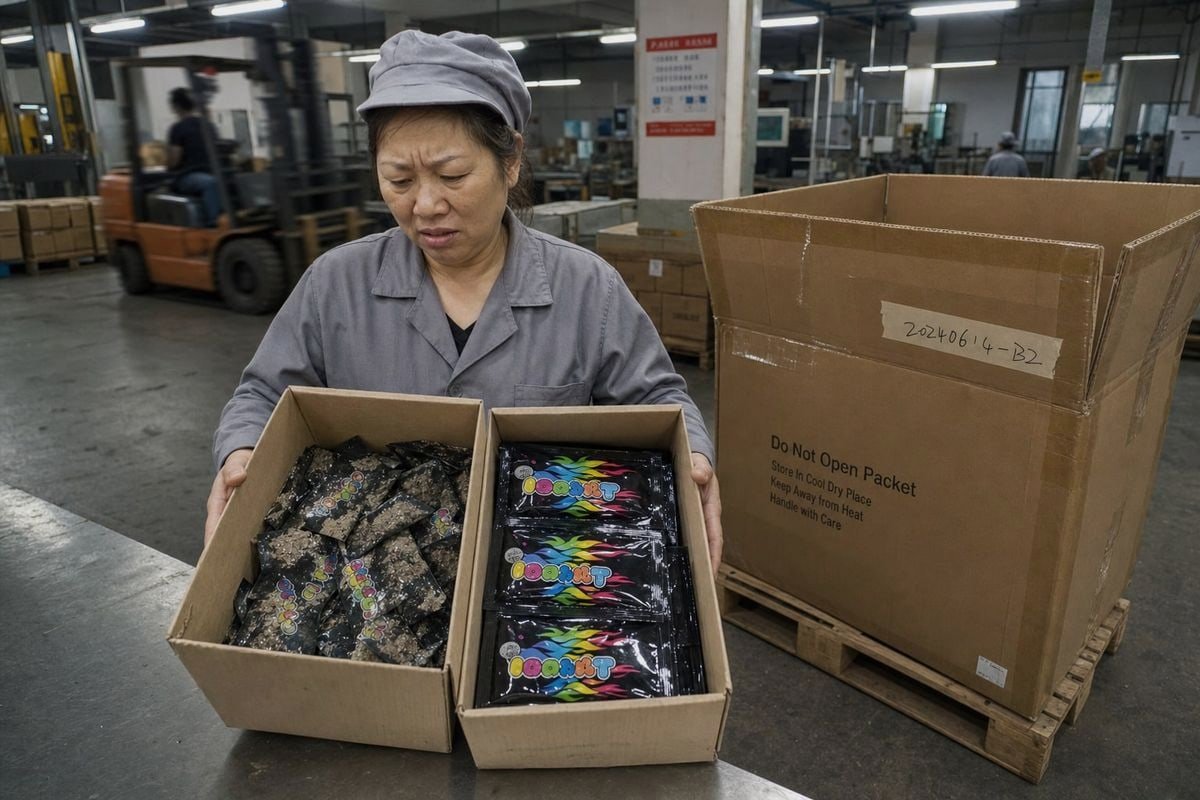
Bulk packaging for Magic Fire Powder makes or breaks group orders. On our production line, I have seen a single damp carton turn 1,200 sachets into unsellable clumps — and one packaging redesign fix it for good.
Bulk packaging for Magic Fire Powder should use moisture-resistant foil sachets as unit packs, inner boxes of 25–50 sachets, and reinforced master cartons of 24 boxes. Print "Do Not Open Packet" and "Do Not Cook Over Colored Flames" warnings on every level, and add lot codes for traceability.
That is the short answer. Below, I break down each part: materials, pack sizes, labeling rules, and custom branding. Use it as a working brief for your next wholesale order.
What packaging materials keep my Magic Fire Powder safe during bulk outdoor shipments?
A buyer in the Netherlands once returned a trial shipment because sea-freight humidity had reached the powder inside standard poly bags. That claim taught our team more about barrier materials than any lab test.
Moisture-resistant foil-laminated sachets protect Magic Fire Powder best during bulk shipment. Pair them with kraft or corrugated inner boxes, desiccant packs, and reinforced master cartons with liner coatings. The chemically inert barrier layer prevents humidity, clumping, and reactions with the metal salt colorants inside.
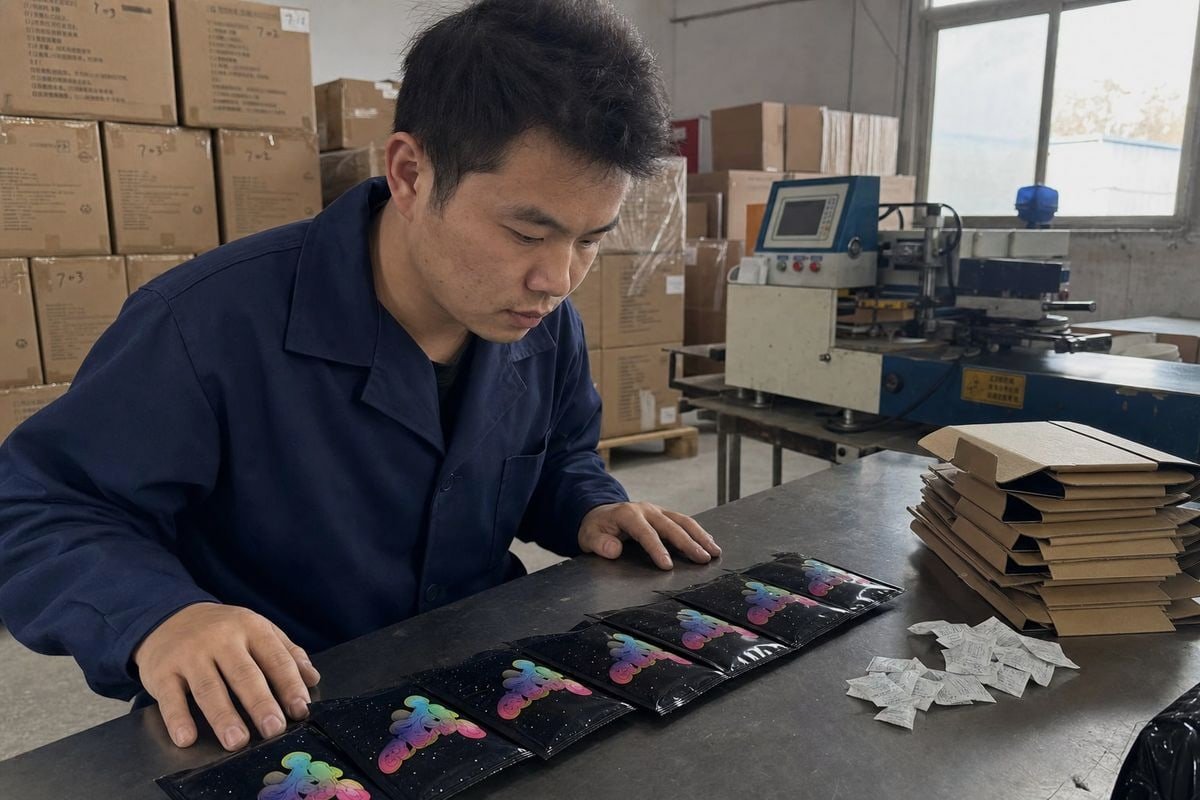
The core threat to any chemical fire additive is water. Magic Fire Powder relies on dry sais metálicos 1 to produce clean color. Once humidity gets in, the crystals clump, the burn becomes uneven, and the color effect weakens. So the packaging job starts with a proper moisture-resistant barrier at the unit level, then adds structural protection at the carton level.
The three-layer defense we use
After 17+ years shipping flame colorant packets to 30+ countries, we settled on a layered system. Each layer solves a different failure mode.
| Camada | Material | What it protects against |
|---|---|---|
| Primary sachet | Foil-laminated film, heat-sealed | Humidity, oxygen, powder leakage |
| Secondary box | Coated cardboard or kraft box | Crushing, sachet abrasion, count errors |
| Caixa master | Double-wall corrugated with liner | Stacking loads, sea-freight condensation, handling drops |
The foil laminate matters most. It must be chemically inert, because copper- and other metal-salt colorants 2 can slowly react with cheap films or bare metallized layers. We use food-grade laminate structures similar to HDPE-lined pouches, and we heat-seal both edges. The crinkled sealed border you see on our glossy black pouches is not decoration — it is the seal integrity you are paying for.
For sea shipments to humid markets like Brazil or the Middle East, we add desiccant sachets 3 inside each inner box and specify moisture-wicking coatings on the master carton. Reinforced corners handle the reality of remote delivery: pallets get broken down, and cartons ride in vans to campsites and warehouses. One more point: because the whole sachet is thrown into the fire unopened, the film must burn cleanly. We test each laminate batch for clean combustion, and we offer biodegradable packaging film options for brands with Leave No Trace positioning.
How do I choose the right pack size for group campfire activities without wasting product?
When we develop a private-label run, the first question I ask a buyer is not "what design?" but "who lights the fire?" A scout leader and a festival vendor need very different pack counts.
Match sachet weight and case count to fire size and session length. Use 10–15 g sachets for small campfires, 25–30 g for bonfires, and case packs of 25–50 sachets for group events. Users typically throw 1–3 packets at once, so build counts in multiples of three.
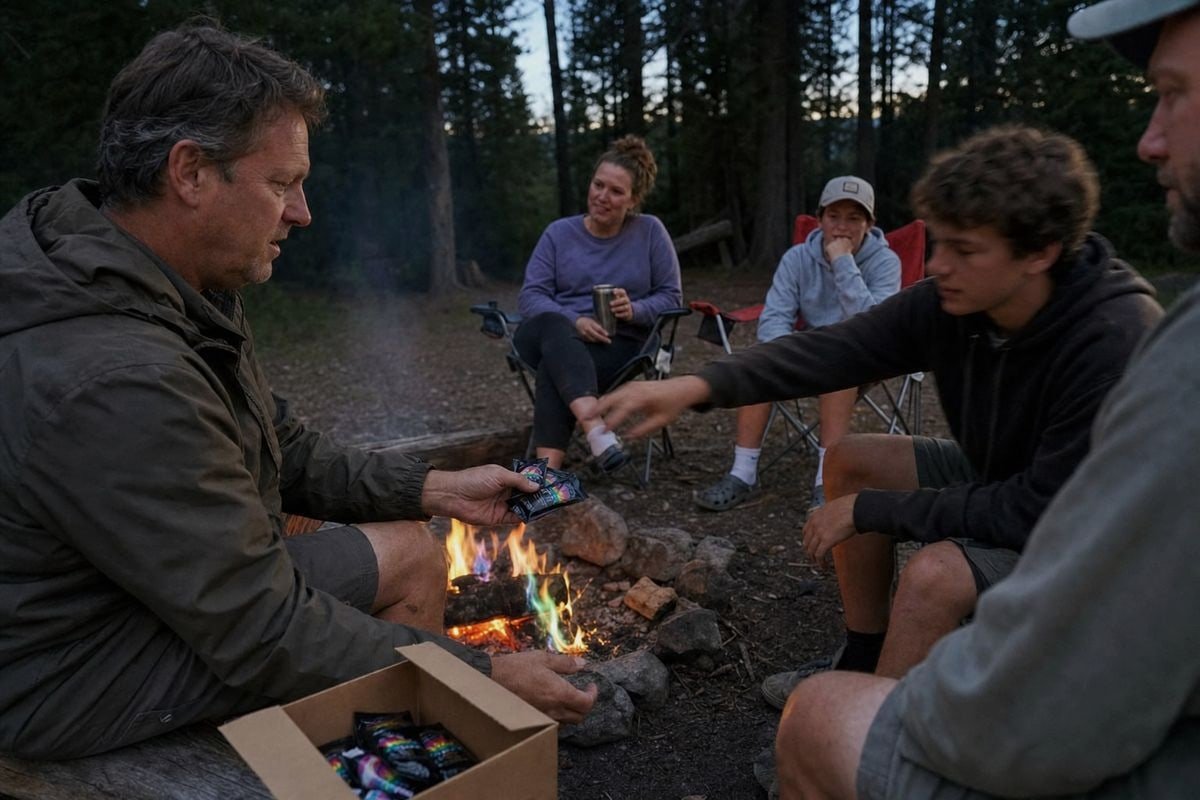
Pack sizing is a dosing problem. The market has already converged on unit weights of 10 g, 15 g, 25 g, and 30 g, and wholesale structures like 25 bags per box with 24 boxes per carton, or flat 50-sachet case packs. Your job is to map those formats to real outdoor scenarios instead of guessing.
Match the pack to the event, not the shelf
Here is the sizing logic we walk buyers through before every OEM order:
| Tipo de comprador | Recommended unit size | Suggested pack format | Por que funciona |
|---|---|---|---|
| Camp organizers, scout groups | 10–15 g | 25 sachets per box | One sachet per small fire; easy handout counting |
| Event hosts, bonfire parties | 25–30 g | 10–15 sachets per box | 2–3 sachets cover a large fire in one throw |
| Retailers reselling singles | 15 g | 24 boxes per master carton | Shelf-ready inner boxes, clean case math |
| Distributors and venues | Misto | 50-sachet case packs | Bulk economy with predictable inventory counts |
Be careful with burn-time promises. Supplier claims range from 20–30 minutes, to roughly 50 minutes for a 25 g sachet, to "10 minutes up to much longer" depending on flame size. The spread is real because burn time depends on wood, wind, and fire size. My advice: print a conservative range on the pack and let the product over-deliver. Overpromising is the fastest way to generate marketplace returns.
One trend worth adopting: event-sync packaging. For festival and LARP buyers, we number and color-code sachets inside a case so a group leader can run a timed multi-color display — green, then blue, then purple — without opening anything in the dark. It costs little at the printing stage and gives your product a genuine group-activity feature that single-color competitors lack.
What labeling and safety warnings must I include for international bulk orders?
Compliance paperwork is the first thing our European buyers ask about — usually before price. In our experience exporting to Germany and the UK, a missing warning line can hold an entire container at customs.
International bulk orders must carry "Do Not Open Packet," "Throw Whole Packet Into Fire," and "Do Not Cook Food Over Colored Flames" warnings on every sachet, box, and carton. Add ingredient disclosure, a Material Safety Data Sheet reference, lot codes, net weight, and market-specific hazard symbols.
Labeling is where convenience-first packaging strategies fall apart. These are chemical fire additives 4, not candy, and every market treats them accordingly. Our factory runs ISO 9001 and BSCI systems, and we supply CE marks plus SGS or Intertek test reports with each export batch, because our buyers treat certification as a hard requirement — not a nice-to-have.
The non-negotiable warning set
Four instructions appear across nearly every credible listing, and they must appear on your packaging too:
- Do not open the packet — throw it into the fire whole.
- Do not cook food or roast marshmallows over the colored flames.
- Use only in wood fires: campfires, fireplaces, fire pits, and bonfires.
- Keep away from children and pets; adult supervision required.
Print these on the front panel, back panel, and the inner count box, not just the master carton. Group activities happen at dusk. Warning text must stay legible in low light, so we specify high-contrast type — white or yellow on black works well — at a size readable at arm's length. For retail channels in the US and EU, discuss child-resistant packaging or at minimum a tamper-evident seal with your compliance advisor; requirements vary by market and chemical classification.
Documentation for the carton level
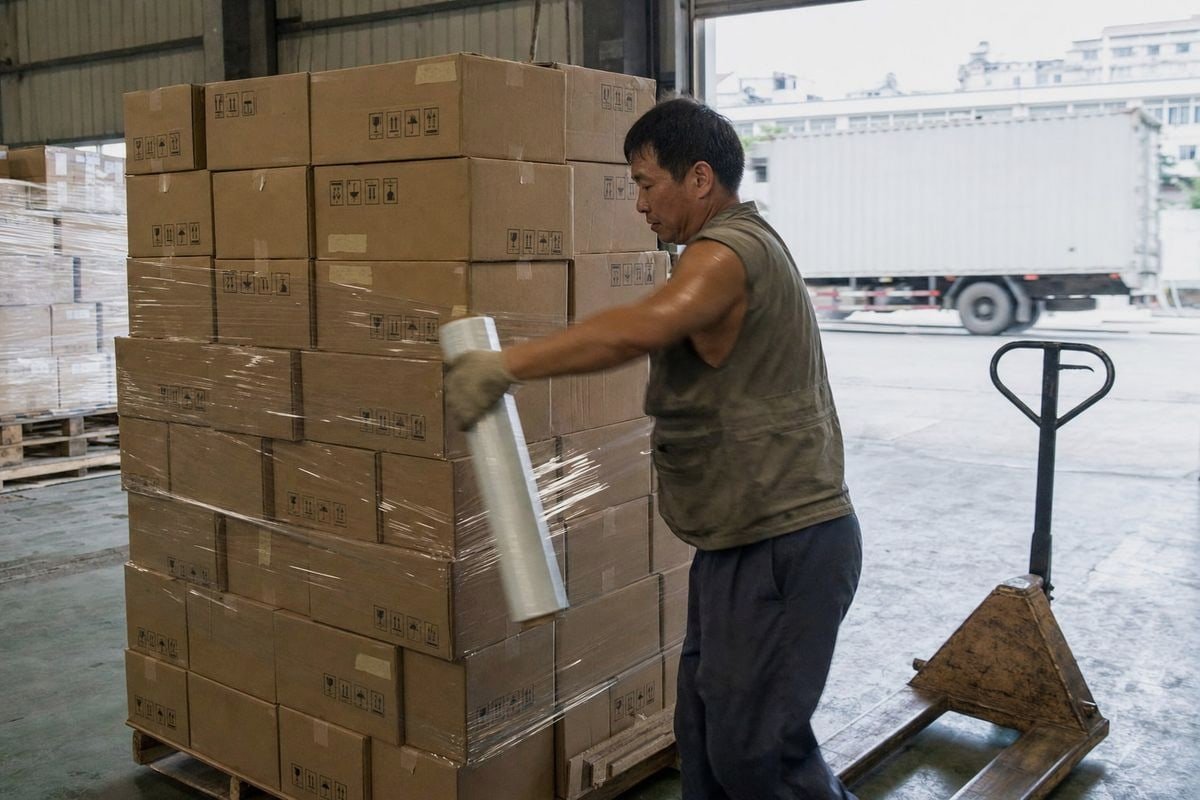
The master carton carries the logistics data: net quantity, lot and batch identification, país de origem 5, and handling marks. We batch-code every production run so a buyer can trace any sachet back to a QC record. For freight, follow the transport classification on your Ficha de Dados de Segurança de Materiais 6; larger consolidated shipments may call for UN-certified bulk shipping containers, and your forwarder will need the MSDS to book space correctly. Getting this right up front is far cheaper than re-labeling a held container at port.
Can I customize bulk packaging design for my brand while meeting compliance standards?
The trade-off I weigh most often in ODM projects is design space versus warning space. A US camping brand once sent us artwork covering the entire pouch face — we sent it back with a compliance zone marked in red.
Yes. Full private-label customization — custom logo printing, colors, pouch style, box format, and carton graphics — is standard for bulk orders, provided fixed compliance zones remain: mandatory warnings, ingredient disclosure, lot codes, and barcodes. Reserve roughly a quarter of each panel for safety content.
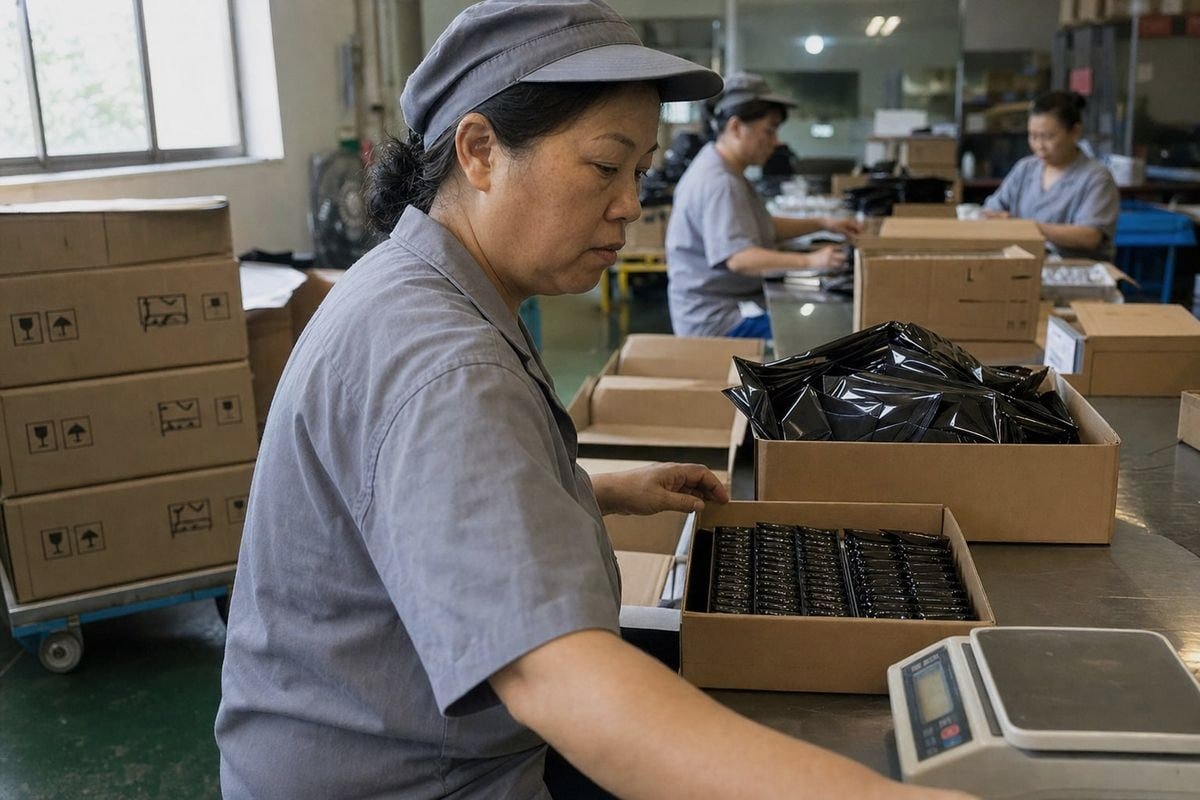
Customization is genuinely wide open on the wholesale supply chain side. Our one-stop OEM/ODM service covers sachet size, burn-time formulation, pouch material, box structure, display packaging, warning labels, and barcodes. The key is designing branding and compliance together, not bolting warnings on at the end.
What you can change, and what stays fixed
| Elemento | Personalizável? | Notas |
|---|---|---|
| Logo, brand name, artwork | Sim | Custom logo printing on sachet, box, and carton |
| Pouch format | Sim | Glossy foil, kraft stand-up with zip, or plastic jar |
| Sachet weight and burn time | Sim | We calibrate the formula and fill weight per spec |
| Box and case counts | Sim | 25-per-box, 50-per-case, or your own structure |
| Warning text and symbols | Não | Fixed wording, minimum size, high contrast |
| Lot codes and barcodes | Não | Necessário para rastreabilidade e escaneamento de varejo |
Two design directions dominate right now. Novelty-forward brands use glossy black pouches with rainbow flame graphics — vivid, energetic, and strong on marketplace thumbnails. Outdoor-authentic brands prefer matte kraft stand-up pouches 7 with resealable zips, which pair naturally with biodegradable packaging claims and campfire safety guidelines printed in a field-guide style. We produce both, and we often build a kraft secondary pouch around foil primary sachets so a brand gets the rustic look outside and the barrier performance inside.
Some buyers push further: QR codes linking to usage videos or educational content for youth groups, flip-top display boxes with a circular photo showing the real blue-green flame effect, and handle cutouts on cartons for event staff. All of it is feasible. Because we run complete production lines with batch-to-batch QC, your approved sample is what mass production actually delivers — which is the whole point of working with a factory rather than a trading company.
Conclusão
Design bulk Magic Fire Powder packaging as a logistics-and-safety system first: foil barriers, event-matched counts, layered warnings, then branding. Get those right, and your product arrives dry, compliant, and shelf-ready.
Notas de rodapé
1. Scientific definition of the chemical salts used to create color in pyrotechnic applications. ↩︎
2. Explains the chemical agents responsible for the color-changing effects in fire products. ↩︎
3. Official FDA resource for safety standards regarding packaging materials and food-contact substances. ↩︎
4. Technical background on the chemical compositions used to produce colored flames. ↩︎
5. Comprehensive definition of country of origin marking requirements for international trade compliance. ↩︎
6. Authoritative OSHA landing page for Hazard Communication standards and safety documentation requirements. ↩︎
7. Detailed technical overview of stand-up pouch construction, barrier properties, and material layers. ↩︎



 English
  Spanish
  German
  French
  Arabic
  Portuguese
Participe da conversa