







Buyers ask me about total landed cost for Magic Fire powder almost weekly. They compare factory quotes, pick the lowest, and then watch tariffs, testing fees, and safety stock 1 quietly eat the savings.
Total landed cost for China-only sourcing of Magic Fire powder is usually 15–30% lower at the unit level, but dual sourcing can win overall when tariff exposure, hazmat freight surcharges, disruption risk, and inventory carrying costs are high. The optimal split is often partial China allocation, not 100%.
The answer depends on [your full cost stack](https://sunrichfire.com/how-calculate-landed-cost-magic-fire-powder-shipping-packaging-fees/), not the quote sheet. Let me walk you through each hidden layer, using the numbers we see on real color-flame powder shipments.
Last spring, a US distributor showed me two quotes for color-flame packets. The "cheaper" supplier ended up costing him more after brokerage, re-labeling, and one rejected batch. Our team rebuilt his model together.
Beyond unit price and freight, your landed cost model must include import duties and tariffs, customs brokerage, cargo insurance, compliance testing, quality fallout (rework, rejects, returns), currency conversion costs, inland trucking, and inventory carrying cost driven by lead-time variability. These items often add 20–40% to the ex-factory price.

The biggest mistake I see is treating landed cost as "price plus a container." In our 17 years exporting color-flame products to the US, Germany, the UK, and 27 other markets, the invisible line items decide profitability far more often than the visible ones.
The full cost stack, item by item
Here is the framework we build with our B2B buyers before they compare any sourcing scenario:
| Cost Layer | Typical Impact on Landed Cost | Often Missed? |
|---|---|---|
| Ex-factory unit price | Baseline | No |
| Ocean or air freight | 5–15% | No |
| Import duty / Section 301 tariffs | 0–25%+ | Sometimes |
| Customs brokerage and classification | 1–3% | Yes |
| Cargo insurance and payment financing | 1–2% | Yes |
| Compliance testing and certification | Fixed overhead per SKU | Yes |
| Quality fallout (rejects, rework, returns) | 1–8% | Almost always |
| Inventory carrying cost from long lead times | 8–15% annually | Almost always |
| Currency hedging or conversion spread | 1–3% | Almost always |
Two of these deserve special attention for Magic Fire powder. First, HTS classification 2 matters. Color-flame formulations rely on metal-salt compounds like copper and strontium salts 3. How your broker classifies them can change your duty rate, and in some cases trigger anti-dumping or countervailing duty 4 exposure HTS classification 5 tied to Chinese exporters. We help buyers get classification right before the first container ships, because reclassification after arrival is painful.
Second, quality fallout. A rejected batch of a consumer fire product is not just scrap cost. It is retail chargebacks, lost shelf placement, and sometimes recall exposure. This is why we run strict batch-to-batch QC on our production lines in Ningbo, so the first sample genuinely reflects mass-production quality. In a landed cost model, a supplier with a 1% defect rate can beat a supplier with a lower price and a 5% defect rate every single time.
How do compliance and testing requirements affect my total cost when sourcing from a single China factory versus splitting orders?
A German fireplace distributor once told me his previous supplier's "certificates" turned out to be borrowed documents. Customs held his goods for six weeks. Compliance is not paperwork; it is landed cost insurance.
With a single certified China factory, compliance testing, SGS or Intertek reports, and audit costs are paid once per SKU. Dual sourcing duplicates lab certification, batch testing, labeling validation, and factory audits across two facilities, adding fixed overhead that only large order volumes can absorb.
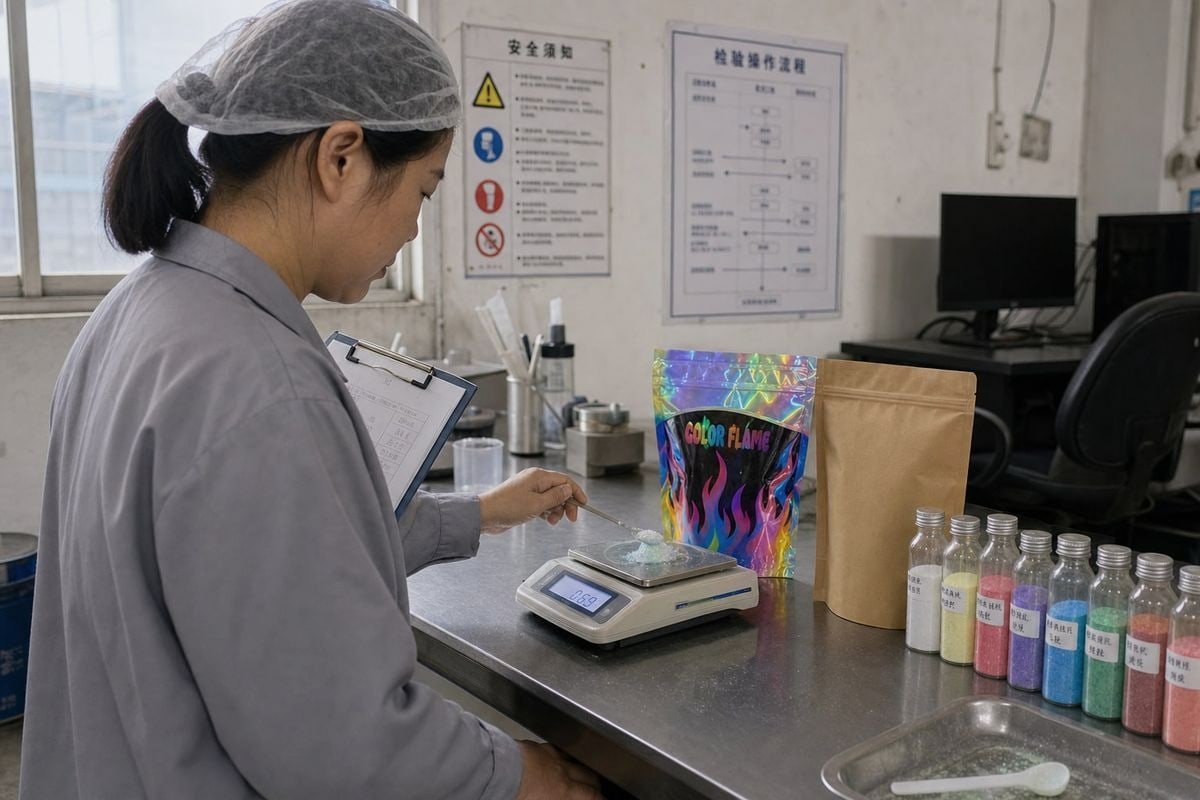
Compliance is the area where the China-only versus dual-sourcing comparison changes shape completely. Variable costs like freight scale with volume. Compliance costs are largely fixed per facility, per SKU, per market. That structure punishes fragmentation.
Why compliance costs double, not split
When you split orders between two factories, you do not split the testing bill. You pay it twice. Here is what duplication looks like for a color-flame powder sold into the US and EU:
- Third-party test reports (SGS or Intertek) for each formulation, from each facility, because the chemistry and process are never identical between plants.
- Factory audits — BSCI social compliance 6 and quality system audits per site.
- Labeling and warning-text validation for each market, verified against each factory's actual packaging output.
- Batch-testing protocols maintained in parallel, with two sets of retained samples and two documentation trails.
- Country-of-origin documentation managed separately for each customs regime.
At our Liuyang headquarters, we hold ISO 9001, BSCI, and CE certification with current SGS and Intertek 7 test reports, because for our buyers this is a hard requirement, not a nice-to-have. When a purchasing manager sources from us alone, that entire compliance stack is already built and amortized across our full production volume. When the same buyer adds a second source, they must verify that the second facility's reports are real, current, and cover the exact formulation shipped — not a lookalike sample.
There is one important counterpoint, and I will be honest about it. If your second source sits in a country with lighter duty treatment for your HTS code, the duplicated testing overhead can still pay for itself at high volumes. The break-even point matters. For trial orders and mid-size programs, single-source compliance is almost always cheaper. For very large programs facing 25% tariff exposure, duplicated compliance can be a rational insurance premium. We tell buyers to calculate the fixed compliance overhead per unit at their real volume before deciding, not after.
Can dual sourcing really lower my risk without driving up my per-unit costs and MOQs?
Trade-offs are my daily work. Every time we quote a private-label program, I weigh scale economies against the buyer's concentration risk. The honest answer: dual sourcing lowers risk, but rarely for free.
Dual sourcing meaningfully reduces tariff, disruption, and concentration risk, but it typically raises per-unit costs by 5–12% through lost volume discounts, duplicated tooling, and split freight. It also doubles your MOQ exposure, since each factory enforces its own minimums for custom packaging and formulations.

Research on global dual sourcing supports something counterintuitive: total cost is often convex in the China allocation. In plain English, the cheapest overall mix is frequently a partial China allocation — say 70/30 or 80/20 — rather than either extreme. The question is whether your program is big enough to reach that optimum without breaking on MOQs.
Where the extra cost actually comes from
| Cost Driver | China-Only | Dual Sourcing (80/20 Split) |
|---|---|---|
| Volume pricing tier | Full consolidation, best tier | Both orders drop a tier |
| Custom packaging plates/tooling | One set | Two sets, duplicated |
| Freight consolidation | Full containers, lower per-unit | Split shipments, more LCL |
| MOQ pressure | One threshold to clear | Two thresholds to clear |
| Supplier management time | One relationship | Two relationships, two QC trails |
| Tariff/disruption exposure | Concentrated | Diversified |
The MOQ issue hits novelty fire products harder than most categories. Custom printed pouches, display boxes, warning labels, and barcodes each carry their own print minimums. Split your volume in half, and you may fall below the packaging MOQ at both factories. This is one reason we keep flexible MOQs for trial orders at our factory — we would rather let a buyer prove the product in their market first, then scale into better pricing tiers, than force an oversized first commitment.
There is also a risk-side argument that favors keeping one strong primary source. Concentration risk is real, but so is qualification risk. A second supplier who has never run your exact formulation is a source of new failure modes: color shifts, burn-time drift, packaging errors. In our OEM programs, we see that formulation and process maturity — knowing exactly how a copper-salt blend behaves batch after batch — is what keeps field defect rates near zero. A risk-adjusted model should count both the probability-weighted cost of a China disruption and the probability-weighted cost of a second-source quality failure. Most buyers only count the first.
What lead time and inventory carrying cost differences should I expect between a China-only supply chain and a dual-sourcing strategy?
A Canadian camping brand we supply once ordered late for the fall season. That near-miss taught both of us to model lead time as money, not just calendar days.
China-only supply chains typically run 45–60 days ocean transit plus production, requiring higher safety stock and adding an estimated 8–15% in annual inventory carrying cost. Dual sourcing with a nearer or faster second lane cuts buffer stock, but split shipments raise per-shipment freight and clearance fees.

Lead time is where inventory carrying cost is born. The longer and less predictable your replenishment cycle, the more safety stock you must finance, insure, warehouse, and risk marking down. For a seasonal product like color-flame powder — which peaks around camping season and winter holidays — carrying cost is not a rounding error. It is a strategic variable.
How lead time converts into carrying cost
Think of it as a chain: production time plus transit time plus clearance time equals replenishment lead time. Safety stock scales with both the length and the variability of that lead time. Then carrying cost applies to every unit of that stock — capital cost, warehousing, insurance, and obsolescence risk for date-sensitive packaging.
| Scenario | Typical Replenishment Lead Time | Safety Stock Level | Relative Carrying Cost |
|---|---|---|---|
| China-only, ocean freight | 60–90 days total | High | Baseline |
| China-only, with DG-experienced forwarder and planned POs | 60–80 days, low variance | Moderate | Lower than baseline |
| Dual source, China + nearer-shore second lane | Blended, 30–80 days | Lower | 8–15% lower annually |
| Dual source, poorly coordinated | Variable, unpredictable | Higher than China-only | Higher than baseline |
Notice the last row. Dual sourcing only reduces carrying cost when the second lane is genuinely faster or more reliable. Two uncoordinated suppliers with mismatched schedules can force more buffer stock, not less.
One more factor specific to this category: shipping classification. Oxidizing or combustible powders classified as Dangerous Goods 8 carry hazmat freight surcharges of roughly 20–40% above standard rates, and those surcharges vary by carrier and origin. Our Magic Fire packets are made from eco-friendly materials with no harmful chemicals, which simplifies documentation and keeps freight closer to standard rates. When we optimize logistics for buyers shipping to the US, Germany, or Australia, predictable classification and steady production scheduling often recover more carrying cost than a second sourcing country ever would. Reliability is a lead-time strategy in itself.
Conclusion
Chasing the lowest quote quietly destroys margins. Model the full landed cost stack instead: a certified, consistent China partner often wins — and when dual sourcing wins, the data will show it.
Footnotes
1. Explains the inventory concept driving carrying cost calculations discussed in the lead-time analysis. ↩︎
2. Official US tariff schedule reference for verifying correct HTS classification of flame-colorant powders. ↩︎
3. Background on strontium, the metal-salt compound used in color-flame powder formulations. ↩︎
4. WT

 English
  Spanish
  German
  French
  Arabic
  Portuguese
Join the Conversation