







Every week, buyers ask me why custom label Magic Fire Powder quotes vary so much. One quote says 500 units. Another says 30,000. Both are for the "same" product. The confusion costs buyers time, money, and sometimes an entire retail season. After 17 years running color-flame production lines in China, I can tell you the numbers are not random — and once you understand the logic, you can negotiate far better terms.
MOQ thresholds for custom label Magic Fire Powder typically range from 500–1,000 units for sticker-on-stock options up to 30,000 units for fully custom sachets. Price markups of 10–30% cover printing plates, setup, and compliance work, and drop as volume rises through tiered pricing.
That is the short version. But there is more than one minimum hiding inside a single quote. Let me break down each layer so you can compare suppliers apples-to-apples.
What MOQ Tiers Should I Expect When Ordering Custom Label Magic Fire Powder?
Last month, a German distributor sent me three competing quotes and asked why the MOQs ranged from 1,000 to 30,000 units. The answer sat in the packaging format, not the powder itself.
Expect three MOQ tiers: 500–1,000 units for semi-custom sticker-on-stock pouches, 2,000–5,000 units for digitally printed custom sachets, and 10,000–30,000 units for fully custom plate-printed foil packaging. Each label design and each SKU variant usually carries its own separate minimum.

The most important thing I tell buyers is this: MOQ is not one number. A custom label Magic Fire Powder order stacks several minimums on top of each other. There is a minimum for the powder fill run. There is a minimum for the label or printed film. There is often a minimum order value on top of both. Miss any one of them, and your per-unit price jumps.
Why the Packaging Format Sets the Floor
Our automated sachet lines run glossy foil film at high speed. Starting that line for a custom print job means loading a new film roll, calibrating heat seals, and running waste film until registration is perfect. That setup cost is the same whether you order 2,000 sachets or 50,000. This is why fully custom plate-printed sachets carry the highest thresholds. By contrast, our kraft stand-up pouches and plastic jars can be labeled semi-manually, so we can accept much smaller runs with a printed sticker applied to stock packaging.
Typical MOQ Structure by Format
| Packaging Format | Customization Level | Typical MOQ | Why |
|---|---|---|---|
| Stock foil pouch + custom sticker | Semi-custom (white label packaging) | 500–1,000 units | Manual labeling, no plate fees |
| Kraft bag or jar + printed label | Semi-custom | 1,000–2,000 units | Small label print runs are viable |
| Digitally printed sachet | Custom | 2,000–5,000 units | No printing plates needed |
| Fully custom plate-printed sachet | Full custom | 10,000–30,000 units | Plates, dies, machine calibration |
| Custom display box + sachets | Full custom retail-ready | 5,000–20,000 sets | Box tooling plus fill run |
One more thing many buyers miss: variants multiply minimums. If you want three flame-color blends, or English and German label versions, each variant usually needs its own MOQ. A different label means separate proofing, separate setup, and separate inventory risk on our side. Consolidating SKUs is the single fastest way to hit a threshold.
How Much Does Private Labeling Actually Add to My Per-Unit Price?
A UK camping brand once told me a competitor quoted them "free" private labeling. Six weeks later, they came back — the markup had simply been buried in the unit price.
Private labeling typically adds 10–30% to the per-unit price of Magic Fire Powder at low volumes. The markup covers artwork setup, printing plates, compliance labeling, and changeover time. Through a tiered pricing structure, this premium shrinks to 5–10% on orders above roughly 20,000 units.

Markup is not profit padding. It is how we price real customization work into small runs. When we set up a custom print job, we pay for plate-making or digital print setup, artwork proofing, seal calibration, and machine downtime during changeover. On a 30,000-unit run, those fixed costs disappear into fractions of a cent. On a 2,000-unit run, they can add 20% or more per unit. This is basic break-even math, and every honest quote reflects it.
The Real Cost Drivers Behind the Markup
Here is where the money actually goes on a typical custom label job through our OEM branding services:
| Cost Driver | One-Time or Recurring | Impact at Low Volume | Impact at High Volume |
|---|---|---|---|
| Printing plates / dies | One-time per design | High | Negligible |
| Artwork proofing and revisions | One-time per version | Moderate | Negligible |
| Line changeover and calibration | Per production run | High | Low |
| Compliance and warning label work | Per SKU per market | Moderate | Low |
| Raw flame colorant chemicals | Recurring, market-priced | Same | Slightly lower via bulk buying |
| Liability and documentation under your brand | Per program | Moderate | Low |
Two drivers deserve special attention. First, raw material pricing floats. Flame colorant chemicals such as copper compounds 1 move with spot metal prices, so quotes in this niche often carry a validity window of 30–60 days. Second, there is a genuine liability markup for custom orders. When your brand name goes on the pouch, we prepare Material Safety Data Sheets 2, test documentation, and regulatory paperwork under your identity — that work has a cost.
How to Shrink the Markup Without Raising Volume
You can reduce markup pressure even at modest quantities. Use a standard label size. Cut ink colors from six to three. Choose our stock pouch shape instead of a custom die-cut. Run one language version with a multilingual back panel instead of separate country SKUs. Every one of these choices removes a fixed cost from your quote, which directly protects your retail profit margins downstream.
Can I Start With a Smaller Trial Order Before Committing to Full MOQ?
The trade-off I weigh most often is this: a small trial run costs us money on setup, but a buyer who tests successfully becomes a long-term repeat account. We almost always choose the relationship.
Yes. Most established suppliers, including our factory, offer trial orders of 500–2,000 units using stock packaging with a custom sticker label, or digitally printed sachets from around 2,000 units. Expect a 15–25% per-unit premium and sometimes a minimum order value of $350–$1,000.
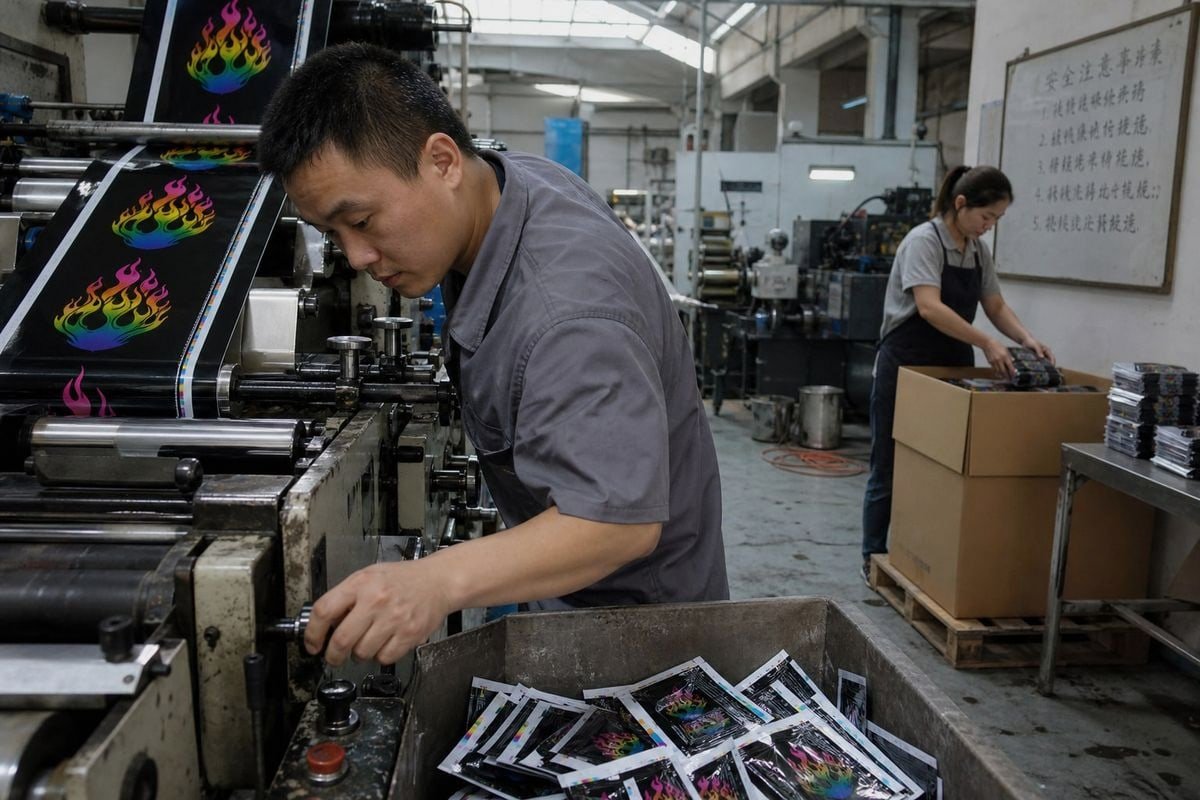
A trial order is not just a smaller version of a full order. It is a different production path, and understanding that path helps you negotiate one. Here is how we typically structure a trial-to-scale program for bulk campfire colorants:
- Sample stage. You receive stock samples of our Magic Fire packets in the 10g trial-packet and 25g standard weights so you can test burn performance and flame colors yourself.
- Semi-custom trial run. We fill stock foil pouches or kraft bags and apply your printed sticker label. This avoids plate fees entirely and lets you test 500–1,000 units in your market.
- Digital print bridge. If the trial sells, digital sachet printing lets you move to fully branded packaging at around 2,000 units — still no traditional plate-making fees.
- Full custom scale-up. Once you forecast steady demand, we shift to plate-printed sachets at 10,000+ units, where your per-unit cost drops sharply.
Two honest warnings from my side. First, trial units cost more per piece — accept that as market-testing tuition, not supplier greed. Second, confirm that your trial packaging matches the compliance standard of your scale-up packaging. I have seen buyers test with a simplified label, get retail interest, then discover the compliant final label needs redesign and re-approval. Build the warning text, batch coding, and barcode into the trial label from day one. Manufacturing lead times for trial runs are usually shorter too — often 2–3 weeks versus 4–6 weeks for a full custom run — which lets you validate demand before a seasonal buying window closes.
Do Certification and Compliance Requirements Affect My MOQ or Pricing?
A hard lesson from our early export years: a shipment is only as good as its paperwork. One missing test report at customs can idle an entire container, so compliance is now built into every quote we issue.
Yes, significantly. Compliance adds per-SKU costs for GHS-compliant warning labels, MSDS documentation, and region-specific requirements like California Prop 65. Certified suppliers may quote 5–15% higher, but they prevent customs holds, retailer rejections, and liability exposure that far exceed the premium.

Compliance touches both your MOQ and your markup, and it does so in ways many first-time private label buyers underestimate. On the MOQ side, every regulated label element that changes by market — warning language, hazard pictograms, importer address — creates a distinct label version. Each version is a separate print setup. That is why a buyer selling into the US, Germany, and France may face three label minimums instead of one, even for identical powder.
What Compliance Actually Costs Across Markets
| Requirement | Applies To | Cost Impact | MOQ Impact |
|---|---|---|---|
| GHS-compliant warning labels 3 | Most markets | Label design and legal review per SKU | Per-language label versions |
| Material Safety Data Sheets | All B2B and retail channels | Documentation fee per formulation | None directly |
| California Prop 65 4 wording | US retail | Minor per-label cost | May force a US-specific label |
| CE marking 5 and test reports | EU markets | Testing fees per product family | None if supplier holds reports |
| Limited Quantity 6 (LQ) shipping classification | Powder chemical goods | Freight surcharge on landed cost | Affects carton and pallet configuration |
Here is where supplier choice matters most. Our factory already holds ISO 9001 7, BSCI, and CE certification, with SGS and Intertek test reports on file for our color-flame products. When a supplier already carries these, you inherit the compliance framework — you pay for label adaptation, not for testing from scratch. When a supplier does not, the "cheaper" quote quietly transfers testing costs, delay risk, and liability to you. For the purchasing managers I work with in the US and Europe, this is a hard requirement, not a nice-to-have.
One more landed-cost note. Chemical powders often ship under Limited Quantity rules, which trigger handling surcharges. Always ask whether a quote includes LQ-compliant packaging and freight, or you will find the markup in your freight invoice instead of your product invoice. Comparing quotes on landed cost — not unit price — is the only fair comparison. Wholesale volume discounts of 5–25% as order values climb from $1,000 to $20,000+ only mean something once compliance and freight are counted the same way on every quote.
Conclusion
MOQ thresholds and price markups are not arbitrary barriers — they price real setup, packaging, and compliance costs into custom label Magic Fire Powder orders. I have watched buyers overpay simply because they compared unit prices instead of the full order stack. The fix is straightforward: separate the label MOQ from the fill MOQ, confirm whether minimums apply per variant, start with a semi-custom trial run, and insist on certified documentation from day one. Do that, and every quote becomes comparable — and every scale-up becomes predictable. If you want to test a private label manufacturing 8 program with realistic trial quantities and full compliance support, my team and I are ready to walk you through the numbers line by line.
Footnotes
1. Copper compounds are named as a flame colorant chemical with price volatility. ↩︎
2. MSDS documentation is a regulatory requirement referenced for compliance costs. ↩︎



 English
  Spanish
  German
  French
  Arabic
  Portuguese
Join the Conversation