







Wood fire starters look simple, but I have watched buyers lose entire shipments over GHS Rev 7 1 compliance gaps. One mislabeled pallet at customs, and your season is gone. Our factory learned to prevent that.
To ensure wood fire starters comply with GHS Rev 7, classify the product through flammable solids testing, apply the correct pictogram, signal word, hazard statements, and precautionary statements, maintain an aligned Safety Data Sheet, and verify your supplier documents every batch and every export market.
That answer covers the framework. Now let me walk you through each step in practical terms, based on what actually happens between a factory floor in China and a retail shelf in the US or Europe.
What GHS Rev 7 Labeling Requirements Apply to Wood Fire Starters?
During a pre-shipment audit for a German fireplace distributor last year, our QC team caught a label proof missing one precautionary statement. That single line would have blocked customs clearance. Small details carry real money in this business.
GHS Rev 7 requires wood fire starters classified as flammable solids to carry the flame pictogram, a signal word (Danger or Warning), hazard statements such as H228, precautionary statements for storage and handling, a product identifier, and supplier contact details on every label.

The starting point is classification, not label design. A wax-dipped wood roll made of 50% wood fiber and 50% paraffin behaves differently from a gel starter or a loose wood-wool bundle. Under the UN Model Regulations 2 and GHS criteria, most compressed wood-and-wax starters land in flammable solids 3 classification, Category 1 or Category 2, based on standardized burning rate tests. The category then dictates the label content. Category 1 takes the signal word Danger; Category 2 takes Warning. Guessing is not allowed. You test, then you label.
The Six Mandatory Label Elements
Chemical labeling requirements under GHS Rev 7 break down into six pieces. Here is how they typically apply to a wax-based wood fire starter:
| Label Element | Typical Requirement for Wood Fire Starters |
|---|---|
| GHS pictograms | Flame symbol (red diamond border) |
| Signal word | Warning (Cat. 2) or Danger (Cat. 1) |
| Hazard statements | H228: Flammable solid |
| Precautionary statements | Keep away from heat, sparks, open flames; store in a cool, dry place |
| Product identifier | Product name matching the SDS |
| Supplier identification | Name, address, and phone number of responsible party |
Small Container Allowances
Many fire starters ship as small cubes or sticks with almost no label space. OSHA's 2024 rule 4 aligning the HCS with GHS Rev 7 allows abbreviated labels on containers up to 100 mL, and packages of 3 mL or less may need only a product identifier, provided full hazard information appears on the outer packaging. We use this provision often when designing retail display boxes for private-label clients. The outer box carries the complete label; individual pucks carry the identifier.
One more point: OSHA HCS compliance follows a phased timeline. Substances must comply by January 19, 2026, and mixtures by July 19, 2027. Most wood fire starters are mixtures, but we advise buyers not to wait for the deadline. Retailers already ask for updated labels now.
Which Test Reports Should I Request From My Wood Fire Starter Supplier?
A UK importer once asked us a blunt question: "Can you prove the classification, or are you just copying a competitor's label?" It was the right question. Our SGS and Intertek reports answered it in one email.
Request a flammable solids burning rate test report (UN Test N.1), a current GHS Rev 7 Safety Data Sheet, composition verification for SDS Section 3, third-party lab reports from SGS or Intertek, and transport classification documents referencing the UN Model Regulations.

Documentation is where good suppliers separate from cheap ones. In our 17-plus years exporting fire products to 30-plus countries, we have never seen a serious retailer accept a product file without third-party evidence. The label is a claim. The test report is the proof behind the claim.
The Core Document Set
Here is the document package I recommend every purchasing manager demand before placing a trial order:
| Document | What It Proves | Red Flag If Missing |
|---|---|---|
| UN Test N.1 burning rate report | Correct flammable solids category | Label may be guessed, not tested |
| GHS Rev 7 SDS (16 sections) | Full hazard communication | Outdated Rev 3/4 SDS still in use |
| SDS Section 3 composition data | Ingredient disclosure matches formula | Formula drift between batches |
| SGS or Intertek certificate | Independent third-party verification | Self-declared "compliance" only |
| Transport classification letter | Correct shipping under UN Model Regulations | Customs holds and reclassification fees |
| ISO 9001 5 / BSCI certificates | Quality and social compliance systems | No process control behind the product |
Reading the SDS Critically
Do not just file the Safety Data Sheet 6. Open it. Section 2 must state the exact hazard class and category, with matching hazard statements and precautionary statements. Section 3 must list wood fiber and paraffin percentages that match the printed packaging. Section 9 should now include particle characteristics for solid wood components, a newer GHS Rev 7 expectation for shavings-based products. Section 1 needs a valid emergency contact, and for US sales, a US-based responsible party address.
Also check the revision date. An SDS written under an older GHS revision is a warning sign. When we updated our own product files for the Rev 7 transition, we revised every SDS, every label proof, and every export document together, because a mismatch between label and SDS is one of the most common findings in retailer audits.
How Do I Verify My Manufacturer's Batch-to-Batch Compliance Consistency?
The trade-off we weigh every week on our Ningbo production line is speed versus verification. Skipping a wax-ratio check saves an hour. Catching a drifted batch before it ships saves a client relationship. We always choose the check.
Verify batch-to-batch consistency by requiring batch numbers on every carton, per-batch QC records for wax ratio and burn time, periodic third-party retesting, retained samples from each production run, and a documented change-control process that triggers SDS and label review whenever the formula shifts.
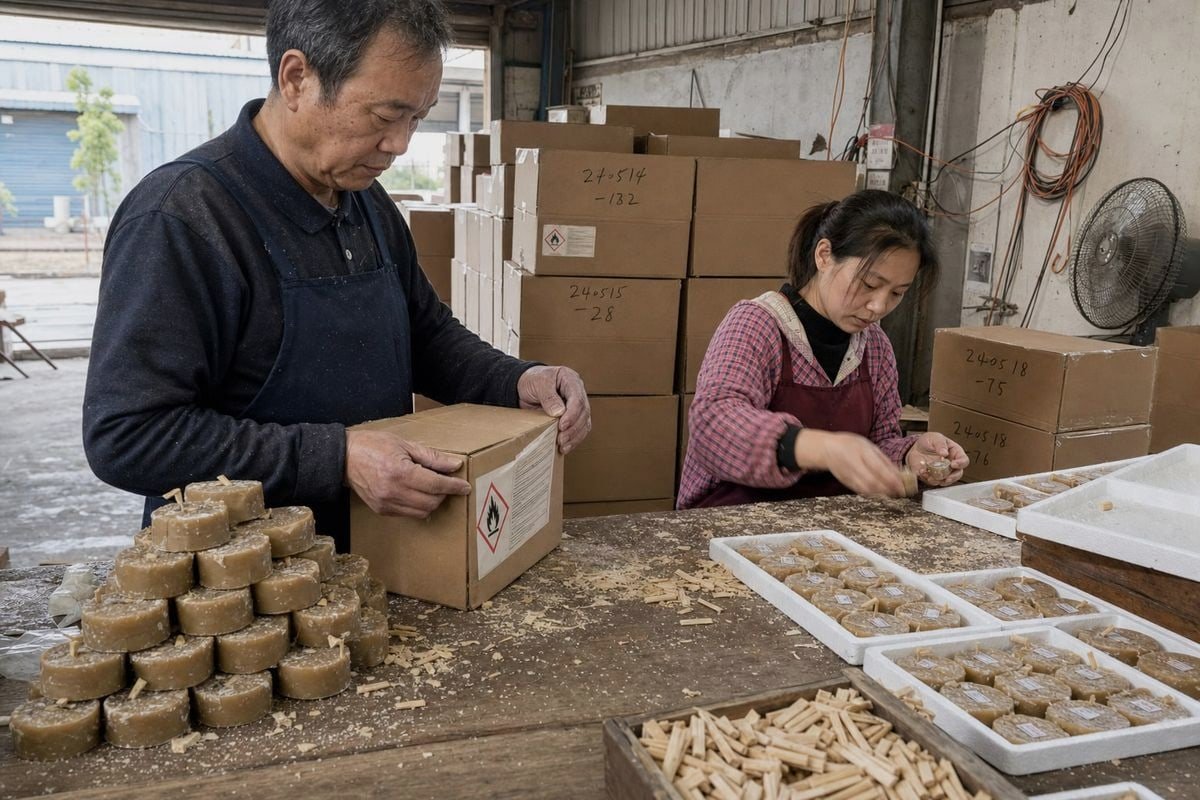
Compliance is not a one-time certificate. A fire starter that tested as Category 2 last year can drift toward Category 1 behavior if the paraffin ratio creeps up or the wood fiber source changes. Natural materials vary. Resin content in wood, wax penetration depth, and roll density all affect burning rate. That is why classification evidence must be tied to a controlled, repeatable process, not just to a single golden sample.
A Practical Verification Workflow
I suggest buyers follow this sequence with any supplier, including us:
- Ask for the QC plan in writing. It should define wax-to-fiber ratio tolerances, burn time ranges, and dimensional specs for every SKU.
- Request batch traceability. Every carton should carry a batch code that links back to raw material lots and inspection records.
- Compare your trial order against mass production. We tell clients openly: the first sample must reflect bulk quality. If burn time or density shifts between sample and shipment, walk away.
- Schedule periodic retesting. Annual or semi-annual third-party burn tests confirm the classification still holds as materials and seasons change.
- Demand change notification. Any formula, binder, or supplier change should trigger a review of the SDS, the label, and the transport classification before the next shipment.
Why Retained Samples Matter
Our factory keeps retained samples from production runs. When a question comes up months later, we can burn-test the actual retained batch instead of arguing from memory. For a purchasing manager, asking whether a supplier retains samples is a fast way to gauge how seriously they treat consistency. A supplier who cannot produce last quarter's sample probably cannot reproduce last quarter's quality either.
Fluctuating natural inputs also justify a worst-case benchmark. For resin-rich woods, we classify against the highest realistic resin concentration, so the label stays valid even when raw material varies.
Can My Supplier Handle Custom Warning Labels for Different Export Markets?
Early in our OEM work, a client selling in both the US and the Netherlands assumed one English label would cover both markets. We flagged it before printing. Dutch retail required Dutch-language hazard text, and the rework would have cost weeks.
A capable supplier should offer OEM warning-label customization for each export market, including translated hazard and precautionary statements, market-specific responsible-party details, CPSC-aligned retail text for the US, CLP-aligned labels for the EU, and correct GHS pictograms sized to each package format.

GHS is a global framework, but every jurisdiction implements it differently. The US follows OSHA's HCS 7 aligned with GHS Rev 7. The EU applies CLP with its own mandatory language rules. Australia has run a GHS 7 regime since January 2023. Canada, the UK, and the Middle East each add their own wrinkles. A single generic label cannot serve them all, and a supplier who insists it can is a supplier who has not exported widely.
What Market-Specific Customization Looks Like
| Market | Key Label Requirement | What We Adapt |
|---|---|---|
| United States | OSHA HCS (GHS Rev 7) plus CPSC retail rules | US responsible-party address, English hazard text, dual retail/workplace framing |
| EU (Germany, France, NL, Poland) | CLP 8 labeling in official local languages | Translated hazard and precautionary statements, EU importer details |
| United Kingdom | GB CLP post-Brexit | GB-specific supplier identification |
| Australia | GHS 7 mandatory since 2023 | Local emergency contact, GHS 7 SDS |
| Middle East | Varies by country; often Arabic labeling | Bilingual label layouts |
Beyond the Label Itself
Real one-stop OEM support goes further than printing text. On our lines in Ningbo, we handle custom box design, display packaging, barcodes, and warning-label placement as one integrated file per market. That matters because label size, pictogram dimensions, and the small-container allowances all interact with your packaging format. A 100-piece bulk box of wax rolls needs different labeling architecture than a six-pack retail sleeve for a fireplace boutique.
One tension worth naming: sustainability claims must never crowd out hazard information. A "100% Natural" badge cannot contradict or visually overwhelm the flame pictogram and flammability warnings. We design both onto the artwork together, so the eco message and the compliance message coexist cleanly. Ask your supplier to show you finished, market-specific label artwork from past projects. The answer tells you quickly whether they truly manage multi-market chemical labeling requirements or just print whatever file you send.
Conclusion
GHS Rev 7 compliance for wood fire starters follows a chain: test, classify, label, document, verify, and adapt per market. Choose a supplier who proves every link, and your shelves stay stocked and audit-ready.
Footnotes
1. Provides background on the GHS classification framework referenced throughout the article. ↩︎
2. Background on the international transport classification system cited for flammable solids shipping. ↩︎
3. Background on flammability classification concepts underlying the burning rate testing discussed. ↩︎
4. Official OSHA source for the Hazard Communication Standard update aligning with GHS Rev 7. ↩︎



 English
  Spanish
  German
  French
  Arabic
  Portuguese
Join the Conversation