






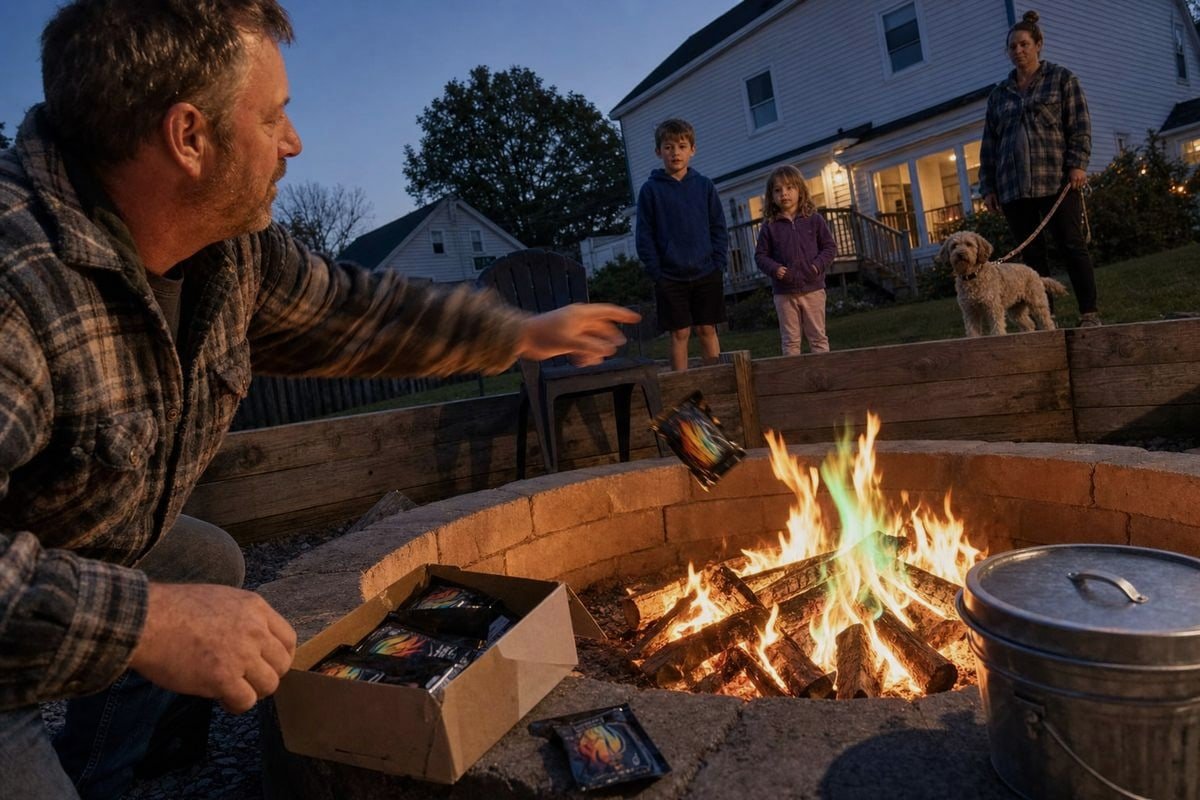
Safety precautions for Magic Fire Powder are the first thing I discuss with new buyers, because one poorly labeled sachet can trigger returns, complaints, or worse — a poison control call.
Magic Fire Powder safety precautions include childproof storage, adult-only handling, throwing sachets into flames unopened, keeping pets away from the fire area, cleaning up residue and ash, verified non-toxic formulations, compliant warning labels, and SGS or Intertek test reports confirming the product contains no harmful chemicals.
Those precautions only work if the product behind them is genuinely safe and consistently made. Let me walk you through what to check, section by section.
What Certifications Confirm This Product Is Safe Around Children and Pets?
During a factory audit last year, a German buyer spent a full day reviewing our test reports before even discussing price. chemical test reports 1 That order taught me how seriously European importers treat compliance paperwork.
Certifications that confirm safety include SGS or Intertek chemical test reports verifying no heavy metal toxicity, CE marking for the EU market, ISO 9001 for quality management, BSCI for ethical production, plus a complete Material Safety Data Sheet covering ingredients, first-aid steps, and handling guidance.
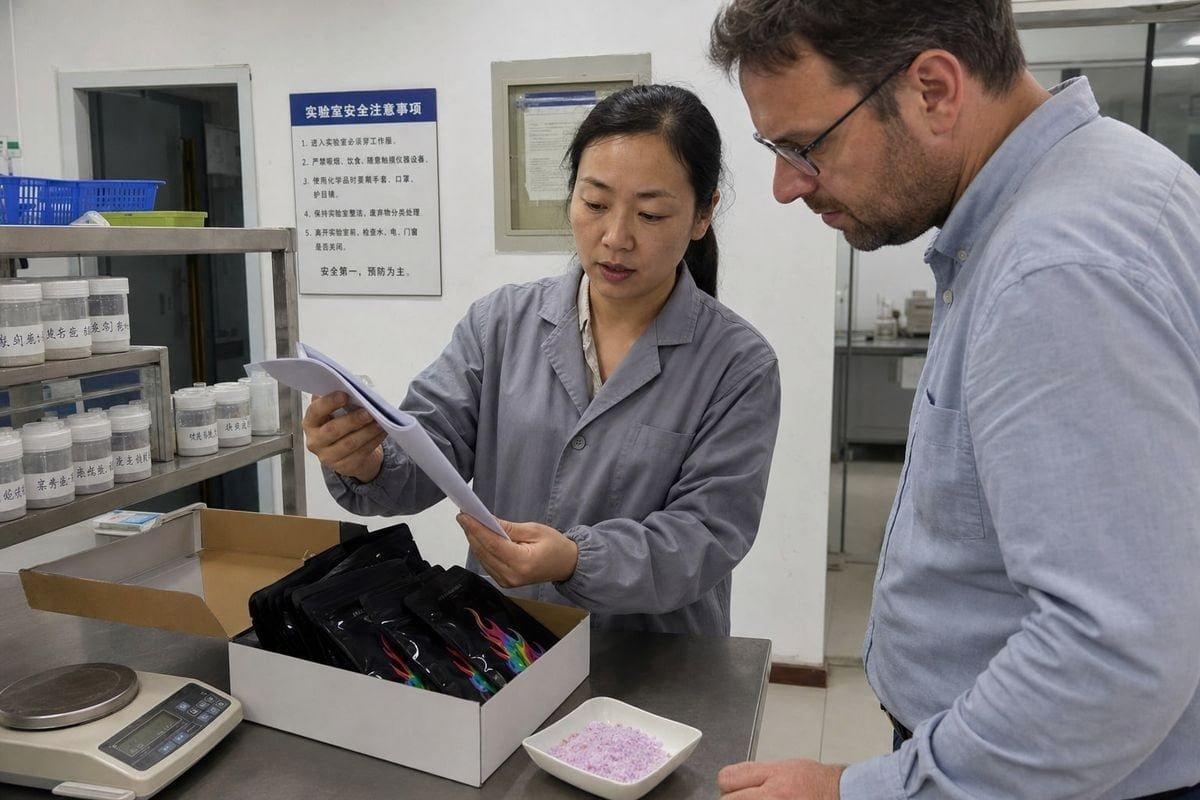
Not all flame colorants are made the same way. Some cheap formulations still rely on sulfate de cuivre 2 or other aggressive metal salts that can cause chemical burns if a child or pet ingests them. Others, like the eco-friendly formulations we run on our production lines in Ningbo, are built specifically to avoid harmful chemicals. The only way a purchasing manager can tell the difference is through third-party documentation.
Les documents essentiels à demander
Ask every supplier for these four items before you commit to anything:
| Document | Ce qu'il prouve | Why It Matters for Kids and Pets |
|---|---|---|
| Rapport de test SGS / Intertek | Chemical composition, no restricted substances | Confirms low heavy metal toxicity risk on accidental contact |
| Fiche de données de sécurité des matériaux 3 | Ingredients, first-aid, storage, ventilation requirements | Gives poison control and vets accurate data in an emergency |
| CE / market compliance file | Product meets EU consumer safety rules | Legally required for many retail channels |
| Certificat ISO 9001 | Système de gestion de la qualité cohérent | Safety claims hold true batch after batch |
Why the SDS Matters Most in an Emergency
If a child swallows powder or a dog licks residue from a fire pit, the first question poison control asks is: what exactly is in it? A complete, honest Material Safety Data Sheet answers that instantly. In our experience exporting to 30+ countries, buyers who stock the SDS on their websites resolve customer incidents far faster than those who cannot name their own ingredients. No certificate makes a fire product childproof. But real certification tells you the formulation itself will not add chemical harm on top of normal fire pit safety risks.
Which Warning Labels and Packaging Details Should I Require From My Supplier?
One lesson I learned early: a US retail buyer once rejected an entire private-label sample run because the caution text was too small. Since then, our packaging team treats warning labels as seriously as the formula itself.
Require sealed foil sachets with clear "keep out of reach of children and pets" text, "throw unopened into fire" instructions, "outdoor use only" or ventilation guidance, "do not cook food over colored flames," first-aid and poison control directions, plus market-specific hazard symbols and barcodes.

Packaging is your first physical barrier against accidents. The glossy foil sachet with rainbow lettering looks fun on a shelf — that is exactly the problem. Bright crystalline granules in a small pouch can look like candy to a toddler. So the packaging has to work harder than the marketing.
Label Elements Your Market Regulators Expect
| Élément d'étiquette | Objectif | Common in Which Markets |
|---|---|---|
| Keep out of reach of children and pets | Prevents accidental chemical ingestion | US, EU, UK, Canada, Australia |
| Ne pas ouvrir le paquet avant utilisation | Stops dust inhalation and skin contact | Tous les marchés |
| Do not cook or roast food over colored flames | Prevents residue contaminating food | US, EU |
| Outdoor use only / use with good ventilation | Manages fume exposure | EU, Canada |
| First-aid instructions and poison control note | Guides emergency response | Tous les marchés |
Physical Packaging Features That Reduce Risk
Beyond text, look at the structure. Heat-sealed crimped edges prevent leakage during shipping. Individual single-use sachets mean no leftover open powder sitting in a drawer. For jar or kraft-bag formats, we recommend resealable closures so any unused product stays contained. When we run OEM projects, we also adjust warning language, hazard icons, and barcode placement pictogrammes de danger 4 for each destination country — because a label that passes in Poland may fail a Home Depot–style compliance review in the US. Ask your supplier to show label artwork before la production de masse 5, not after. Fixing a label at the design stage costs nothing. Fixing it after 50,000 printed sachets costs a container's worth of margin.
Are the Chemical Ingredients in Magic Fire Powder Non-Toxic If Accidentally Touched or Inhaled?
The honest answer depends entirely on the formulation, and I say this having reformulated our own products years ago to remove anything we would not want near our own families.
Quality Magic Fire Powder made from eco-friendly metal salts is low-risk on brief skin contact, but no flame colorant should be inhaled, eaten, or handled by children; cheap versions using copper sulfate can cause irritation, chemical ingestion injuries, and toxic fumes when burned indoors.

Flame colorants work through des sels métalliques. Different metal ions glow in different colors when heated — that is the "magic." The safety question is which salts a supplier chooses. Responsible formulations use compounds selected for low toxicity. Irresponsible ones cut costs with harsher industrial chemicals.
Exposure Routes and Sensible Responses
Think about exposure in four practical scenarios:
- Skin contact. With a well-made product, brief contact with granules is usually a minor irritant at most. Wash hands with soap and water. Do not eat or smoke while handling any fire product.
- Eye contact. Fine crystalline powder can irritate eyes. Rinse with clean water for several minutes. Adults should keep sachets sealed until use, which prevents this almost entirely.
- Inhalation. Never open a sachet and breathe near loose powder. During burning, follow ventilation requirements — outdoor use only, or a properly drafting fireplace. Smoke from any fire is harmful to small lungs and pets with sensitive respiratory systems.
- Ingestion. This is the serious one. If a child or pet swallows powder or a spent packet, contact poison control or an emergency veterinarian immediately, with the SDS in hand. Do not wait for symptoms.
Pets Face Extra Risks
Pets are exposed differently than children. A dog can walk through cooled ash, then lick residue off its paws during grooming. Curious animals may also approach unusual colored flames 6 closer than they would a normal fire. So keep pets out of the fire area before, during, and after use, and remove all ash once it cools. Also never add colorant to fires burning pressure-treated or painted wood — that combination creates far more toxic airborne compounds than the powder alone.
How Can I Verify Batch-to-Batch Safety Consistency Before Placing a Bulk Order?
A buyer from the Netherlands once told me his previous supplier's third shipment burned dull orange instead of blue-green. The formula had drifted. Nobody had noticed until customers complained — and that story shaped how we structure our own batch QC.
Verify consistency by requesting recent third-party test reports per batch, comparing a fresh production sample against your approved golden sample, auditing the supplier's ISO 9001 quality system, checking raw material traceability records, and confirming the factory — not a trading company — controls the mixing process.
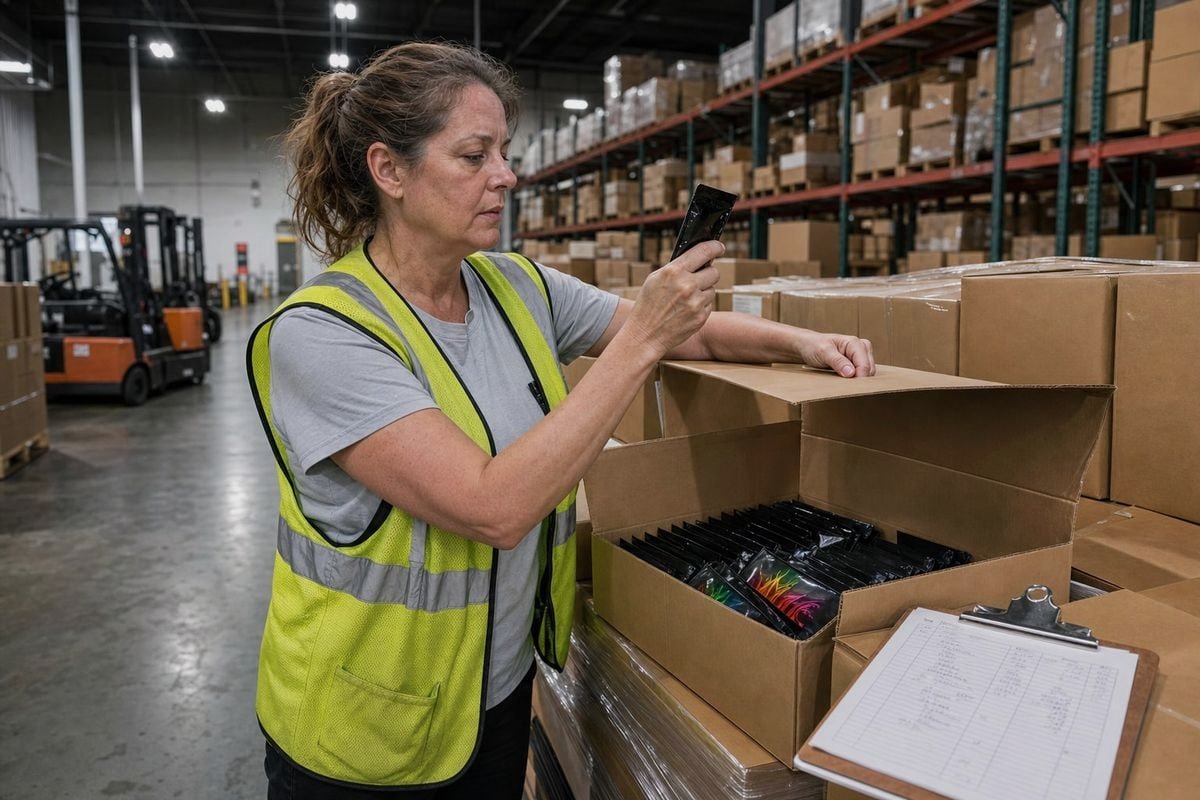
Safety consistency is where trading companies fail and real factories prove themselves. A test report from two years ago tells you nothing about the container leaving the port next month. You need a verification process, not a one-time document.
A Practical Five-Step Verification Process
| Étape | What to Do | Ce qu'il attrape |
|---|---|---|
| Échantillon d'or | Lock an approved reference sample with agreed color, granule size, and burn behavior | Formula drift over time |
| 2. Batch test reports | Request SGS/Intertek reports tied to recent production lots, not old marketing files | Outdated or recycled certificates |
| 3. Pre-shipment inspection | Burn-test random sachets from the actual shipment batch | Mixing errors, contamination |
| 4. Raw material traceability | Ask how metal salts are sourced and logged per batch | Ingredient substitution to cut costs |
| 5. Factory audit | Verify ISO 9001 and BSCI on-site or via video walkthrough | Sociétés commerciales se faisant passer pour des usines |
Why Manufacturing Depth Is the Real Safeguard
Consistency comes from process control, not promises. quality assurance 7 On our lines, each batch of colorant is weighed, mixed, and logged against a standard recipe, then sample-burned before packing. That is why the first sample a buyer approves reliably matches mass production. When you evaluate any supplier, ask one blunt question: can you show me the QC record for your last three production batches? A factory with 17+ years of records answers in minutes. A middleman goes quiet. For a product that ends up near children, pets, and open flames, that difference is worth far more than a few cents per sachet.
Conclusion
Magic Fire Powder is safe around families only when certified formulations, honest labels, sealed handling, and strict batch QC work together — choose a supplier who proves all four before you order.
Notes de bas de page
1. Updated SGS service page for chemical safety and toxicity testing. ↩︎
2. Technical overview of copper sulfate, commonly used in flame coloring but requiring safety handling. ↩︎
3. OSHA's Hazard Communication Standard defines the requirements for Safety Data Sheets in the US. ↩︎
4. Official OSHA government resource explaining GHS hazard communication symbols. ↩︎
5. Overview of mass production techniques and the importance of quality control in large-scale manufacturing. ↩︎
6. Scientific explanation of how different chemicals produce unusual colored flames in pyrotechnics. ↩︎
7. Authoritative overview explaining the distinction between quality assurance and control. ↩︎


 English
  Spanish
  German
  French
  Arabic
  Portuguese
Rejoignez la conversation