







Poudre magique pour feu 1 la précision des couleurs est la question que j'entends le plus souvent de la part des acheteurs qui visitent notre ligne de production. Si vous vous trompez, vos clients de détail publient des photos décevantes. Si vous réussissez, les réapprovisionnements suivent.
La précision des couleurs de la poudre magique pour feu dépend des sels métalliques utilisés, de la température de la flamme, de la qualité du bois et du dosage. Les acheteurs doivent vérifier la précision au moyen d'essais d'échantillons documentés par vidéo, de rapports de tests de lots, de certifications SGS ou Intertek, et d'une petite série pilote avant de s'engager dans des commandes de production en gros.
Ci-dessous, je détaille chaque étape de vérification dans l'ordre où un véritable responsable des achats la suivrait. C'est le même processus que suivent nos clients à l'exportation aux États-Unis et en Allemagne.
Comment puis-je vérifier la précision de la couleur de la flamme avant de passer une commande en gros ?
Au printemps dernier, un distributeur néerlandais m'a demandé de brûler des échantillons en direct lors d'un appel vidéo avant de signer. Cette seule session a répondu à plus de questions que trois semaines d'e-mails.
Vérifier la précision de la couleur de la flamme en demandant des tests de combustion en direct ou enregistrés sur du bois sec et assaisonné, en comparant les résultats aux images marketing du fournisseur, en vérifiant les produits chimiques colorants de flamme déclarés sur la fiche technique et en testant vous-même des échantillons dans le même type de feu que celui que vos clients utiliseront.

Le point de départ honnête est le suivant : aucune poudre magique pour feu ne produit des teintes d'une précision de laboratoire. Ce sont des paquets de flammes arc-en-ciel conçus pour le divertissement, donc "l'exactitude" signifie en réalité la cohérence et une intensité de couleur crédible. Votre travail en tant qu'acheteur est de confirmer que ce que vous avez vu dans l'échantillon correspond à ce qui est expédié dans le conteneur.
Processus de vérification étape par étape
Voici le processus que nous recommandons à chaque nouveau client, basé sur plus de 17 ans d'expédition de produits à flammes colorées vers plus de 30 marchés :
- Demandez la classe de formule. Demandez quels sels métalliques produisent chaque couleur. Le sulfate de cuivre et chlorure de cuivre 2 donnent du bleu-vert, le strontium donne du rouge, le potassium donne du violet. Si un fournisseur ne nomme pas la famille chimique, partez.
- Regardez une combustion documentée. Exigez une vidéo non montée montrant le paquet placé dans une vraie cheminée ou un brasero à bois, avec un horodatage.
- Brûlez des échantillons dans vos propres conditions. La taille de la flamme, le flux d'air et l'essence de bois modifient tous l'intensité de la couleur. Testez dans le cadre où vos clients finaux l'utilisent réellement.
- Comparez les lots. Demandez des échantillons de deux dates de production différentes. Une couleur cohérente entre eux signale un véritable contrôle de processus.
Ce à quoi ressemblent les bons et les mauvais résultats
| Observation | Ce qu'il vous dit |
|---|---|
| Les couleurs fleurissent en 30 à 60 secondes, tiennent fermement | Formulation micronisée et bien mélangée |
| La flamme reste principalement jaune | Dosage faible ou contamination par le sodium des cendres |
| La couleur n'apparaît que par brefs éclairs | Granulés grossiers, mélange inégal |
| Les couleurs correspondent étroitement à la vidéo du fournisseur | Les affirmations marketing sont fondées sur la réalité |
Un conseil de plus : brûlez l'échantillon sur du bois sec et bien vieilli. Le bois humide produit de la vapeur qui dilue visuellement la saturation du spectre de la flamme, et vous blâmerez injustement la poudre.
Quels rapports de test ou certifications dois-je demander pour confirmer la cohérence des couleurs ?
La paperasse de conformité est ce qui fait ou défait les affaires dans notre activité d'exportation. Un acheteur de détail américain a un jour rejeté l'expédition d'un concurrent uniquement pour des documents de test de métaux lourds manquants.
Demander les rapports de composition chimique SGS ou Intertek, les tests de teneur en métaux lourds, la certification du système qualité ISO 9001, les résultats d'audit social BSCI, la conformité CE le cas échéant, et les enregistrements de contrôle qualité au niveau des lots. Ensemble, ces documents prouvent à la fois la conformité en matière de sécurité et la capacité du fournisseur à maintenir la cohérence des couleurs lot après lot.

Les certificats remplissent deux fonctions distinctes, et les acheteurs avisés les gardent séparés dans leur esprit. Les documents de sécurité vous protègent légalement. Les documents sur le système qualité prédisent si le lot cinquante ressemblera au lot un. Vous avez besoin des deux.
La liste de contrôle des documents
| Document | Ce qu'il confirme | Pourquoi c'est important pour la couleur |
|---|---|---|
| Rapport de test SGS / Intertek | Composition chimique, limites de teneur en métaux lourds | Confirme que les produits chimiques colorants de flamme réels correspondent à la formule déclarée |
| certification ISO 9001 | Un système de gestion de la qualité fonctionnel | Le contrôle des matières premières est ce qui maintient la couleur stable d'un lot à l'autre |
| Audit BSCI | Conditions d'usine éthiques | Requis par la plupart des canaux d'approvisionnement de détail américains et européens |
| Conformité CE | Conformité au marché de l'UE | Non négociable pour les distributeurs européens de cheminées et de camping |
| Dossiers de contrôle qualité des lots | Données d'inspection par lot | La preuve directe de la cohérence des couleurs au fil du temps |
Lire les rapports de manière critique
Ne vous contentez pas de collecter des PDF. Vérifiez trois choses. Premièrement, la date du rapport — un test datant de cinq ans dit peu sur la production actuelle. Deuxièmement, le nom du produit testé — il doit correspondre au SKU que vous commandez, pas à un produit sœur. Troisièmement, la portée — un rapport couvrant les matériaux d'emballage ne couvre pas la poudre elle-même.
Dans notre usine de Ningbo, nous conservons échantillons conservés 3 de chaque lot de production pour cette raison exacte. Lorsqu'un client remet en question une expédition, nous pouvons brûler l'échantillon conservé par rapport à l'échantillon de plainte côte à côte. Demandez à votre fournisseur s'il fait de même. Un "oui" avec des photos de l'étagère de rétention vaut mieux qu'une brochure glacée.
Demandez également les fumées toxiques 4 déclaration de précautions et illustration de l'étiquette d'avertissement. Les régulateurs dans l'UE et en Amérique du Nord s'attendent à des avertissements clairs sur les étiquettes contre la cuisson au-dessus de flammes traitées, et des étiquettes manquantes peuvent bloquer les marchandises à la douane.
Pourquoi les couleurs des flammes varient-elles d'un lot à l'autre et comment Sunrich contrôle-t-il cela ?
Au début de ma carrière, nous avons attribué une plainte de "vert délavé" à un seul fournisseur de matières premières qui avait modifié la taille des granulés de son sel de cuivre sans nous le dire. Cette leçon a remodelé notre processus d'inspection à réception de manière permanente.
Les couleurs de flamme varient entre les lots en raison des changements de pureté des matières premières, d'un mélange inégal, de l'absorption d'humidité pendant le stockage et des changements de taille des granulés. Sunrich contrôle cela grâce à l'approvisionnement en matières premières certifiées, à l'inspection à la réception, au mélange contrôlé, aux tests de combustion par lot et aux échantillons conservés pour chaque lot de production.

Comprendre les causes de variation vous aide à poser des questions plus précises à n'importe quel fournisseur, alors laissez-moi décomposer séparément la chimie et le côté processus.
D'où vient réellement la variation
Les sels métalliques sont le cœur de chaque produit à flamme colorée. L'élément décide de la teinte : cuivre pour le bleu-vert, strontium pour le rouge, potassium pour le violet, calcium pour l'orange. Mais le sel n'est qu'une partie de l'histoire. La pureté compte énormément. Un lot de sulfate de cuivre avec une teneur légèrement plus élevée d'impureté de sodium 5 poussera la flamme vers le jaune, car l'émission du sodium est intensément brillante et submerge facilement tout le reste. Même les cendres laissées dans un brasero peuvent ajouter suffisamment de sodium pour atténuer les couleurs d'un paquet.
La taille des particules est le deuxième facteur. Les granulés fins et micronisés se dispersent rapidement et donnent une floraison de couleur rapide et uniforme. Les cristaux grossiers libèrent la couleur lentement et de manière inégale. Si l'étape de broyage 6 d'un fournisseur dérive, la même formule produit des résultats visiblement différents. Différents sels se subliment également à différentes températures, c'est pourquoi un paquet en combustion montre souvent une séquence de couleurs plutôt qu'une seule teinte plate — et pourquoi la température du feu change ce que vous voyez.
Comment nous verrouillons les variables
Notre chaîne de contrôle s'exécute en cinq étapes :
- Fournisseurs qualifiés uniquement. Les matières premières proviennent de sources vérifiées avec des certificats de composition pour chaque livraison.
- Inspection à réception. Nous vérifions la pureté et la taille des granulés avant que le matériau n'entre dans la salle de mélange.
- Mélange contrôlé. Des temps de mélange fixes et un stockage à humidité contrôlée empêchent le mottage par l'humidité, ce qui fausse le comportement de combustion et la durée de combustion.
- Tests de combustion par lot. Le personnel de CQ brûle des échantillons de chaque lot sur du bois sec standard et évalue la performance des couleurs par rapport à une vidéo de référence.
- Échantillons conservés. Chaque lot laisse un échantillon scellé sur notre étagère de rétention pour comparaison future.
C'est une véritable profondeur de fabrication, pas des promesses de société de négoce. C'est pourquoi nos clients trouvent que le premier échantillon reflète de manière fiable la qualité de la production de masse — le but du contrôle par lot est qu'il n'y ait pas de surprises après le paiement de l'acompte.
Puis-je obtenir un tirage d'échantillon pour vérifier les performances des couleurs avant la production de masse ?
Une marque de camping britannique a récemment commandé un petit lot pilote chez nous avant son lancement saisonnier — et a utilisé les images de ses propres tests de combustion comme contenu marketing de lancement.
Oui. Les usines réputées proposent des échantillons et de petites séries pilotes avant la production de masse. Demandez des échantillons à partir de l'équipement de production réel, testez-les dans votre type de feu cible, documentez l'intensité de la couleur et la durée de combustion, puis approuvez un échantillon de référence qui devient la référence qualité contractuelle pour la commande en gros.
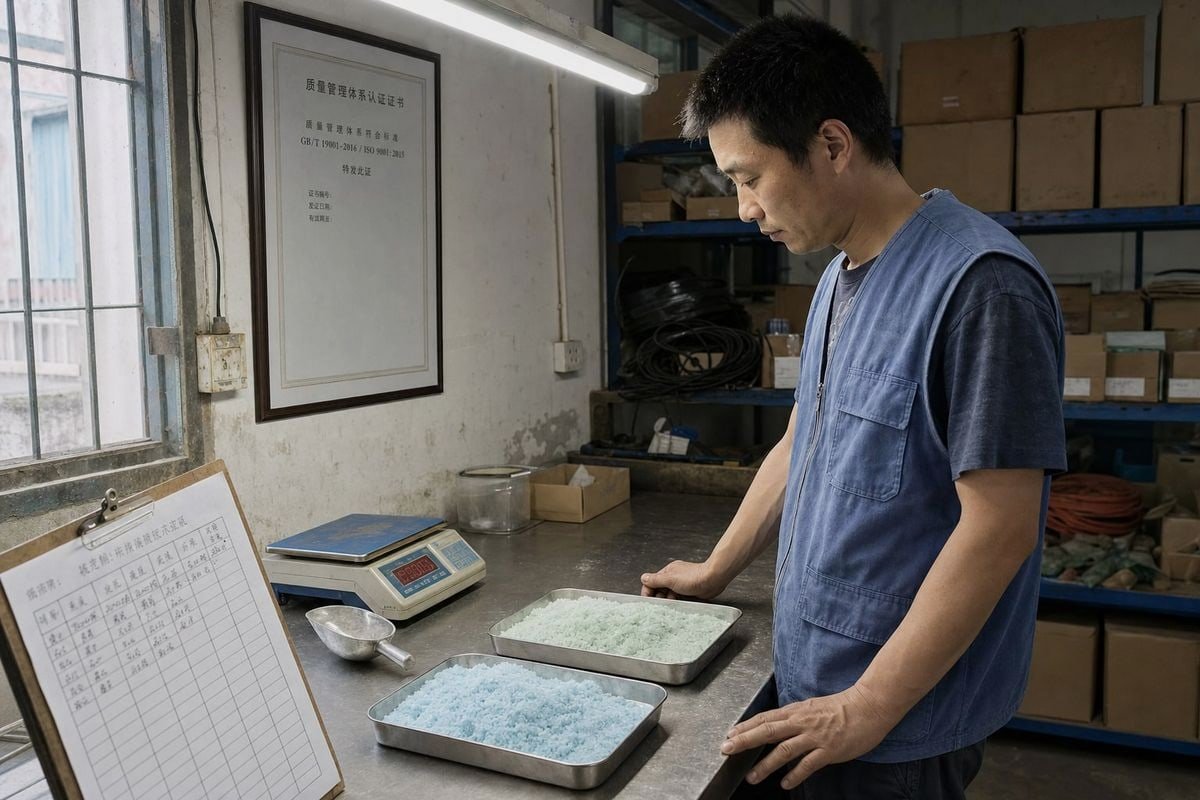
Un essai d'échantillon est votre police d'assurance la moins chère, mais seulement si vous le structurez correctement. De nombreux acheteurs traitent les échantillons comme une formalité. Les plus avisés les traitent comme un outil contractuel.
Comment structurer une commande pilote significative
Le concept clé est l'échantillon d'or. Il s'agit d'une unité de référence scellée et mutuellement approuvée — paquet, poudre et emballage ensemble — que les deux parties conservent. Chaque expédition future est jugée par rapport à celui-ci. Nos clients OEM en Allemagne et au Canada utilisent des échantillons d'or de manière routinière, et cela élimine presque tous les litiges de qualité avant qu'ils ne commencent.
Lorsque vous testez vos échantillons pilotes, évaluez systématiquement plutôt qu'à la légère :
| Facteur de test | Que vérifier | Résultat cible |
|---|---|---|
| Type de feu | Cheminée à bois, brasero ouvert, feu de camp | Couleurs visibles dans chaque environnement prévu |
| Dosage | Un paquet contre plusieurs dans un feu plus grand | Instructions de dosage claires pour votre étiquette |
| Durée de combustion | Temps entre le début de la couleur et sa disparition | Correspond à la durée de combustion annoncée dans la mesure du possible |
| Gamme de couleurs | Quelles teintes apparaissent et dans quelle séquence | Bleu-vert, rouge, violet tous identifiables |
| Sécurité du brasero | Comportement des résidus, pas de flambées agressives | Libération de couleur calme et contrôlée |
Deux avertissements pratiques tirés de notre expérience. Premièrement, les braseros sans fumée avec combustion secondaire 7 injectent de l'oxygène supplémentaire dans la flamme, ce qui peut brûler les colorants plus rapidement et raccourcir l'effet visible — testez-en un si vos clients les utilisent. Deuxièmement, suivez toujours la méthode du paquet non ouvert pendant les tests. Le sachet scellé contrôle la libération chimique et évite les risques d'inhalation, et c'est ainsi que vos clients finaux utiliseront le produit.
Enfin, discutez ouvertement des MOQ d'essai. Nous maintenons délibérément les quantités pilotes flexibles pour les nouveaux partenaires, car une commande d'essai bien gérée, en pots en plastique, en sacs en papier kraft ou en sachets sous marque privée, est le chemin le plus rapide vers une relation d'approvisionnement à long terme pour les deux parties.
Conclusion
La précision des couleurs de la poudre magique pour feu n'est jamais absolue — mais elle est vérifiable. Exigez des vidéos de combustion, des rapports de test certifiés, des contrôles de lot et un essai pilote avec échantillon d'or, et votre commande en gros correspondra aux attentes.
Notes de bas de page
Aperçu Wikipedia des colorants pyrotechniques et des produits chimiques utilisés pour produire des flammes colorées dans les produits de divertissement. ↩︎
Entrée faisant autorité sur Wikipédia pour le chlorure de cuivre, un produit chimique utilisé pour créer des couleurs de flamme bleu-vert dans les feux d'artifice. ↩︎
Source faisant autorité sur Wikipédia couvrant les procédures de contrôle qualité et d'échantillonnage dans la fabrication. ↩︎
Lignes directrices de l'OSHA sur les dangers chimiques et l'importance des déclarations de précautions de sécurité pour les matières dangereuses. ↩︎
Page Wikipédia sur le sodium, détaillant son émission jaune caractéristique qui peut interférer avec d'autres couleurs de flamme. ↩︎
<span id="note


 English
  Spanish
  German
  French
  Arabic
  Portuguese
Rejoignez la conversation