






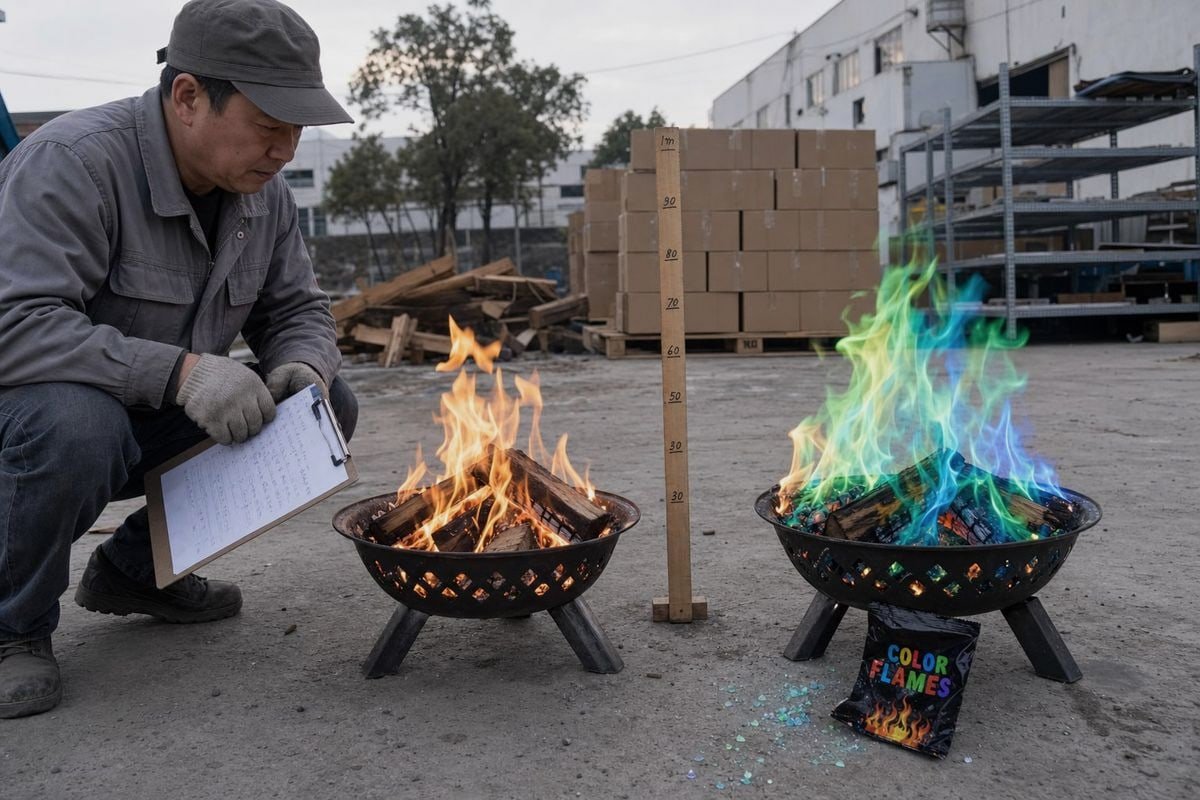
Les acheteurs me demandent sans cesse si la poudre Magic Fire rend les flammes plus hautes ou plus chaudes. Les idées fausses à ce sujet entraînent des retours, des plaintes et même des inquiétudes pour la sécurité — alors laissez-moi clarifier les choses.
La poudre Magic Fire ne modifie pas de manière significative la hauteur de la flamme ou l'intensité de la combustion. C'est un colorant de flamme à base de sels métalliques, pas un combustible ou un oxydant. Le bois reste la source de combustible, donc la production de chaleur, la vitesse de combustion et la taille de la flamme restent essentiellement les mêmes.
Cette réponse courte cache beaucoup de détails utiles. Ci-dessous, j'explique comment la poudre se comporte réellement dans un feu, ce qui change, ce qui ne change pas, et quelles limites de conformité sont importantes pour les importateurs.
Comment la Poudre Magique de Feu affecte-t-elle la hauteur et la stabilité de mes flammes ?
Lors d'un de nos premiers tests de combustion à Ningbo, un client a insisté pour dire que les flammes " paraissaient plus grandes " après l'ajout de nos sachets. Nous les avons mesurées image par image. Elles ne l'étaient pas.
La poudre Magic Fire change la couleur et la luminosité de la flamme, pas la hauteur ou la stabilité de la flamme. Les sels métalliques se vaporisent dans la flamme existante et émettent de la lumière colorée. Parce que la poudre n'ajoute presque aucune charge de combustible, la colonne de flamme conserve la même taille, forme et stabilité qu'auparavant.

La confusion est compréhensible. Une flamme verte ou bleue semble spectaculaire, donc l'œil la perçoit comme " plus grande ". Mais la hauteur de la flamme est une mesure géométrique. Elle dépend de la quantité de combustible brûlée par unité de surface, ainsi que de la circulation de l'air, de la disposition du bois et de l'humidité. Un sachet de flamme colorée pèse quelques grammes. Un feu de camp brûle des kilogrammes de bois. La poudre est tout simplement une masse trop petite pour influencer la géométrie de la flamme.
Ce qui se passe réellement dans la flamme
Quand vous jetez un sachet dans un feu chaud, le sachet fond et les granulés subissent une décomposition thermique. Les sels métalliques — composés de cuivre 1 pour les verts et les bleus, d'autres sels pour les rouges et les violets — se vaporisent dans la flamme. Les électrons excités dans le les atomes métalliques 2 émettent des longueurs d'onde lumineuses spécifiques. C'est tout le mécanisme. C'est un spectacle lumineux, pas un événement de combustion.
Hauteur vs. apparence : ce qui change et ce qui ne change pas
| Propriété de la flamme | Effet de la poudre Magic Fire |
|---|---|
| Hauteur de la flamme | Aucun changement significatif |
| Couleur de la flamme | Changement marqué (vert, bleu, violet, etc.) |
| Luminosité perçue | Apparaît souvent plus vive |
| Stabilité de la flamme | Inchangée ; toujours déterminée par le bois et la circulation de l'air |
| Durée de l'effet | Dépend de la température du lit de braises et du dosage |
Une nuance que nous observons lors des tests : un lit de braises plus chaud vaporise les sels plus rapidement. Ainsi, un feu très chaud donne un spectacle de couleurs plus court mais plus intense, tandis qu'un feu modéré étire l'effet. Dans aucun des cas, la hauteur des flammes n'est modifiée. Si vous voyez une brève flambée lorsque le sachet tombe, c'est le matériau de l'emballage qui s'enflamme pendant une seconde ou deux — pas le colorant lui-même qui augmente le feu.
L'ajout de poudre colorante changera-t-il la vitesse ou la chaleur de ma flamme ?
Un distributeur allemand nous a un jour demandé des données de laboratoire sur ce point précis avant de passer sa première commande de conteneur. Ses acheteurs au détail voulaient la preuve que le produit ne modifierait pas les feux de cuisson.
Non. La poudre colorante ne hausse pas la température de la flamme ni n'accélère le taux de combustion. Elle ne contient pas d'oxydants, elle ne peut donc pas accélérer la combustion. La production de chaleur provient toujours entièrement du bois. Tout changement de température perçu est une illusion visuelle causée par le spectre de couleurs déplacé.

Il y a une vraie science derrière la raison pour laquelle les gens jugent mal cela. Un feu de bois traditionnel rougeoie en orange et jaune, et nous associons ces couleurs à la chaleur. Si le spectre se déplace vers le bleu et le vert, le feu peut en fait sembler plus froid à l'œil, même si la température de la flamme est identique. La lumière de plus courte longueur d'onde transporte également moins d' énergie infrarouge 3 que le spectre classique des flammes oranges, de sorte que la perception de la chaleur rayonnante peut subtilement diminuer. Le thermomètre, cependant, indiquera la même chose.
Pourquoi la poudre ne peut pas intensifier la combustion
Une combustion rapide et intense nécessite l'une des deux choses suivantes : un combustible supplémentaire facilement disponible, ou un oxydant tel qu'un chlorate ou un nitrate 4 qui alimente la réaction en oxygène. Les produits chimiques pyrotechniques dans les poudres flash et les mélanges de démonstration utilisent exactement ces ingrédients, c'est pourquoi ils flamboient violemment. Les produits de consommation à flammes colorées sont délibérément formulés sans eux. Nos granulés Magic Fire sont des porteurs de colorant, pas des matériaux énergétiques. Ce n'est pas une limitation — c'est la conception. C'est ce qui maintient le produit dans la catégorie des " accessoires de feu fantaisie " au lieu de la catégorie des produits pyrotechniques réglementés.
La taille des particules compte — mais seulement pour le visuel
La science du feu montre que les poudres fines brûlent plus vite que le matériau en vrac, car les petites particules ont une énorme surface et un meilleur accès à l'oxygène. Ce principe s'applique aux poussières combustibles 5 comme le magnésium ou le lycopodium. Pour un colorant non combustible, la taille des particules contrôle plutôt la texture visuelle. Des granulés ultra-fins donnent un lavis de couleur lisse et uniforme. Des grains cristallins plus gros produisent un effet d'étincelles lorsque des particules individuelles frappent la zone de combustion. Nous ajustons la taille des granulés sur notre chaîne de production en fonction de si un client souhaite un " lavis " ou des " étincelles " pour sa marque privée — et aucune des deux options ne modifie la puissance thermique ou le taux de combustion.
Puis-je contrôler l'intensité de la combustion par des ajustements de dosage et de formulation ?
Le compromis dont nous discutons le plus souvent avec les clients OEM est le suivant : les ajustements de dosage vous permettent d'obtenir une couleur plus longue, pas un feu plus grand — et définir cette attente sur l'emballage évite à tous des maux de tête.
Le dosage et la formulation contrôlent la vivacité, la teinte et la durée de la couleur — pas l'intensité de la combustion. Plus de poudre ou de sachets plus grands prolongent l'affichage de la couleur. Différents sels métalliques modifient la teinte. Mais aucun ajustement de formulation sans danger pour le consommateur ne rendra le feu lui-même plus intense.

Voici ce que la formulation vous permet réellement de régler. Au cours de 17 années de fabrication de sachets de flammes colorées, de pommes de pin et d'allume-feux, nous avons appris que les clients obtiennent les meilleurs résultats lorsqu'ils considèrent le dosage comme un réglage de " durée de couleur " plutôt qu'un réglage de " puissance ".
Ce que chaque variable contrôle réellement
| Réglage | Ce que cela change | Ce que cela ne change PAS |
|---|---|---|
| Poids du sachet (dosage) | Durée de l'effet de couleur | Hauteur de flamme, puissance thermique |
| Sélection du sel métallique | Teinte (vert, bleu, rouge, violet) | Vitesse de combustion, température de la flamme |
| Granulométrie | Texture visuelle (lavage vs. étincelle) | Intensité de combustion |
| Teneur en donneur de chlore | Vivacité et volatilité de la couleur | Charge de combustible |
| Matériau support | Vitesse de libération du colorant | Taille du feu |
Quelques notes sur ce tableau. Les recettes classiques utilisent sulfate de cuivre 6 pour les verts et le chlorure de cuivre pour les bleus, avec des sels de strontium ou de lithium couvrant les rouges profonds. Certaines formulations héritées ajoutent un donneur de chlore comme le PVC pour créer des composés plus volatils chlorures métalliques 7 et des couleurs plus vives — mais cette chimie génère des sous-produits corrosifs et des fumées potentiellement toxiques, c'est précisément pourquoi nous l'avons éliminée de nos formulations écologiques. Les acheteurs soucieux de la conformité aux États-Unis et dans l'UE ne l'accepteront de toute façon pas.
Conseils pratiques de dosage pour les utilisateurs finaux
- Commencez avec un sachet par feu de camp ou brasero moyen.
- Attendez un lit de braises mature ; un lit plus chaud vaporise les sels plus rapidement et raccourcit le spectacle.
- Ajoutez un deuxième sachet uniquement pour prolonger la durée, espacé autour du feu.
- N'ouvrez jamais le sachet et ne dispersez pas la poudre en vrac — la pochette scellée contrôle la libération.
- Ne cuisinez jamais au-dessus d'un feu coloré ; la cendre et la fumée ne sont pas sans danger pour la consommation.
Si un acheteur souhaite réellement un "plus grand feu" comme avantage produit, la réponse honnête est un produit combustible — comme nos allume-feux en bois trempés dans la cire — pas un colorant. Nous regroupons souvent les deux dans des boîtes d'exposition au détail pour cette raison exacte.
Y a-t-il des limites de conformité ou de sécurité que je dois prendre en compte pour les changements de hauteur de flamme ?
L'expédition de produits pour le feu dans plus de 30 pays nous a appris une dure leçon : les douanes et les acheteurs de détail se soucient beaucoup moins de la couleur de la flamme que de la catégorie dans laquelle votre chimie vous place.
Oui. Les produits qui augmentent matériellement la hauteur ou l'intensité de la flamme risquent d'être classés comme pyrotechniques, déclenchant une réglementation stricte. Les colorants de flamme purs évitent cela car ils n'ajoutent ni combustible ni oxydant. Les acheteurs doivent néanmoins vérifier les certifications, les étiquettes d'avertissement, les limites de métaux lourds et les avertissements de non-cuisson pour leur marché.

C'est là que la question "cela change-t-il la hauteur de la flamme" devient une question commerciale, pas une question scientifique. Les régulateurs font la distinction entre les additifs passifs et les matériaux énergétiques. Un produit qui colore simplement la flamme se trouve confortablement sur les étagères de vente au détail générales. Un produit formulé pour flamber, s'enflammer ou faire grandir le feu entre dans le territoire pyrotechnique, avec toutes les charges de licence, de transport et de stockage qui en découlent. C'est une des raisons pour lesquelles nous gardons délibérément nos formulations Magic Fire exemptes d'oxydants — cela protège la classification d'importation de nos clients autant que leurs utilisateurs finaux.
La liste de contrôle de conformité que nous parcourons avec les acheteurs
| Zone de conformité | Pourquoi c'est important pour les produits à flamme colorée |
|---|---|
| Classification du produit | Les formules uniquement colorantes évitent la réglementation pyrotechnique |
| Tests de sécurité chimique | Les rapports SGS/Intertek vérifient l'absence de métaux lourds restreints |
| Conformité CE et marché | Requis pour le placement en détail dans l'UE |
| Audits d'usine (ISO 9001, BSCI) | Demandé par les grands canaux d'approvisionnement de détail |
| Étiquettes d'avertissement et codes-barres | Avertissements de ne pas cuisiner, de garder scellé et de sécurité pour les enfants |
| Documentation de transport | Confirme le statut d'expédition en tant que marchandises non dangereuses |
Conseils de sécurité qui doivent figurer sur chaque emballage
La sécurité du feu de camp ne change pas parce que les flammes sont vertes. Les mêmes règles s'appliquent : foyer stable, distance des structures, surveillance par un adulte, extinction complète. Les ajouts spécifiques au colorant sont simples — ne pas cuire ou rôtir d'aliments sur des flammes traitées, ne pas ouvrir les sachets et conserver les paquets hors de portée des enfants. Nous imprimons ceux-ci dans les langues du marché cible du client, avec la bande jaune d'avertissement que vous pouvez voir sur notre emballage de détail, car une étiquette d'avertissement manquante est le moyen le plus rapide de faire rejeter un envoi lors de l'inspection.
Une autre note pratique pour les marques de braseros : les anciennes formulations riches en chlorures peuvent accélérer la corrosion des braseros en métal en libérant des précurseurs d' acide chlorhydrique 8 pendant le chauffage. Si votre gamme de produits comprend des braseros en acier, insistez sur des formulations testées pour leur corrosivité. C'est un petit poste sur un rapport de test qui évite un gros problème de garantie plus tard.
Conclusion
La poudre Magic Fire colore les flammes ; elle ne les agrandit ni ne les intensifie. Pour les importateurs, cette distinction fait la différence entre un produit de nouveauté conforme et un problème réglementaire.
Voici le tableau complet en bref. La hauteur de la flamme dépend de la charge de combustible, du flux d'air et de la structure du feu — quelques grammes de sels métalliques ne peuvent pas la modifier. L'intensité de la combustion dépend de l'apport de combustible et d'oxygène — un colorant sans oxydants ne peut pas l'accélérer. Ce que la poudre offre réellement, c'est un effet de couleur vif et contrôlable dont la teinte, la texture et la durée peuvent être ajustées par la formulation et le dosage. C'est précisément ce qui en fait un produit de vente au détail solide : un impact visuel spectaculaire avec un comportement de feu inchangé. Si vous vous approvisionnez en produits à flamme colorée pour le marché américain ou européen, privilégiez les fournisseurs qui peuvent prouver cette histoire de sécurité avec de vraies certifications et une production cohérente par lot. Après plus de 17 ans à gérer nos propres lignes à Liuyang et Ningbo, nous avons constaté que les marques qui gagnent de la place dans les rayons sont celles qui vendent la magie honnêtement — de belles couleurs, le même feu sûr.
Notes de bas de page
Informations faisant autorité de la Royal Society of Chemistry concernant le cuivre et ses divers composés chimiques. ↩︎
Explication faisant autorité sur la façon dont les atomes métalliques émettent de la lumière colorée, soutenant directement le contexte scientifique de l'article. ↩︎
Explique la relation entre le spectre lumineux, la longueur d'onde et la chaleur perçue. ↩︎
Aperçu scientifique des chlorates et des nitrates en tant qu'agents oxydants courants dans les réactions chimiques. ↩︎
Informations faisant autorité sur la sécurité concernant les propriétés de combustion des matériaux finement divisés. ↩︎
Détaille le produit chimique spécifique couramment utilisé pour produire des flammes vertes dans les produits de feu. ↩︎
Aperçu scientifique des composés chlorés et de leur rôle dans la volatilité et les réactions chimiques. ↩︎
Base de données gouvernementale complète sur les propriétés chimiques et la sécurité, remplaçant le lien NIOSH inaccessible. ↩︎


 English
  Spanish
  German
  French
  Arabic
  Portuguese
Rejoignez la conversation