






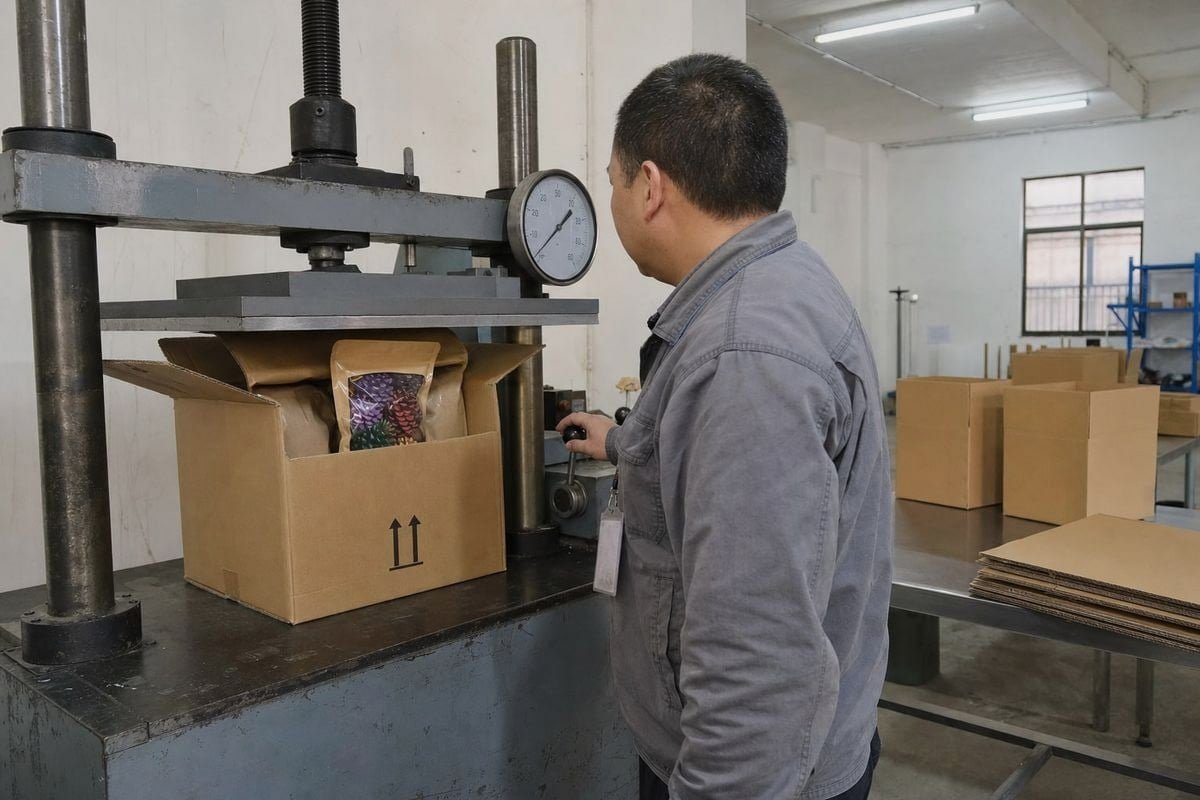
Verifying carton strength for long-distance shipping saved our color-flame pinecone line more than once. One crushed container can wipe out a season's margin. Here is how we prevent that.
To verify carton strength for long-distance shipping of colored pine cones, request ECT and Mullen Burst Test reports, run a Box Compression Test on the packed carton, perform ISTA-style drop and vibration tests, and condition samples at high humidity before approving bulk production.
That is the short answer. Now let me walk you through each step, using what we have learned shipping color-flame pinecones to over 30 countries.
What Carton Strength Test Reports Should I Request Before Placing a Bulk Order?
A German distributor once asked us for "the strongest box available." That request sounds safe, but it misses the point. Our packaging team asks a better question: strong against what, exactly?
Before a bulk order, request three reports: an Edge Crush Test (ECT) report for board stacking strength, a Mullen Burst Test report for puncture resistance, and a Box Compression Test (BCT) report performed on the actual finished carton, not just the raw board.
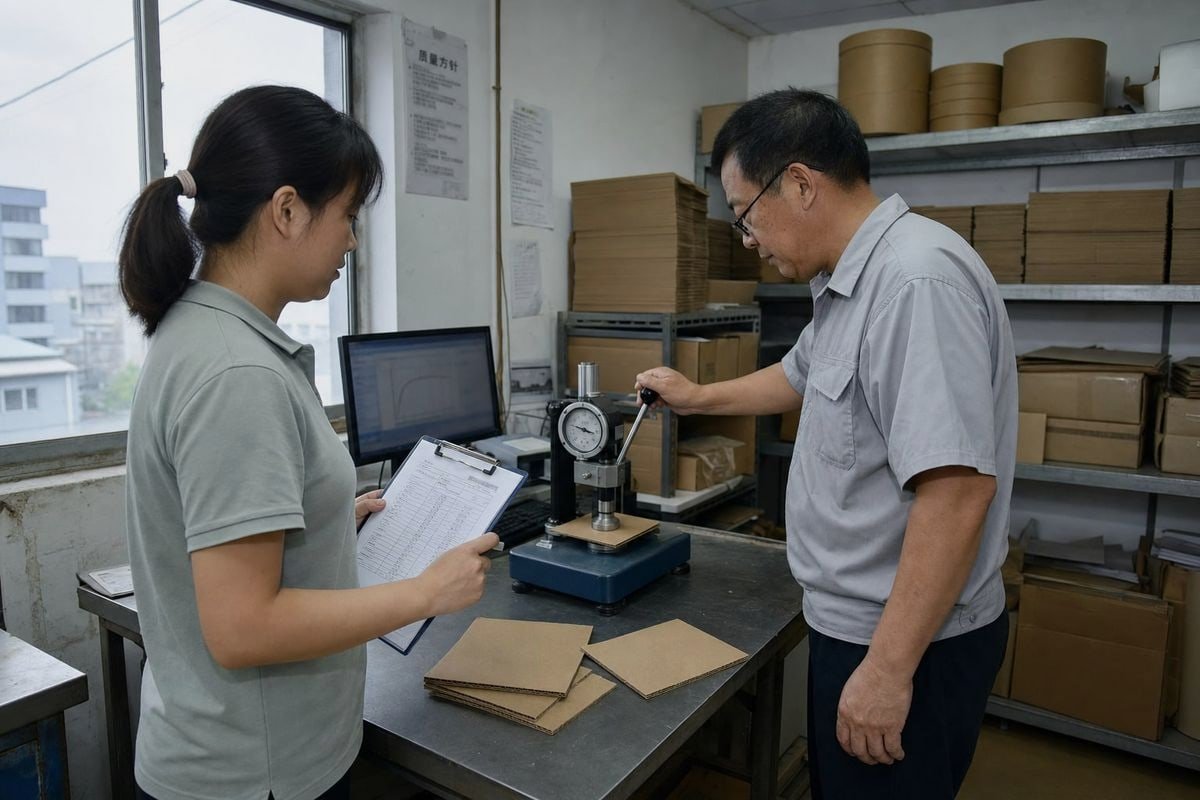
Each report answers a different question, and colored pine cones fail in ways that a single number cannot predict. Pine cones are light but awkward. They shift, rub, and shed scales. So the carton rarely fails from pure weight. It fails from weak seams, soft board, or poor internal design.
The Three Core Reports Explained
Here is how we position each test when a buyer reviews our documentation:
| Report | Test / Norme | Pourquoi c'est important pour les pommes de pin |
|---|---|---|
| Edge Crush Test (ECT) | Edgewise compression strength 1 of the corrugated board | Predicts how the board grade handles pallet stacking |
| Mullen Burst Test | Resistance to bursting or puncture through the wall | Protects against rough handling at sorting hubs |
| Box Compression Test (BCT) | Load the finished, assembled box takes before collapse | Validates the real carton with its glue, size, and print |
The key distinction is this: ECT is a board specification, while BCT is a real-box validation. A supplier can quote an excellent ECT value on paper, yet the finished carton can still underperform because of a poor glue joint, an oversized footprint, or heavy print coverage that weakens the board.
For our color-flame pinecones, we typically specify single-wall board 2 for parcel-weight retail cartons, and double-wall corrugated board for master cartons that face le fret maritime 3 and long stacking dwell times. We also share a simple stacking strength calculation with buyers, so they can see how many layers the master carton supports on a pallet with a safety margin built in.
One more objection we hear often: "Just give me the highest burst rating." That adds cost without solving the real risks. A high Mullen value does not stop vibration abrasion or humidity softening. Ask for all three reports, then match them to your route.
How Do I Know If Packaging Will Survive Ocean Freight to My Warehouse?
Early in our export history, a shipment of decorative cones arrived in Rotterdam with soft, bulging master cartons. The board grade was correct. The humidity planning was not. That lesson reshaped our whole verification process.
Packaging survives ocean freight when it passes a combined test sequence: humidity pre-conditioning, a Box Compression Test on the packed carton, multi-orientation drop tests, and transit vibration protection checks. One test alone cannot prove a carton is sea-freight ready.
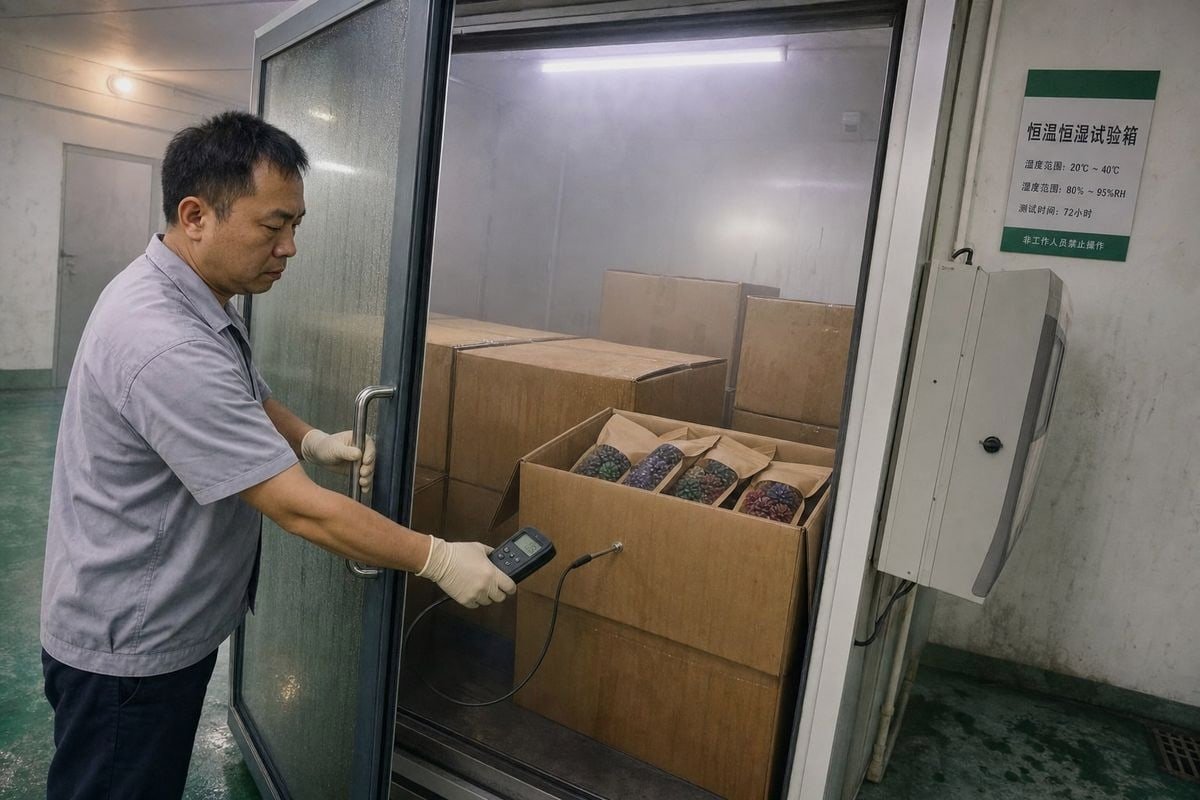
Ocean freight is a worst-case environment. A container can sit in a humid port for weeks. Corrugated board absorbs that moisture, and its compression strength can drop by half. That is why we design for the worst-case route, not the average one. Humidity control in shipping is not an extra; it is part of carton strength itself.
Why Humidity Is the Silent Killer
Natural pine cones are hygroscopic. They release and absorb moisture. So the threat comes from both outside the carton and inside it. Our process addresses both sides:
- We dry and stabilize the cones before packing, checking that board moisture content stays low with a moisture meter.
- We specify moisture-resistant packaging for sea routes, such as coated liners or a poly barrier inside the master carton.
- We condition sample cartons at elevated humidity, then re-test crush resistance. A carton that only passes in a dry lab has not really passed.
Vibration and Shock on Long Routes
Weeks of road, rail, and sea movement create constant low-level vibration. For lightweight decorative goods, this abrades painted surfaces and loosens contents more than it crushes boxes. So we add vibration testing to every export-bound pack design, and we verify that no cone touches the carton wall during movement. Void fill materials, honeycomb inserts, or molded dividers keep the cones locked in place.
Here is the sequence we recommend to buyers, in order:
| Étape | Test | Objectif |
|---|---|---|
| 1 | Humidity pre-conditioning | Simulate port and container moisture exposure |
| 2 | BCT on packed carton | Confirm stacking strength in real conditions |
| 3 | Multi-orientation drops | Check seams, corners, tape, and contents |
| 4 | Vibration run | Detect abrasion, shifting, and closure loosening |
| 5 | Final inspection | Verify structure and appearance both pass |
Test in the same way the box will fail. Real transit combines compression, impact, and environment, so verification must combine them too.
What Certifications Prove My Supplier's Cartons Meet International Shipping Standards?
Compliance paperwork is the first thing serious buyers ask us for, usually before pricing. In our experience exporting to the US, Germany, and the UK, a supplier who hesitates on documentation will hesitate on quality too.
Look for a Box Manufacturer's Certificate stamped on the carton, third-party test reports from labs like SGS or Intertek, ISTA test compliance for transit performance, and supplier-level quality systems such as ISO 9001 and BSCI audits.
Certifications work at two levels: the carton and the company behind it. You need both. A great box from an inconsistent factory only protects your first order.
Carton-Level Documentation
Le Box Manufacturer's Certificate 4 (BMC) is the round stamp printed on the bottom flap of a corrugated carton. It states the board construction, the ECT or Mullen Burst Test rating, and the size and gross weight limits. It is the fastest way to confirm the carton you received matches the specification you paid for. When we ship master cartons of color-flame pinecones, buyers can check the BMC against our packing specification sheet line by line.
Third-party lab reports add independence. We provide SGS et Intertek 5 test documentation on request, because our retail and distributor customers face their own downstream audits. An ISTA 3A 6 drop test report is especially useful if your pine cones will move through parcel networks after arriving at your warehouse, since ISTA 3A simulates the shocks and vibration of small-parcel delivery.
Company-Level Assurance
Factory certifications tell you whether quality repeats. Our ISO 9001 system governs batch-to-batch consistency, so the sample carton you approve genuinely reflects mass production. Our BSCI audit covers conformité sociale 7, which many European retailers now require before listing any product. CE marking applies to the product side of our fire goods.
One nuance worth raising: certificates prove capability, not each shipment. Pair documentation with a simple incoming inspection at your warehouse. Check the BMC stamp, measure a few cartons, and squeeze-test a corner. It takes ten minutes and catches substitution before it becomes a claim.
How Can I Test Sample Cartons Before Committing to a Full Container Order?
The trade-off we weigh with every new buyer is speed versus certainty. A trial order feels urgent, but skipping sample testing to save two weeks can cost a full container later. We always push for the test.
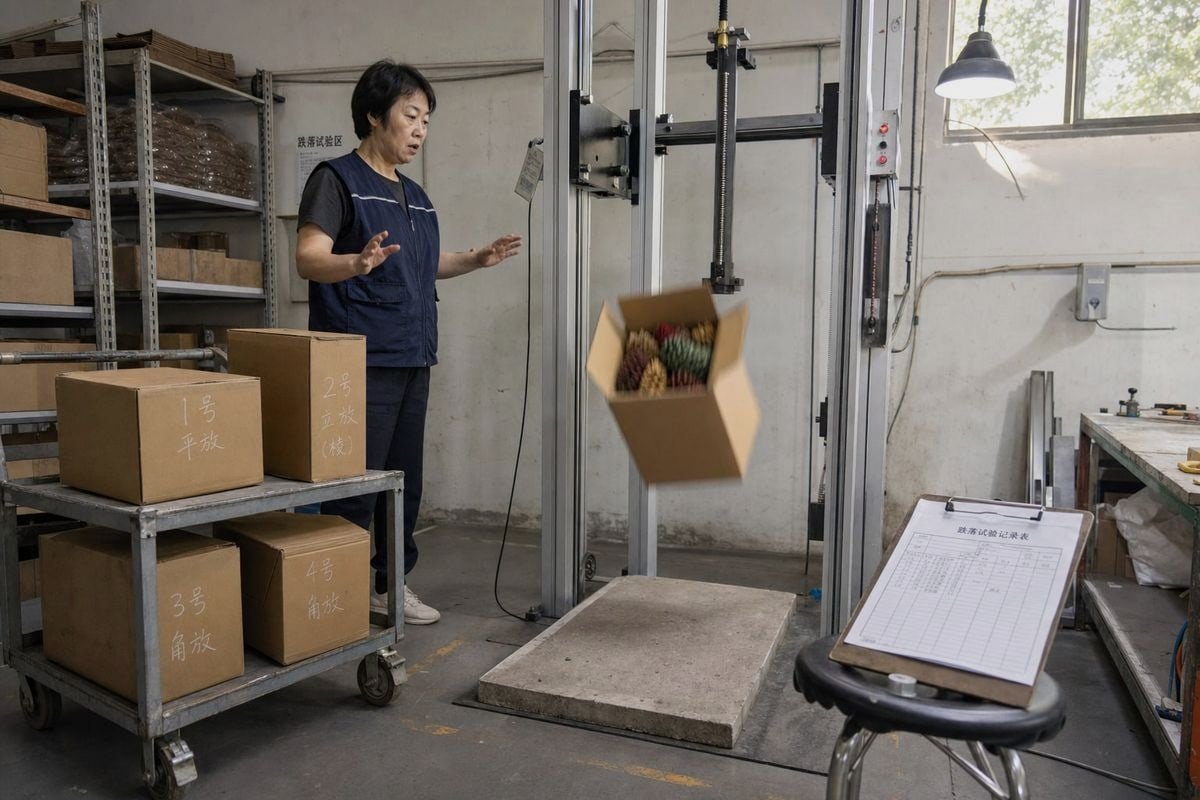
Request packed sample cartons, condition them at realistic humidity, then run drop tests from about 60–80 cm for cartons under 10 kg, add a vibration or rough-transit simulation, and inspect for structural damage, scuffed dye, broken scales, and contents shifting.
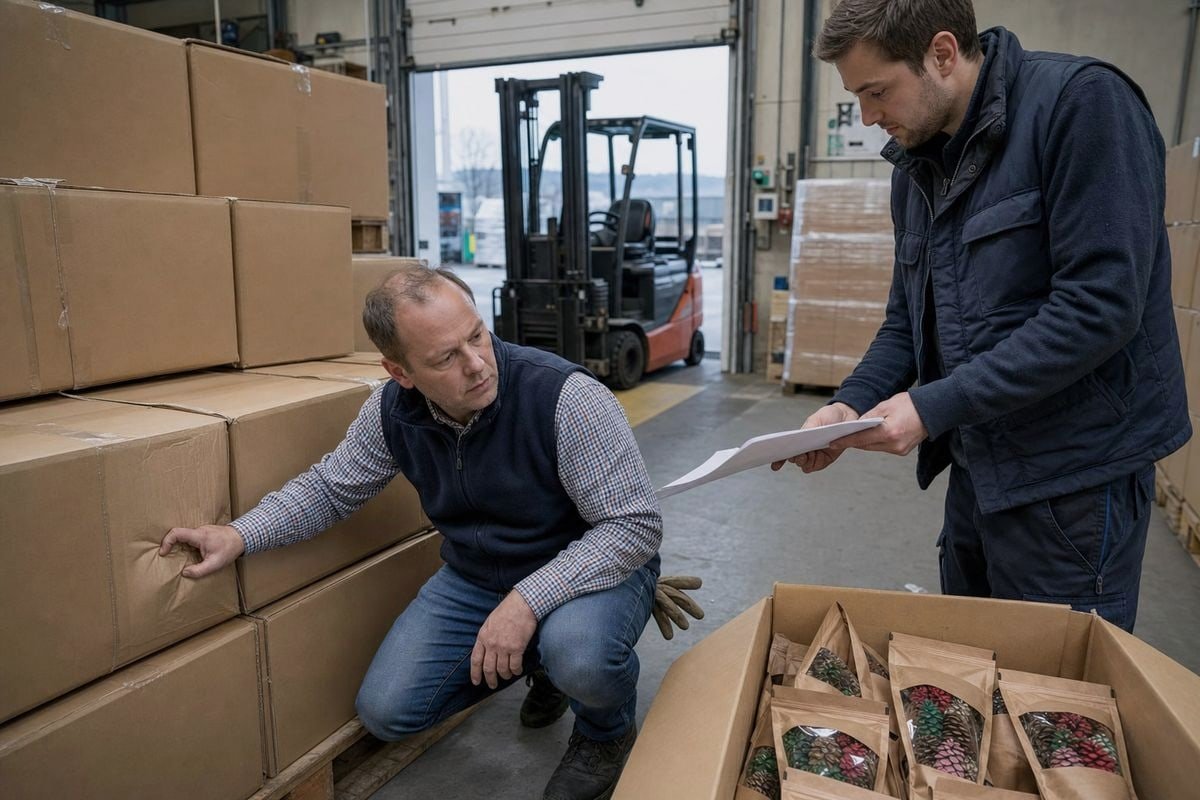
You do not need a full laboratory to run a meaningful sample check. What you need is a repeatable sequence and honest pass/fail criteria. Here is the workflow we share with buyers who test our samples in-house.
A Practical Six-Step Sample Test
- Define acceptance limits first. Decide how much cosmetic damage is tolerable before you drop anything.
- Condition the packed carton for 48 hours in a humid room or near 80% relative humidity if you can manage it.
- Drop the carton from a weight-matched height. Common practice is roughly 76 cm for cartons of 1–9 kg and 61 cm for 10–18 kg.
- Drop on multiple orientations: flat faces, edges, and corners. Corners fail first, so never skip them.
- Simulate vibration. A lab shaker is ideal; a long drive over rough roads with the carton in a van is a rough field substitute.
- Open, inspect, and photograph everything.
What Counts as a Failure
For decorative goods, "pass" means structural integrity plus appearance integrity. Use criteria like these:
| Catégorie | Réussir | Fail |
|---|---|---|
| Carton structure | No collapse, torn seams, or open flaps | Corner bursting, tape failure, flap separation |
| Product condition | Cones intact, scales attached | Broken tips, crushed cones, shed flakes |
| Surface finish | No visible scuffing or dye transfer | Paint rubbed onto liner or other cones |
| Internal pack | Contents held in position by void fill | Cones touching the carton wall after transit |
Because our pinecones carry a painted, lacquered finish, we also test the internal liner against the coating itself, checking that abrasive scales do not saw through the divider fibers and that no dye transfers under vibration. If a sample fails, do not simply jump to heavier board. Fix the internal pack first: tighter dividers, better void fill materials, or a resized carton. Overpackaging lightweight cones wastes money and material. After lab-style validation passes, we recommend one small pilot shipment on your real route before releasing the full container.
Conclusion
Verify carton strength with ECT and burst reports, a BCT on the finished box, drop and vibration testing, and humidity conditioning. Prove the trip, not just the warehouse.
Notes de bas de page
1. Explains the Box Compression Test (BCT) used to measure the stacking capacity of finished shipping containers. ↩︎
2. Provides technical details on corrugated board construction, including single-wall and double-wall configurations for shipping. ↩︎
3. Overview of international ocean freight logistics and the environmental challenges faced during long-distance maritime transport. ↩︎
4. Authoritative Wikipedia entry explaining the certification and its requirements. ↩︎
5. Leading global testing company providing independent verification of packaging performance and international shipping compliance. ↩︎
6. Official ISTA directory for parcel delivery shipment test procedures. ↩︎
7. Details the amfori BSCI system for monitoring and improving social compliance standards in global supply chains. ↩︎



 English
  Spanish
  German
  French
  Arabic
  Portuguese
Rejoignez la conversation