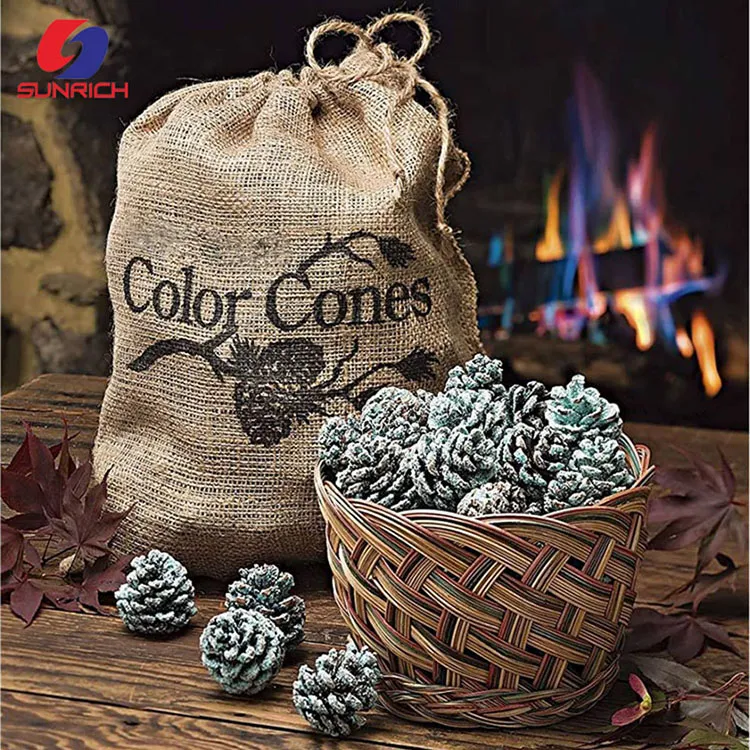

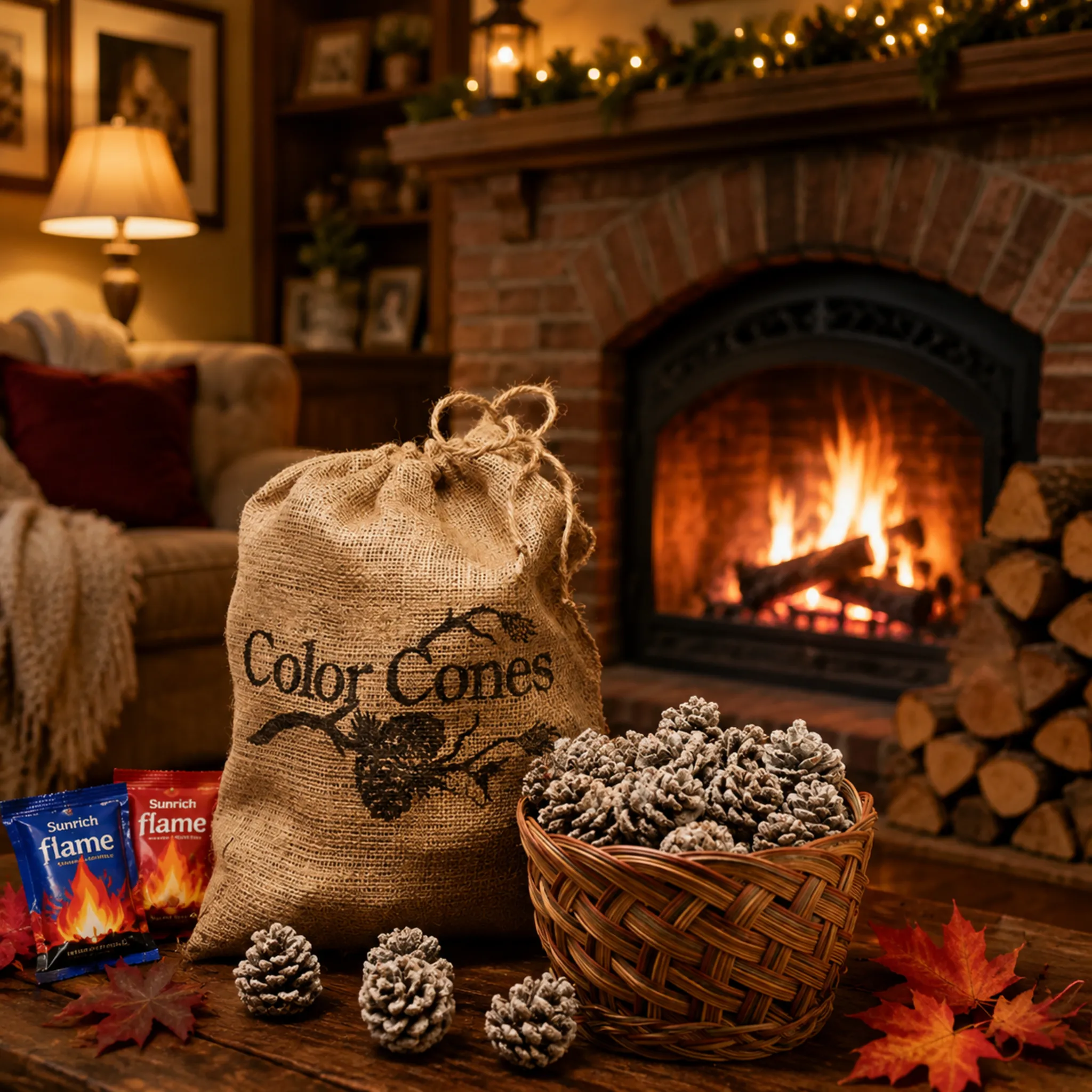


Labeling colored pine cones correctly keeps buyers out of trouble chlorure de potassium 1. On our production line in Ningbo, one mislabeled shipment nearly cost a client a retail contract — labels matter that much.
Suppliers should label colored pine cones with a front-panel statement reading "For wood-burning fireplaces and wood stoves only," plus explicit prohibitions against gas fireplaces, electric fireplaces, and cooking fires, supported by chemical disclosure, prohibition pictograms, and an accessible Safety Data Sheet.
Getting this right is not complicated, but it does require a checklist. Below, I walk through what to demand from your supplier, how to verify it, and what to avoid.
What warning label information should I require from my colored pine cone supplier?
A German distributor once asked us to redraft his entire label set three weeks before shipment. His legal team had flagged missing appliance restrictions. We now build those warnings in from day one.
Require a front-panel "wood fires only" statement, explicit prohibitions against gas fireplaces, electric fireplaces, pellet stoves, and cooking fires, chemical flame colorant disclosure, child and pet warnings, one-color-at-a-time instructions, ventilation guidance, ash disposal directions, and a QR code linking to the Safety Data Sheet.

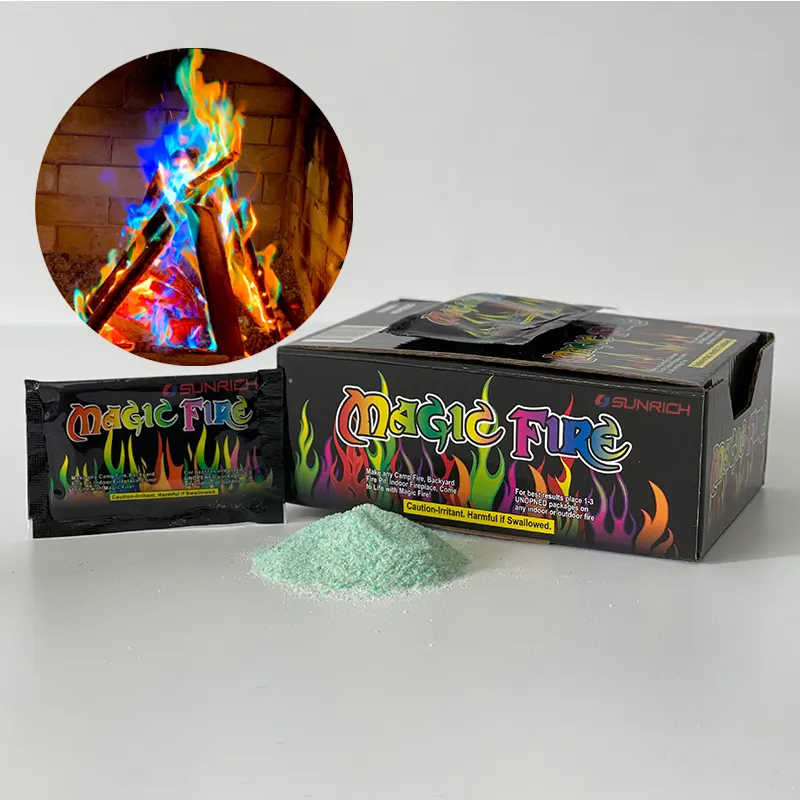
Colored pine cones are not ordinary holiday decor. They are decorative fire starters coated with colorants chimiques pour flammes 2 — typically metal salts such as copper sulfate, chlorure de strontium 3, or potassium chloride. When burned, these compounds produce vivid flames. They can also produce smoke and fumes. That is why the label must treat the product as a controlled-use fire accessory, not a craft item.
Les éléments d'étiquetage non négociables
In our experience exporting to the US and EU, these elements should appear on every retail package:
| Élément d'étiquette | Emplacement | Pourquoi c'est important |
|---|---|---|
| "For wood-burning fireplaces or wood stoves only" | Front panel, prominent | Defines the only approved use case |
| "Do not use in gas fireplaces, electric fireplaces, or pellet stoves" | Front or side panel, bold | Prevents appliance damage and hazards |
| "Do not cook over this fire" | Panneau latéral | Stops toxic vapors from contaminating food |
| Chemical disclosure (metal salts used) | Panneau arrière | Essential for poison control centers |
| "Tenir hors de portée des enfants et des animaux domestiques" | Front or back panel | Coatings are harmful if handled or ingested |
| "Burn one color at a time; do not mix" | Instructions d'utilisation | Mixing formulas creates unpredictable combustion |
| Conseils d'élimination des cendres | Panneau arrière | Metal salt residues 4 should not enter garden soil |
| QR code linked to SDS | Panneau arrière | Instant access for emergency responders |
Why the SDS link matters
Safety Data Sheets are increasingly expected by large retail sourcing channels. A scannable QR code on the pouch gives medical professionals immediate chemical information. We print these on kraft bags, jars, and stand-up pouches alike, and buyers consistently tell us it smooths retailer onboarding.
Wording should be behavior-specific. "Use with caution" tells the consumer nothing. "Do not use in gas fireplaces" tells them exactly what not to do.
Which certifications confirm my supplier's labels meet US and EU compliance standards?
Compliance paperwork is the first thing serious buyers ask us for — usually before they ask about price. After 17 years shipping to 30-plus countries, we treat test reports as part of the product itself.
Look for ISO 9001 quality management, BSCI social compliance, CE marking for EU market access, and third-party test reports from SGS or Intertek confirming label content, chemical safety, and packaging claims. These certifications together verify that warning labels reflect genuinely tested, compliant products.

Certification does two jobs. First, it proves the product behind the label is safe when used as directed. Second, it proves the supplier has a documented process for keeping labels accurate batch after batch. A beautiful warning label on an untested product is worse than useless — it creates false confidence.
How each certification maps to labeling
| Certification / Rapport | Ce qu'il confirme | Relevance to Labeling |
|---|---|---|
| ISO 9001 | Système de management de la qualité | Label content is version-controlled and checked at each production stage |
| Marquage CE | Conformité UE | Product and its warnings meet applicable EU directives |
| Rapports de test SGS / Intertek | Vérification par laboratoire indépendant | Confirms no harmful chemicals beyond declared colorants; supports "eco-friendly" claims |
| BSCI | Audit de production éthique | Required by many EU retailers before listing any fire product |
Regional differences worth knowing
The US and EU do not read labels the same way. US retailers lean heavily on plain-language cautionary statements and clear hazard identification. EU buyers expect CE conformity, multilingual warning text, and standardized pictograms. Our clients in Germany and France routinely request warning panels in three or more languages; our US clients prioritize a bold English front-panel restriction.
One practical tip: ask your supplier for the actual test reports, not just certificate numbers. A factory with genuine documentation will send scans within a day. We keep ours ready because buyers for whom compliance is a hard requirement — not a nice-to-have — will walk away if the paper trail stalls.
How can I verify my supplier's labeling process during sample and mass production?
The trade-off I weigh most often with new buyers is speed versus verification. Everyone wants fast samples. But a sample approved without label checks invites a mass-production surprise, so we push clients to audit labeling at both stages.
Verify labeling by requesting pre-production label artwork approval, physical samples with final printed packaging, batch-level QC records comparing labels to approved masters, third-party inspection of mass production, and confirmation that the SDS QR code resolves correctly before shipment leaves the factory.

The core risk in this category is drift. The sample looks perfect. Then mass production ships with an outdated label file, a missing prohibition line, or a QR code pointing to a dead page. A disciplined process closes those gaps.
Un flux de travail de vérification en cinq étapes
- Approuvez d'abord la conception numériquement. Sign off on the exact label file — including every warning line, pictogram, and barcode — before any printing begins. Keep this file as your master reference.
- Demand a true pre-production sample. The sample must carry the final printed pouch, kraft bag, or jar label, not a placeholder. On our lines, the first sample is built to reflect mass-production quality exactly, and we expect buyers to hold us to that.
- Check the QR code and barcode. Scan them yourself. Confirm the SDS loads, is current, and lists the actual chemical flame colorants used in your batch.
- Require batch QC records. Ask for the checklist showing labels were compared against the approved master during the run. Strict batch-to-batch quality control is what keeps warning text from drifting between orders.
- Réservez une inspection avant expédition. A third-party inspector should pull random cartons, verify label placement and legibility, and photograph packaging against your master file.
What to spot-check on-site or via inspection photos
Focus the inspector on high-risk details: is the "wood fires only" statement on the front panel, not buried on the base? Are prohibition icons — such as the red slash over a gas flame — printed at legible size? Is the ash disposal note present? Small print errors here become large liability exposures at retail.
What labeling mistakes should I watch for when importing colored pine cones for retail?
A lesson we learned early: buyers rarely reject shipments over the product itself. They reject them over packaging. One missing prohibition line once forced a client to re-sticker thousands of pouches at his own warehouse.
Watch for buried warnings in fine print, missing gas and electric fireplace prohibitions, undisclosed chemical colorants, absent cooking-fire warnings, no mixing restriction, imagery showing prohibited uses, missing ash disposal guidance, and marketing claims like "safe for all fireplaces" that contradict the product's actual limitations.

Some suppliers argue these products are perfectly safe, so heavy warnings are overkill. That view is half right — and dangerous. Colored pine cones are safe in the right appliance under the right conditions: an open wood-burning fireplace or wood stove with ventilation. But gas and electric units are a different story. Gas log set damage is a real risk because metal salt residues can foul burners and ceramic logs, and fireplace burner clogging is expensive to repair. In vent-free units, chemical off-gassing can foul the oxygen depletion sensor 6, undermining vent-free fireplace safety and risking monoxyde de carbone 7 accumulation. Electric fireplaces have no real flame at all; organic material on a heating element can trip a non-resettable thermal fuse and permanently disable the appliance. The label must exclude these uses precisely because they are outside the intended combustion environment.
The mistakes ranked by risk
| Erreur | Niveau de risque | Consequence at Retail |
|---|---|---|
| No gas/electric prohibition | Critique | Appliance damage claims, safety incidents, recalls |
| "Safe for all fireplaces" marketing copy | Critique | Direct contradiction of product limits; legal exposure |
| Warnings only in fine print | Élevé | Fails the "prominent and conspicuous" expectation of US retailers |
| No chemical disclosure | Élevé | Poison control cannot respond; retailer delisting |
| Missing cooking-fire warning | Élevé | Food contamination from toxic combustion byproducts |
| No ash disposal instructions | Moyen | Metal salt residues leach into soil and groundwater |
| Packaging imagery showing a gas insert or grill | Moyen | Visual cues override text warnings for many consumers |
| No mention of chimney maintenance | Faible–Moyen | Chimney soot accumulation complaints from heavy users |
The residue problem retailers overlook
Product warning labels usually address the flame. Fewer address what remains afterward. Treated ash carries concentrated metal salts, so disposal guidance — treat it as household hazardous waste where required, never spread it on gardens — belongs on the back panel. Importers who add this line early avoid awkward retailer questions later.
Conclusion
Weak labels turn a charming seasonal product into a liability. Demand front-panel restrictions, verified certifications, and batch-level QC — and partner with a factory that builds compliance in from the start.
Notes de bas de page
1. Authoritative data on potassium chloride, used in fire accessories to produce purple or lilac flame hues. ↩︎
2. Authoritative overview of the chemical compounds used to produce specific flame colors in fire products. ↩︎
3. Detailed chemical information on strontium chloride, the standard compound for producing red flame effects. ↩︎
4. The original 'Metal salts' page is 404; 'Salt (chemistry)' is the correct, active Wikipedia article for this concept. ↩︎
5. Official chemical database entry for copper sulfate, a primary agent for creating blue and green flames. ↩︎
6. The original specific page is 404; the



 English
 Spanish
 German
 French
 Arabic
 Portuguese
Rejoignez la conversation