







Se tromper sur les quantités de boîtes intérieures et de cartons extérieurs pour Magic Fire Powder coûte cher. J'ai vu des acheteurs perdre de la marge sur le fret, des refus de vente au détail et des frais de reconditionnement — tout cela avant même que nos sachets n'atteignent les étagères.
Définir les quantités de boîtes intérieures et de cartons extérieurs pour la poudre Magic Fire en travaillant à rebours à partir de la dose de détail : emballer les sachets à usage unique dans des boîtes intérieures prêtes à l'emploi de 20 à 35 sachets (selon le poids du sachet), puis charger 24 boîtes intérieures par carton principal, en maintenant le poids brut en dessous de 15 kg pour une manipulation sûre.
C'est la réponse courte. Mais les bons chiffres dépendent du poids de votre sachet, de votre canal de vente et de vos besoins de conformité. Laissez-moi vous guider étape par étape.
Comment calculer la bonne quantité de boîtes intérieures pour mes sachets de poudre Magic Fire ?
Sur notre ligne de production de Ningbo, la première question que nous posons à chaque nouvel acheteur ne porte pas sur le prix. Elle porte sur le poids du sachet, car ce chiffre détermine toute la hiérarchie de l'emballage de gros.
Calculer la quantité de boîtes intérieures en faisant correspondre le poids des sachets à la densité d'affichage : 35 sachets pour des sachets de 10 g, 30 pour 15 g, 25 pour 25 g et 20 pour 30 g. Cela permet de maintenir chaque boîte d'affichage de taille et de poids similaires tout en s'adaptant aux présentoirs standards des magasins.

La logique est simple une fois que vous l'avez comprise. Une boîte d'exposition doit atteindre trois objectifs à la fois : elle doit tenir sur une étagère, elle doit être suffisamment légère pour que le personnel du magasin puisse la soulever d'une seule main, et elle doit contenir un nombre propre et comptable d'unités. Les sachets de colorant pour flammes sont vendus en poids échelonnés — 10g, 15g, 25g, 30g, et parfois 35g — donc le compte intérieur varie pour maintenir l'empreinte de la boîte constante.
Commencez par la dose de détail
Les consommateurs jettent un sachet non ouvert dans un feu de camp, et les gros utilisateurs en ajoutent jusqu'à trois pour un grand feu. Ce comportement d'utilisation unique est la raison pour laquelle le sachet, et non le gramme, est votre véritable Unité de Mesure. Tout ce qui est en amont est construit en multiples de ce sachet.
Configurations standard de la boîte intérieure
Voici le tableau de configuration que nous utilisons comme point de départ pour la plupart des commandes OEM :
| Poids du sachet | Sachets par boîte intérieure | Poids net de la boîte intérieure | Canal typique |
|---|---|---|---|
| 10g | 35 | 350g | Présentoirs de comptoir, boutiques de souvenirs |
| 15g | 30 | 450g | Vente au détail de camping |
| 25g | 25 | 625g | Chaînes de magasins d'articles de plein air, présentoirs de comptoir |
| 30g | 20 | 600g | Magasins de cheminées et de foyers |
Un autre point à souligner de nos plus de 17 ans d'exploitation de ces lignes : 25 sachets par présentoir est la demande la plus courante des acheteurs américains et allemands, car elle correspond aux empreintes typiques des présentoirs de comptoir et facilite les calculs de réapprovisionnement. Mais c'est une convention, pas une règle. Lorsqu'une marque néerlandaise de camping nous a demandé 12 unités par boîte intérieure pour correspondre à leur planogramme, nous l'avons fait sans problème — la personnalisation complète de la configuration des cartons est exactement ce pour quoi une usine ODM est là.
Quelles sont les limites de taille et de poids des cartons extérieurs à respecter pour un envoi plus sûr et moins cher ?
Un acheteur en Pologne m'a dit un jour que son précédent fournisseur expédiait des cartons principaux de 25 kg. Son équipe d'entrepôt a refusé de les empiler à la main, et chaque palette a nécessité une reprise. Cette leçon a façonné la façon dont nous spécifions les cartons aujourd'hui.
Suivez une norme de 24 boîtes intérieures par carton principal, en maintenant un poids brut entre 10 et 15 kg. Cela produit 480 à 840 sachets au total selon le poids du sachet, protège l'intégrité du carton pendant le transport maritime et reste dans les limites de manipulation manuelle sécuritaire par une seule personne dans le monde entier.

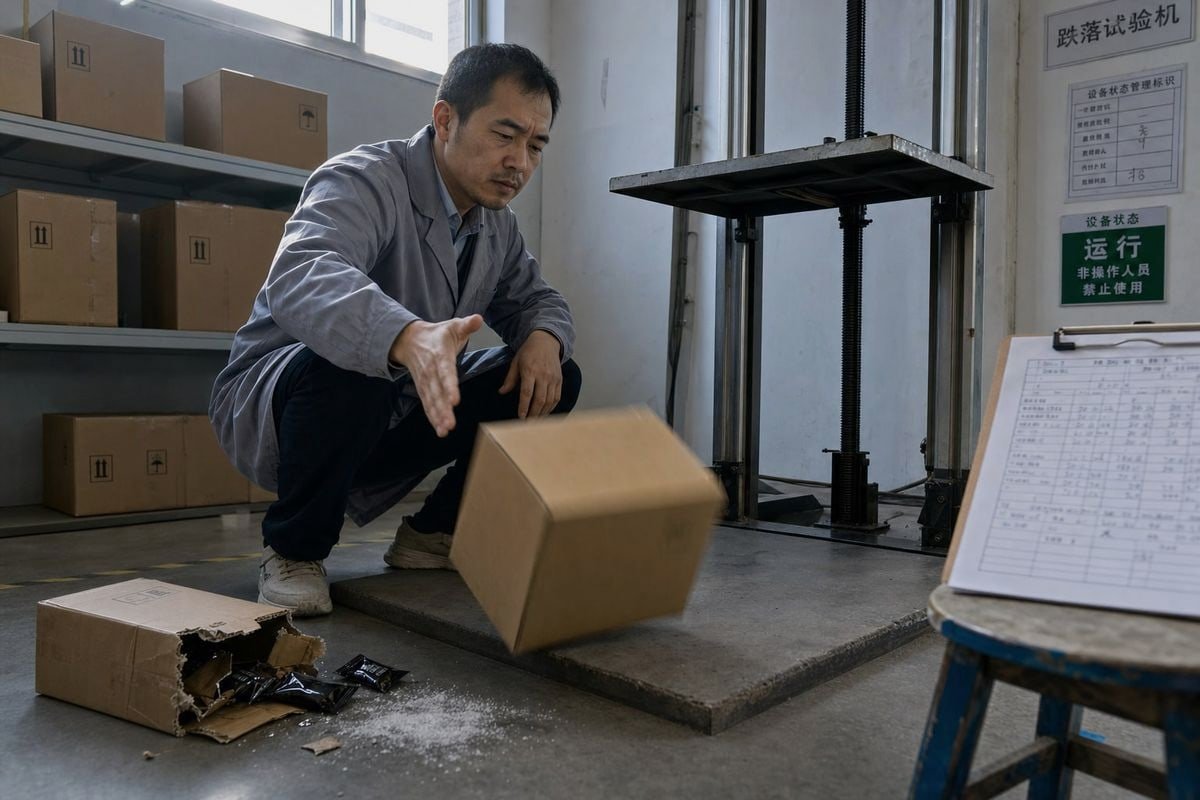
Les spécifications des cartons principaux sont d'abord une décision logistique et ensuite une décision marketing. Le carton doit survivre à un voyage en mer de plus de 30 jours, s'empiler six ou sept couches de haut sur une palette, et passer par les centres de distribution sans s'écraser. Nos ingénieurs spécifient du carton ondulé double paroi 1 avec une résistance à l'éclatement adaptée au poids chargé, et nous soumettons les cartons chargés à des tests de chute avant d'approuver toute nouvelle configuration.
Le carton principal standard de 24 boîtes intérieures
Pourquoi 24 boîtes intérieures ? Parce que 24 se divise proprement en couches de palettes — les configurations 4x6, 3x8 ou 2x12 fonctionnent toutes — ce qui est le fondement des bonnes normes de palettisation 2. Voici comment les quantités totales évoluent :
| Configuration | Boîtes intérieures par carton | Sachets par carton | Poids brut approximatif |
|---|---|---|---|
| Boîtes intérieures de 10g x 35 sachets | 24 | 840 | ~11 kg |
| Boîtes intérieures de 15g x 30 sachets | 24 | 720 | ~13 kg |
| Boîtes intérieures de 25g x 25 sachets | 24 | 600 | ~17 kg (envisager 20 boîtes intérieures) |
| Boîtes intérieures de 30g x 20 sachets | 24 | 480 | ~16 kg (envisager 20 boîtes intérieures) |
Cartons à haute ou basse quantité
Certains acheteurs résistent et demandent des cartons droits de 50 unités sans structure intérieure. Je comprends l'attrait : moins de matériaux, un coût inférieur, une sélection plus simple pour le commerce électronique. Et pour le traitement des commandes en ligne uniquement, cette objection est valable — une approche « Expédié dans son propre emballage » peut réduire considérablement le coût des matériaux d'emballage. Mais pour la distribution au détail, l'effondrement de la hiérarchie se retourne contre vous. Un carton de 600 sachets endommagé sans emballage intérieur signifie 600 unités en vrac à inspecter. Avec des emballages intérieurs d'exposition, les dommages sont contenus boîte par boîte. Les cartons à grand nombre réduisent le fret par unité ; les cartons à faible nombre réduisent le risque de stock. Choisissez en fonction de l'endroit où votre produit se vend réellement.
Suivez le volume, pas seulement le nombre
Chaque feuille d'emballage que nous émettons liste les dimensions du carton, le volume, le poids brut et le code-barres à côté de la quantité. Si le volume de votre carton ne s'adapte pas proprement à votre motif de palette, vous payez pour expédier de l'air. Pour les vendeurs Amazon FBA 3, maintenir les cartons dans des catégories de taille standard réduites réduit considérablement les surcharges de traitement — cela vaut la peine de vérifier avant de finaliser les dimensions.
Comment puis-je aligner les quantités d'emballage avec les exigences d'affichage et d'étagère du commerce de détail ?
Lorsque nous avons développé notre boîte d'exposition à rabat pour les sachets Magic Fire, nous avons d'abord simulé une section complète d'étagère dans notre salle d'exposition. Voir la boîte à côté des articles de camping concurrents a modifié trois de nos décisions de dimensions.
Aligner les quantités avec le commerce de détail en concevant la boîte intérieure comme un présentoir prêt pour l'étagère : adapter son empreinte à la profondeur standard de l'étagère, contenir 20 à 35 sachets pour une plénitude visible tout au long du cycle de vente, et confirmer les quantités par rapport au planogramme du détaillant et aux multiples de réapprovisionnement avant la production.
Emballage prêt pour la vente au détail 4 est l'endroit où votre décision de quantité devient visible pour les acheteurs. Un emballage intérieur d'exposition n'est pas seulement une boîte ; c'est l'unité de marchandisage. Le personnel du magasin le découpe ou le retourne, le place sur l'étagère ou le comptoir, et s'en va. Si le compte est erroné, l'exposition semble à moitié vide en quelques jours ou monopolise l'espace de l'étagère pendant des mois.
Faites correspondre le compte au taux de vente
Pensez à la vitesse à laquelle le produit se vend. Un présentoir de comptoir de 25 unités dans un magasin de camping très fréquenté pourrait se vendre en deux semaines — parfait. Le même présentoir dans un magasin de foyers peu fréquenté pourrait rester pendant une saison, et les derniers sachets semblent avoir été choisis. D'après notre expérience d'exportation dans plus de 30 pays, nous conseillons des comptes intérieurs plus petits pour les canaux spécialisés à faible trafic et des comptes plus grands pour les chaînes de plein air à forte vélocité.
Boîte d'exposition versus emballage intérieur simple
Certains acheteurs en gros nous demandent de sauter l'exposition imprimée et d'utiliser des emballages intérieurs simples en kraft pour économiser des coûts. C'est une objection valable pour la fourniture B2B et hôtelière, où personne ne voit la boîte intérieure. Mais pour la vente au détail aux consommateurs, l'exposition imprimée à rabat fait un véritable travail de vente — notre illustration d'arc-en-ciel sur une boîte noire stimule les achats impulsifs qu'une boîte simple ne fera jamais. Nous imprimons les deux ; le bon choix dépend de qui ouvre la boîte.
Une liste de contrôle d'alignement pratique
- Obtenez la profondeur d'étagère et la largeur de face du détaillant avant de finaliser les dimensions de la boîte.
- Confirmez l'unité de mesure de réapprovisionnement — certaines chaînes commandent par emballage intérieur, d'autres par carton maître.
- Définissez le compte intérieur de manière à ce qu'une nouvelle exposition dure un cycle complet de réapprovisionnement.
- Vérifiez que le compte du carton maître correspond aux multiples de commande minimum du détaillant.
- Testez la stabilité de l'exposition chargée — une boîte trop lourde bascule sur les étagères métalliques.
Le format du sachet est également important ici. Les sachets individuels en aluminium gardent l'exposition propre et la dose infaillible. Les poudres en vrac dans des pots peuvent réduire le coût de l'emballage, mais cela complique les instructions et la présentation sur étagère, de sorte que la plupart des acheteurs au détail restent avec des sachets.
Quelles étiquettes de conformité et quels documents dois-je apposer sur les boîtes intérieures et les cartons extérieurs ?
La conformité est la première question que nos acheteurs européens posent — avant le prix, avant le MOQ. Nos certifications ISO 9001, BSCI, CE et SGS/Intertek existent parce que les douanes et les détaillants exigent des preuves, pas des promesses.
Les boîtes intérieures nécessitent le marquage CE, des avertissements de sécurité interdisant le rôtissage d'aliments et l'utilisation dans des appareils à gaz, des instructions d'utilisation et un code-barres EAN/UPC. Les cartons extérieurs nécessitent un code-barres GTIN-14, des données de quantité et de poids, des marques de manutention et une documentation FDS disponible pour l'expédition et le dédouanement.

Les échecs de documentation arrêtent les expéditions. J'ai vu des conteneurs de concurrents rester à Rotterdam pendant des semaines à cause de documents manquants fiches de données de sécurité 5, nous intégrons donc la conformité dans les spécifications du carton dès le premier jour, pas comme une réflexion après coup.
Étiquetage par niveau d'emballage
Chaque niveau de la hiérarchie porte des informations différentes. Voici la répartition que nous appliquons à chaque commande de marque privée :
| Niveau d'emballage | Éléments requis | Objectif |
|---|---|---|
| Sachet (primaire) | Nom du produit, poids net, avertissements " ne pas ouvrir " et de sécurité incendie | Sécurité du consommateur au point d'utilisation |
| Boîte intérieure (exposition) | Marquage CE, texte d'avertissement complet, instructions, code-barres EAN/UPC, code de lot | Numérisation au détail et informations consommateur |
| Carton principal | Code-barres GTIN-14 6, quantité, poids brut/net, dimensions du carton, marques de manutention | Numérisation d'entrepôt et logistique |
| Documents d'expédition | FDS, rapports de test, copies de certificats | Examen des réglementations d'expédition des matières dangereuses et douanières |
Les exigences de code-barres GTIN-14 piègent de nombreux importateurs pour la première fois : le carton extérieur a besoin de son propre code au niveau du carton, pas d'une répétition du code-barres de détail, sinon les scanners du centre de distribution liront mal les quantités de cartons.
Avertissements de sécurité qui comptent vraiment
Le avertissements obligatoires pour les produits de coloration de flamme incluent : ne pas rôtir d'aliments sur des flammes traitées, ne pas utiliser dans des appareils à gaz propane ou à gaz artificiel, et ne pas ouvrir le sachet avant utilisation. Nous imprimons ceux-ci sur la boîte intérieure et le sachet. Certains de nos acheteurs ajoutent maintenant un code QR sur la boîte intérieure reliant à des conseils de sécurité localisés et à des vidéos explicatives — un moyen intelligent et peu coûteux de réduire l'exposition à la responsabilité sur les marchés.
Classification de transport et protection des matériaux
Même les formulations écologiques et non nocives comme les nôtres doivent être examinées par rapport aux règles sur les marchandises dangereuses pour le marché de destination, car les classifications de poudre combustible peuvent limiter la masse nette de l'emballage intérieur et nécessiter un emballage combiné protégé. Enfin, spécifiez une barrière résistante à l'humidité sur le sachet lui-même — nous utilisons un film métallisé à haute barrière afin que la poudre cristalline ne s'agglomère jamais pendant le stockage en entrepôt humide. La conformité protège le produit ; le film protège la chimie.
Conclusion
Les mauvaises quantités de cartons réduisent silencieusement la marge sur chaque expédition. Commencez par la dose de sachet, construisez des emballages intérieurs prêts pour la vente, spécifiez 24 cartons maîtres intérieurs de moins de 15 kg, et vérifiez la conformité — alors votre poudre magique pour le feu arrive prête pour la vente et rentable.
Notes de bas de page
Définition faisant autorité du matériau d'emballage structurel utilisé pour les cartons maîtres. ↩︎
Explique les normes logistiques mondiales pour l'empilage et l'expédition des marchandises sur palettes. ↩︎
Ressource officielle pour les vendeurs utilisant le réseau de distribution d'Amazon et les exigences d'emballage. ↩︎
Norme de l'industrie pour les emballages conçus pour passer directement de l'expédition à l'étagère. ↩︎
Page officielle de communication sur les dangers de l'OSHA couvrant les réglementations et les exigences des fiches de données de sécurité (FDS). ↩︎
La norme mondiale pour l'identification des articles commerciaux au niveau du carton. ↩︎
Page officielle de la Commission européenne expliquant la conformité obligatoire pour les produits vendus dans l'EEE. ↩︎



 English
  Spanish
  German
  French
  Arabic
  Portuguese
Rejoignez la conversation