






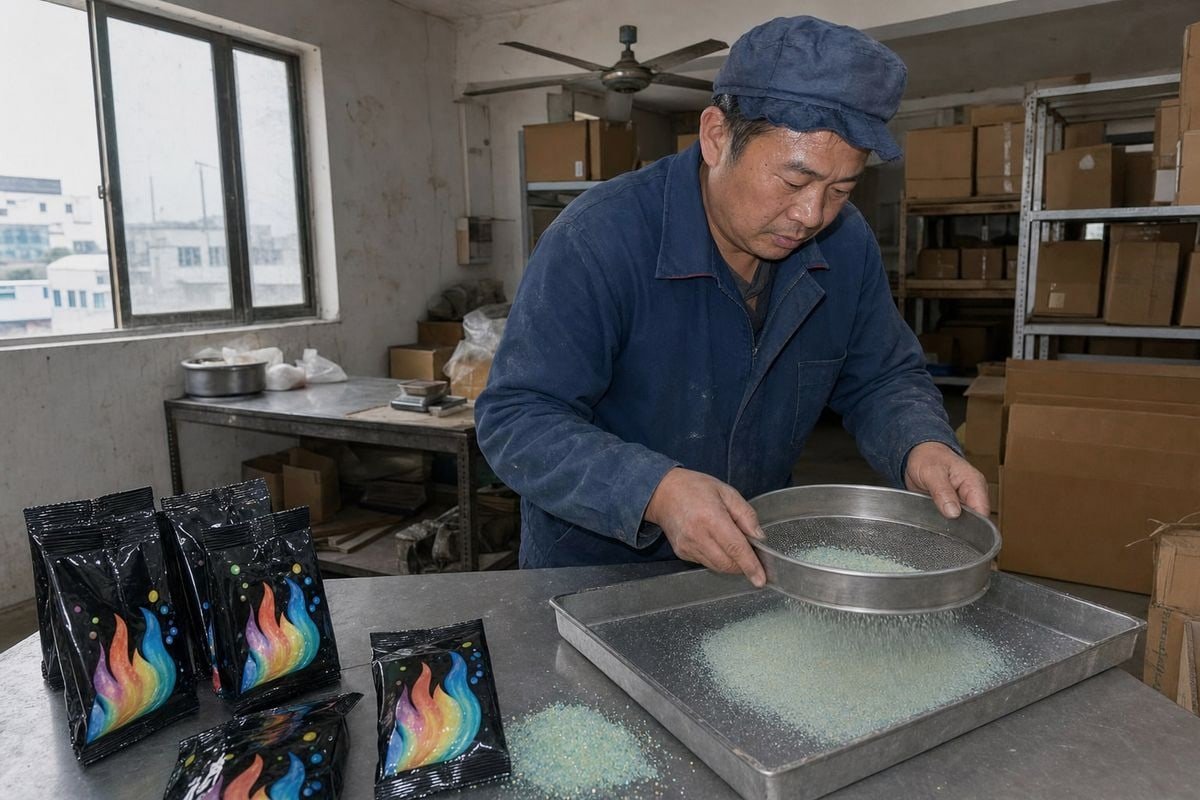
La poudre "Magic Fire" agglomérée est l'une des plaintes les plus fréquentes que notre usine reçoit des importateurs. Un conteneur arrive, les sachets sont durs au toucher, et soudain, une expédition entière semble invendable.
La poudre Magic Fire légèrement humide peut souvent être récupérée en la faisant sécher à l'air en une fine couche dans un endroit sec et ventilé, puis en la tamisant doucement pour retrouver des granulés lâches. Les grumeaux durs et fusionnés ou la poudre pâteuse doivent être jetés et remplacés, car les performances de combustion deviennent imprévisibles.
C'est la réponse courte. L'image complète dépend de la quantité d'humidité que la poudre a absorbée, de la raison pour laquelle elle a été mouillée, et de la manière dont vous prévoyez de l'éviter la prochaine fois. Laissez-moi vous expliquer chaque partie.
Qu'est-ce qui fait que ma poudre Magic Fire absorbe l'humidité et s'agglomère en premier lieu ?
Pendant un mois d'août humide à Ningbo, nous avons effectué un test de stockage sur des échantillons de flammes colorées non scellés. En dix jours, les granulés en vrac s'étaient visiblement collés les uns aux autres. Ce test nous a appris exactement pourquoi l'agglomération se produit.
La poudre Magic Fire s'agglomère car ses colorants de flamme à base de sels métalliques, tels que les cristaux de sulfate de cuivre et le chlorure de strontium, sont hygroscopiques — ils absorbent naturellement la vapeur d'eau de l'air. De mauvais joints, des entrepôts humides, des variations de température et la condensation lors du transport maritime accélèrent tous cette absorption d'humidité.
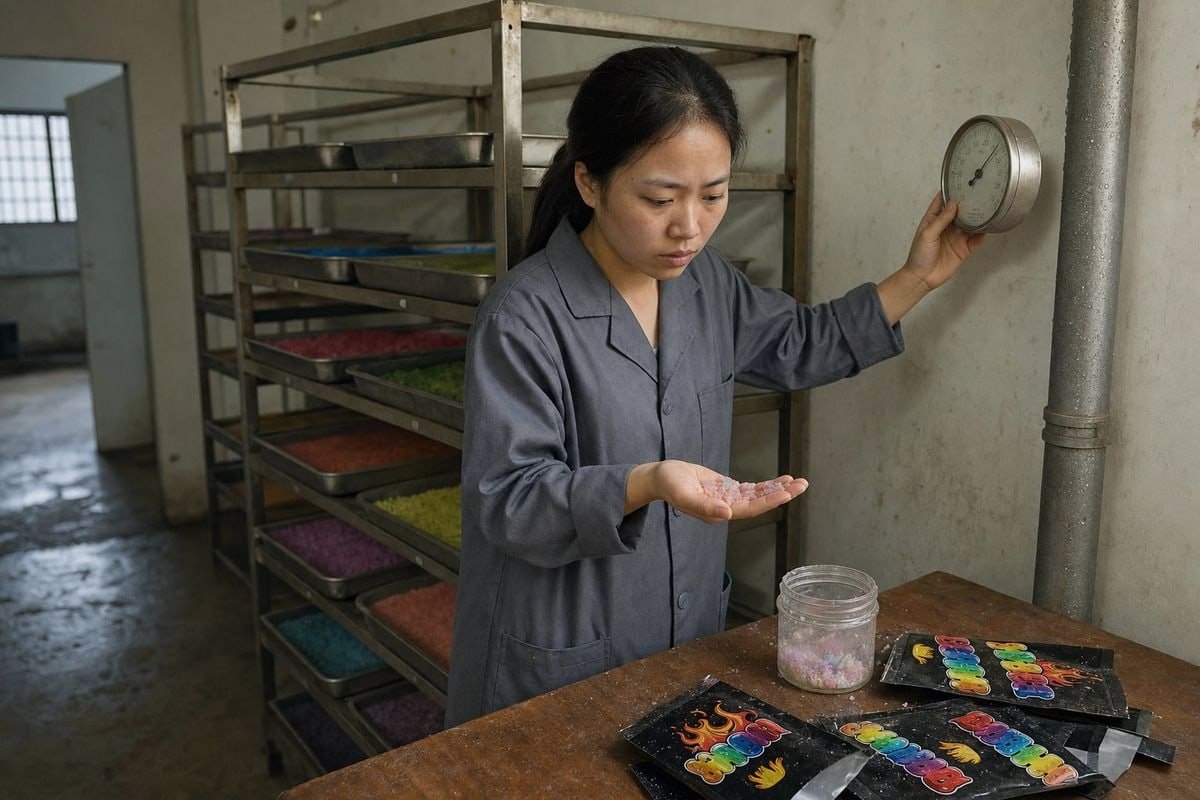
Le problème principal est la chimie, pas l'inadvertance. Les produits à flamme colorée fonctionnent parce que les sels métalliques émettent une lumière colorée lorsqu'ils sont chauffés. Les composés de cuivre donnent des flammes bleues et vertes. Chlorure de strontium 1 donne du rouge. Les sels de potassium donnent du violet. Ces mêmes sels ont de fortes propriétés hygroscopiques 2. En termes simples, ils agissent comme de minuscules éponges. Ils absorbent les molécules d'eau directement de l'air humide.
Une fois qu'un granulé a absorbé suffisamment d'eau, sa surface devient légèrement collante. Les granulés voisins se lient les uns aux autres. D'abord, vous obtenez des amas mous. Ensuite, lorsque la poudre se dessèche d'elle-même, les sels dissous se recristallisent entre les granulés et les enferment dans des mottes dures. C'est pourquoi un sachet aggloméré ressemble souvent à une brique solide, même lorsqu'il semble sec.
Les voies d'humidité les plus courantes
D'après notre expérience d'exportation dans plus de 30 pays, l'humidité ne provient presque jamais d'un événement spectaculaire. Elle résulte de petites expositions répétées.
| Source d'humidité | Comment cela se produit | Niveau de risque |
|---|---|---|
| Scellages de sachets faibles | Des perforations ou un scellage thermique incomplet laissent l'air humide entrer lentement | Élevé |
| Condensation dans le conteneur | "Pluie de conteneur" pendant le transport maritime sur des routes tropicales | Élevé |
| Stockage en entrepôt humide | Poudre stockée près des quais de chargement ou dans des espaces non climatisés | Moyen |
| Emballage de détail ouvert | Consommateurs ou personnel de magasin ouvrant des pochettes et les refermant mal | Moyen |
| Cycles de température | Des variations répétées de chaud et froid provoquent de la condensation à l'intérieur de l'emballage | Moyen |
Pourquoi l'agglomération est importante au-delà de l'apparence
L'agglomération n'est pas seulement cosmétique. Lorsque l'humidité redistribue les sels à l'intérieur du mélange, le mélange d'additifs pyrotechniques devient inégal. Une motte peut brûler avec une couleur vive ; une autre peut à peine modifier la flamme. Pour une marque de détail, cela signifie des expériences client incohérentes et des retours. Pour la sécurité de la combustion, un matériau inégal signifie un comportement imprévisible dans un incendie — jamais une bonne chose.
Puis-je encore utiliser en toute sécurité la poudre colorée pour flammes après qu'elle s'est agglomérée, ou dois-je la jeter ?
Un distributeur allemand nous a un jour envoyé par e-mail des photos de sachets agglomérés provenant de l'expédition d'un concurrent, demandant si le stock pouvait être récupéré. Notre réponse dépendait entièrement d'une question : amas mous ou mottes dures ?
Poudre légèrement agglomérée, toujours granulaire, peut généralement être récupérée : séchez-la à l'air libre en fine couche, puis cassez-la doucement et tamisez-la. Les grumeaux durs fusionnés, la pâte ou la boue doivent être jetés, car les colorants de flamme se sont redistribués et le comportement de combustion n'est plus prévisible.

La réponse honnête est que toute poudre humide n'est pas égale. Il y a une véritable ligne de démarcation entre "légèrement humide" et "compromis". Tracer cette ligne protège à la fois vos marges et vos clients finaux.
Le test de décision de récupération
Voici le contrôle pratique que nous enseignons aux acheteurs. Pressez doucement un amas entre vos doigts gantés.
| Condition | Ce que vous voyez | Verdict |
|---|---|---|
| Coulant librement avec quelques amas mous | Les amas s'effritent sous une légère pression des doigts | Récupérable |
| Aggrégation molle uniforme | La poudre se sépare mais semble légèrement humide | Probablement récupérable après un séchage complet |
| Mottes dures fusionnées | Les mottes résistent à la pression ; ressemblent à de la pierre ou à une brique | Jeter |
| Pâte, boue ou taches humides visibles | Le matériau s'étale ou colle | Jeter |
| Fleur de cristal blanche en surface | Les sels ont migré et se sont recristallisés | Jeter |
Comment récupérer les cas d'amas mous
Suivez un processus conservateur. Ne vous précipitez pas avec de la chaleur.
- Portez des gants en nitrile et un masque anti-poussière. La fine poussière de sel métallique ne doit pas être inhalée.
- Étalez la poudre en une couche fine et uniforme sur un plateau propre et non réactif.
- Laissez sécher à l'air dans une pièce sèche et bien ventilée, à l'abri des flammes nues, des radiateurs et de la lumière directe du soleil à travers une vitre.
- Une fois complètement sec, passez le matériau à travers un tamis fin en acier inoxydable pour briser les amas mous et enlever les nodules durs.
- Transférez immédiatement la poudre restaurée dans un récipient hermétique avec un sachet de gel de silice déshydratant à l'intérieur.
Ce qu'il ne faut pas faire
Évitez les fours, les déshydrateurs, les micro-ondes et tout séchage à haute température. Les conseils sur le séchage en four à 50°C pour les poudres ménagères ne s'appliquent pas en toute sécurité aux additifs pyrotechniques. La chaleur peut déclencher l'oxydation des sels métalliques, dégrader le mélange de colorants ou créer un risque d'incendie réel. Évitez également les broyeurs et les mixeurs. La friction mécanique et les étincelles autour des mélanges combustibles présentent un risque de sécurité de combustion, pas une solution. Et ne dissolvez pas les grumeaux durs dans l'eau pour les recristalliser — il s'agit d'un retraitement amateur d'un produit chimique, et le matériau résultant ne correspondra pas à la formulation d'origine.
Comment dois-je stocker et emballer la poudre Magic Fire pour éviter les dommages dus à l'humidité pendant l'expédition et le stockage ?
Nous avons modifié notre propre spécification de film pour sachets il y a des années après avoir suivi les plaintes d'humidité d'un client brésilien. La leçon était simple : la prévention est bien moins chère que la récupération.
Conservez la poudre Magic Fire dans un emballage scellé, étanche à l'humidité — sachets en aluminium ou pochettes doublées — à l'intérieur de contenants hermétiques avec du gel de silice déshydratant. Maintenez l'humidité de l'entrepôt en dessous d'environ 60 %, évitez les variations de température, gardez les cartons hors des sols en béton et utilisez un déshydratant dans les conteneurs d'expédition.

La protection contre l'humidité fonctionne par couches. Aucune barrière unique n'est parfaite, donc un bon système empile plusieurs barrières imparfaites ensemble. Lorsqu'une couche s'affaiblit, la suivante tient.
Couche un : le sachet primaire
Le sachet en contact avec la poudre est le plus important. Le film laminé en feuille d'aluminium a un taux de transmission d'humidité bien inférieur au film plastique simple. C'est pourquoi nos propres sachets Magic Fire utilisent des sachets laminés en feuille thermosoudés avec des bords sertis. Une soudure thermique solide et continue est aussi importante que le film lui-même. Un film de qualité supérieure avec un trou d'épingle dans la soudure échoue comme un film bon marché. 3 taux de transmission d'humidité.
Couche deux : emballage secondaire
Les pochettes à fermeture éclair Kraft, les boîtes d'exposition et les bocaux ajoutent un deuxième tampon. Les fermetures éclair refermables aident les consommateurs à protéger les sachets restants après avoir ouvert un multi-pack. Pour les formats de bocaux, un joint en silicone est plus performant qu'un couvercle à pression lâche.
Couche trois : conditions d'entrepôt et de transit
| Point de contrôle | Pratique recommandée | Pourquoi ça marche |
|---|---|---|
| Humidité de l'entrepôt | Maintenir en dessous d'environ 60% d'humidité relative | Ralentit l'absorption d'humidité à travers les défauts d'étanchéité |
| Contact avec le sol | Palettes sur des sols en béton | Le béton transmet l'humidité du sol dans les cartons |
| Chargement du conteneur | Ajouter déshydratant de conteneur 4 bandes ou sacs | Absorbe la condensation "pluie de conteneur" sur les routes maritimes |
| Doublure de carton | Doublures en polyéthylène ou film rétractable autour des palettes | Bloque l'air humide pendant les retards de quai |
| Rotation des stocks | Premier entré, premier sorti | Limite le temps d'exposition total pour chaque lot |
| Stock ouvert | Refermer avec du gel de silice déshydratant à l'intérieur | Extrait l'humidité résiduelle des sachets restants |
Une note sur les saisons d'expédition
Le transit maritime par les routes tropicales en été est la fenêtre la plus risquée. Les températures intérieures des conteneurs fluctuent fortement entre le jour et la nuit, entraînant des cycles de condensation. Si vos expéditions traversent l'équateur ou arrivent pendant votre saison des pluies, demandez à votre fournisseur d'augmenter la quantité de déshydratant dans le conteneur pour ces commandes spécifiques. Nous le faisons régulièrement pour les expéditions au Moyen-Orient et au Brésil, et cela coûte presque rien par rapport à une cargaison endommagée.
Quelles normes d'emballage et de contrôle qualité devrais-je demander à mon fournisseur pour éviter ce problème dans les futures commandes ?
Les responsables des achats qui visitent notre siège de Liuyang posent généralement la même question intelligente : que faut-il écrire dans le bon de commande pour que l'agglomération ne devienne jamais leur problème ?
Demander des sachets barrière anti-humidité en laminé aluminium avec tests de vérification d'intégrité des soudures, contrôles de teneur en humidité au niveau des lots, inclusion de dessicant, rapports de test SGS ou Intertek, production ISO 9001, stockage sous atmosphère contrôlée avant chargement, et dessicant pour conteneur pour le fret maritime — le tout spécifié par écrit sur le bon de commande.

Les plaintes d'agglomération remontent presque toujours à une spécification qui n'a jamais été écrite. Si la protection contre l'humidité n'est pas dans votre bon de commande, vous ne pouvez pas l'appliquer. Voici ce qu'il faut mettre sur papier.
La liste de contrôle des spécifications d'emballage
Demandez à votre fournisseur de confirmer chacun de ces éléments par écrit avant le début de la production :
- Film laminé en feuille d'aluminium ou film à haute barrière équivalent pour le sachet primaire, avec la structure du film nommée.
- Intégrité de la thermosoudure vérifiée par des tests de soudure réguliers sur la ligne de production, pas seulement des contrôles visuels.
- Gel de silice déshydratant inclus dans les cartons principaux ou les bocaux, avec le poids en grammes spécifié.
- Teneur en humidité de la poudre finie vérifiée au niveau du lot avant le remplissage.
- Stockage hermétique des produits finis dans un entrepôt sec jusqu'au chargement du conteneur.
- Desiccants pour conteneurs ajoutés pour les expéditions maritimes, adaptés à l'itinéraire et à la saison.
- Étiquettes d'avertissement conformes, codes-barres et instructions imprimés correctement pour votre marché.
Certifications et rapports qui comptent vraiment
Pour les produits à flamme colorée, la conformité est une exigence stricte, pas une décoration. Nos propres acheteurs aux États-Unis, en Allemagne et au Royaume-Uni n'inscriront pas un produit sans documentation. Exigez Gestion de la qualité ISO 9001 5, la conformité sociale BSCI, le marquage CE le cas échéant, et les rapports de test par des tiers tels que SGS ou Intertek. Demandez à voir les vrais rapports Marquage CE 6 avec les descriptions de produits correspondantes — pas seulement des logos sur un site Web.
Cohérence de l'échantillon à la production de masse
Un piège dont nous avertissons les acheteurs : un bel échantillon doré suivi d'une commande en vrac bâclée. Exigez que votre fournisseur exploite des lignes de production complètes avec un contrôle qualité lot par lot, de sorte que le premier échantillon reflète véritablement la qualité de la production de masse. Demandez comment ils documentent chaque lot. Une usine avec plus de 17 ans d'historique de production Conformité sociale BSCI 7 devrait répondre à ces questions immédiatement et spécifiquement. Une société commerciale ne le peut généralement pas, car elle ne contrôle pas la ligne. Cette différence se manifeste des mois plus tard — souvent sous la forme d'une palette de sachets agglomérés.
Conclusion
La poudre de feu magique agglomérée signifie des ventes perdues et un risque pour la sécurité. Récupérez les amas mous en les séchant à l'air et en les tamisant, jetez les grumeaux durs et évitez les répétitions avec un emballage barrière, des dessicants et des normes de contrôle qualité écrites du fournisseur.
Notes de bas de page
Explique le composé chimique responsable de la coloration rouge de la flamme mentionnée dans l'article. ↩︎
Définit la propriété chimique absorbant l'humidité, essentielle pour expliquer pourquoi la poudre s'agglomère. ↩︎
Contexte technique sur la propriété du film qui détermine l'efficacité de l'emballage contre l'humidité. ↩︎
Le contexte sur les dessicants soutient les recommandations de contrôle de l'humidité pour l'expédition et le stockage de l'article. ↩︎
Ressource officielle du NIST détaillant la mise en œuvre de l'ISO 9001 et la gestion de la qualité pour les organisations de fabrication. ↩︎
Source officielle de l'UE expliquant l'exigence de marquage CE référencée pour la documentation de conformité. ↩︎
Source officielle décrivant la norme d'audit de conformité sociale que les acheteurs sont invités à exiger. ↩︎


 English
  Spanish
  German
  French
  Arabic
  Portuguese
Rejoignez la conversation