







Les acheteurs demandent souvent à notre usine des matériaux de produits originaux pour les pages A+, puis se retrouvent bloqués car ils ne spécifient jamais les fichiers, les formats ou les droits d'utilisation — et les lancements sont retardés de plusieurs semaines.
Pour demander des supports produits originaux pour les pages A+ à un fournisseur de Magic Fire Powder, demandez des photos haute résolution, des illustrations d'emballage, des fiches de données de sécurité (FDS), des certifications, des spécifications techniques, des vidéos de démonstration et une lettre d'autorisation écrite — en précisant les formats de fichiers, la résolution et les droits d'utilisation commerciale dans une seule demande claire.
Ci-dessous, je décompose cela en quatre questions pratiques documentation CE 1. Chaque section montre exactement ce qu'il faut demander, pourquoi c'est important et comment vérifier ce que vous recevez.
Quelles certifications et rapports de test dois-je demander avant de créer mon contenu de page A+ ?
Au printemps dernier, un distributeur américain nous a envoyé un e-mail de deux lignes demandant "tous vos certificats". Nous avons envoyé douze fichiers. Il en fallait trois. Une demande précise fait gagner une semaine à tout le monde.
Avant de créer du contenu A+ pour la poudre magique à feu, demandez la Fiche de Données de Sécurité (FDS) du fournisseur, les rapports de test SGS ou Intertek, la documentation CE, les certificats ISO 9001 et BSCI, ainsi qu'une confirmation écrite des allégations de sécurité que le fournisseur autorise pour une utilisation publique.
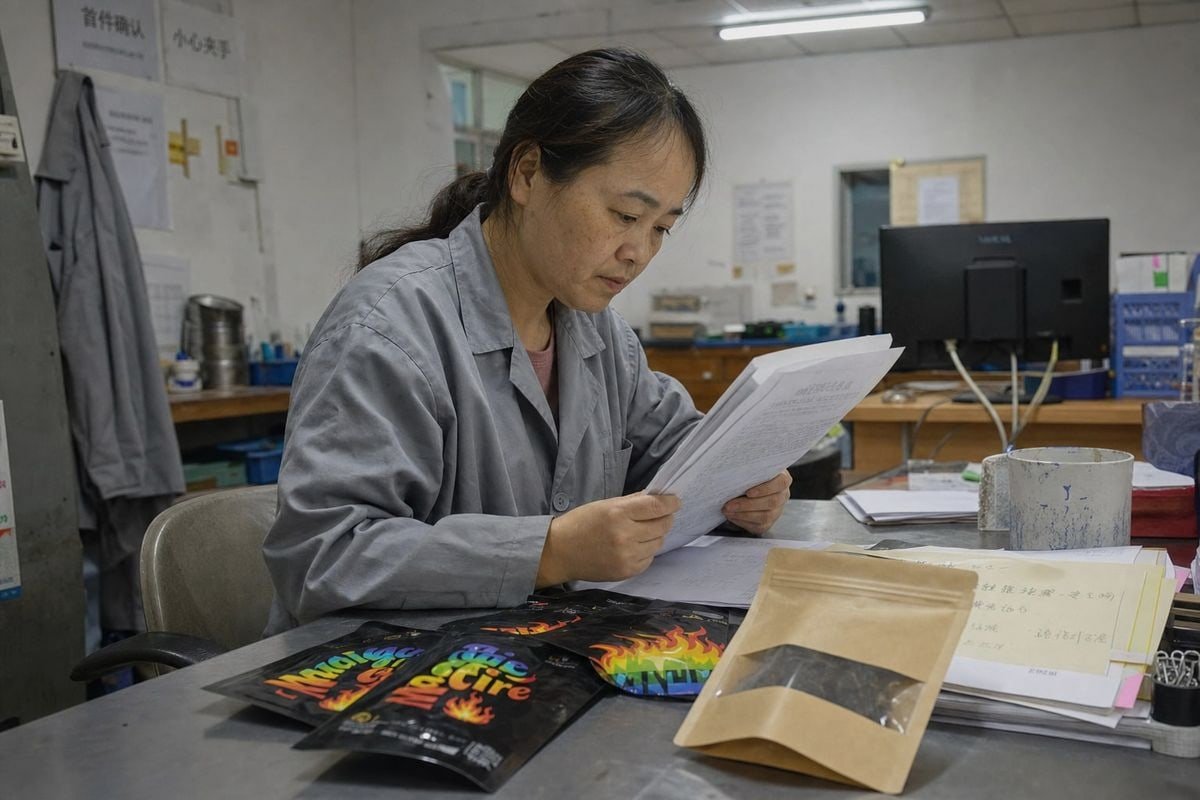
La documentation est la base du contenu amélioré de marque Amazon conforme. Pour un produit de coloration de flamme, ce n'est pas une option. Amazon peut supprimer les listes qui font des affirmations de sécurité non étayées. Le texte de votre page A+ doit remonter à des documents réels, pas à des suppositions.
Voici ce que nous remettons aux acheteurs le premier jour, et ce que vous devriez exiger de tout fournisseur :
Voici l'ensemble exact que nous préparons pour nos acheteurs d'exportation. Demandez à votre fournisseur chaque article par son nom.
| Document | Ce qu'il prouve | Où vous l'utilisez sur les pages A+ |
|---|---|---|
| Fiche de Données de Sécurité (FDS) | Composition, dangers, manipulation, stockage | Déclarations de sécurité, avertissements |
| Rapport de test SGS / Intertek | Vérification par des tiers des normes de sécurité des colorants de flamme Rapport de test SGS ou Intertek 2 | Badges de confiance, tableaux comparatifs |
| documentation CE | Conformité au marché de l'UE | Listes du marché européen |
| ISO 9001 3 certificat | Système de management de la qualité | Crédibilité du module Histoire de marque |
| rapport d'audit BSCI 4 | Conditions d'usine éthiques | Message sur les valeurs de la marque |
| Feuille de revendications autorisées | Quelles déclarations le fournisseur approuve | Tous les modules de texte |
Pourquoi la feuille de revendications autorisées est la plus importante
D'après mon expérience d'exportation dans plus de 30 pays, le plus grand risque pour les pages A+ n'est pas de manquer des certificats. C'est un vendeur qui invente une affirmation que les documents ne soutiennent pas. Certains produits de coloration de flamme sur le marché sont conçus pour être utilisés avec des carburants spécifiques ou dans des foyers spécifiques. Si les instructions de votre fournisseur limitent l'utilisation, le texte de votre page A+ doit refléter cette limite. Demandez directement au fournisseur : "Quelles affirmations concernant la sécurité, l'éco-compatibilité et l'utilisation autorisez-vous par écrit ?" Nos paquets utilisent des matériaux écologiques sans produits chimiques nocifs, et nous confirmons exactement cette formulation par écrit afin que les acheteurs ne devinent jamais.
Vérifiez les dates
Les rapports de test vieillissent. Un rapport d'il y a cinq ans peut ne pas couvrir la formulation actuelle ou le lot actuel. Demandez la date du rapport, le numéro du lot testé, et si la formule a changé depuis le test. Un fournisseur ayant une profondeur de fabrication réelle peut répondre en un e-mail. Une société de négoce généralement pas.
Comment obtenir des images et des vidéos de produits en haute résolution qui montrent une qualité de production de masse réelle ?
Nous avons une fois expédié une commande d'essai à un distributeur allemand de foyers dont le designer a rejeté toutes les photos de leur fournisseur précédent — toutes des captures d'écran de 800 pixels. Notre studio a refait la prise de vue de la ligne en trois jours.
Demandez des photographies originales de produits en haute résolution — clichés sur fond blanc, images de style de vie, gros plans d'emballage et photos de flammes en basse lumière — ainsi que des vidéos de démonstration de produits HD dans des fichiers modifiables ou de grand format (JPG, PNG, PSD, MP4), prises à partir de lots de production de masse réels, et non d'échantillons prototypes.
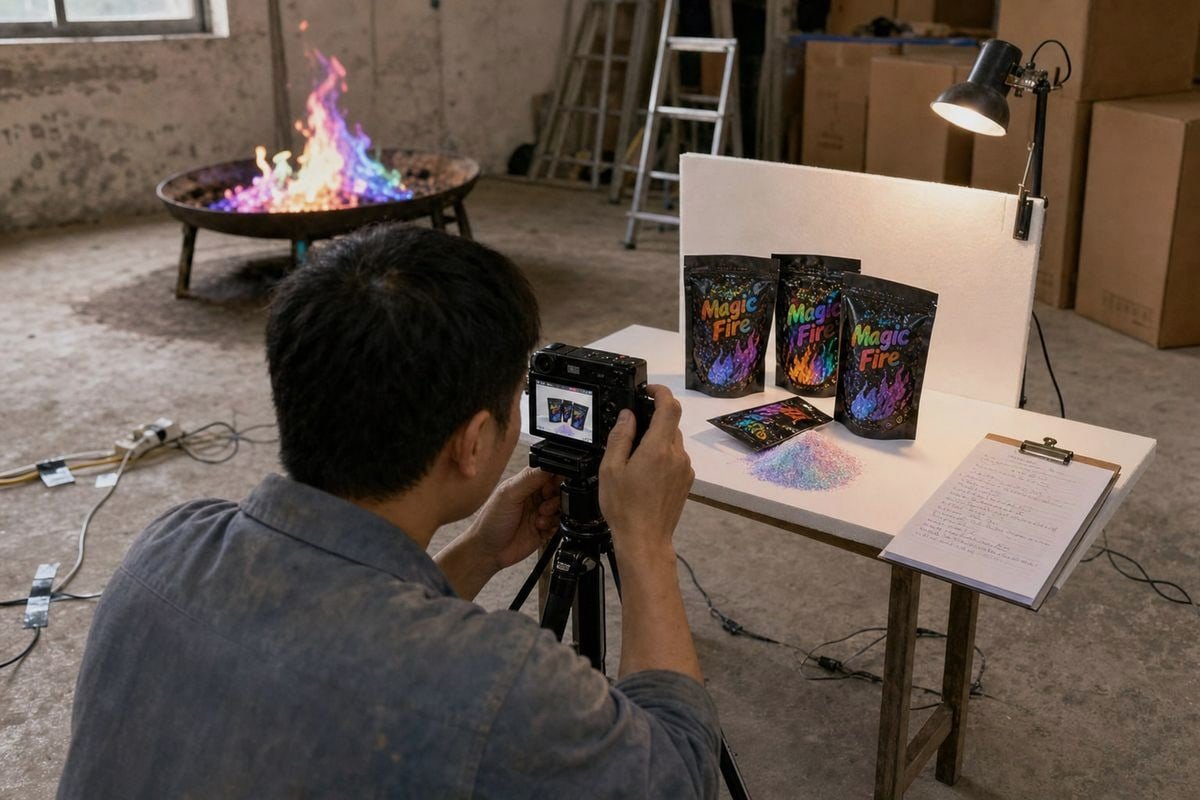
"Veuillez envoyer les matériaux" est trop vague. Cela invite à des captures d'écran WeChat de faible résolution. Au lieu de cela, nommez les types d'actifs exacts et les spécifications dont vous avez besoin. Voici comment je recommande de structurer la demande d'images et de vidéos.
Spécifiez les types d'actifs, pas seulement "des photos"
Un kit complet d'actifs marketing pour une liste de poudre magique pour le feu devrait inclure :
- Photos principales sur fond blanc de la pochette, du pot ou du sac kraft sous plusieurs angles.
- Images de style de vie montrant la poudre utilisée lors de feux de camp, de foyers extérieurs et de foyers intérieurs — des environnements diversifiés élargissent votre public.
- Photos de détails de l'emballage: gros plans de l'étiquette, zones d'étiquettes d'avertissement, zones de codes-barres et photos de cartons.
- Photographie de flamme en basse lumière qui capture le spectre de couleurs bleu, vert et violet sans surexposer les hautes lumières. Celles-ci font de fortes bannières principales.
- Vidéos de démonstration de produits en HD, suffisamment courts pour les modules vidéo Premium A+, montrant l'effet de changement de couleur du versement à la flamme complète.
- Vidéo à haute fréquence d'images de la réaction de couleur, si disponible, pour des boucles au ralenti.
- Images de l'usine et du contrôle qualité — inspection des lots, étapes de traçabilité des matières premières — idéales pour le module Histoire de marque.
Spécifiez les exigences techniques
| Exigence | Spécification minimale | Pourquoi c'est important |
|---|---|---|
| Résolution de l'image | 1600 px+ sur le côté le plus long | Permet le zoom Amazon et un recadrage net |
| Espace colorimétrique | RVB | Amazon rejette ou déforme les fichiers CMJN |
| Format de fichier | Grand JPG/PNG ; PSD si modifiable | Flexibilité de post-production |
| Format vidéo | MP4, 1080p ou supérieur | Compatibilité module vidéo Premium A+ |
| Lot source | Série de production en masse | Le premier échantillon doit correspondre au produit de l'étagère |
Insister sur l'imagerie de production en masse
Voici un compromis que j'évalue constamment sur notre site de production de Ningbo : les photos de prototypes sont plus nettes, mais elles peuvent induire en erreur. Parce que nous effectuons un contrôle qualité strict lot par lot, notre premier échantillon reflète de manière fiable la qualité de la production en masse — nous photographions donc de vrais lots de production. Demandez à votre fournisseur si les images montrent une série de production réelle. S'ils hésitent, demandez des photos de contrôle qualité sur le terrain pour vérification. Cette seule question permet d'écarter la plupart des sociétés commerciales.
Quelles spécifications techniques et informations de sécurité mon fournisseur doit-il fournir pour un contenu A+ conforme ?
Un acheteur canadien a une fois construit son tableau de comparaison complet à partir de notre fiche technique — temps de combustion, couverture, poids net, instructions de stockage — et sa fiche produit a surpassé un concurrent qui avait deviné les chiffres.
Votre fournisseur doit fournir des spécifications techniques complètes du produit — poids net, dimensions, nombre d'emballages, durée de combustion, gamme de couleurs de flamme, instructions d'utilisation, conseils de stockage, texte d'avertissement et informations de sécurité basées sur la FDS — au format PDF en anglais, afin que chaque allégation de module A+ soit vérifiable.

La précision technique entraîne l'optimisation du taux de conversion 5 plus que la plupart des vendeurs ne le réalisent. Les acheteurs comparant des produits à flammes colorées recherchent des chiffres concrets : combien de temps brûle un paquet, combien de paquets par boîte, quelles couleurs apparaissent. Une copie vague fait perdre la vente. Une copie erronée fait perdre le compte.
La fiche technique que vous devriez exiger
À notre siège de Liuyang, nous maintenons une fiche technique standard en anglais pour chaque référence. Votre fournisseur devrait être en mesure d'en envoyer une équivalente. Elle devrait couvrir :
| Catégorie de spécification | Détails à demander |
|---|---|
| Physique | Poids net par paquet, dimensions du paquet, nombre de paquets par boîte, dimensions et poids du carton |
| Performances | Temps de combustion par paquet, couleurs de flamme attendues, taille de flamme recommandée |
| Utilisation | Instructions étape par étape, si le paquet reste scellé lorsqu'il est ajouté aux flammes |
| Stockage | Plage de température, instructions d'humidité, durée de conservation |
| Sécurité | Texte de l'étiquette d'avertissement, mentions de tenir hors de portée des enfants, instructions d'urgence de la FDS |
| Logistique | code SH 6, références de la documentation d'exportation, classification d'expédition |
Pourquoi les instructions d'utilisation façonnent votre copie
N'écrivez pas les étapes d'utilisation de manière imaginaire. De nombreux paquets de flammes colorées — y compris les nôtres — sont conçus pour être jetés dans le feu sans être ouverts. Si votre page A+ montre quelqu'un saupoudrant de la poudre libre alors que les instructions disent le contraire, vous créez une inadéquation de sécurité entre la fiche produit, l'emballage et la documentation. Les examinateurs de la place de marché et les régulateurs remarquent ces lacunes. Demandez la fiche d'instructions officielle du fournisseur et reproduisez-la exactement.
Faire correspondre l'étiquette à la fiche produit
Un problème récurrent que nous résolvons pour les acheteurs : les affirmations de l'étiquette et la copie de la fiche produit divergent au fil des cycles de réapprovisionnement. Demandez à votre fournisseur les illustrations actuelles de l'étiquette ainsi que la fiche technique, puis auditez-les côte à côte avant chaque mise à jour A+. Cinq minutes de vérification évitent un retrait pour non-conformité.
Mon fournisseur peut-il personnaliser les matériaux du produit pour correspondre à mon image de marque privée pour les pages A+ d'Amazon ?
La leçon que j'ai apprise tôt dans notre travail d'OEM : les acheteurs ne veulent pas seulement les photos de notre marque — ils veulent des actifs que leurs propres designers peuvent rebrand sans retouche.
Oui — une usine OEM/ODM authentique peut fournir des actifs de style de vie sans marque, des illustrations d'emballage personnalisées avec votre logo, des pochettes ou des bocaux sous marque de distributeur, des étiquettes d'avertissement et des codes-barres localisés, ainsi qu'une lettre d'autorisation soutenant votre autorisation d'enregistrement de marque sur Amazon.
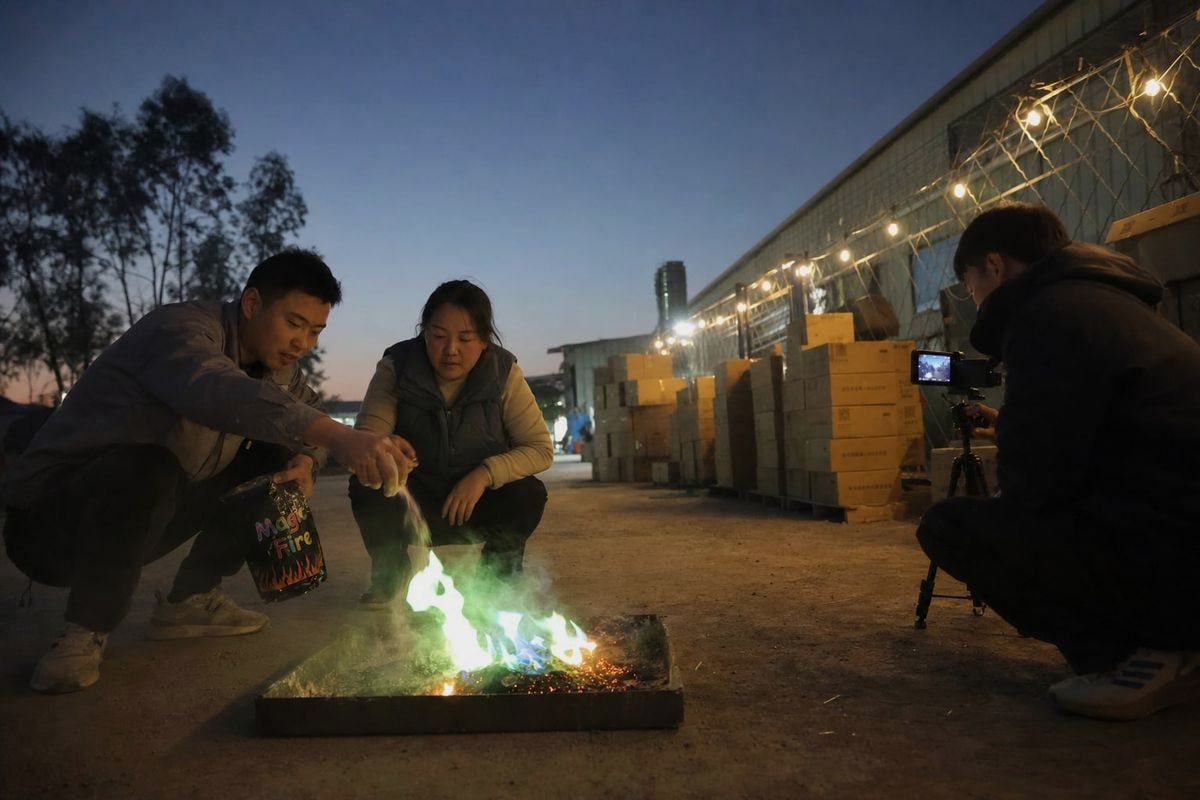
Le support en marque blanche sépare les vraies usines des revendeurs. Un revendeur ne peut que transmettre les images du propriétaire de la marque — que vous n'avez peut-être pas le droit légal d'utiliser. Une usine qui possède sa chaîne de production peut shooter des actifs sans marque, redessiner l'emballage autour de votre identité, et tout mettre par écrit.
Ce que la personnalisation complète devrait inclure
Après plus de 17 ans dans la production de flammes colorées, voici ce que nous considérons comme un package complet en marque blanche :
- Actifs de style de vie sans marque — des prises de vue nettes sans logo visible, afin que votre équipe superpose sa propre image de marque et son emballage localisé en post-production.
- Formats d'emballage personnalisés — sac en plastique, pochette à fermeture éclair en papier kraft, ou bocal en plastique, correspondant aux attentes de votre marché en matière d'étagère.
- Boîtes et emballages de présentation personnalisés — boîtes de vente au détail à rabat, présentoirs de comptoir et configurations multipacks.
- Éléments de conformité localisés — étiquettes d'avertissement dans la langue de votre marché, placement correct du code-barres et texte réglementaire spécifique au marché.
- Paramètres de produit réglables — taille, temps de combustion et nombre d'emballages adaptés à votre prix.
- 3D rendus ou fichiers dieline — pour créer des infographies personnalisées et des schémas d'emballage dans vos modules A+.
Obtenez les documents, pas seulement les pixels
Les actifs sans droits sont des passifs. Demandez une lettre d'autorisation formelle couvrant l'utilisation commerciale sur Amazon A+, votre vitrine et d'autres canaux. Si vous vous inscrivez auprès de Registre des Marques 7, confirmez que le fournisseur ne vendra pas votre conception de marque personnalisée à un autre acheteur. Nous signons ce type d'exclusivité pour les clients en marque privée en pratique standard — toute usine sérieuse devrait le faire.
Un calendrier réaliste
L'approbation des illustrations personnalisées prend généralement une à deux semaines d'échanges. La photographie de votre emballage de marque ajoute plusieurs jours supplémentaires après la première série de production de marque. Intégrez cela dans votre plan de lancement plutôt que de le découvrir au moment du téléchargement.
Conclusion
Demander les matériaux de produit d'origine pour les pages A+ fonctionne lorsque vous nommez des documents exacts, des spécifications d'image, des données techniques et des droits d'utilisation. Des demandes précises à une usine certifiée créent plus rapidement des listes conformes et à forte conversion.
Notes de bas de page
La page de la Commission européenne explique les exigences de marquage CE pour les produits entrant sur les marchés de l'UE. ↩︎
SGS est un organisme d'inspection et de certification tiers leader qui vérifie les affirmations de sécurité des colorants ignifuges. ↩︎
ISO 9001 est la norme de gestion de la qualité reconnue internationalement à laquelle il est fait référence pour la certification des fournisseurs. ↩︎
amfori BSCI est l'organisme officiel derrière l'audit d'usine éthique auquel il est fait référence pour la conformité des fournisseurs. ↩︎
Concept d'arrière-plan expliquant pourquoi des spécifications techniques précises améliorent les performances de conversion des listes. ↩︎
Wikipédia explique le codage du système harmonisé utilisé pour la documentation d'exportation et la classification des expéditions. ↩︎
Page officielle du programme d'enregistrement de marque Amazon pertinente pour les exigences d'autorisation de marque privée. ↩︎


 English
  Spanish
  German
  French
  Arabic
  Portuguese
Rejoignez la conversation