






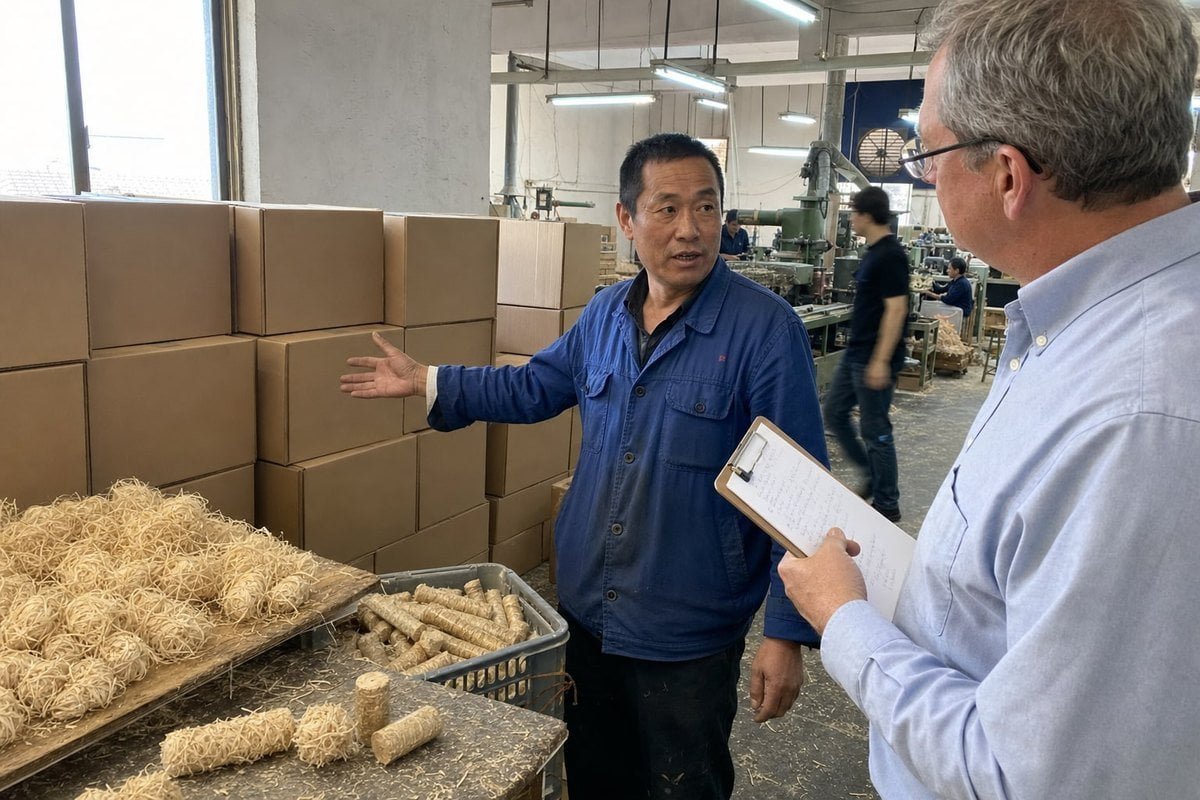
Choosing a new wood fire starter supplier can feel like gambling. I have watched buyers lose whole seasons to bad batches — a risk our factory works daily to eliminate.
To reduce risks with a new wood fire starter supplier, verify certifications like ISO 9001 and MSDS documentation, test samples from multiple production batches, place a small trial order under real conditions, and lock lead times, quality tolerances, and private-label terms into a written agreement.
That is the short answer. Below, I break each step down into a practical due-diligence framework you can use before your first purchase order.
What certifications should I verify before signing with a wood fire starter supplier?
A German distributor once asked me for our full audit file before even discussing price. That request was smart. After 17 years exporting fire products, I respect buyers who lead with compliance.
Before signing, verify ISO 9001 for quality management, BSCI for social compliance, CE marking where applicable, third-party test reports from labs like SGS or Intertek, a product-specific Material Safety Data Sheet (MSDS), and FSC certification if sustainable wood sourcing matters to your market.

Certifications are not paperwork for its own sake. They are the fastest way to separate a real factory from a trading company reselling unknown goods. In our experience exporting to the US, Germany, and the UK, retail sourcing channels 1 increasingly refuse to onboard fire products without a documented compliance file. If your supplier cannot produce these documents within a few days, they probably do not have them.
Les documents essentiels à demander
Ask for each document by name. Then check that the product name, factory name, and dates match the goods you actually plan to buy. A common trick is showing a certificate issued for a different product line or even a different factory.
| Document | Ce qu'elle prouve | Signal d'alarme en cas d'absence |
|---|---|---|
| ISO 9001 | Quality control standards are systemized, not improvised | Batch quality depends on luck |
| rapport d'audit BSCI | Factory meets social compliance requirements | Big-box retailers may reject you |
| FDS / SDS | Composition, handling, and combustion behavior are disclosed | Unknown accelerants or additives |
| Rapports de test SGS / Intertek | An independent lab verified safety claims | Claims rest on verbal assurance |
| Certification FSC | Wood fiber 2 comes from responsibly managed sources | Traceability gaps in raw material |
| Conformité CE / marché | Product meets your destination market rules | Customs or liability exposure |
Watch the formulation, not just the file
One point I stress with every new buyer: check what the fire starter is actually made from. Wax-dipped wood rolls using natural wax and clean wood fiber behave predictably. Products built on kerosene, methanol, or unclear petroleum accelerants create flash-fire and toxicity risks — and no certificate fixes a bad formulation. Ask whether the wood waste input is virgin fiber or salvaged material. Recycled scrap from treated lumber or furniture can carry toxic glues and métaux lourds 3 into your product. The MSDS should make the composition explicit. If it does not, walk away.
How can I confirm consistent quality across production batches before placing a bulk order?
Batch drift is the silent killer in this category. On our Ningbo production line, we weigh wax uptake per roll because we learned early that "close enough" eventually becomes a customer complaint.
Confirm consistency by requesting samples from at least two or three separate production runs, defining measurable tolerances for moisture content, wax loading, dimensions, and burn time in a spec sheet, and asking how the factory documents batch-level quality control before shipment.
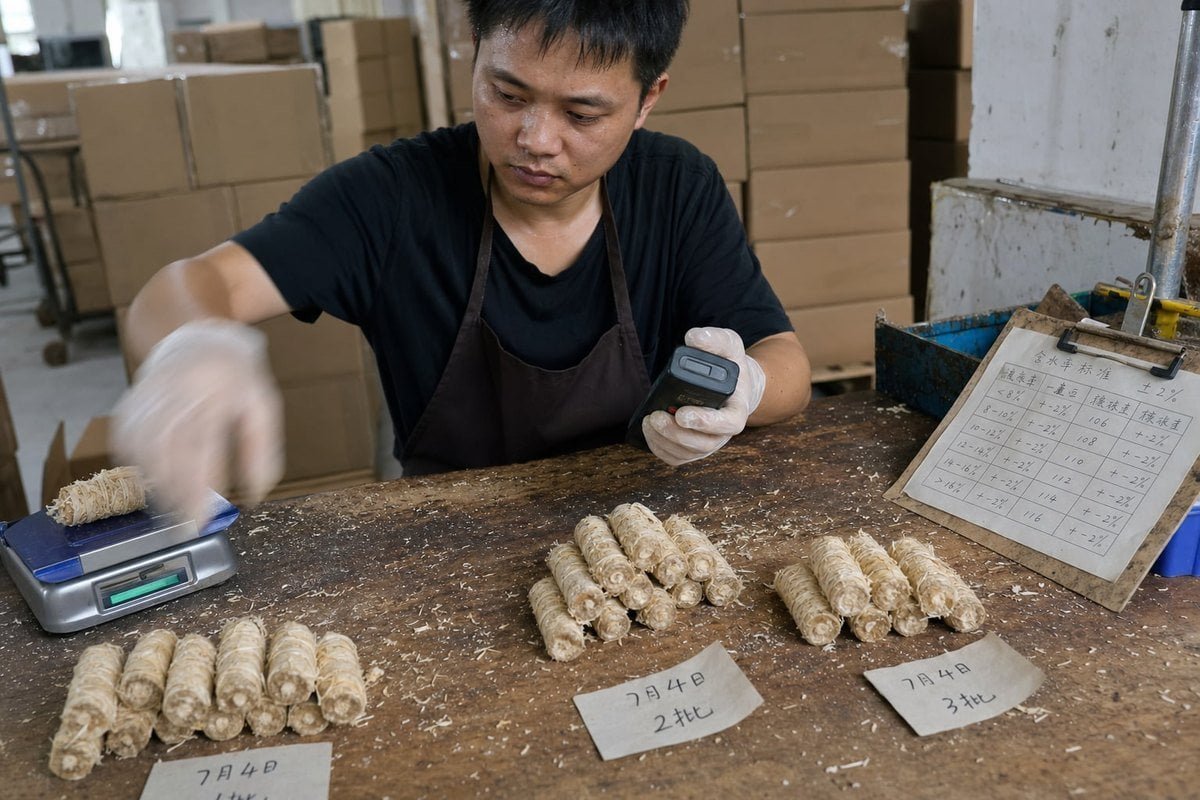
A single perfect sample proves very little. Suppliers often send a hand-picked "golden sample" that outperforms real production. The only defense is comparing goods made at different times. When a buyer asks us for samples, we encourage pulling from separate runs — because our batch records let us stand behind every one, and it exposes suppliers who cannot.
Define tolerances you can actually measure
Vague terms like "good quality" are unenforceable. Put numbers on paper. Here are the variables that matter most for wax-infused wood rolls and compressed wood wool starters:
| Variable | Pourquoi c'est important | Typical check method |
|---|---|---|
| Teneur en humidité | Above roughly 20%, ignition slows and mold risk rises | Calibrated moisture meter |
| Wax loading per unit | Controls burn duration and flame height | Weighing sampled units |
| Temps d'allumage | Consistency defines the user experience | Timed lighting test |
| Durée de combustion | Your packaging claim must hold true | Timed burn to extinction |
| Dimensions and weight | Affects packaging fit and per-carton counts | Caliper and scale sampling |
| Intégrité de l'emballage | Prevents moisture re-absorption in transit | Visual and seal inspection |
Ask how they control drift, not just detect it
Detection is reactive. Control is proactive. Ask the factory three questions. First, how do they monitor raw wood fiber moisture 4 across seasons, since natural drying times shift with regional humidity? Second, do they keep retained samples from each batch for reference? Third, can they run batch-level composition checks to catch undisclosed synthetic additives entering through the raw material stream? A supplier with genuine manufacturing depth answers these quickly. A middleman stalls, because they do not control the line. Strong sample testing protocols on your side, matched with documented in-process QC on theirs, is what makes the first container look like the fifth.
What should I include in a trial order to test a new fire starter manufacturer safely?
A Canadian fireplace distributor once told me his rule: never scale past a trial order until the trial has survived a full shipping cycle. We build our flexible MOQs around exactly that logic.
A safe trial order should include a small commercial quantity in final retail packaging, units pulled from a normal production run, real-condition ignition and burn testing, a shipping and storage stress check, and written confirmation that trial quality legally represents future bulk shipments.
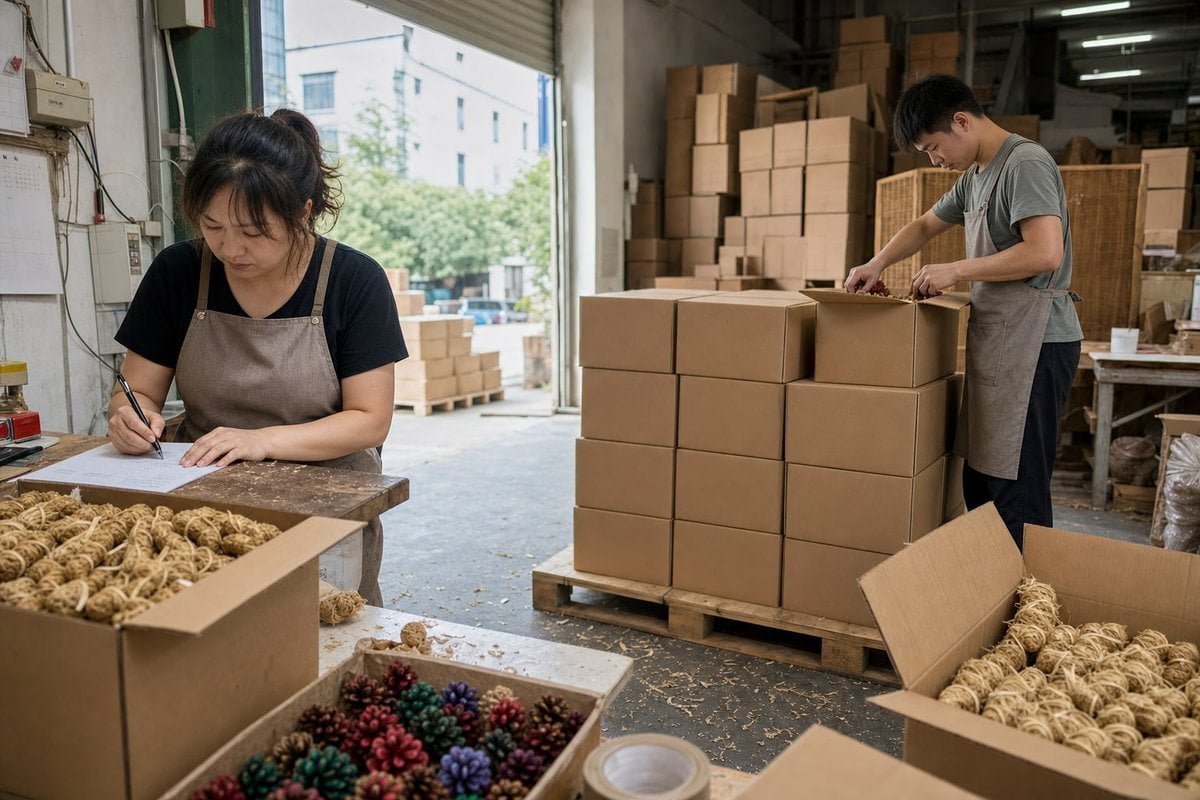
The trial order is your last low-cost checkpoint before real money moves. Treat it like a controlled experiment, not a discounted first purchase. The goal is to test the supplier's whole system — production, packing, documentation, and logistics — at a scale where mistakes are cheap.
Structure the trial as a five-step protocol
- Order a meaningful quantity in final packaging. A few hundred to a few thousand units, packed exactly as your bulk goods will be. Packaging failures only show up when goods are packed for real.
- Insist the units come from standard production. State in writing that trial goods must reflect normal line output, not a special run. This is where genuine manufacturers separate from assemblers.
- Test under your customers' real conditions. Light the eco-friendly firelighters in a fireplace, grill, and fire pit. Record ignition speed, flame behavior, burn duration, and residue. Test a few units after deliberate exposure to humid air to check water resistance.
- Stress the packaging and shelf life. Fire starters re-absorb atmospheric moisture. Check whether the packaging provides a real vapor barrier, and store part of the trial for several weeks before re-testing burn performance.
- Audit the paperwork flow. Did the MSDS, labels, barcodes, and shipping documents arrive complete and correct? Documentation errors on a trial predict customs headaches on a container.
What the trial really measures
Beyond the product, the trial measures communication. Did the supplier answer questions in clear English within a business day? Did they flag issues proactively? For higher-risk or sole-source relationships, pair the trial with a manufacturing capacity audit 5 — on-site or through a third party — to confirm the factory can scale when your seasonal peak hits. Responsiveness during a small order is the best predictor of behavior when something goes wrong at container scale.
How do I protect my business with clear agreements on lead times and private-label terms?
Every autumn, our Liuyang headquarters watches order volume spike as Northern Hemisphere buyers stock for winter. The buyers who suffer least are always the ones who fixed terms in writing months earlier.
Protect your business by contractually defining production lead times with delay remedies, reorder timelines, quality tolerances tied to your spec sheet, ownership of private-label artwork and tooling, exclusivity scope, defect and return procedures, and a contingency plan for supply interruption.

Verbal assurances evaporate under pressure. A written agreement is not a sign of distrust — it is what allows both sides to perform predictably. In our OEM/ODM work with outdoor brands and BBQ distributors across the US and Europe, the smoothest partnerships are the ones where every commercial variable was defined before the first bulk PO.
The clauses that prevent the most disputes
| Contract area | Ce qu'il faut spécifier | Risk it removes |
|---|---|---|
| Production lead times | Days from PO to ex-factory, plus peak-season adjustment | Missed retail windows |
| Seasonal moisture buffer | Schedule flexibility tied to raw material drying cycles | Rushed shipments of damp product |
| Quality standard | Spec sheet with tolerances as a contract annex | "That's normal variation" disputes |
| Defect remedy | Inspection window, claim process, replacement or credit terms | Absorbing losses on bad batches |
| La fabrication en marque privée | Artwork ownership, brand exclusivity scope, tooling rights | Your design appearing elsewhere |
| Pricing structure | Bulk procurement pricing tiers, validity period, raw-material triggers | Surprise mid-season increases |
| MOQ and reorders | Trial MOQ, standard MOQ, reorder lead time | Stockouts during demand spikes |
Private-label specifics deserve extra care
When we produce custom boxes, display packaging, warning labels, and barcodes for a client's brand, we treat that artwork as the client's property — and your contract should state that explicitly with any supplier. Define who owns dies, plaques d'impression 6, and design files. Confirm that warning labels and packaging text meet your destination market's rules, because retail compliance failures land on the brand owner, not the factory. Finally, build supply chain reliability 7 into the plan itself: even with a strong primary partner, keep a qualified backup source identified for any business-critical SKU. A supplier confident in their own performance will never object to that.
Conclusion
Reduce supplier risk by verifying certifications, testing multi-batch samples, running a structured trial order, and locking lead times and private-label terms into writing. Evidence beats promises — always request proof before scaling.
Notes de bas de page
1. US government resource providing guidance on international retail and distribution channels. ↩︎
2. Technical definition of wood fiber as a raw material in industrial products. ↩︎
3. EPA guidance on chemicals in treated wood, including heavy metals like arsenic and chromium. ↩︎
4. Scientific concept explaining how wood moisture interacts with environmental humidity. ↩︎
5. Global leader in inspection and verification services for factory and manufacturing audits. ↩︎
6. Overview of the printing plate process used in manufacturing and packaging. ↩︎
7. Government resource on managing and securing industrial supply chains. ↩︎



 English
  Spanish
  German
  French
  Arabic
  Portuguese
Rejoignez la conversation