







Planifier la quantité de commande de poudre Magic Fire pour la capacité de chargement des conteneurs perturbe de nombreux importateurs pour la première fois Rapports de test SGS/Intertek 1. J'ai vu des acheteurs payer pour des conteneurs à moitié vides que notre usine aurait pu remplir correctement.
Pour planifier la quantité de commande de poudre Magic Fire pour le chargement du conteneur, calculez les unités par carton principal, divisez le volume utilisable du conteneur (environ 28 CBM pour 20 pieds, 58 CBM pour 40 pieds) par le volume du carton, puis alignez ce chiffre sur votre MOQ, vos limites de conformité et une marge de 5 à 10%.
C'est la réponse courte. Ci-dessous, je détaille chaque étape avec des chiffres réels de notre expérience d'exportation, afin que vous puissiez dimensionner votre prochaine commande en toute confiance.
Combien d'unités de poudre magique à feu puis-je mettre dans un conteneur de 20 pieds ou 40 pieds ?
Au printemps dernier, un distributeur allemand nous a posé cette question exacte avant sa première commande d'essai Marquage CE 2. Notre équipe d'expédition a fait le calcul avec lui carton par carton, et la réponse l'a surpris.
Un conteneur de 20 pieds (environ 28 m³ utilisables) contient généralement 250 000 à 350 000 sachets Magic Fire standard de 25 g dans des cartons principaux, tandis qu'un conteneur de 40 pieds (environ 58 m³) contient environ 550 000 à 700 000 sachets, en fonction des dimensions des cartons et de l'emballage des boîtes d'exposition.
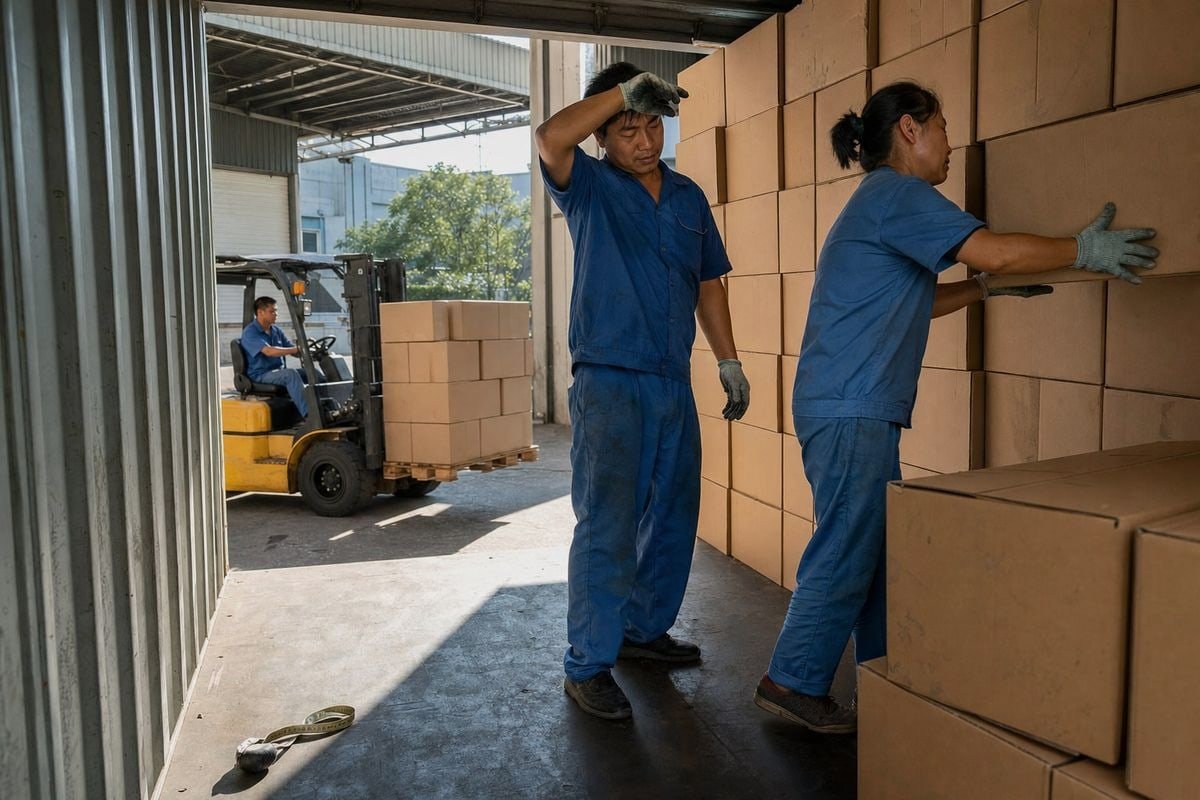
Le point de départ n'est jamais le conteneur lui-même. C'est le carton maître. Sur notre site de production de Ningbo, nous emballons des sachets dans des boîtes d'exposition intérieures, puis dans des cartons d'exportation des cartons principaux 3. Les dimensions extérieures et le poids brut du carton décident de tout le reste.
Le calcul de base, étape par étape
Voici la méthode que nous appliquons à chaque nouvel acheteur :
- Confirmer la taille de l'unité (par exemple, un sachet de 25 g).
- Confirmer les unités par boîte d'exposition (souvent 24 ou 50).
- Confirmer les boîtes d'exposition par carton maître.
- Mesurer les dimensions extérieures du carton maître et calculer son CBM.
- Diviser le CBM utilisable du conteneur par le CBM du carton.
- Vérifier par rapport à la limite de poids de charge utile du conteneur.
Référence de capacité typique
| Contenant | Volume utilisable | Limite de charge utile | Cartons maîtres estimés | Sachets de 25 g estimés |
|---|---|---|---|---|
| 20 pieds | ~28 M3 | 20 000–24 000 kg | 550–650 | 250,000–350,000 |
| 40 pieds | ~58 M3 | 26 000–28 000 kg | 1,150–1,350 | 550,000–700,000 |
| 40 pieds HQ | ~68 M3 | 26 000–28 000 kg | 1,350–1,550 | 650,000–800,000 |
Un point clé : les sachets de couleur flamme sont légers par rapport à leur volume. D'après notre expérience d'expédition aux États-Unis et en Europe, la cargaison Magic Fire "remplit" presque toujours le volume avant d'atteindre le poids. Cela signifie que le volume, et non le poids, est votre facteur limitant. L'optimisation des dimensions des cartons est donc beaucoup plus importante que le chiffre de charge utile sur la fiche technique du conteneur. Nous ajustons souvent les tailles de cartons de quelques centimètres pour y glisser une couche supplémentaire de cartons — un petit changement qui peut ajouter des milliers d'unités vendables par conteneur.
Mon choix de format d'emballage affecte-t-il la quantité de produit que je peux charger par conteneur ?
Le format d'emballage est le levier le plus important ici. Lorsque nous avons développé notre gamme de sacs en kraft parallèlement au sachet classique en aluminium, nous avons mesuré une différence à deux chiffres dans la densité du conteneur entre les deux.
Oui, le format d'emballage modifie considérablement la capacité du conteneur. Les sachets compacts en aluminium en cartons en vrac maximisent la densité ; les pochettes kraft autoportantes perdent 10 à 20 % de capacité à cause de l'espace libre ; les pots en plastique perdent 25 à 40 % à cause des espaces d'air rigides ; et les boîtes d'exposition au détail réduisent davantage la densité mais arrivent prêtes à être mises en rayon.

Chaque format que nous produisons — sachet en aluminium, pochette stand-up en kraft et pot en plastique — entraîne une pénalité de densité différente. Le compromis est simple : les formats qui s'emballent le plus serré ne sont pas toujours ceux qui se vendent le mieux en rayon.
Comparaison de nos trois formats principaux
| Format d'emballage | Densité du conteneur | Préparation pour la vente au détail | Acheteur type |
|---|---|---|---|
| Sachet en aluminium (plat, emballé en vrac) | Le plus haut | Nécessite une boîte d'exposition | Grossistes, marques de distributeur |
| Sachet stand-up en papier kraft | Moyen | Bonne présence en rayon | Marques d'extérieur et de camping |
| Bocal en plastique | Le plus bas | Aspect premium | Distributeurs de foyers et de barbecues |
| Sachets en boîte d'exposition à rabat | Moyen-faible | Entièrement prêt pour la vente en rayon | Grandes chaînes de distribution |
Pourquoi l'espace libre et la rigidité sont importants
La poudre ne remplit pas l'emballage à 100 %. Les pochettes souples ont besoin d'espace libre pour que les granulés se tassent et que le scellage reste propre. Les pots rigides retiennent l'air par conception — vous expédiez l'espace vide avec le produit. Dans la manipulation de poudre 4 plus largement, les conteneurs sont souvent remplis à seulement 50 à 80 % de leur capacité volumétrique pour assurer la stabilité et une distribution cohérente. Nous appliquons la même logique conservatrice : les pochettes trop remplies risquent des défaillances de scellage, un mottage et une poussière pendant le transport.
Il y a aussi la question de l'humidité. Nos granulés de couleur flamme sont sensibles à l'humidité, donc des doublures scellées et des dessicants 5 sont parfois ajoutés pour les marchés de destination humides comme le Brésil ou le Moyen-Orient. Ces couches protectrices consomment une petite quantité de volume de carton. C'est un compromis valable — un envoi rejeté coûte bien plus cher que quelques CBM perdus. Lorsque nous réalisons des projets OEM, nous modélisons tout cela avant de faire un devis, afin que le coût d'atterrissage par unité de l'acheteur reflète la réalité, et non un maximum théorique.
Puis-je mélanger plusieurs références ou couleurs dans un seul conteneur sans gaspiller d'espace ?
Une marque britannique de camping nous a demandé un jour de combiner des sachets, des pommes de pin à flamme colorée et des torches en cire dans un conteneur de 40 pieds pour leur première saison. Nous avons réussi, avec un peu de planification.
Oui, vous pouvez mélanger plusieurs références, couleurs, voire gammes de produits dans un même conteneur sans gaspiller d'espace, à condition que tous les cartons principaux aient des dimensions standardisées, que chaque référence respecte son propre minimum de colisage, et que le plan de chargement soit simulé avant la réservation pour confirmer l'efficacité de l'empilage.

Le chargement mixte est une pratique courante pour nos acheteurs à l'exportation, et c'est souvent le moyen le plus intelligent de tester un marché. Au lieu d'engager un conteneur entier pour un seul SKU, vous répartissez le même coût de fret sur une gamme de produits plus large.
Comment nous rendons les conteneurs mixtes efficaces
Le secret est la standardisation des cartons. Dans notre usine, nous concevons des cartons maîtres pour différents SKU autour de dimensions de base communes dans la mesure du possible. Lorsque les cartons partagent une base, ils s'empilent en couches nettes et imbriquées, quel que soit leur contenu. Lorsqu'ils ne le font pas, vous obtenez des vides en forme de pyramide qui gaspillent des mètres cubes pour lesquels vous avez déjà payé.
Notre processus pour une commande mixte ressemble à ceci :
- L'acheteur envoie les quantités cibles par SKU et par couleur.
- Nous vérifions chaque SKU par rapport à son emballage et à son minimum de lot de production.
- Notre équipe logistique effectue une simulation de chargement pour cartographier le placement des cartons.
- Nous ajustons les quantités légèrement à la hausse ou à la baisse pour éliminer les couches partielles.
- Les articles plus lourds (bocaux, cartons de pommes de pin) sont placés en bas ; les cartons de sachets plus légers sont empilés sur le dessus.
Règles pratiques à suivre
Quelques leçons tirées de plus de 17 ans d'expérience. Premièrement, gardez le nombre de SKU raisonnable — trois à six SKU par conteneur est gérable ; quinze crée des erreurs de prélèvement à destination. Deuxièmement, mélanger les couleurs au sein d'un même SKU de sachet ne coûte rien de plus en espace, car les dimensions de l'emballage sont identiques ; seuls l'impression ou l'étiquette changent. Troisièmement, insistez sur un plan de chargement de conteneur clair et un schéma de marquage des cartons, afin que votre entrepôt puisse trier rapidement l'expédition à l'arrivée. Nous fournissons des schémas de chargement étiquetés avec chaque expédition mixte pour cette raison exacte. 6 Le compromis dont nous discutons le plus avec les nouveaux acheteurs est le suivant : nos MOQ d'essai flexibles sont bien inférieurs à ceux d'un conteneur complet, mais le fret par unité diminue considérablement à mesure que vous approchez du FCL.
Comment puis-je équilibrer mon MOQ avec la capacité du conteneur pour obtenir le meilleur coût d'expédition ?
L'économie du fret récompense le volume, mais seulement jusqu'au point où le risque de stock prend le dessus. L'objectif n'est pas la plus grosse commande possible. C'est la taille de la commande où le coût d'atterrissage par unité et le risque de trésorerie se croisent à un point acceptable.
Équilibrer le MOQ et la capacité du conteneur en commandant par multiples de conteneurs complets chaque fois que la demande le justifie, car le FCL réduit considérablement le fret par unité par rapport au LCL. Pour les commandes d'essai, utilisez un MOQ plus petit via LCL, puis passez à un conteneur complet de 20 pieds une fois que la vente est prouvée.

FCL par rapport à LCL : le véritable tableau des coûts.
Approche de commande
| Coût de fret par unité | Risque de stock | Commande d'essai LCL (niveau MOQ) | Idéal pour |
|---|---|---|---|
| Test de marché, nouveaux SKU | Élevé | Faible | Conteneur partiel via LCL |
| Réapprovisionnements croissants | Moyen-élevé | Moyen | Conteneur complet de 20 pieds (FCL) |
| Demande établie sur un marché unique | Faible | Moyen | Conteneur complet de 40 pieds (FCL) |
| Stockage multicanal ou saisonnier | Le plus bas | Plus élevé | Une méthode de planification simple |
Voici la séquence que je recommande aux responsables des achats :
Estimez les ventes réalistes par mois et par canal.
- Multipliez par votre cycle de réapprovisionnement (délai de production plus transit).
- Ajoutez une marge de 5 à 10% pour les dommages, les problèmes d'humidité ou les contrôles qualité.
- Arrondissez le total à la quantité de conteneur complet la plus proche — ou restez délibérément en LCL si l'écart est trop important.
- Réservez à l'avance avant les pics saisonniers.
- . Les produits pour feux de camp et cheminée augmentent avant l'automne et les fêtes, et les tarifs de fret augmentent avec eux. Un facteur de plus que les acheteurs manquent souvent :. affecte la capacité utilisable et la planification. Nos produits sont écologiques et expédiés avec des rapports de test SGS/Intertek, mais les douanes de destination veulent toujours une classification correcte, des étiquettes d'avertissement et des documents. Obtenir la documentation correcte avant de réserver évite le scénario coûteux d'un conteneur immobilisé au port. D'après notre expérience d'exportation vers plus de 30 pays, une expédition FCL bien documentée est dédouanée plus rapidement qu'une expédition LCL mal documentée — une autre raison cachée pour laquelle les conteneurs complets gagnent souvent en coût total.
L'expédition FCL offre généralement un coût de fret par unité beaucoup plus bas que le LCL pour la poudre Magic Fire documentation de conformité Le FCL répartit un taux de conteneur fixe sur des centaines de milliers d'unités légères, tandis que le LCL ajoute des frais de manutention, des frais de consolidation et une tarification par mètre cube qui gonflent le coût unitaire. Marquage CE 7 Vous devriez toujours commander un conteneur complet pour obtenir la meilleure offre.
Conclusion
Deviner les quantités de conteneurs gaspille de l'argent — soit par des conteneurs à moitié vides, soit par des stocks invendus. La solution est de simples calculs mathématiques et une planification disciplinée.
Commencez par les dimensions de votre carton principal, calculez le CBM du conteneur, tenez compte du format d'emballage et de l'espace libre, et alignez le résultat avec votre MOQ et la demande saisonnière. Le volume, pas le poids, sera votre contrainte, donc l'optimisation des cartons est rentable. Que vous soyez en train de tester le marché avec une commande d'essai ou de remplir des conteneurs de 40 pieds chaque saison, chez Sunrich, nous effectuons ces calculs avec chaque acheteur avant de faire un devis — car un conteneur bien planifié est celui que vous expédierez le moins cher.
Notes de bas de page
Liens vers une autorité de test reconnue à l'origine de la documentation de conformité mentionnée. ↩︎
Source officielle de l'UE clarifiant les exigences de marquage CE référencées pour la documentation de conformité. ↩︎
Contexte sur la conception des cartons aidant les acheteurs à comprendre l'unité d'emballage qui pilote les calculs de conteneurs. ↩︎
Explique les principes généraux derrière les ratios de remplissage et la capacité volumétrique référencés dans le texte. ↩︎
Clarifie le matériau de contrôle de l'humidité mentionné pour les expéditions sur les marchés humides. ↩︎
Organisme des règles du commerce international pertinent pour la documentation d'expédition et les pratiques de chargement. ↩︎
Source officielle de l'UE expliquant la marque de conformité requise pour les produits exportés. ↩︎



 English
  Spanish
  German
  French
  Arabic
  Portuguese
Rejoignez la conversation