







Verrouillage d'un échantillon de référence scellé pour les pommes de pin colorées pour cheminée vous protège de la décoloration de la qualité test de teneur en humidité 1. Sur notre chaîne de production, nous avons vu des acheteurs perdre des saisons entières sans en avoir un.
Pour garantir un échantillon de référence scellé pour des pommes de pin colorées pour cheminée, exigez un échantillon entièrement séché, traité chimiquement, emballé et scellé dans un emballage inviolable, signé et daté par les deux parties, soutenu par un accord écrit sur l'échantillon maître couvrant la couleur de la flamme, la charge chimique, l'humidité et les spécifications d'emballage.
C'est la réponse courte. Les détails comptent davantage. Ci-dessous, je passe en revue l'accord, les étapes de vérification, la paperasserie et les règles de stockage — dans cet ordre.
Que dois-je inclure dans un accord d'échantillon de référence scellé avant de passer une commande en gros ?
Un distributeur allemand nous a un jour demandé pourquoi notre documentation d'échantillons s'étendait sur quatre pages. Ma réponse était simple : chaque ligne de ce document est un litige sur lequel nous n'avons jamais à nous disputer plus tard. Notre usine a appris cela en 17 ans d'exportation de pommes de pin à flamme colorée.
Un accord de référence scellé pour les échantillons doit spécifier l'espèce et la gamme de tailles du cône de pin, les produits chimiques colorants de flamme utilisés, une métrique de charge chimique par cône, les limites d'humidité, les normes de couleur de flamme et de durée de combustion, les matériaux d'emballage, et une clause vous permettant de rejeter les expéditions qui s'écartent de l'échantillon approuvé.

L'accord est l'endroit où vous traduisez "ça a l'air joli" en spécifications de fabrication une usine peut réellement être tenue. D'après notre expérience dans la fourniture de marques de plein air et de distributeurs de cheminées aux États-Unis et en Europe, les accords faibles échouent aux mêmes endroits prévisibles. Je vais donc décomposer le document en ses parties non négociables.
Définir d'abord la matière première
Différentes espèces de cônes se comportent différemment dans le processus de trempage chimique. Un grand cône de Ponderosa ouvert absorbe plus de solution colorante qu'un petit cône dense, il brûle donc avec une couleur plus vive plus longtemps. Votre accord doit indiquer l'espèce, la plage de tailles acceptable et l'ouverture requise des écailles. Si vous sautez cela, un fournisseur peut secrètement passer à des cônes plus petits et moins chers et vos performances de flamme diminuent.
Préciser la chimie
Les produits chimiques colorants de flamme déterminent tout ce que le client final voit. Les composés de cuivre produisent des flammes bleu-vert ; d'autres sels minéraux produisent des rouges, des violets et des ors. Votre accord doit indiquer quels colorants sont autorisés, et il doit exiger la conformité avec les réglementations sur les métaux lourds 2 sur votre marché cible. Nous refusons certaines formulations héritées — certaines anciennes traitement au sulfate de cuivre 3 recettes sont efficaces mais ne répondent pas aux attentes chimiques modernes du commerce de détail — et votre contrat devrait vous donner le même pouvoir de refuser.
Verrouiller une métrique de charge chimique
C'est la clause la plus utile. Spécifiez les grammes de sel colorant actif par cône, avec une tolérance. La décoloration de la qualité se produit presque toujours ici : l'échantillon est généreusement traité, puis la production de masse réduit discrètement la dose. Une métrique de charge chimique écrite la rend mesurable au lieu d'argumentable.
| Clause d'accord | Ce qu'il faut spécifier | Pourquoi c'est important |
|---|---|---|
| Espèce et taille | Variété de cône, plage de longueur, écailles ouvertes | Contrôle l'absorption et le taux de combustion |
| Chimie du colorant | Sels autorisés, substances interdites | Conformité aux réglementations sur les métaux lourds |
| Métrique de charge chimique | Grammes de sel par cône ± tolérance | Empêche la décoloration de la qualité dans les lots en vrac |
| Limite d'humidité | % d'humidité maximum à l'emballage | Assure l'allumage et la stabilité des cônes |
| Performance de la flamme | Minutes minimum de sortie de couleur | Lie l'échantillon à un test mesurable |
| Emballage | Pochette résistante à l'humidité, type de joint | Protège les revêtements hygroscopiques pendant le transport |
| Droits de rejet | Déclencheurs de déviation, délai de recours | Donne des dents juridiques à l'échantillon |
Enfin, formalisez la clause d'échantillon maître elle-même : l'échantillon scellé est la norme de qualité contraignante, et les expéditions qui s'écartent de son intensité de couleur ou de ses caractéristiques de combustion peuvent être rejetées. Sans cette phrase, l'échantillon est une décoration, pas une protection.
Comment vérifier que la production de masse correspond à mon échantillon Pinecone approuvé ?
Au début de notre histoire d'exportation, un acheteur canadien nous a donné une leçon : il a brûlé trois cônes de chaque rangée de carton pendant son inspection, côte à côte avec son échantillon conservé. Cette visite a remodelé la façon dont nous gérons le contrôle qualité lot par lot dans notre usine de Ningbo.
Vérifier la production de masse en prélevant des cartons aléatoires lors de l'inspection avant expédition, en comparant les cônes à votre échantillon scellé pour la couleur, la taille, le revêtement et le poids, en effectuant des tests de teneur en humidité et un test de persistance de flamme chronométré pour confirmer que la sortie de couleur correspond à la norme approuvée.
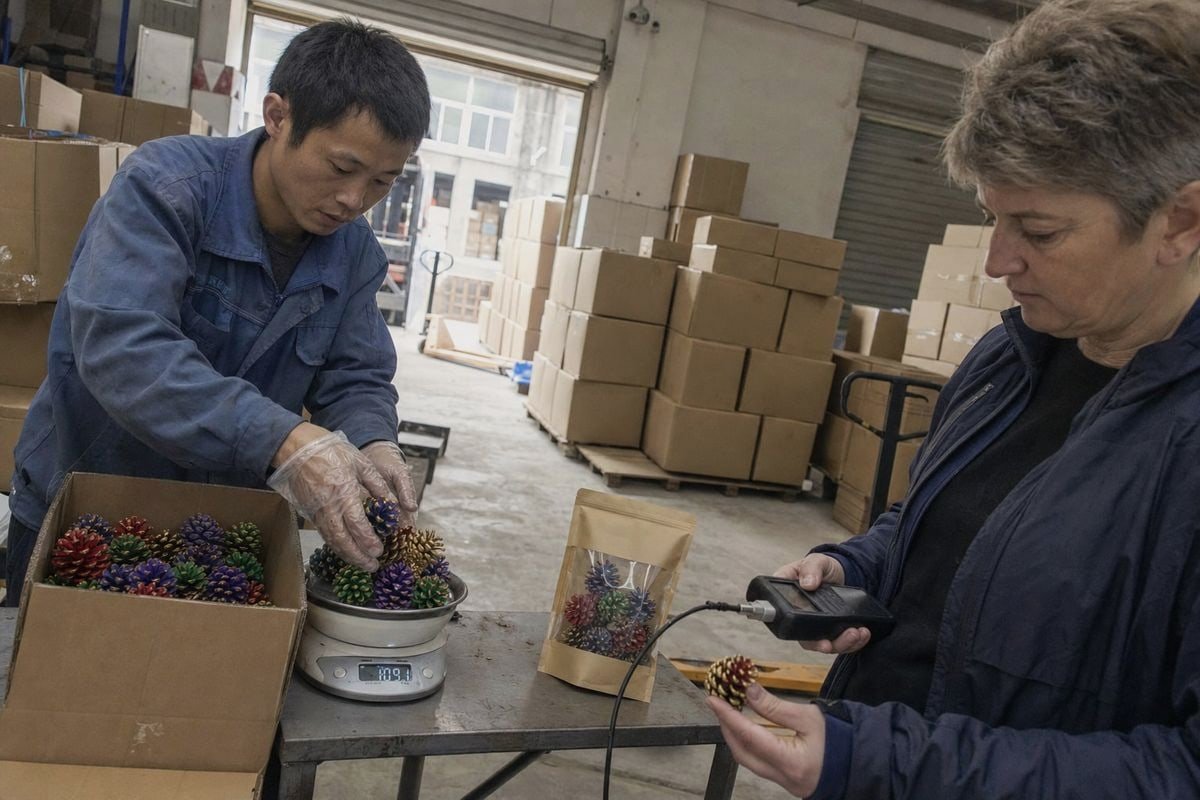
La vérification est l'endroit où les normes de cohérence des lots cessent d'être des mots sur papier et deviennent une procédure physique. La bonne nouvelle est que les pommes de pin colorées pour cheminée sont faciles à tester si vous savez quels quatre contrôles sont importants. Voici le processus que nous recommandons à chaque acheteur en gros, qu'il inspecte en personne ou qu'il engage une agence tierce.
La séquence de vérification en quatre points
- Échantillonnage aléatoire. Prélevez des cônes dans les cartons sur l'ensemble de la production, pas seulement sur la couche supérieure de la première palette. Utilisez un plan d'échantillonnage reconnu afin que la taille de l'échantillon soit défendable.
- Comparaison physique. Placez les cônes de production à côté de votre référence de travail non scellée. Vérifiez l'espèce, la taille, l'ouverture de l'écaille, le revêtement et les résidus de cristaux visibles. Pesez les cônes individuellement ; les cônes sous-pondérés signifient généralement un colorant sous-dosé.
- Test de teneur en humidité. Un humidimètre à pointes prend quelques secondes. Les cônes humides brûlent mal, peuvent se refermer pendant le transport et peuvent entraîner des plaintes de moisissure plus tard. Votre accord devrait fixer le plafond ; l'inspection le confirme.
- Test de persistance de la flamme. Brûlez des cônes d'échantillons dans des conditions contrôlées et chronométrez la sortie de couleur. Une référence courante est un minimum de huit minutes de flamme colorée continue sous un flux d'air standardisé. Si votre échantillon de référence l'a atteint, la production doit aussi.
Qui devrait conserver les échantillons ?
Le protocole d'échantillons scellés tripliqués résout l'argument "votre échantillon contre mon échantillon" avant qu'il ne commence. Trois échantillons scellés identiques sont préparés lors de l'approbation : un pour vous, un conservé à l'usine et un déposé auprès d'une inspection par un tiers 4 agence. En cas de litige, le troisième échantillon neutre le règle. Nous préparons des ensembles tripliqués sur demande pour cette raison exacte — une profondeur de fabrication authentique signifie que le premier échantillon reflète de manière fiable la qualité de la production de masse, et nous voulons que les acheteurs puissent le prouver.
| Vérification de la vérification | Outil requis | Source des critères de réussite |
|---|---|---|
| Correspondance visuelle et de taille | Échantillon de travail conservé | Accord d'échantillon maître |
| Poids du cône | Balance numérique | Spécification de la charge chimique |
| Taux d'humidité | Humidimètre à pointes | Plafond d'humidité convenu |
| Persistance de la flamme | Chronomètre, zone de combustion contrôlée | Minutes minimales de sortie de couleur |
Une note pratique : ne brûlez jamais votre échantillon de référence scellé lui-même. Demandez toujours des cônes lâches supplémentaires du même lot approuvé comme "échantillons de travail" brûlables. L'unité scellée existe pour rester scellée.
Quelle documentation doit accompagner mon échantillon scellé pour éviter les litiges de qualité ultérieurs ?
Il y a un compromis que j'évalue avec chaque nouveau client : une documentation plus lourde ralentit l'approbation de l'échantillon de quelques jours, mais elle élimine des mois de litiges potentiels plus tard. Pour les acheteurs qui commandent des conteneurs de pommes de pin à flamme colorée, ce compromis n'est jamais proche.
Votre échantillon scellé doit être accompagné d'une feuille d'approbation signée avec la date et le numéro de lot, des fiches de données de sécurité du produit, d'un rapport de composition chimique ou d'empreinte de lot, des certificats de test de conformité, des enregistrements de tests d'humidité et de combustion, et des spécifications d'emballage — le tout faisant référence croisée au numéro de sceau de l'échantillon.

Un cône scellé sans documentation n'est qu'un joli objet dans un sac. La documentation est ce qui en fait une norme de qualité qui survit au roulement du personnel, au refus du fournisseur et aux questions des douanes. Permettez-moi d'aborder d'abord l'objection que j'entends le plus souvent, puis de lister les documents réels.
"Un échantillon signé ne suffit-il pas ?"
Certains acheteurs supposent que l'échantillon physique seul règle tout. Ce n'est pas le cas. Un échantillon prouve à quoi ressemblait le produit ; il ne peut pas prouver ce qu'il y a dans le revêtement, si la formulation respecte les réglementations sur les métaux lourds, ou quelle était la lecture d'humidité le jour de l'approbation. Lorsqu'une équipe de conformité d'un détaillant pose des questions sur les résidus chimiques dans les cheminées, vous avez besoin de papier, pas de pommes de pin. Notre propre pile de certification — ISO 9001 5, BSCI, CE et rapports de tests SGS/Intertek — existe parce que nos acheteurs américains et européens considèrent cela comme une exigence stricte, pas comme un avantage.
L'ensemble de documents de base
| Document | Ce qu'il prouve | Qui signe |
|---|---|---|
| Feuille d'approbation de l'échantillon | L'acheteur a accepté ce lot exact à cette date | Acheteur + usine |
| Fiches de données de sécurité 6 (FDS) | Dangers chimiques, manipulation, classe de transport | Problèmes d'usine |
| Empreinte de lot / analyse de laboratoire | Signature chimique du lot approuvé | Laboratoire tiers |
| Certificats de conformité | Marquage CE 7, rapports de tests SGS/Intertek | Organisme de certification |
| Enregistrement des tests d'humidité et de combustion | Performance de base à l'approbation | Inspecteur ou contrôle qualité de l'usine |
| Spécification de l'emballage | Matériau de la pochette, type de sceau, étiquetage, codes-barres | Acheteur + usine |
L'avantage de l'empreinte de lot
Le document le plus solide est une analyse de laboratoire de la signature chimique du lot approuvé. Cette empreinte de lot vous offre deux protections. Premièrement, les expéditions futures peuvent être testées par sondage par rapport à celle-ci, de sorte que personne ne puisse diluer la formulation sans être remarqué. Deuxièmement, à mesure que les règles sur l'air pur pour les produits de foyer d'intérieur évoluent, vous détenez déjà une preuve documentée de ce que contient votre produit. Chaque document doit porter le même numéro de lot et numéro de sceau imprimés sur l'échantillon scellé lui-même. Cette référence croisée est ce qui fait tenir l'ensemble du dossier en cas de litige.
Comment conserver et référencer mon échantillon approuvé tout au long de la série de production ?
Un distributeur britannique de foyers nous a une fois retourné un échantillon "changé", convaincu que nous avions expédié un produit différent. La pomme de pin s'était simplement fermée — il l'avait stockée dans un coin humide de l'entrepôt. Cet incident nous a poussés à inclure des instructions de stockage avec chaque échantillon scellé que nous envoyons.
Conservez votre échantillon scellé dans un endroit frais, sec et sombre, à l'abri de l'humidité et de la chaleur, conservez-le séparément de l'inventaire vendable, inspectez le sceau et l'état du cône à intervalles définis, utilisez des échantillons de travail non scellés pour les comparaisons, et retirez l'échantillon uniquement lorsqu'un nouveau est formellement approuvé.

Les pommes de pin sont des objets naturels et hygroscopiques. Leurs écailles s'ouvrent et se ferment avec l'humidité, et les revêtements colorants eux-mêmes sont également hygroscopiques, ce qui signifie que la couche de sel peut absorber l'humidité et même s'infiltrer si le stockage est négligent. Verrouiller physiquement l'échantillon est donc une véritable tâche de conservation, pas seulement une tâche de classement.
Stabiliser avant de sceller
La pomme de pin doit être entièrement stabilisée avant le scellage final, sinon vous verrouillez le mauvais état. Une pomme de pin de référence correctement préparée a été nettoyée, séchée à fond — souvent séchée au four ou à basse température jusqu'à ce que les écailles soient complètement ouvertes — puis traitée et séchée à nouveau pendant plusieurs jours. Si votre gamme de produits comprend une version décorative, un scellant transparent peut préserver l'apparence, mais ne confondez jamais un revêtement de surface avec la sécheresse. Pour les produits combustibles, la sécheresse et le traitement correct sont la norme ; une finition laquée est une catégorie de produit entièrement différente.
Règles de stockage qui comptent vraiment
- Température et humidité. Conservez l'échantillon dans une armoire de bureau climatisée, pas dans un entrepôt. La chaleur dégrade les revêtements ; l'humidité ferme les écailles et peut provoquer des moisissures.
- Emballage résistant à l'humidité. Une pochette scellée en aluminium ou laminée, idéalement avec un sachet déshydratant 8, protège le revêtement pendant la durée de conservation du produit que vous avez déclarée sur l'emballage de détail.
- Ségrégation. Stockez-le à l'écart des stocks en combustion et à l'écart de tout ce qui est parfumé. Un échantillon de référence qui capte les odeurs d'entrepôt perd de sa valeur en tant que référence olfactive.
- Réinspection programmée. Vérifiez trimestriellement l'intégrité du sceau, les moisissures, les odeurs, la décoloration ou le mouvement des écailles. Enregistrez chaque vérification avec une date et des initiales.
Référencement sans briser le sceau
Conservez un petit ensemble d'échantillons de travail non scellés du même lot approuvé à côté de l'unité scellée. Utilisez-les pour les comparaisons quotidiennes, les démonstrations clients et les vérifications de combustion. L'échantillon scellé n'est ouvert conjointement — ou sa jumelle tierce partie est ouverte — que lorsqu'un litige formel l'exige. Lorsque vous approuvez une nouvelle formulation ou la production d'une nouvelle saison, scellez un nouvel échantillon, retirez l'ancien avec une note, mais conservez-le archivé. Les anciens échantillons documentent l'évolution de votre norme de qualité d'approvisionnement en gros, ce qui est utile lorsque les détaillants auditent votre chaîne d'approvisionnement 9.
Conclusion
Acheter des pommes de pin colorées pour foyers sans échantillon de référence scellé invite à la dégradation de la qualité, aux litiges et aux pertes de saisons

 English
  Spanish
  German
  French
  Arabic
  Portuguese
Rejoignez la conversation