






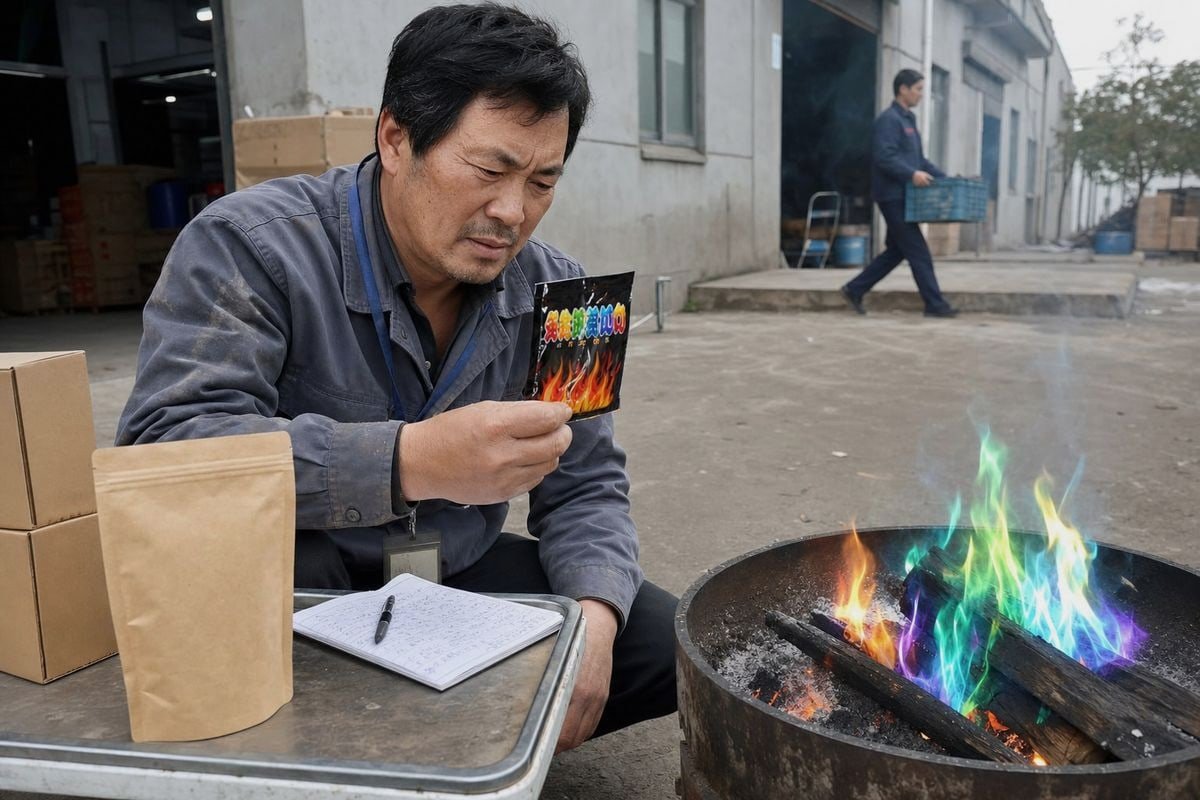
Choosing the wrong magic fire powder formula can sink a product launch. On our ligne de production à Ningbo 1, we've seen buyers learn this lesson the expensive way.
A supplier's magic fire powder formula fits your use case if it matches your fuel type, burn environment, required duration, and market compliance rules. Verify certifications, request SDS documents, run real-fire samples, and confirm the formula is designed for wood fires, not gas or cooking applications.
That short answer covers the basics. But each of those checkpoints deserves a closer look. Below, I walk through the four questions I hear most often from purchasing managers, and how to answer them before you place a container order.
What Certifications Should I Check to Confirm the Formula Is Safe for My Market?
A German distributor once told me his previous shipment sat in customs for six weeks because the supplier had no test reports. Our team hears stories like this every quarter.
Check for ISO 9001 quality management, BSCI social compliance, CE marking for Europe, and third-party lab reports from SGS or Intertek. Always request the SDS to verify the magic fire powder formula contains no restricted heavy metals or banned chemicals for your target market.

Certification is the first filter, and honestly, it should be a hard filter. In our 17-plus years exporting color-flame products to more than 30 countries, we've never seen a serious retail buyer skip this step. The reason is simple. Magic fire powder is a chemical product. It goes into consumers' fireplaces and fire pits. If something goes wrong, the importer of record carries the liability, not the factory overseas.
The Documents You Should Request
Ask for these before you even discuss pricing:
| Document | Ce qu'il prouve | Signal d'alarme s'il manque |
|---|---|---|
| FDS (Fiche de Données de Sécurité) | Exact chemical composition and hazards | Supplier is hiding the formula or never tested it |
| Rapport de test SGS ou Intertek | Vérification par laboratoire indépendant | Claims are marketing copy only |
| Certificat ISO 9001 | Système de gestion de la qualité cohérent | Batch-to-batch quality may drift |
| rapport d'audit BSCI | Conditions d'usine éthiques | Retail chains may reject the listing |
| documentation CE | Conformité au marché de l'UE | Product may be blocked at EU customs |
Match the Paperwork to the Market
Requirements differ by destination. Our shipments to the US, Germany, the UK, France, and the Netherlands each go through slightly different documentation checks. The EU tends to scrutinize chemical composition under REACH-style thinking. US retailers focus heavily on warning labels and liability coverage. Australia and Canada often follow whichever standard is stricter.
One more point. Read the SDS yourself, or have a compliance consultant do it. Some color-flame formulas on the market rely on composés de cuivre 2 and chloride salts. That is normal chemistry for colored flames. But the concentrations, fillers, and impurity levels vary widely between factories. A vague or generic SDS 3 usually means the supplier copied it from someone else. That is a deal-breaker in our view, because it tells you the formula was never independently verified.
How Can I Test Whether the Color-Flame Effect Matches My Brand's Requirements?
Before any private-label order leaves our Ningbo facility, we burn samples from the actual production batch on camera. Buyers who skip their own testing almost always regret it later.
Order samples and burn them under realistic conditions: your target wood type, fire size, and setting. Evaluate color vibrancy, color range, time to full effect, burn duration per packet, smoke, and residue. Film every test so you can compare suppliers side by side objectively.

Sample testing is where marketing claims meet reality. A supplier may promise a rainbow of blue, green, and purple flames. Whether you actually get that effect depends on the formula quality, the packet weight, and your fire conditions. So test methodically, not casually.
Établir un protocole de test simple
Here is the process we recommend to buyers evaluating our Magic Fire packets or any competitor's product:
- Request samples from a production batch, not a hand-made lab sample. First samples should reflect mass-production quality. If a supplier can't promise that, walk away.
- Replicate your customer's real fire. If you sell to campers, test on an outdoor wood campfire. If you sell fireplace accessories, test in an enclosed hearth with proper ventilation.
- Chronométrez tout. Note when colors appear, when they peak, and when they fade. Claims range from 5–10 minutes to 30 minutes or more per packet, depending on packet size and fire intensity.
- Check the aftermath. Look for unusual smoke, odor, sticky residue, or discolored ash. Indoor customers care about cleanup far more than campers do.
- Test multiple packets at once. Larger fires may need two or three packets for full coverage. Confirm the effect scales the way the supplier claims.
Ce à quoi ressemble un "bon" produit
Strong formulas deliver distinct blues, greens, and purples that stand out against normal orange flames. Weak formulas produce a faint tint that disappears in daylight or in a large bonfire. Also compare color transition. Some formulas cycle through colors as different salts activate at different temperatures, which many consumers actually prefer for the "magic" effect. Decide what your brand story requires, then hold the supplier to it in writing.
Will the Formula Perform Consistently Across Different Fireplace and Fire Pit Conditions?
Batch-to-batch consistency is the trade-off we obsess over most. A formula can look perfect in one demo fire and disappoint in a damp autumn fire pit two months later.
Consistent performance depends on formula stability, moisture-proof packaging, and disciplined production QC. Test the powder across wood fires, fire pits, and fireplaces, in varying weather, and across separate batches. A reliable supplier controls raw materials and sealing so results repeat every time.

Real-world fires are messy. Consumers use damp wood, small hearths, roaring bonfires, windy beaches, and enclosed fireplaces. Your product must perform acceptably across most of these, or you'll face returns and one-star reviews. In our experience, three factors determine whether a magic fire powder formula stays consistent outside the demo video.
Factor One: Fuel and Fire Type
Most color-flame powders are designed for wood and wood briquettes 4 only. They are additives, not fuels, so they need an established flame with enough heat to vaporize the des sels métalliques 5. Here is how typical use cases compare:
| Cas d'utilisation | Fit | Ce qu'il faut vérifier |
|---|---|---|
| Backyard wood campfire | Strong fit | Packet count needed for large flames |
| Brasero à bois | Strong fit | Wind tolerance of the color effect |
| Cheminée intérieure à bois | Conditional fit | Explicit indoor rating and ventilation guidance |
| Propane or gas log set | Poor fit | Most formulas prohibit this outright |
| Feux de cuisson | Poor fit | Never cook over colored flames |
| Theatrical stage effects | Conditional fit | May require professional-grade chemistry |
Factor Two: Packaging Integrity
Le crystalline granules 6 absorb moisture if the sachet seal fails. Damp powder produces weak, patchy color. We heat-seal our foil sachets and pull samples from every batch for seal-strength checks, because a beautiful formula in a leaky pouch is a bad product. Ask your supplier how they test seals and what shelf life they guarantee.
Factor Three: Batch Control
Raw material salts vary between chemical suppliers. Without strict incoming inspection and consistent mixing procedures, color intensity drifts from batch to batch. Ask how the factory verifies each batch before packing. A vague answer here predicts inconsistent shipments later.
Can the Supplier Customize the Formula for My Private-Label Packaging Needs?
Last year, a UK fireplace brand asked us for a longer-burning packet in a kraft stand-up pouch with their own artwork. That project taught me how much customization separates real factories from trading companies.
A capable supplier offers true OEM/ODM service: adjustable packet size and burn time, choice of sachet, kraft bag, or jar packaging, custom branding, warning labels, barcodes, and display boxes. Confirm they manufacture in-house, since trading companies cannot control formula or packaging changes.

Private-label success depends on more than slapping your logo on a generic pouch. The formula, the format, and the retail presentation all need to work together for your specific channel. When we run OEM projects at our factory, we walk buyers through four customization layers.
Les quatre couches de personnalisation
| Couche | Options | Pourquoi c'est important |
|---|---|---|
| Formule | Burn time, color mix, packet weight | Matches your market's expectations and price point |
| Emballage primaire | Sachet en aluminium, pochette en kraft, pot en plastique | Signals your brand position (novelty vs. premium) |
| Emballage de vente au détail | Display boxes, flip-top counter units, blister cards | Determines shelf presence in big-box or specialty stores |
| Éléments de conformité | Étiquettes d'avertissement, codes-barres, langage spécifique au marché | Gets you through customs and onto retail shelves |
Questions That Reveal Real OEM Capability
Ask these directly, and listen for specifics:
- Can you adjust burn duration per packet, and what is the realistic range?
- What is your MOQ for a custom trial order, and can artwork change between orders?
- Do you print warning labels compliant with US and EU requirements, or do I supply them?
- Will my first sample reflect mass-production quality, and how do you guarantee that?
- Do you handle export logistics, or do I need a separate freight forwarder?
A genuine factory answers these in detail because it controls the production line. A trading company gives vague answers because it has to relay every question to someone else. For flexible trial orders, we've found that reasonable MOQs matter enormously to importers testing a new market. If a supplier demands a full container before proving the product sells, the risk sits entirely on your side of the table. A partner mindset looks different: smaller trial runs, responsive English communication, and packaging that arrives shelf-ready so you can go straight to your retail buyers.
Conclusion
The wrong formula wastes months and money. Match the supplier's compliance documents, tested performance, and customization depth to your exact use case, and your magic fire powder launch stays on track.
Notes de bas de page
1. Background on Ningbo as a major Chinese manufacturing and export hub relevant to sourcing decisions. ↩︎
2. Background on copper chemistry used in producing colored flame effects. ↩︎
3. OSHA's hazard communication standard defines proper Safety Data Sheet requirements. ↩︎
4. EPA Burn Wise provides guidance on wood-burning fuel types and emissions. ↩︎
5. Explains the chemistry of how metal salts produce colored flames, relevant to formula performance. ↩︎
6. Explains hygroscopic moisture absorption affecting crystalline powder performance.



 English
  Spanish
  German
  French
  Arabic
  Portuguese
Rejoignez la conversation