






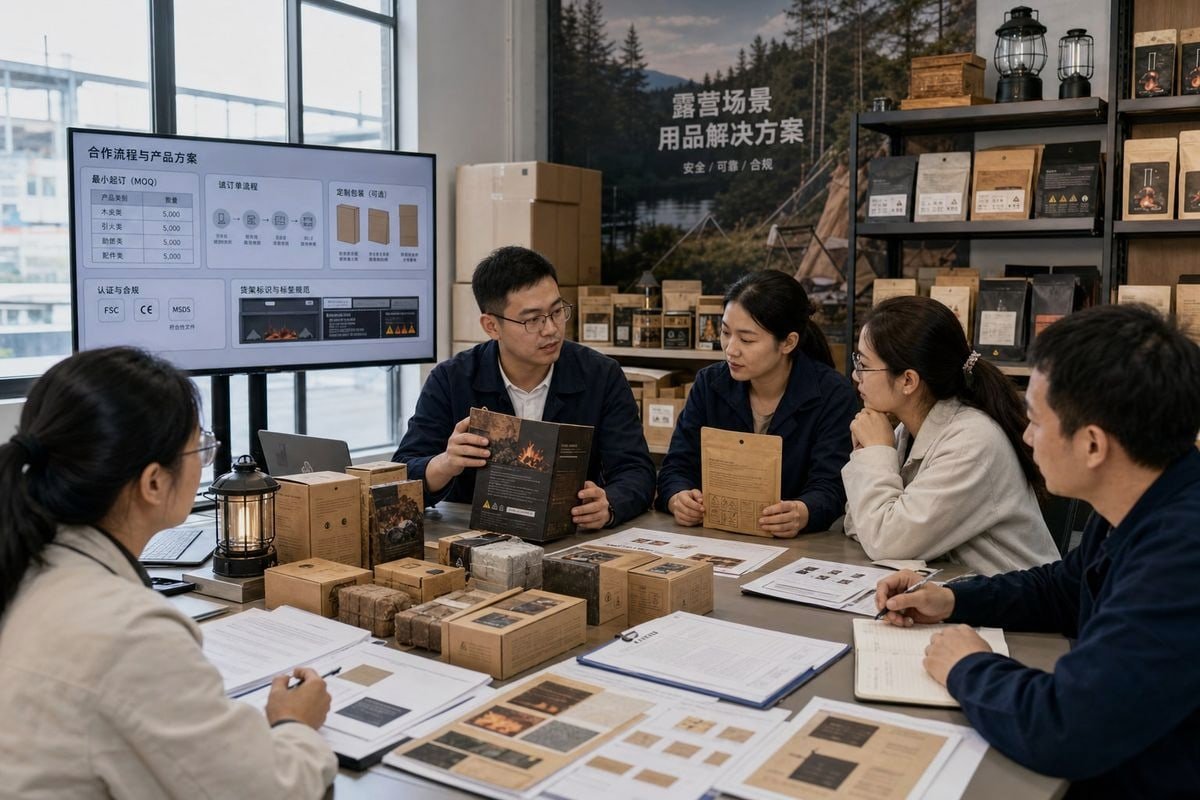
Introduire Magic Fire Powder dans les magasins de camping et de terrains de camping semble facile — jusqu'à ce que les acheteurs, lors des appels clients de notre chaîne de production, posent les questions difficiles sur la conformité, les MOQ et l'étiquetage.
Pour introduire Magic Fire Powder dans les magasins de camping et de terrains de camping, obtenir d'abord des rapports de test SGS ou Intertek et la conformité CE, commencer par des commandes d'essai à faible MOQ, étiqueter en privé les paquets pour votre marque, et utiliser un emballage axé sur la sécurité avec des instructions simples à jeter près des présentoirs de caisse.
Je vais passer en revue ces quatre étapes dans l'ordre. Chacune d'elles est issue de conversations réelles avec les distributeurs que nous fournissons. Commençons par la conformité, car tout le reste en dépend.
Comment obtenir la certification et la conformité de la poudre magique à feu pour les marchés de détail des campings ?
Un distributeur allemand a un jour envoyé un e-mail à notre bureau de Liuyang 1 à minuit, demandant notre rapport SGS avant même de discuter des prix. Cet e-mail m'a appris par où commence toujours cette conversation.
Obtenir la conformité de la poudre magique à feu pour la vente au détail dans les campings signifie obtenir des rapports de tests chimiques SGS ou Intertek, le marquage CE pour les marchés européens, une FDS pour les dossiers de responsabilité du détaillant, et confirmer que la formule ne contient pas de métaux lourds restreints — des documents que vos acheteurs de détail de camping et leurs assureurs exigeront d'emblée.
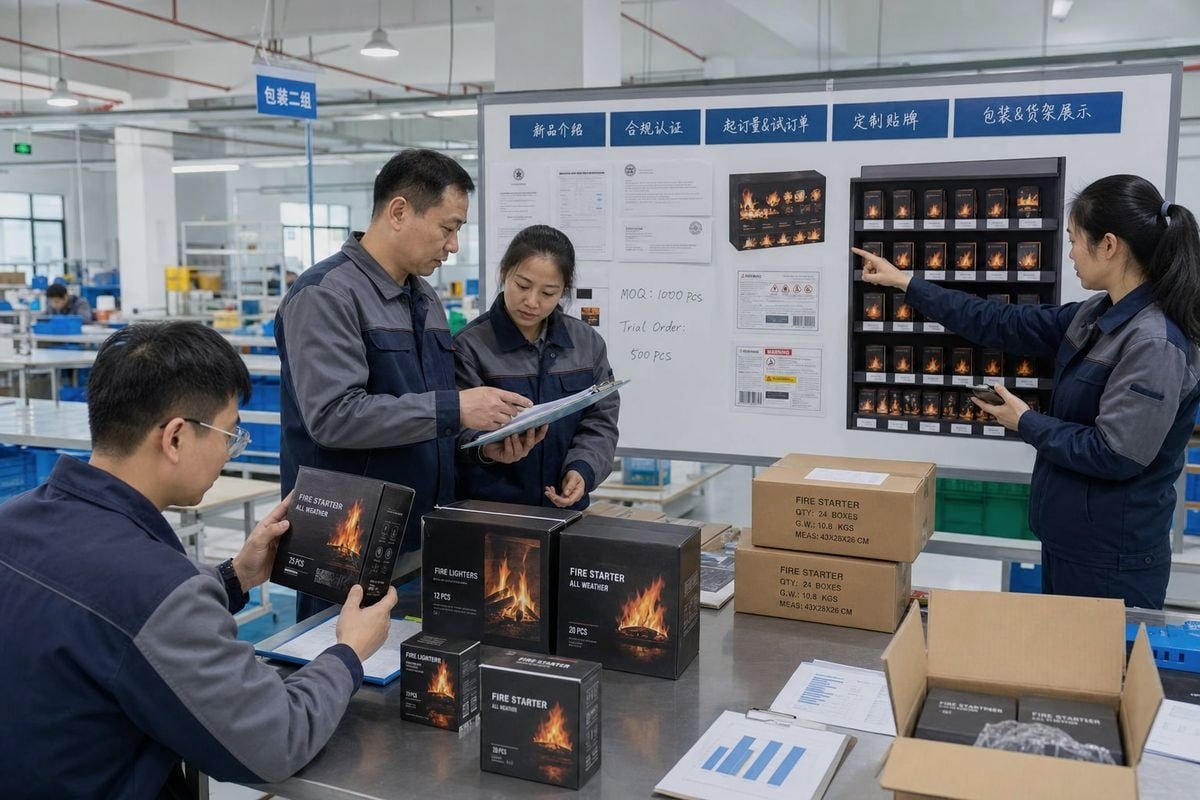
La conformité n'est pas un luxe dans cette catégorie. Les exploitants de campings et les équipes de gestion des ventes des parcs de camping-car 2 portent une réelle exposition à la responsabilité, et leurs assureurs posent des questions avant même qu'un seul sachet n'atteigne l'étalage. Au cours de nos 17 années d'exportation de produits à flamme colorée vers plus de 30 pays, nous n'avons jamais décroché de compte de vente au détail sérieux sans présenter d'abord les documents.
La pile de documents de base
Voici ce qu'un responsable des achats d'un importateur établi nous demande généralement, et pourquoi chaque article est important :
| Document | Ce qu'elle prouve | Qui le demande |
|---|---|---|
| Rapport de test SGS / Intertek | La composition chimique est sûre, aucune substance réglementée | Acheteurs au détail, douanes |
| FDS (Fiche de Données de Sécurité) | Instructions de manipulation, de stockage et d'urgence | Assureurs, exploitants de magasins |
| Conformité CE | Conforme aux exigences de l'UE en matière de produits de consommation | Distributeurs européens |
| Certificat d'usine ISO 9001 | Système de qualité de production constant | Grands canaux d'approvisionnement |
| Audit BSCI | Conformité éthique et sociale de l'usine | Chaînes de vente au détail américaines et européennes |
Pourquoi "écologique, sans produits chimiques nocifs" doit être prouvable
Les recettes DIY de flammes colorées impliquent des sels de cuivre et de strontium 3, et les acheteurs sceptiques le savent. C'est précisément pourquoi nous formulons nos sachets Magic Fire à partir de matériaux écologiques sans produits chimiques nocifs — et étayons cette affirmation par des rapports de tests par des tiers 4. Ne laissez jamais un fournisseur vous dire "c'est bon, tout le monde le vend". Demandez les rapports au niveau du lot. Vérifiez également les réglementations locales en matière de sécurité des feux de camp 5 dans vos régions cibles, car certains parcs restreignent les additifs pour feux pendant les interdictions de brûlage. Un produit conforme avec documentation facilite ces conversations. Un produit sans cela bloque dès la première réunion avec l'acheteur.
Quelles options de MOQ et de commande d'essai fonctionnent le mieux lorsque je teste la demande de vente au détail dans les campings ?
Le compromis que j'évalue le plus souvent avec les nouveaux acheteurs est simple : commander trop gros et vous risquez des stocks morts ; commander trop petit et votre coût unitaire débarqué mange la marge.
Pour tester la demande de vente au détail dans les campings, commencez par une commande d'essai de 500 à 1 000 sachets à usage unique dans deux ou trois formats d'emballage, placez-les dans cinq à dix sites pilotes et n'augmentez les quantités qu'après une saison de pointe complète qui confirme la vente.
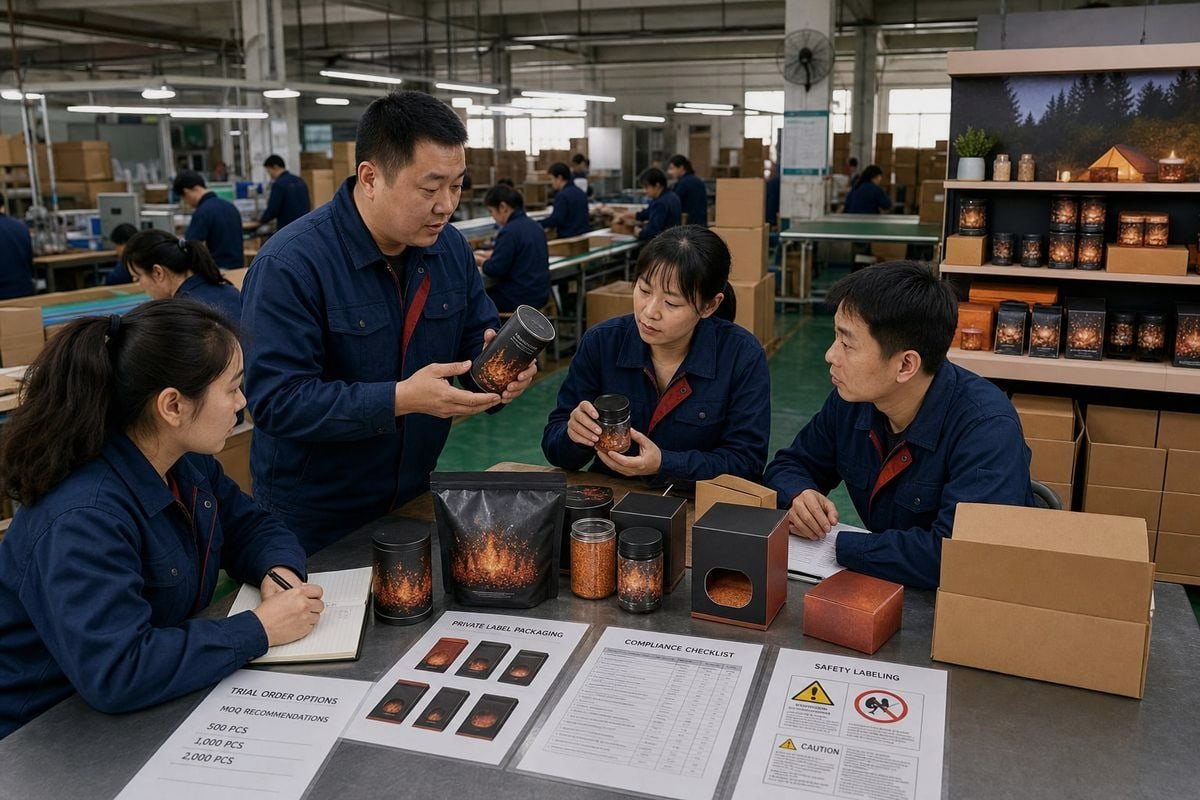
Magic Fire Powder est un article d'impulsion de nouveauté 6, pas un produit de base pour camping. Je le dis ouvertement, même si nous fabriquons le produit. Cette réalité façonne la façon dont vous devriez commander. Vous ne stockez pas de bois de chauffage — vous testez si les campeurs saisiront un ajout amusant à la caisse. La structure d'essai est donc plus importante que le prix unitaire.
Un déploiement réaliste en trois étapes
- Stade pilote. Commandez 500 à 1 000 sachets. Répartissez-les entre les formats de pochettes en plastique et de sacs en papier kraft. Placez de petits présentoirs au point de vente dans une poignée de magasins près des râteliers de bois de chauffage et des comptoirs de caisse.
- Stade de validation. Suivez les ventes hebdomadaires pendant une saison de camping de pointe. Notez quel format se vend le mieux, si les lots multiples se vendent mieux que les unités simples, et comment le trafic du week-end se convertit.
- Phase de mise à l'échelle. Passez à des commandes consolidées ou en conteneur complet de votre SKU gagnant, programmé pour que l'inventaire arrive avant le printemps.
Planification autour de la demande saisonnière
Les accessoires d'extérieur saisonniers vivent et meurent au calendrier. La saison des feux de camp culmine de la fin du printemps au début de l'automne aux États-Unis et en Europe, avec un pic secondaire autour de la saison des cheminées sur les marchés d'hiver comme l'Allemagne et le Canada.
| Planification des commandes | Objectif | Quantité typique |
|---|---|---|
| Janvier-février | Commande d'essai arrivée avant le printemps | 500–1 000 sachets |
| Mars–Mai | Placement pilote, premières données de ventes | Réapprovisionnement selon les besoins |
| Juin–Août | Validation de la saison de pointe | Mise à l'échelle du SKU gagnant |
| Septembre-octobre | Planification du marché des cheminées d'hiver | Planification des conteneurs |
D'après notre expérience d'exportation vers les États-Unis et l'Allemagne, les acheteurs qui suivent ce rythme évitent les deux erreurs classiques : un conteneur de stock invendu en novembre, ou une étagère vide en juillet. Nous maintenons des MOQ d'essai flexibles pour cette raison exacte — le premier échantillon de notre chaîne reflète de manière fiable la qualité de la production de masse, de sorte qu'un petit pilote prédit réellement à quoi ressemblera une commande importante. Lors de l'approvisionnement en fournitures de camping en gros, cette cohérence d'un lot à l'autre est ce qui rend un petit test significatif.
Comment puis-je étiqueter en privé la poudre magique pour le feu pour ma marque de vente au détail de camping?
A Canadian outdoor brand we work with came to us with nothing but a logo file and a Pantone code. Eight weeks later, their branded color-changing flame packets were on campground shelves.
Pour étiqueter en marque privée la poudre Magic Fire, choisissez un format d'emballage (sachet en aluminium, sac en papier kraft ou bocal), fournissez votre logo et les illustrations de votre marque, et laissez l'usine s'occuper des sachets imprimés, des boîtes d'exposition personnalisées, des codes-barres, des étiquettes d'avertissement et du texte de conformité spécifique au marché dans le cadre d'un programme OEM/ODM tout-en-un.
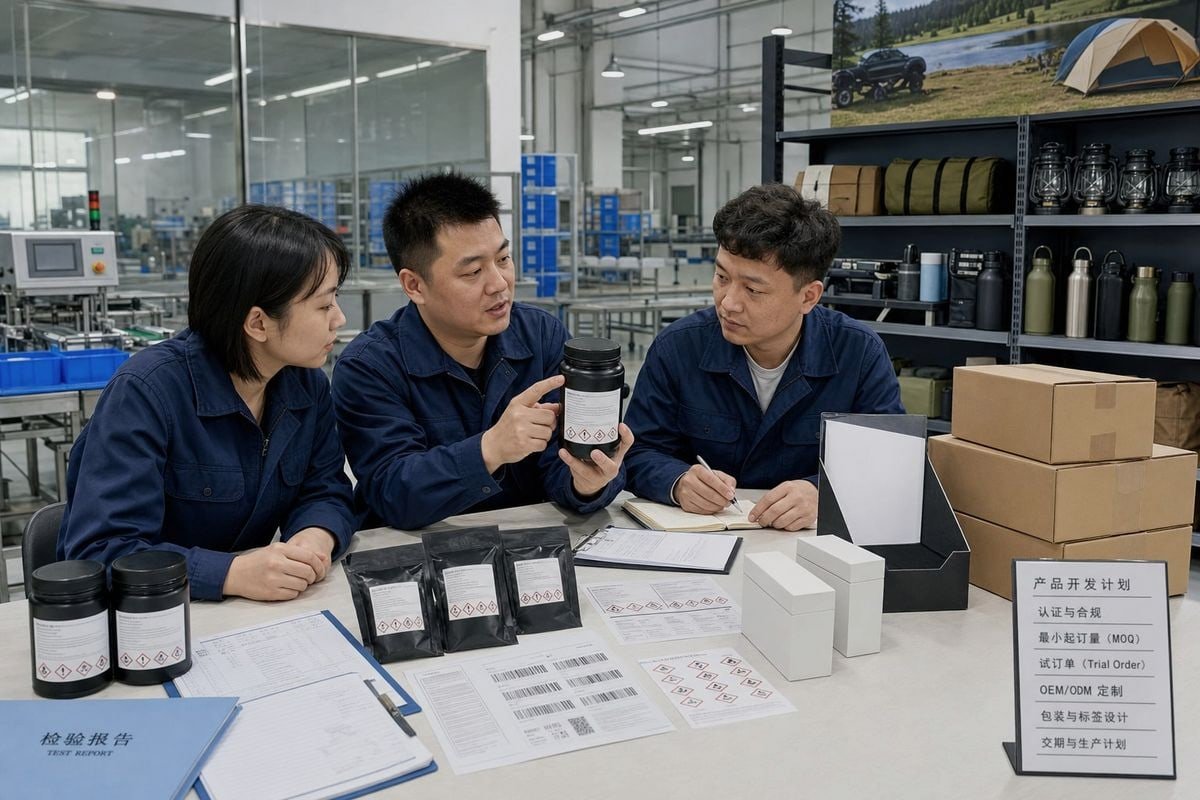
Private labeling is where this product stops being a commodity and starts building your margin. A generic packet competes on price. A branded "campfire experience" packet, designed for your customer, competes on story. For campground gift shop inventory, story wins — because campers buy the memory, not the chemistry.
Ce que vous pouvez personnaliser
Our OEM/ODM process covers more than a logo swap. Here is the realistic customization menu we run through with brand buyers:
| Élément | Options | Why it matters at retail |
|---|---|---|
| Emballage primaire | Glossy foil pouch, kraft stand-up bag, plastic jar | Kraft suits eco-positioned brands; foil pops at checkout |
| Burn time / fill weight | Adjustable powder quantity per packet | Multi-night family packs vs. single-evening packets |
| Emballage d'exposition | Flip-top counter display box, hang tabs | Ready for point-of-purchase displays without extra work |
| Étiquetage | Barcodes, warning text, multi-language instructions | Shelf-ready on arrival, no relabeling cost |
| Bundles | Multi-packs, pairing with color-flame pinecones or firestarters | Higher basket value per camper |
Positioning your brand against DIY alternatives
One objection I hear from cautious buyers: "Campers can Google a DIY colored-flame recipe — why would they pay for a packet?" My answer is that DIY alternatives actually strengthen the retail case. Handling raw copper salts is exactly what vacationing families do not want to do. Your private-label packet sells packaged convenience and tested safety. Keep the branding playful — rainbow flames, bold bubble lettering, a photo of the effect — and skip the chemistry lecture. Outdoor novelty products succeed on spectacle and simplicity, not ingredient lists. We design artwork with buyers in both directions: fun on the front, safety-forward on the back.
Quels emballages et étiquetages de sécurité ai-je besoin pour les étagères des magasins de camping ?
Early in my career, we lost a reorder because a batch of pouches clumped in a humid seaside campground display. That lesson permanently changed how we spec packaging seals.
L'emballage de présentation du camping nécessite une pochette en aluminium scellée contre l'humidité, une instruction visuelle en trois étapes à jeter, et des avertissements clairs : ne pas ouvrir le sachet, utiliser uniquement dans des feux à bois, et ne pas cuire d'aliments sur les flammes colorées — plus les symboles et le langage de mise en garde requis par le marché.

Packaging does two jobs on a campground shelf. It has to sell the effect in three seconds, and it has to prevent misuse without a staff member explaining anything. Campground stores are often self-service, semi-outdoor, and staffed by seasonal workers. Your packet must do the talking.
The non-negotiable safety messages
Consumer-facing guidance for this category is remarkably consistent, and your label should reflect it word for word:
- Ne pas ouvrir le sachet. The sealed pouch goes into the fire whole.
- Uniquement les feux de bois. Not for gas fireplaces, stoves, or grills.
- Do not cook over the colored flames. Roast marshmallows before, not after.
- Tenir à l'écart des enfants. Adults toss the packet; kids watch the show.
- Follow local rules. A short line pointing to campfire safety regulations covers burn-ban regions.
Keep the usage side even shorter. A three-icon strip — build fire, toss packet, enjoy colors — outperforms any paragraph of text. Some of our buyers add a QR code linking to a video demo of the rainbow flame effect, which works well on point-of-purchase displays.
Built for the campground environment
Campground retail is humid, hot, and often open-air. We seal our foil pouches to resist moisture so the crystalline powder stays free-flowing, and we spec display boxes in coated cardboard that survives a summer on a countertop near the firewood rack. For impulse buy merchandising, placement finishes the job: position the display beside firewood, fire starters, lighters, and s'mores kits 7 — the fire-night essentials campers already came in to buy. That cross-sell logic is why wholesale fire colorants belong in the fire aisle, never the souvenir corner.
Conclusion
Introducing Magic Fire Powder to campsite retail works when you lead with compliance, test with small MOQs, private-label the experience, and merchandise it safety-first beside the firewood.
Notes de bas de page
1. Liuyang is the global center for pyrotechnic production and chemical fire product manufacturing. ↩︎
2. National association representing the interests and management of private campgrounds and RV parks. ↩︎
3. Scientific overview of the chemical salts used to produce specific colors in flames. ↩︎
4. Authoritative testing service for chemical safety and regulatory compliance in consumer products. ↩︎
5. Official government safety guidelines and restrictions for maintaining campfires in public lands. ↩︎
6. Authoritative Wikipedia entry defining impulse buying and consumer behavior. ↩︎
7. Reference to the traditional campfire treat often sold alongside fire novelty products. ↩︎



 English
  Spanish
  German
  French
  Arabic
  Portuguese
Rejoignez la conversation