






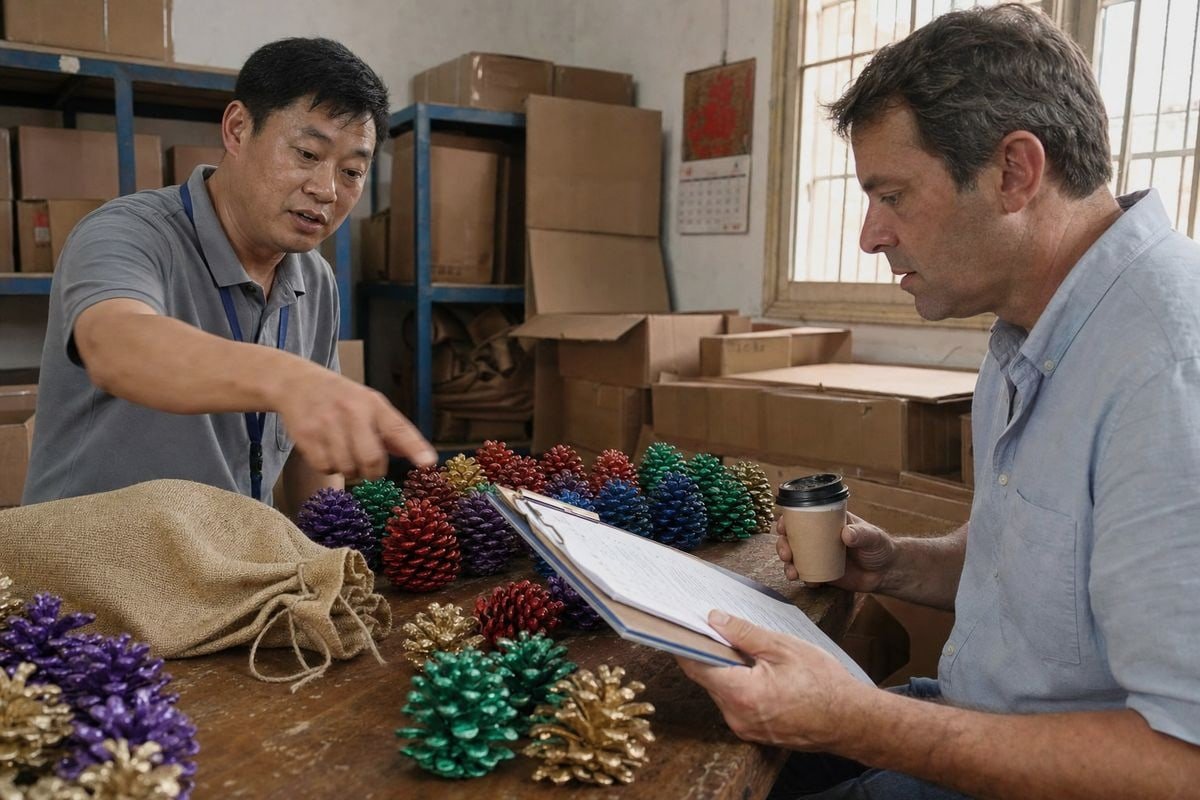
Une fiche technique vague pour des pommes de pin colorées pour cheminée cause de réels dommages. Sur notre chaîne de production, j'ai vu des spécifications d'acheteur peu claires se transformer en expéditions contestées, en lancements retardés et en palettes retournées. Un champ manquant — durée de combustion, taille du cône ou type de colorant — peut faire couler toute une commande saisonnière. La solution est une fiche technique structurée qui définit l'effet de couleur, la taille physique et les performances de combustion en termes mesurables.
Une fiche technique pour des pommes de pin colorées pour cheminée devrait définir les couleurs de flamme (typiquement bleu-vert), la durée de la couleur (5 à 12 minutes par pomme de pin), la gamme de tailles de pommes de pin (3 à 6 pouces selon l'espèce), le poids et le nombre par paquet, la teneur en humidité, le type de revêtement, les avertissements de sécurité et les certifications de conformité comme les rapports de test SGS.
Ci-dessous, je divise la fiche technique en quatre parties pratiques. Chaque partie correspond à une section que vous pouvez copier dans votre propre document d'approvisionnement. Commençons par la couleur et la durée de combustion.
Quelles couleurs et quels détails de temps de combustion dois-je inclure dans ma fiche technique de pommes de pin colorées ?
Lors d'une revue de contrôle qualité l'hiver dernier, nous avons découvert un lot où la flamme verte s'est estompée après trois minutes au lieu de huit. La fiche technique de l'acheteur nous a sauvés — elle définissait précisément la durée de la couleur, nous savions donc exactement quoi corriger.
Votre fiche technique doit indiquer les couleurs dominantes de la flamme (bleu, vert ou multicolore), le niveau d'intensité visuelle, le temps d'apparition de la couleur, la durée de la couleur active par cône (cible 5–10 minutes), les colorants chimiques de flamme utilisés et une tolérance de cohérence de lot afin que chaque cône du sac se comporte de la même manière.

La couleur est la raison pour laquelle votre client achète ce produit. Elle mérite donc la section la plus détaillée de votre fiche technique. Au cours de nos 17 années de fabrication de paquets Magic Fire et de pommes de pin à flamme colorée, nous avons appris que "de belles flammes arc-en-ciel" est une phrase marketing, pas une spécification. Vous avez besoin de champs mesurables.
Mapper les colorants aux couleurs de flamme attendues
Différents colorants chimiques pour flammes 1 produisent différentes teintes. Votre fiche technique doit indiquer la famille de colorants afin que votre fournisseur ne puisse pas substituer des composés moins chers. Voici la correspondance standard que nous utilisons :
| Couleur de flamme | Colorant typique | Notes pour la fiche technique |
|---|---|---|
| Bleu-vert | Composés de cuivre (par exemple, sulfate de cuivre cristallisé) | La revendication commerciale dominante ; effet visuel le plus fort |
| Vert | Acide borique / borax | Vert plus doux ; souvent mélangé avec du cuivre |
| Rouge | Chlorure de strontium | Vif mais s'estompe plus rapidement dans les feux chauds |
| Violet | Sels de potassium | Subtil ; a besoin d'un feu établi pour bien se montrer |
| Jaune-orange | Sels de sodium | Souvent indésirable ; peut masquer d'autres couleurs |
Un avertissement que je donne toujours aux acheteurs : les produits chimiques mélangés peuvent s'annuler mutuellement ou ternir. Si vous voulez un effet multicolore, spécifiez que les couleurs proviennent de cônes traités séparément dans un même sac, et non d'un cône trempé dans tout.
Définir la durée honnêtement
Les listes commerciales se situent autour de 5 à 10 minutes de couleur active par cône, ou 10 à 12 minutes pour deux à trois cônes. Votre fiche technique doit séparer trois chiffres : le début de la couleur (à quelle vitesse la couleur apparaît une fois que le cône prend feu), la durée de la couleur maximale et la durée totale de combustion. Un cône continue souvent de brûler après que la couleur visible se soit estompée, car le revêtement brûle avant le bois. Notez également que les feux plus chauds raccourcissent l'effet de couleur. Spécifier "8 minutes minimum dans un feu de bois modéré établi" est testable. "Couleur durable" ne l'est pas.
Comment spécifier les exigences de taille et d'emballage pour des commandes en gros cohérentes ?
Il y a un compromis que j'évalue sur chaque commande de pommes de pin : un calibrage strict de la taille augmente le coût et rejette les cônes utilisables, tandis qu'un calibrage lâche risque des plaintes de l'acheteur concernant les "petits cônes". La fiche technique est l'endroit où nous réglons cet équilibre à l'avance.
Spécifiez une plage de tailles de cônes (par exemple, 3 à 6 pouces par espèce de pin nommée), le poids du paquet (1 lb, 2 lb ou 5 lb), le nombre minimum par paquet, un pourcentage maximum d'humidité de 8 à 10 % et une tolérance écrite pour la variation naturelle de taille.
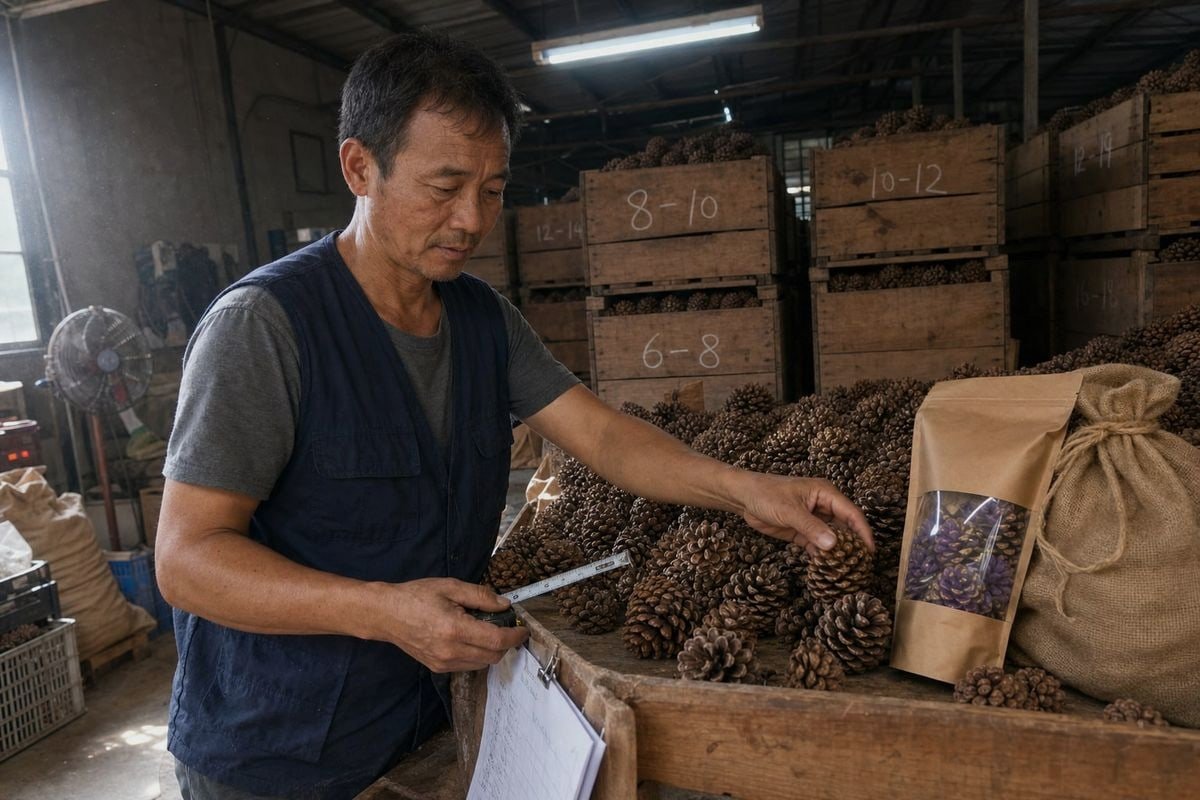
Les pommes de pin sont des produits naturels. Il n'y en a pas deux identiques. C'est normal — mais votre fiche technique doit le dire par écrit, sinon un acheteur au détail mesurera dix cônes avec une règle et déposera une réclamation. Dans notre expérience d'exportation aux États-Unis et en Europe, la section sur la taille évite plus de litiges que toute autre partie du document.
Les champs physiques de base
Commencez par l'espèce de pomme de pin. Les cônes Loblolly et Ponderosa sont plus grands, généralement de 3 à 6 pouces, et donnent une forte présence sur l'étagère. Les petits cônes décoratifs peuvent mesurer de 1,2 à 1,6 pouce (3 à 4 cm). Nommer l'espèce fixe la classe de taille avant même le début du calibrage. Définissez ensuite l'humidité. Un pourcentage maximal de teneur en humidité 2 de 8 à 10 % maintient les cônes stables en rayon dans un emballage de vente au détail scellé et empêche la pourriture interne pendant le transport maritime.
| Champ de spécification | Valeur exemple | Pourquoi c'est important |
|---|---|---|
| Espèce | Loblolly ou Ponderosa | Contrôle la taille de base et la structure de l'échelle |
| Plage de longueur du cône | 3–6 pouces (ou 3–4 cm pour les petits cônes) | Définit l'impact visuel et la durée de combustion |
| Tolérance de variation de taille | ±15 % dans la plage indiquée | Reconnaît honnêtement la variation naturelle |
| Teneur en humidité | ≤ 8–10 % | Prévient la moisissure, la pourriture et l'échec d'allumage |
| Poids du paquet | 1 lb / 2 lb / 5 lb | Formats de vente au détail standard |
| Nombre minimum | par exemple, ≥30 cônes par boîte de 1 lb | Protège contre les sacs sous-remplis |
| Type d'emballage | Pochette kraft refermable, sac en toile de jute ou bocal | Affecte la protection contre l'humidité et l'aspect de l'étagère |
Emballage qui résiste au transport
Nous recommandons également de spécifier un rapport chimique-liant standardisé et, le cas échéant, une revêtement de cire de paraffine 3 est utilisée, une dureté de cire adaptée à votre voie climatique. Cela évite la poussière chimique à l'intérieur du sac pendant le transport et le blanchiment de la cire sur les routes de conteneurs chaudes. Sur notre ligne OEM, nous personnalisons le matériau des sachets, l'impression en marque privée, les étiquettes d'avertissement et les codes-barres — mais seulement après que la fiche technique de l'acheteur ait d'abord fixé le produit physique. Les décisions d'emballage basées sur une spécification de produit instable finissent toujours par vous nuire.
Quelles certifications de sécurité et de conformité dois-je demander à mon fournisseur de pommes de pin ?
Un distributeur allemand m'a dit un jour que son fournisseur précédent était resté silencieux lorsque les douanes ont demandé des documents de test. Son conteneur est resté au port pendant cinq semaines. Cette conversation est la raison pour laquelle la conformité dirige tous les devis que nous envoyons.
Demander la certification d'usine ISO 9001 et BSCI, le marquage CE le cas échéant, des rapports de test SGS ou Intertek par des tiers, une fiche de données de sécurité pour le revêtement colorant, des résultats de test sur les métaux lourds et les émissions de COV, et la conformité aux étiquettes d'avertissement spécifiques au marché avant de passer toute commande en gros.
Les produits colorés à feu se situent dans une catégorie sensible. Ils brûlent à l'intérieur, près des familles, dans les salons. Les régulateurs et les grands détaillants les traitent en conséquence. Pour nos acheteurs aux États-Unis, en Allemagne, au Royaume-Uni et en France, la certification est une exigence stricte, pas un avantage — et votre fiche technique devrait l'indiquer comme condition d'acceptation, pas comme une demande polie.
Documents à exiger, par ordre de priorité
- Fiche de données de sécurité. Chaque revêtement chimique en a besoin d'un. Il identifie les colorants, les risques de manipulation et les mesures de premiers secours. Aucune usine sérieuse n'hésite à le fournir.
- Rapports de test sur les métaux lourds et les COV. Les acheteurs modernes s'attendent à des formulations sans métaux lourds. Qualité de l'air intérieur 4 les normes continuent de se resserrer, en particulier dans l'UE. Les rapports de tiers de SGS ou Intertek 5 ont beaucoup plus de poids que la propre déclaration d'une usine.
- Certificats du système d'usine. L'ISO 9001 prouve un système qualité documenté. La BSCI couvre conformité sociale 6, que les grands canaux d'approvisionnement au détail auditent désormais régulièrement.
- Marquage CE le cas échéant pour le marché européen.
- Examen des étiquettes d'avertissement. Les pommes de pin colorées sont destinées uniquement aux feux de bois, aux foyers et aux feux de camp — jamais aux foyers à gaz, aux appareils sans évacuation ou aux feux utilisés pour la cuisson. Votre fiche technique devrait exiger que ce texte soit imprimé sur l'emballage.
Abordez les objections de front
Certains acheteurs demandent si ces produits aggravent l'accumulation de créosote 7 dans les cheminées. Un revêtement correctement formulé, sans métaux lourds et utilisé à la dose recommandée — une à trois pommes par feu — ajoute un résidu négligeable par rapport au bois lui-même. D'autres s'inquiètent de la qualité de l'air intérieur. C'est précisément pourquoi vous spécifiez des formulations écologiques et testées par écrit au lieu de vous fier à une photo de liste. Dans notre usine de Ningbo, nous conservons les rapports de test actuels à disposition précisément parce que les responsables des achats les demandent avant même l'expédition du premier échantillon.
Comment une fiche technique claire peut-elle m'aider à éviter les problèmes de qualité lors de la production de masse ?
Il y a des années, nous avons appris une dure leçon : un acheteur a approuvé un échantillon doré, puis a reçu une production de masse avec des flammes légèrement plus pâles. Rien n'était "faux" — mais rien n'était défini non plus. Depuis lors, nous traitons la fiche technique comme le contrat de cohérence.
Une fiche technique claire transforme les affirmations subjectives en critères de réussite/échec testables — durée de la couleur, taille du cône, humidité, poids du revêtement — afin que le contrôle qualité à la réception, les vérifications en ligne et l'inspection avant expédition mesurent tous par rapport aux mêmes chiffres, garantissant que la production de masse correspond à l'échantillon approuvé.
La qualité de la production de masse n'est pas atteinte lors de l'inspection. Elle est atteinte lors de la spécification. Lorsque chaque champ est mesurable, trois personnes qui ne se sont jamais rencontrées — votre chef de produit, notre superviseur de ligne et un inspecteur tiers — peuvent toutes examiner la même pomme et parvenir à la même conclusion. C'est ce que signifie réellement la cohérence des lots en pratique.
Quand les spécifications non définies échouent
| Étape de production | Risque sans spécification | Ce que la fiche technique corrige |
|---|---|---|
| Approvisionnement en pommes de pin brutes | Mauvaise espèce, écailles fermées, contamination par des parasites | Nom de l'espèce ; cuisson préalable à 200°F pendant une heure |
| Traitement chimique | Couleur faible ou incohérente | Colorant défini, temps de trempage (par exemple, saturation de 24 heures), rapport chimique-liant |
| Revêtement | Poussière, cire inégale | Poids du revêtement de cire de paraffine par pomme ; méthode d'application |
| Séchage | Moisissure dans les sacs scellés | Seuil maximal de teneur en humidité |
| Emballage | Sachets sous-remplis, pommes écrasées | Nombre minimum, poids du paquet, exigence de test de chute du carton |
| Stockage et expédition | Blanchiment de la cire, déliquescence du sel en cas d'humidité | Tolérances de température et d'humidité de stockage |
Faites de l'échantillon la norme
La clause la plus précieuse que je recommande à chaque responsable des achats est simple : "La production de masse doit correspondre à l'échantillon doré approuvé dans les tolérances indiquées dans cette fiche technique." Ensuite, joignez critères de test de combustion — par exemple, cinq pommes par lot brûlées dans un feu de bois standard, chacune montrant une couleur bleu-vert visible pendant au moins six minutes. Sur notre ligne, les contrôles en cours ont lieu lors du traitement, du séchage et de l'emballage, et nous photographions les tests de combustion pour les archives de l'acheteur. Parce que nous effectuons la production complète en interne plutôt que de sous-traiter, le premier échantillon prédit de manière fiable ce qui arrive dans le conteneur. Une fiche technique claire est ce qui rend cette promesse vérifiable plutôt qu'une question de confiance.
Conclusion
Une spécification vague invite les litiges ; une spécification précise les évite. Définissez la couleur, la durée, la taille, l'humidité, l'emballage et la conformité en termes mesurables — puis choisissez une usine certifiée qui accepte ces chiffres.
Notes de bas de page
Explique la chimie des sels métalliques produisant des flammes colorées référencées dans la fiche technique. ↩︎
Les directives de l'EPA soutiennent les affirmations de contrôle de l'humidité liées à la qualité de l'air intérieur et à la prévention des moisissures. ↩︎
Référence de base sur les propriétés de la cire de paraffine utilisées dans le processus de revêtement des cônes. ↩︎
L'EPA est la source faisant autorité sur les normes de qualité de l'air intérieur pertinentes pour la combustion de produits enduits à l'intérieur. ↩︎
Intertek est un laboratoire d'essais tiers de premier plan nommé pour la vérification indépendante des produits. ↩︎
Amfori administre l'audit de conformité sociale BSCI mentionné comme une exigence du fournisseur. ↩︎
Référence de base expliquant ce qu'est le créosote et pourquoi l'accumulation dans la cheminée est importante. ↩︎

 English
  Spanish
  German
  French
  Arabic
  Portuguese
Rejoignez la conversation