






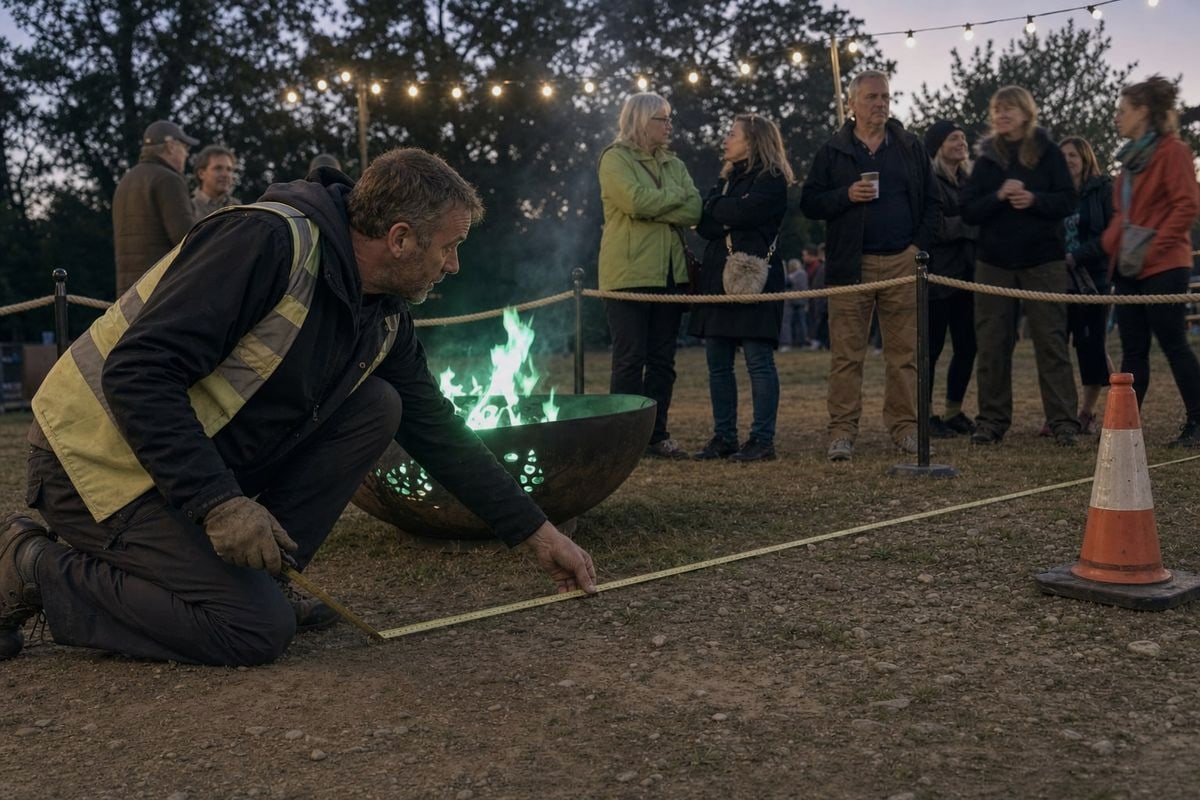
Controlling safety distance and dosage for Magic Fire Powder at large venues worries many event buyers I talk with. One wrong estimate can mean injuries, fines, or a canceled show. After 17+ years running color-flame production lines in Liuyang and Ningbo, our team has helped festival traders and event distributors avoid exactly those failures — and the solution starts with correct classification, documented dosage, and layered distance rules.
Control safety distance and dosage for Magic Fire Powder by following the manufacturer's data sheet, keeping spectators at least 3–5 meters from treated flames, dosing one sachet per standard fire pit, scaling by flame area, and getting local fire authority approval before the event.
Let me break this down step by step. We will cover documentation, dosage math, distance rules, and how custom packaging supports your safety plan.
What safety documentation should I request before ordering Magic Fire Powder for large events?
A German distributor once asked us for paperwork before even discussing price. That order taught me something: for large events, documentation is the product. Our compliance files now travel with every export shipment.
Before ordering, request the SDS (Safety Data Sheet), SGS or Intertek test reports, CE compliance documents, ISO 9001 and BSCI factory certificates, the product technical data sheet with dosage and distance guidance, and confirmation of correct product classification for your jurisdiction.

Documentation matters because color-flame powder sits in a gray zone in many markets. It is not a display firework. It is not flash powder either. But local fire marshals and Authorities Having Jurisdiction (AHJ) 1 will still ask what it is, what it contains, and how it burns. If you cannot answer with paper, they may refuse your permit or classify the product under stricter pyrotechnic rules than necessary.
Voici ce que nous remettons aux acheteurs le premier jour, et ce que vous devriez exiger de tout fournisseur :
| Document | Ce qu'elle prouve | Qui le demande |
|---|---|---|
| FDS (Fiche de Données de Sécurité 2) | Chemical composition, hazards, handling | Fire marshal, insurer, customs |
| Rapport de test SGS / Intertek | Third-party verified burn and safety data | Retailers, event insurers |
| Fiche technique | Dosage per application, recommended distances | Event safety officer, AHJ |
| documentation CE | Conformité au marché de l'UE | EU importers, venue managers |
| Certificats ISO 9001 / BSCI | Consistent production and ethical audit | Responsables des achats |
Pourquoi la classification passe avant tout
The word "fire powder" gets used loosely. Some products sold under similar names behave like pyrotechnic flash compositions 3. Those fall under strict display or close-proximity codes. Our Magic Fire color-flame packets are eco-friendly additives you simply add to an existing campfire, fireplace, or fire pit. They do not detonate, launch, or produce concussion effects. That distinction changes which code applies. So request written classification confirmation from your supplier, and share it with your local AHJ early. In our experience exporting to 30+ countries, the buyers who submit documentation to the fire authority weeks in advance almost never face last-minute event shutdowns.
How much color-flame powder do I need to calculate the correct dosage per fire pit or flame area?
During burn-time calibration at our Ningbo plant, we test each batch against a standard fire pit before release. That routine gives us hard numbers, and I will share the working method here.
Use one 25g sachet per standard fire pit or fireplace for 30–60 minutes of color effect. For larger flame areas, scale at roughly one sachet per square meter of active flame bed, and never exceed the manufacturer's stated maximum per fire.
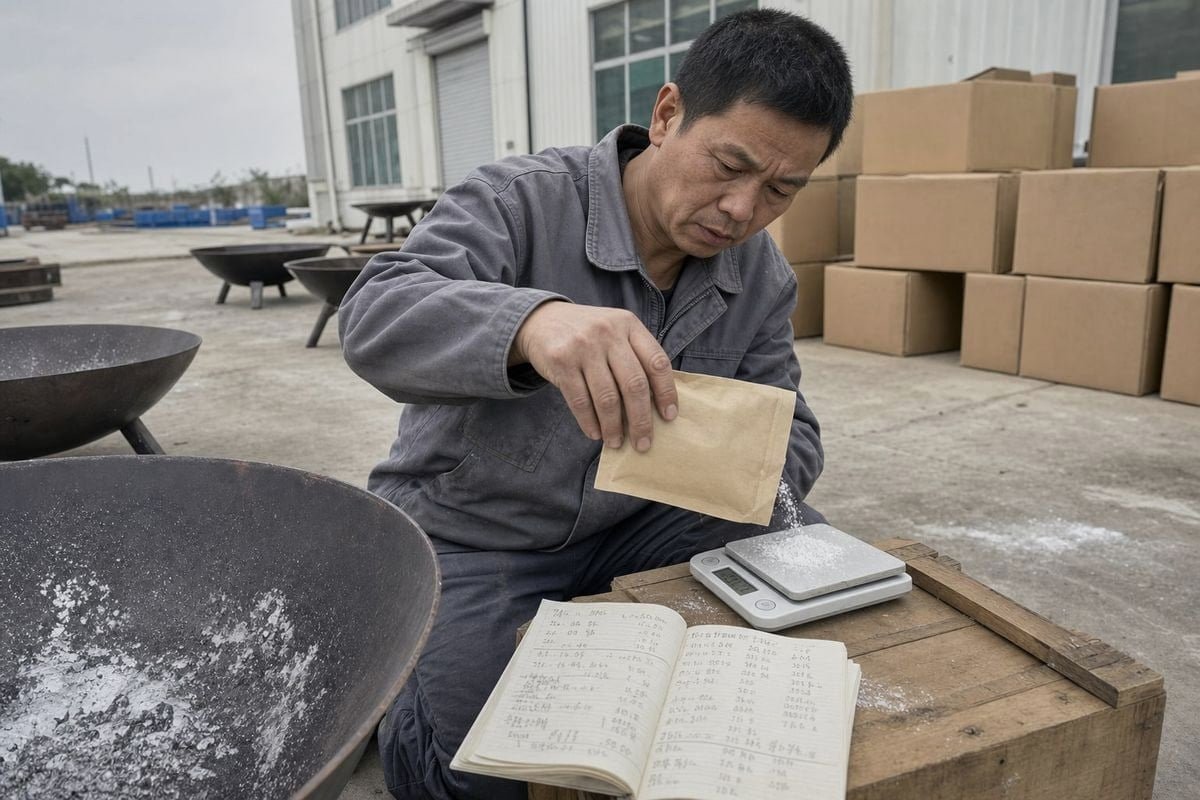
Dosage is a hazard multiplier. More powder does not simply mean more color. It can mean taller flames, more smoke, and a larger fallout of sparks. That is why pyrotechnic safety manuals consistently limit batch sizes and per-cue quantities. The same logic applies to color-flame additives, just at a gentler scale.
A practical dosage method
- Measure the active flame bed area of each fire pit, not the pit rim.
- Apply the base dose: one standard sachet per fire pit up to about one square meter.
- Scale linearly for larger flame areas, but cap total quantity per fire at the data sheet maximum.
- For indoor or covered venues, calculate against venue volume, not just floor area, to control smoke buildup and flame height.
- Run a controlled test firing in the actual venue before the live event.
Dosage reference table
| Application | Flame area | Suggested dose | Durée de l'effet |
|---|---|---|---|
| Home fireplace | Under 0.5 m² | 1 sachet | 30–60 min |
| Standard fire pit | 0.5–1 m² | 1 sachet | 30–60 min |
| Large festival fire bowl | 1–2 m² | 2 sachets | 30–60 min |
| Bonfire / event flame feature | 2 m²+ | Per data sheet only | Variable |
Environmental factors matter too. High humidity slows the color release. Hot, dry air intensifies flames. Our engineers recommend calibrated measurement — sealed single-dose sachets remove guesswork, which is exactly why we designed unit-dose packaging rather than bulk scoops for event use.
What minimum safety distance should I maintain between spectators and treated flames at large venues?
One trade-off we weigh constantly when writing instruction panels: a single distance number is easy to print, but real venues need layered rules. Our export markets prove there is no universal figure.
Maintain the greatest of three values: 3–5 meters as an absolute floor, the manufacturer's recommended distance, or twice the flame's fallout radius. Indoor venues and large crowds typically require 15–20 feet (4.5–6 m) plus physical barriers approved by the local fire authority.
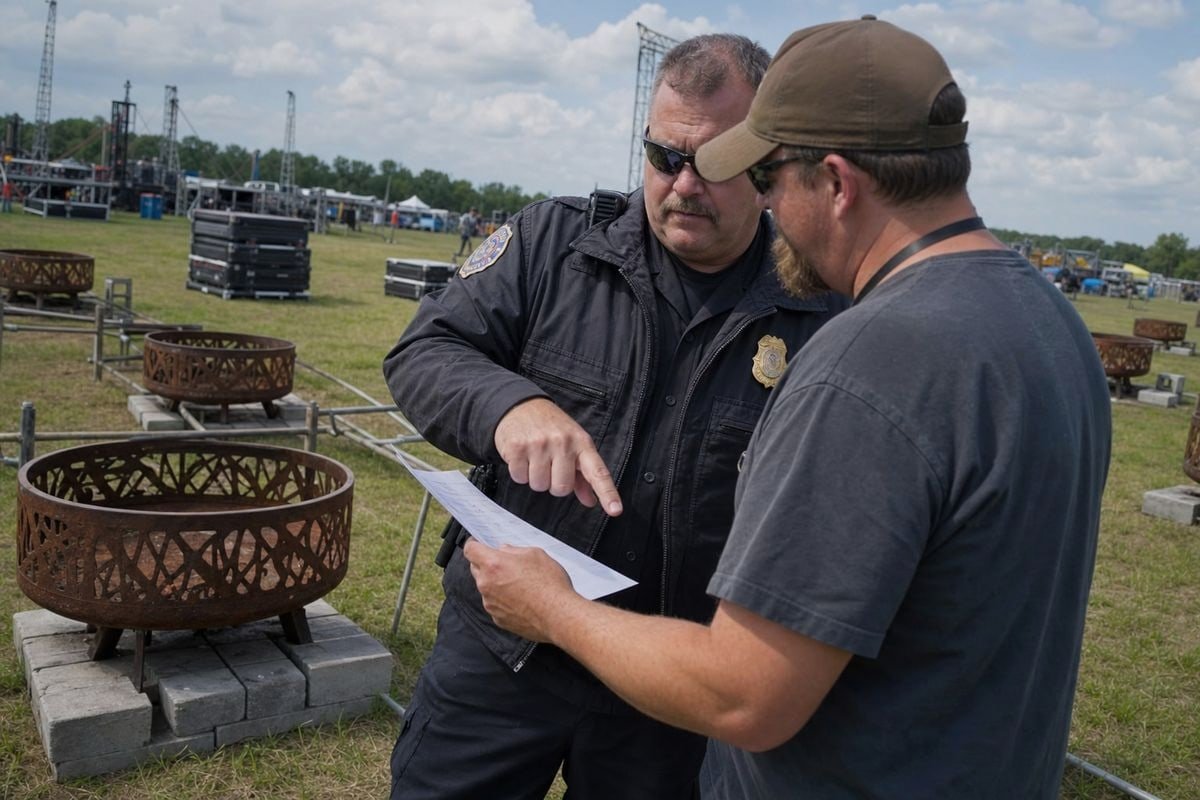
Distance guidance varies widely across jurisdictions because it targets different effect classes. Fire-performance rules 4 in some US cities require 20 feet between the fire-involved item and the audience. Some performance guides accept 15 feet in controlled settings. Canadian special-effect pyrotechnic guidance uses the greatest of 5 meters, the manufacturer's distance, or twice the fallout radius. Display fireworks manuals demand far more — manufacturer distance plus 50 meters. These are not interchangeable standards. Treated open flames from color-flame additives sit closer to the fire-performance end of that spectrum, not the fireworks end. But your AHJ decides which framework governs your event.
Distance benchmarks by context
| Context | Common minimum distance | Notes |
|---|---|---|
| Close-proximity effect floor | 3 m | Never go below this, even if a sheet permits less |
| Baseline treated flame | 5 m | Or manufacturer distance, whichever is greater |
| Indoor fire performance | 15 ft (4.5 m) | Typical fire marshal expectation |
| Municipal fire performance code | 20 ft (6 m) | Some cities require this plus barriers |
| Fallout-radius rule | 2× fallout radius | Measure during your venue test firing |
Why "minimum" is a floor, not a target
Large venues add variables that raw distance cannot solve alone. Crowds move. Sightlines pull people forward. Wind shifts sparks. So layer your controls: barricades for large audiences, trained spotters at the perimeter, extinguishers and fire blankets 5 within reach, clear evacuation routes, and separation from combustible décor. Some operators now add laser or ultrasonic perimeter sensors that alert staff if spectators breach the exclusion zone. You can always exceed the minimum safe distance. You should never reduce it. When our LARP and festival buyers plan events, we advise adding margin beyond the printed figure — extra meters cost nothing, while an incident costs everything.
Can Sunrich provide custom packaging and dosage instructions tailored to my venue's safety requirements?
A UK fireplace distributor recently asked us to redesign warning labels for their national retail chain, and that project shows how deep customization goes on our lines.
Yes. Sunrich offers full OEM/ODM customization: single-dose sachets, kraft bags, jars, or display boxes; private-label branding; market-specific warning labels and barcodes; adjusted burn times and sachet weights; and printed dosage-and-distance instructions written to match your venue type and local compliance needs.
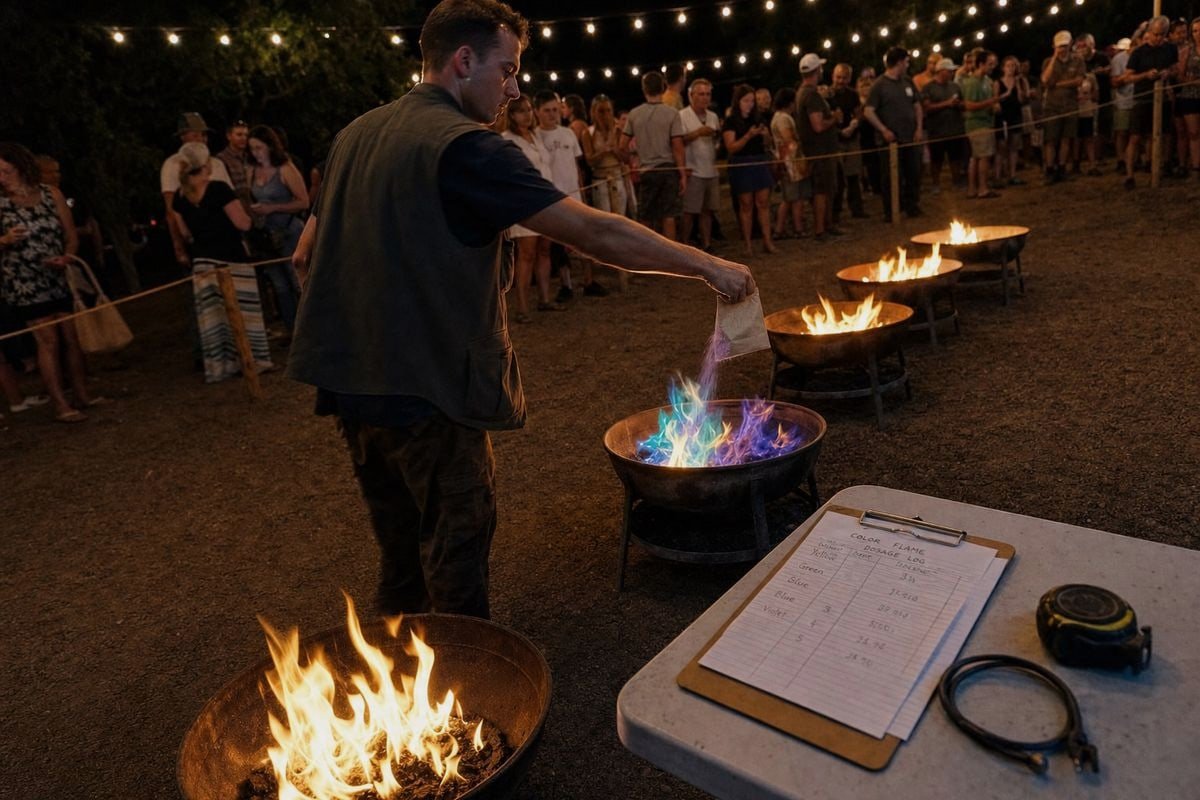
Packaging is a safety tool, not just a marketing surface. A sealed single-dose sachet enforces correct dosage automatically — event staff cannot over-pour what they cannot open in bulk. That design choice came directly from feedback by festival gift traders and event prop buyers who needed foolproof application by non-specialist staff.
What we can tailor for your safety plan
- Unit dose weight. We adjust sachet fill so one packet equals one correct dose for your typical fire pit size. No scoops, no scales, no estimation errors.
- Durée de combustion. We calibrate formulations for 30, 45, or 60-minute color effects, matched to your show schedule.
- Étiquettes d'avertissement. We print jurisdiction-specific caution text, distance guidance, and hazard symbols in your market's language — English, German, French, Dutch, Polish, Portuguese, or Arabic.
- Instruction panels. We include your venue-specific dosage table and minimum-distance guidance directly on the box or sachet.
- Display formats. Flip-top retail boxes, resealable kraft stand-up pouches, or jars, all with barcodes and shelf-ready presentation.
C'est là qu'une usine authentique diffère d'une société commerciale. Un commerçant s'approvisionne chaque commande auprès de celui qui est le moins cher ce mois-là, donc la cohérence d'un lot à l'autre est structurellement impossible. Une usine avec des lignes de production complètes et un contrôle qualité strict des lots, comme la nôtre à Ningbo, contrôle chaque variable, de la matière première au carton scellé. C'est pourquoi notre premier échantillon reflète de manière fiable la qualité de la production de masse, et pourquoi nous encourageons les acheteurs à nous auditer par rapport à cette affirmation.
We run our own production lines with strict contrôle qualité lot par lot 6, headquartered in Liuyang with production in Ningbo. That means the sample you test-fire at your venue behaves the same as the mass-production shipment six months later. Consistency is itself a safety feature: your distance and dosage calculations only hold if every batch burns identically. Our ISO 9001, BSCI, CE, and Documentation SGS/Intertek 7 backs every custom run, and we support flexible MOQs so you can trial a venue-specific format before committing to full volume. Tell us your venue type, fire authority requirements, and target market, and we build the compliant package around them.
Conclusion
Safe use of Magic Fire Powder at large venues comes down to verified documentation, disciplined dosage, layered distance controls, and AHJ approval — and we build products to support all four.
Notes de bas de page
1. Explains the regulatory concept referenced for fire code approval and permitting decisions. ↩︎
2. OSHA defines SDS requirements, supporting the documentation checklist for hazardous materials. ↩︎
3. Background on the pyrotechnic compound category distinguished from color-flame additives. ↩︎
4. NFPA sets fire performance and pyrotechnic proximity standards referenced for venue safety distances. ↩︎
5. Reference for the emergency fire suppression equipment mentioned in layered venue safety controls. ↩︎
6. Links to ISO resources supporting the manufacturing consistency standards


 English
  Spanish
  German
  French
  Arabic
  Portuguese
Rejoignez la conversation