







Comparer des échantillons de poudre magique de feu de plusieurs fournisseurs semble facile jusqu'à ce que deux sachets d'apparence identique brûlent complètement différemment Marquage CE 1. Sur notre chaîne de production, nous voyons chaque jour pourquoi cela se produit.
Pour comparer les échantillons de poudre magique de feu de plusieurs fournisseurs, vérifiez d'abord les certifications et les fiches de données de sécurité, puis effectuez des tests de combustion comparatifs standardisés dans des conditions identiques, interrogez le processus de contrôle qualité de chaque fournisseur et calculez le coût réel tout compris en tenant compte des prix, des MOQ et des délais avant de prendre une décision.
C'est la réponse courte. Le reste de ce guide détaille chaque étape, afin que vous puissiez évaluer équitablement les fournisseurs et éviter des erreurs d'approvisionnement coûteuses.
Quelles certifications devrais-je vérifier avant de demander des échantillons de poudre Magic Fire ?
Un acheteur allemand m'a dit un jour qu'il avait rejeté trois fournisseurs avant de nous contacter — non pas parce que leurs échantillons brûlaient mal, mais parce qu'aucun d'entre eux ne pouvait produire un véritable rapport de test. Ce filtre lui a fait gagner des mois.
Avant de demander des échantillons de Poudre Magique Feu, vérifiez que le fournisseur détient la certification ISO 9001 pour la gestion de la qualité, la BSCI pour la conformité sociale, le marquage CE pour le marché européen, et des rapports de tests de tiers de laboratoires tels que SGS ou Intertek confirmant que la poudre ne contient pas de produits chimiques nocifs.

La documentation doit toujours précéder le test de combustion. Voici pourquoi : une flamme colorée ne vous dit rien sur la possibilité pour le produit d'entrer légalement sur votre marché, de passer la douane ou de se trouver en toute sécurité sur une étagère de vente au détail. Au cours de nos dix-sept années d'exportation de produits à flamme colorée vers les États-Unis, l'Allemagne, le Royaume-Uni et au-delà, nous avons vu des acheteurs perdre des conteneurs entiers à la douane parce que les "certificats" de leur fournisseur se sont avérés être empruntés ou expirés.
La liste de contrôle des documents
Demandez à chaque fournisseur le même dossier de documents. Si un fournisseur livre tout en deux jours et qu'un autre traîne pendant deux semaines, cet écart vous en dit long sur son fonctionnement réel.
| Document | Ce qu'elle prouve | Signal d'alarme en cas d'absence |
|---|---|---|
| ISO 9001 2 certificat | Un système de gestion de la qualité fonctionnel | Absence de contrôle systématique des lots |
| rapport d'audit BSCI | Conditions d'usine éthiques | Possible société de négoce, pas une usine |
| Conformité CE / marché | Légal à vendre dans l'UE | Risque de saisie douanière |
| SGS 3 ou rapport de test Intertek | Vérification indépendante de la sécurité chimique | Allégations "écologiques" non vérifiées |
| FDS (Fiche de Données de Sécurité 4) | Composition, manipulation et conseils de stockage | Ne peut pas expédier ou assurer correctement |
| COA avec numéro de lot | Ce lot spécifique répond aux spécifications | Pas de traçabilité des lots |
Vérifiez, ne vous contentez pas de collecter
Les certificats sont faciles à photographier et difficiles à falsifier sous contrôle. Vérifiez le numéro de certificat auprès de la base de données en ligne de l'organisme émetteur. Confirmez que le nom de l'entreprise sur le certificat correspond à l'entreprise qui vous facture. Les sociétés commerciales présentent souvent le certificat d'une usine comme s'il s'agissait du leur. Vérifiez également la date d'émission et la portée — un certificat ISO 9001 couvrant le "commerce général" n'est pas la même chose qu'un certificat couvrant la fabrication de produits pyrotechniques.
Enfin, demandez la FDS avant l'expédition de l'échantillon. Les additifs pour feux d'artifice sont des marchandises réglementées sur la plupart des marchés. Un fournisseur qui ne peut pas fournir de FDS sur demande aura du mal avec toutes les tâches de conformité en aval que vous lui confierez.
Comment évaluer la cohérence de la couleur de la flamme et la qualité de la combustion sur des échantillons de fournisseurs ?
Dans notre salle de contrôle qualité à Ningbo, chaque test de combustion utilise le même combustible, la même dose et la même distance par rapport à la flamme. Nous avons appris très tôt que la modification de l'une de ces variables modifie le résultat de la couleur — et induit le testeur en erreur.
Évaluer la cohérence de la couleur de la flamme en brûlant chaque échantillon de poudre magique pour le feu dans des conditions identiques : même combustible, dose, récipient, flux d'air et méthode d'allumage. Comparer l'intensité de la couleur, la durée, l'uniformité de la dispersion, les résidus et la fumée. Répéter le test au moins deux fois par échantillon pour confirmer la répétabilité.
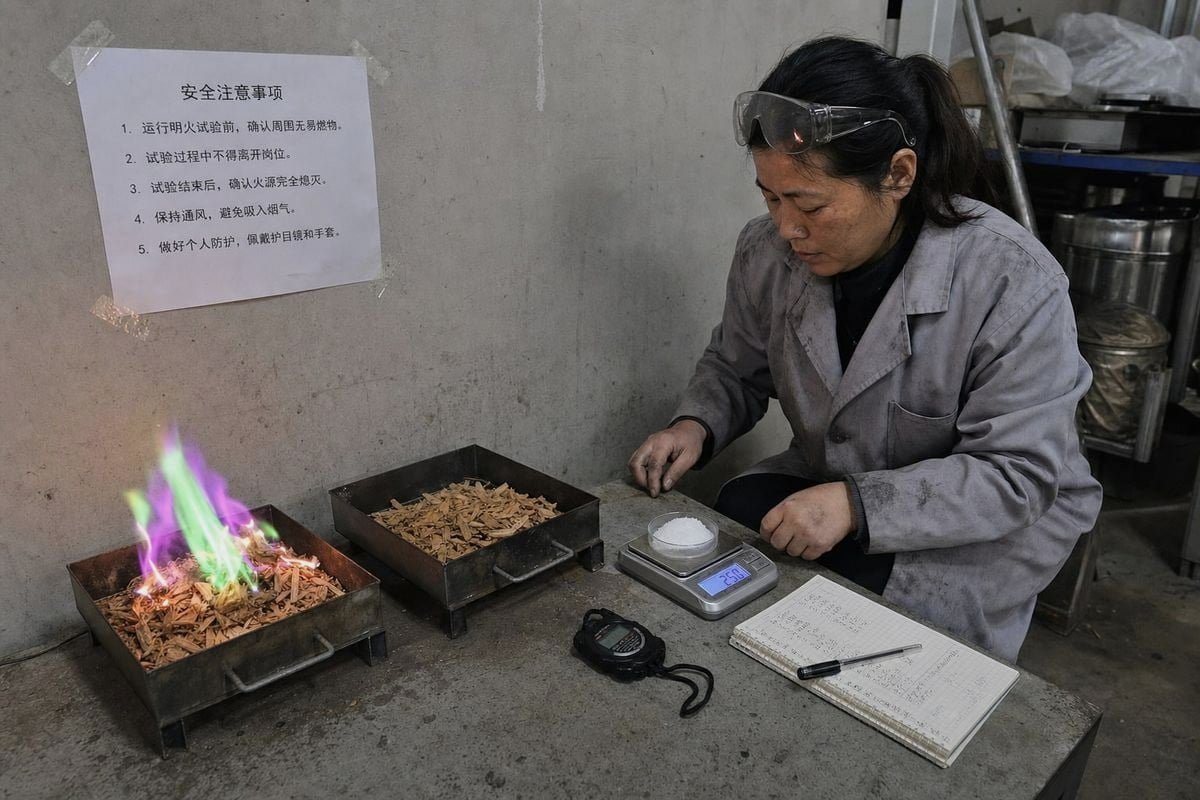
Un test de combustion non contrôlé est pire que pas de test du tout. Il vous donne une fausse confiance. La couleur de la flamme varie avec la température du feu, le type de bois, la circulation de l'air et la quantité de poudre que vous appliquez. Ainsi, deux échantillons de qualité identique peuvent sembler différents si vous jetez l'un dans un feu de joie rugissant et l'autre sur des braises incandescentes. Standardisez tout d'abord, puis comparez.
Un protocole de combustion standardisé simple
- Utilisez le même combustible pour chaque test — par exemple, des bûches de bois dur sèches identiques ou un montage de charbon de bois fixe.
- Laissez le feu atteindre un stade de combustion stable et modéré avant d'ajouter quoi que ce soit.
- Pesez une dose identique de chaque échantillon de poudre. Ne l'estimez pas.
- Appliquez chaque échantillon de la même manière, à la même distance, au même endroit sur le feu.
- Enregistrez une vidéo de chaque combustion afin de pouvoir la comparer ultérieurement.
- Notez quatre choses : la vitesse à laquelle la couleur apparaît, son intensité, sa durée et son estompage.
- Répétez l'ensemble du test sur un second feu. Un bon résultat peut être de la chance. Deux résultats concordants commencent à être une preuve.
Ce qui sépare la bonne poudre de la poudre médiocre
Observez la courbe de durée de combustion, pas seulement le pic. Les formulations bon marché brillent souvent pendant trente secondes puis s'éteignent. Un paquet bien fait doit maintenir la couleur pendant une fenêtre annoncée — sur nos lignes, nous testons la durée de combustion sur chaque lot de production précisément parce que les acheteurs recommandent sur la base de ce chiffre. Inspectez également la poudre elle-même avant de la brûler. L'agglomération suggère une absorption d'humidité et un emballage médiocre. Une taille de granulés inégale suggère un contrôle de processus lâche, et elle produit généralement une couleur inégale et vacillante au lieu d'un effet constant.
Enfin, demandez des échantillons de deux lots de production différents du même fournisseur. La dérive d'un lot à l'autre est la défaillance de qualité la plus courante que nous constatons lorsque les acheteurs nous quittent pour une autre source. Si le lot un et le lot deux brûlent différemment, la commande de production de masse le fera aussi.
Quelles questions devrais-je poser aux fournisseurs pour tester leurs capacités de fabrication et de contrôle qualité ?
Le compromis que j'explique toujours aux nouveaux acheteurs est le suivant : un excellent premier échantillon d'une usine faible ne vaut rien, car vous n'achetez pas un échantillon — vous achetez les vingt conteneurs suivants. Les questions ci-dessous révèlent quels fournisseurs peuvent réellement répéter la qualité de leur échantillon à grande échelle.
Demandez aux fournisseurs comment ils contrôlent la cohérence d'un lot à l'autre, s'ils possèdent leur propre ligne de production ou s'ils externalisent, quels contrôles QC en cours ils effectuent, comment ils gèrent le contrôle de l'humidité et les scellages d'emballage, et s'ils peuvent fournir des COA, des données de temps de combustion et un accès aux audits d'usine.

Le processus d'échantillonnage lui-même est un audit de fournisseur déguisé. La rapidité de leur réponse, la clarté de leurs réponses et leur volonté de partager la documentation prédisent exactement comment ils se comporteront après que vous ayez effectué un dépôt. D'après notre expérience au service des responsables des achats aux États-Unis et en Europe, les acheteurs qui posent des questions pointues à l'avance ne se retrouvent presque jamais en litige par la suite.
Questions qui révèlent une réelle profondeur de fabrication
| Question | Ce à quoi ressemble une réponse solide | Ce à quoi ressemble une réponse faible |
|---|---|---|
| Êtes-vous une usine ou une société de négoce ? | Nomme l'emplacement de l'usine, propose une visite vidéo ou une visite d'audit | Vague, change de sujet, pas d'adresse d'usine |
| Comment assurez-vous la cohérence des lots ? | Décrit l'inspection des matières premières, les contrôles en cours de processus et les tests de combustion par lot | "Notre qualité est très bonne, ne vous inquiétez pas" |
| Puis-je obtenir des COA avec des numéros de lot ? | Oui, avec un exemple de document joint | "Nous pouvons discuter après la commande" |
| Comment contrôlez-vous l'humidité pendant l'emballage ? | Explique les sachets scellés en aluminium, les étapes de séchage, les contrôles d'intégrité de l'emballage | Pas de processus clair |
| Que se passe-t-il si un lot échoue au contrôle qualité ? | Le lot est mis en quarantaine, la cause profonde est trouvée, les enregistrements sont conservés | "Cela n'arrive jamais" |
| Pouvez-vous personnaliser le temps de combustion, l'emballage et les étiquettes ? | Oui, avec des options concrètes OEM/ODM et des exemples passés | Ne vend qu'une seule version standard |
Pourquoi la vente directe d'usine est importante pour les produits de lutte contre l'incendie
Les sociétés commerciales peuvent être utiles pour les biens simples. Mais les produits à flamme colorée sont sensibles à la chimie et à la réglementation. Un intermédiaire ne peut pas répondre aux questions sur le processus, ne peut pas résoudre un problème de formulation et ne peut pas garantir que le lot suivant provient de la même ligne de production. Nous sommes basés à Liuyang — le centre des feux d'artifice en Chine — avec notre propre production à Ningbo, et les acheteurs nous disent régulièrement que la différence se voit surtout dans un domaine : les produits de production de masse correspondent effectivement à l'échantillon approuvé. Demandez directement à chaque fournisseur potentiel si l'échantillon a été fabriqué sur leur propre équipement de production et de remplissage. Ensuite, demandez-leur de le prouver. Un fournisseur ayant une véritable profondeur de fabrication accueillera la question. Un revendeur la détournera.
Testez également leur capacité d'étiquetage privé dès le début. Si vous avez besoin de sachets personnalisés, d'étiquettes d'avertissement, de codes-barres et de boîtes d'affichage, confirmez qu'ils s'en occupent en interne. L'externalisation fragmentée de l'emballage est une source fréquente de retards et d'erreurs d'étiquetage.
Comment comparer équitablement les prix, les MOQ et les délais de livraison lors de l'approvisionnement en poudre Magic Fire ?
Une leçon que nous avons apprise il y a des années, en regardant un importateur britannique rechercher le prix unitaire le plus bas : il a économisé quatre cents par sachet, puis a perdu ces économies trois fois plus en transport aérien de stock de remplacement après un lot défectueux. Les comparaisons de prix ne fonctionnent que lorsque vous comparez le coût total, pas le coût indiqué.
Comparez les fournisseurs sur le coût réel livré — prix unitaire plus expédition, droits de douane, emballage et tests de conformité — et non sur le prix coté seul. Pesez les MOQ par rapport à vos besoins de commande d'essai, confirmez les délais de livraison par écrit pour les échantillons et la production, et tenez compte du coût caché des défaillances de qualité.

Commencez par créer une feuille de comparaison d'une page. Mettez chaque fournisseur dans une colonne et chaque élément de coût dans une ligne. Cela force une comparaison équitable et expose les devis qui semblent bon marché mais ne le sont pas.
La ventilation du coût d'atterrissage réel
| Élément de coût | Pourquoi cela change le classement |
|---|---|
| Prix unitaire (EXW/FOB) | Le point de départ — jamais la ligne d'arrivée |
| Emballage et marque privée | Les sachets, boîtes et étiquettes personnalisés varient considérablement en coût et en qualité |
| Tests de conformité | Si le fournisseur n'a pas de rapports, vous payez vous-même les tests en laboratoire |
| Frais et droits de douane | Les produits liés au feu peuvent comporter des exigences d'expédition spécifiques 7 |
| Engagement MOQ | Un prix unitaire bas pour 50 000 unités peut coûter plus cher qu'un prix juste pour 5 000 unités |
| Risque de défaut et de retravail | Un lot défectueux peut effacer des années d'économies par unité |
MOQ et commandes d'essai
Soyez direct avec les fournisseurs concernant votre plan de déploiement. Une usine raisonnable offrira un MOQ plus bas pour une première commande d'essai, en particulier pour l'emballage standard, et ajustera les prix à mesure que les volumes augmentent. Nous faisons cela régulièrement avec de nouveaux distributeurs, car une première commande réussie et de petite taille établit la relation de réapprovisionnement que les deux parties souhaitent réellement. Soyez prudent avec les fournisseurs qui exigent des MOQ énormes avant que vous n'ayez validé la vente au détail — et soyez tout aussi prudent avec les fournisseurs qui acceptent des commandes ridiculement petites à des prix directs d'usine, car cela signale souvent un revendeur qui augmente le prix du stock de quelqu'un d'autre.
Délais de livraison que vous devriez confirmer par écrit
Obtenez trois dates de chaque fournisseur : délai d'échantillonnage, délai de première production et délai de réapprovisionnement. Ensuite, demandez ce qui se passe pendant la haute saison. Les produits de camping et de cheminée sont saisonniers, et un fournisseur qui indique trente jours en avril peut silencieusement passer à soixante jours en septembre. Une usine avec des lignes de production internes complètes contrôle son propre calendrier ; un fournisseur dépendant de sous-traitants ne le fait pas. Mettez le délai de livraison confirmé et une clause de gestion des retards dans le bon de commande. Les fournisseurs fiables l'acceptent sans friction, car ils planifient correctement leur capacité et n'ont rien à cacher.
Conclusion
Choisir le mauvais fournisseur de poudre magique pour le feu vous coûte des retards douaniers, des lots défectueux et une perte d'espace en rayon. La solution est une comparaison disciplinée : vérifier les certifications, effectuer des tests de combustion contrôlés, auditer la capacité de contrôle qualité et calculer le coût d'atterrissage réel.
Après plus de dix-sept ans d'expédition de produits à flamme colorée à des acheteurs dans plus de trente pays, mon conseil honnête est simple : ne jugez jamais un échantillon par sa flamme seule. Jugez la documentation qui le sous-tend, l'usine qui l'a fabriqué et la cohérence qu'il peut répéter à grande échelle. Les fournisseurs qui réussissent ces quatre tests dans ce guide sont rares — et ce sont eux qui méritent de construire un partenariat à long terme. Si vous souhaitez un point de référence, nous sommes toujours heureux d'envoyer des échantillons documentés et traçables par lot afin que vous ayez une référence pour comparer tous les autres fournisseurs.
Notes de bas de page
Source d'information expliquant le marquage de conformité UE mentionné comme exigence de certification. ↩︎
Référence normative officielle pour la certification de système de management de la qualité discutée dans l'article. ↩︎
Site officiel du laboratoire d'essai tiers référencé pour la vérification indépendante de la sécurité chimique. ↩︎
Explique le type de document FDS que les acheteurs sont invités à demander avant l'expédition. ↩︎
Site officiel du deuxième organisme de test indépendant cité pour la vérification de la conformité. ↩︎
Concept d'arrière-plan expliquant comment les variables de combustion affectent les tests de couleur de flamme décrits. ↩︎
Les réglementations de l'IATA régissent l'expédition internationale de biens liés au feu et de pyrotechnie. ↩︎
Définit le concept de coût total central pour comparer équitablement les prix des fournisseurs. ↩︎


 English
  Spanish
  German
  French
  Arabic
  Portuguese
Rejoignez la conversation