






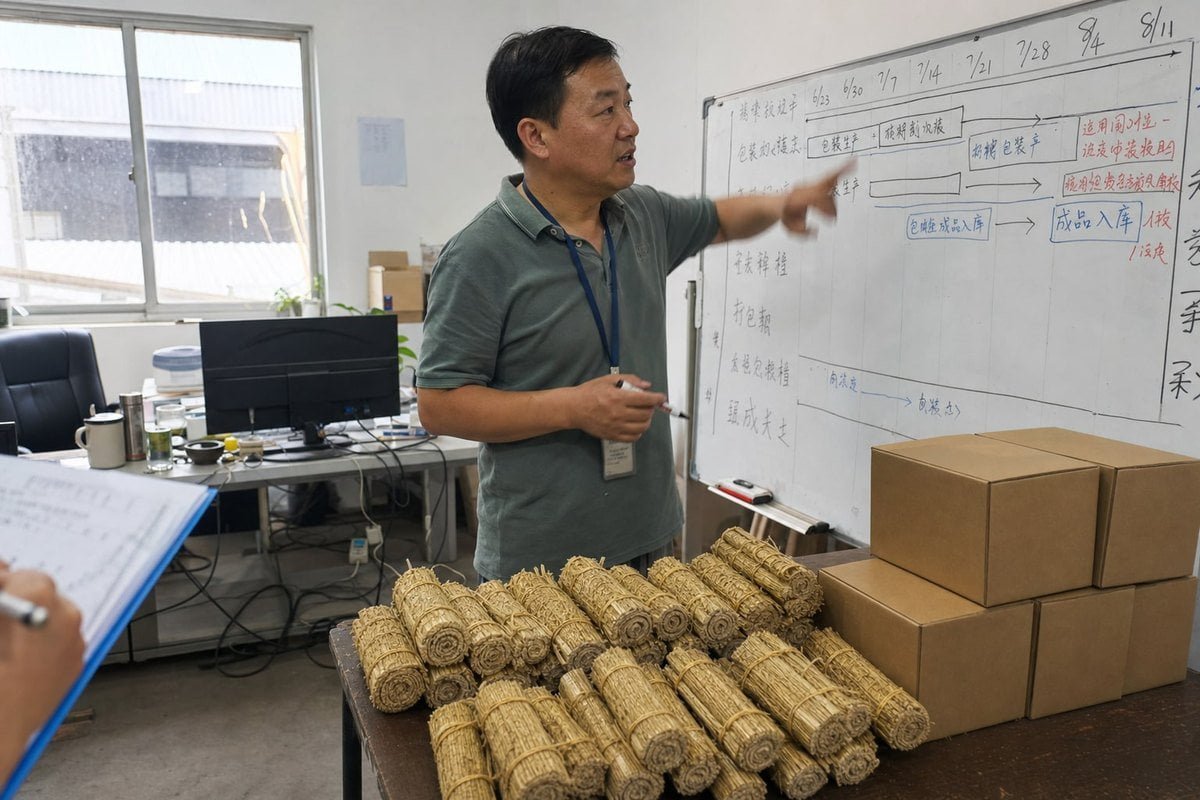
Aligning supplier capacity with a packaging redesign schedule for wood fire starters sounds simple — until a missed slot on our production line once nearly cost a client their entire winter season.
To align supplier capacity with a packaging redesign schedule, work backward from your launch date, lock packaging specs early, get written confirmation of an open production slot, build 4–6 weeks of safety stock in legacy packaging, and stage the rollout on one SKU before full cutover.
That is the short answer. The rest of this article breaks it down step by step, using what we see every season on our own wood fire starter lines.
How can I confirm my supplier's production capacity before locking in a packaging redesign timeline?
A few years back, a German distributor sent us finished artwork and asked us to "just fit it in." Our wax-dipping line was already booked solid for six weeks blanket order scheduling 1. That conversation changed how we onboard redesign projects.
Confirm capacity by asking for a formal capacity audit: daily output for your exact product type, current queue status, bottleneck steps, and a written production slot for your quantity and date. Never rely on a generic lead-time quote — reserved capacity is the only real commitment.

Here is the core problem. Most buyers ask, "What is your lead time?" and get a headline number like "30–40 days." That number is real, but it describes a dynamic slot inside an integrated schedule — not a promise reserved for you Gestion des stocks par le fournisseur 2. On our lines in Ningbo, wax-dipped wood rolls and packaging assembly run on shared equipment. If another order occupies the queue, your 30 days may not start for three weeks.
So separate three different capacities before you fix any timeline:
| Capacity type | Ce qu'il couvre | Que demander |
|---|---|---|
| Packaging capacity | Printing, die-cutting, box conversion | Dieline-to-delivery time, print method, MOQ |
| Filling/assembly capacity | Loading fire starters into new cartons | Daily manufacturing throughput for your format |
| Finished-goods logistics | Palletizing, freight handoff | Booking windows, holiday closures, port dates |
Run a supplier capacity audit, not a lead-time inquiry
Ask your manufacturer four direct questions. What exact event starts the clock? What event ends it? Is capacity for my quantity open right now, or only estimated? Which step is the bottleneck? At our factory, the honest answer often surprises buyers: for redesigned packaging, the bottleneck is usually carton material procurement or automated filling lines changeover — not the fire starters themselves.
Get the slot in writing
We encourage clients to use blanket order scheduling 3 with call-offs. You commit to an annual volume; we reserve production windows before final artwork is even approved. That converts an estimate into a guaranteed slot, and it protects your launch date far better than any quoted lead time.
What lead times should I expect when syncing new packaging approval with mass production of wood fire starters?
When we quote redesign projects for US and European buyers, the trade-off we weigh most often is print method versus calendar time. The choice of printing process alone can swing the schedule by a month.
Expect roughly 4 weeks from dieline receipt to production-ready packaging, 5–45 days of print lead time depending on method, and 30–40 days for manufacturing. For seasonal programs, engage your supplier 6–8 weeks before launch — earlier if specialty materials are involved.

La gestion du délai de livraison starts with knowing which numbers stack and which run in parallel. Artwork approval, material booking, and slot reservation can overlap if you plan them deliberately. If you run them in sequence — the default when nobody owns the timeline — the calendar doubles.
Here are the benchmark windows we use when building critical-path schedules 4 with clients:
| Étape | Durée typique | Notes |
|---|---|---|
| Dieline to production-ready artwork | ~4 weeks | Includes sample proofs and revisions |
| Digital short-run printing | 5–14 jours | Good for trial SKUs and bridge volumes |
| Flexo / corrugated printing | 32–40 jours | Standard for retail cartons and displays |
| Offset / rigid box printing | 10–45 days | Premium gift packaging; longest queue |
| Manufacturing window | 30–40 jours | A dynamic slot, not a fixed block |
| Specialty barrier materials | Up to 12–30 weeks | Moisture barrier protection films, coated boards |
Watch the material lead times, not just the print
Wood fire starters are hygroscopic. Wax-dipped wood rolls tolerate humidity better than raw excelsior, but retail cartons still often need coatings for moisture barrier protection. carton certifié FSC 5 is another common retailer requirement in Germany and the UK, and certified stock can carry longer procurement lead times than standard board. We book these materials before final artwork approval whenever the dieline dimensions are locked, because material availability — not printing speed — is what usually blows a schedule.
Track from procurement start, not artwork approval
One lesson we repeat to every new buyer: your real clock starts when procurement starts. If your internal team spends three weeks debating a flame graphic, that time comes straight out of your buffer, even though the "official" lead time has not begun.
How do I avoid stockouts or delays when my supplier switches to redesigned packaging mid-schedule?
A Canadian camping brand once asked us to switch their entire fire starter range to new boxes in a single production run. We talked them out of it — and that decision saved their Q4.
Avoid stockouts by building 4–6 weeks of safety stock in legacy packaging before cutover, trialing the redesign on one SKU first, keeping a short overlap period where both designs ship, and holding a documented fallback plan if the new line stalls.
The riskiest moment in any redesign is the switchover window. Old packaging stops; new packaging has not yet proven itself at scale. If a print defect, a carton dimension error, or a pallet-pattern problem appears in the first mass run, you have zero sellable inventory. That is how brands miss a season.
We recommend a staged transition, in this order:
- Build the buffer first. Over-produce the legacy design to cover 4–6 weeks of demand. Set safety stock levels against your peak weekly sell-through, not your average.
- Trial one SKU. Run the redesign on a single format — say, the 24-piece box — and let it move through filling, palletizing, and retail receiving before expanding.
- Overlap deliberately. Ship old and new packaging in parallel for one cycle. Retailers rarely object if barcodes and case counts stay consistent.
- Cut over fully. Once the new line proves stable across two clean batches, retire the legacy packaging and release the buffer.
Consider bridge sourcing and VMI for extra protection
Two more tools help. A bridge-sourcing model — using a short-run digital printer for the first 10% of new-design volume — de-risks the long-lead main order. And a Gestion des stocks par le fournisseur 6 (VMI) arrangement, where we hold agreed finished-goods stock and replenish against your sell-through, smooths the handover so a mid-schedule switch never exposes your shelf. Several of our long-term distributors in the Netherlands and Poland run exactly this way, and their transitions are quiet events instead of fire drills.
What questions should I ask my manufacturer to keep compliance and labeling accurate during a packaging transition?
Compliance questions are the ones our export team fields most. For fire-starting goods entering the US and EU, a beautiful redesign with a wrong warning label is an unsellable product.
Ask your manufacturer to confirm required warning text and pictograms per market, verify barcode and batch-code placement on the new dieline, provide current SGS or Intertek test reports, confirm certifications like CE and ISO 9001 remain valid, and check EPR and material-declaration obligations.

A packaging redesign quietly resets your compliance baseline. New artwork means warning statements get re-typeset, translations get re-flowed, and barcodes get repositioned — and every one of those steps can introduce an error that a retailer's receiving audit will catch. In our 17 years exporting fire products to 30+ countries, the most common transition failure we have seen is not print quality. It is a warning label that was correct on the old box and got cropped, mistranslated, or shrunk below legible size on the new one.
Use this checklist in your next supplier call:
| Question à poser | Pourquoi c'est important |
|---|---|
| Which warning texts and pictograms does my market require? | US, EU, and UK requirements differ; multi-language panels need space on the dieline |
| Are current test reports (SGS/Intertek) still valid for the new packaging? | Retail sourcing channels ask for reports tied to the shipped configuration |
| Where do barcode, batch code, and composition text sit on the new dieline? | Composition (wood fiber, paraffin) and traceability must survive the redesign |
| Does the new material affect Extended Producer Responsibility (EPR) fees? | EU EPR schemes charge by packaging material and weight; a redesign changes both |
| Who signs off the final proof — and is there one owner? | One approval owner and one consolidated feedback file cut revision rounds dramatically |
Assign a single approval owner
We insist on this with every OEM client. When marketing, procurement, and a retailer's compliance team all send separate comments, proofs bounce for weeks. One owner, one feedback file, one signed golden sample — that discipline protects both the schedule and the label accuracy. Because our factory handles warning labels, barcodes, and display packaging in-house under ISO 9001 7 and BSCI audit conditions, we can turn a consolidated correction round in days rather than weeks. La prévision de la demande saisonnière shared alongside the artwork also lets us pre-book compliant materials before the proof is even final.
Conclusion
A packaging redesign for wood fire starters is a capacity-planning project in disguise. Miss the alignment and you miss the season; plan it backward and the switch stays invisible.
Design the packaging, but schedule the supply chain. Work backward from launch. Confirm a real production slot in writing, not a quoted lead time. Buffer 4–6 weeks of legacy stock, trial one SKU, and keep compliance under a single approval owner. Our team has run this playbook with distributors across the US and Europe for years — and when the schedule, the slot, and the safety stock line up, a redesign becomes a growth moment instead of a supply risk. If you are planning a transition on your fire starter range, start the supplier conversation now, well before the artwork is final.
Notes de bas de page
1. Wikipedia explains blanket order scheduling concept referenced in supplier commitment strategy. ↩︎
2. Wikipedia explains VMI arrangement referenced as inventory management tool. ↩︎
3. Defines the business practice of long-term purchase agreements for production capacity. ↩︎
4. Wikipedia defines critical-path method used for planning manufacturing timelines. ↩︎
5. Official site for the Forest Stewardship Council standards for sustainable paper products. ↩︎
6. Explains the supply chain strategy where suppliers manage customer inventory levels. ↩︎
7. The international standard for quality management systems in manufacturing environments. ↩︎



 English
  Spanish
  German
  French
  Arabic
  Portuguese
Rejoignez la conversation