







Air quality policies impact inventory planning for wood fire starters more than most buyers expect. I learned this on our own production line when a European client suddenly froze a repeat order.
Air quality policies impact inventory planning for wood fire starters by reducing burn days, tightening product composition rules, and shifting demand toward certified low-smoke options. Retailers must carry leaner safety stock, prioritize compliant SKUs, and align forecasts with local burn-ban calendars instead of weather alone.
The good news is that this risk can be managed. In this article, I will break down certifications, overstock risk, product diversification, and how to pick the right factory partner.
What Certifications Do I Need to Sell Wood Fire Starters in Regulated Markets?
A German distributor once refused our first sample shipment until we sent the full SGS test report 1 — not the certificate, the actual lab data. That moment taught our export team what "regulated market" really means.
To sell wood fire starters in regulated markets, you typically need proof of safe composition through SGS or Intertek lab testing, CE marking for the EU, compliant warning labels, and a factory holding ISO 9001 and BSCI audits. US buyers also expect alignment with EPA emission standards guidance.

Certification is the foundation of inventory planning in regulated markets, because non-certified stock is not just slow-moving — it can become unsellable. Hearth industry regulations differ by region, so let me break this down the way we explain it to new buyers at our factory in Ningbo.
Product-Level vs. Factory-Level Compliance
There are two layers of compliance. Product-level compliance covers what the fire starter is made of and how it burns. Factory-level compliance covers how the product is made and audited. Buyers in strict air districts increasingly ask for both.
| Compliance Layer | Ce qu'elle couvre | Typical Proof |
|---|---|---|
| Product composition | No harmful chemicals, low-smoke ignition, wax and wood fiber content | Rapports de tests SGS ou Intertek |
| Product safety marking | EU market access, safe-use labeling | CE marking, warning labels |
| Factory quality system | Cohérence lot par lot | certification ISO 9001 |
| Factory social audit | Ethical production, retailer onboarding | rapport d'audit BSCI |
| Market-specific rules | Wood smoke ordinances 2, allowed burn materials | Local air district guidance |
Why Composition Documentation Matters More Now
Many wood smoke ordinances explicitly allow starters made from paper, cardboard, sawdust, and wax — but only those. If your packaging cannot prove composition, an enforcement visit or a cautious retail buyer can pull the product. In our experience exporting to 30+ countries over 17 years, the buyers who demand full test documentation upfront face far fewer supply chain disruptions later. We keep test reports current for every batch precisely because Clean Air Act compliance 3 conversations in the US now reach down to accessory products, not just stoves. Certified inventory also clears customs faster, which protects your winter selling window.
How Can I Avoid Overstocking Products That May Face Future Emissions Restrictions?
One of our long-term US importers once described watching a competitor sit on a full container of legacy firelighters after a local rule change. That stranded stock story shaped how we now advise buyers on order sizing.
Avoid overstocking by segmenting SKUs by compliance risk, ordering high-risk products in smaller and more frequent batches, tracking regulatory calendars in your target regions, and negotiating flexible MOQs with your factory. Prioritize reorder speed over deep stock in strict air quality zones.
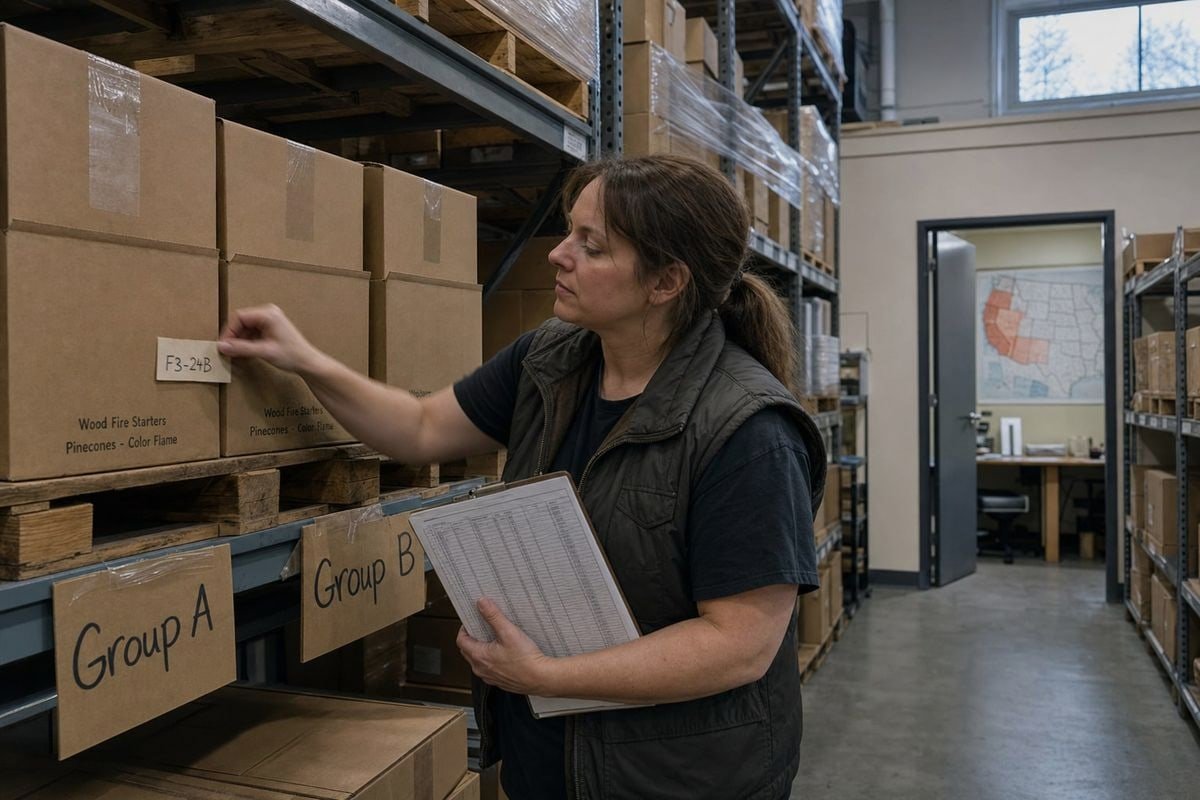
Overstock risk in this category is different from normal seasonal risk. A warm winter delays sales. A rule change can end them. EPA emission standards for wood heaters have already created "inventory deadlocks" in the stove market, where retailers could not legally sell non-compliant units after a deadline. Fire starters face softer versions of the same pressure, especially where PM2.5 particulate matter drives seasonal burn bans.
A Practical Risk-Segmentation Process
Here is the process we walk buyers through before large winter orders:
- Map your regions. Separate strict air districts (California basins, Washington, UK Smoke Control Areas) from rural, lightly regulated markets.
- Grade each SKU. Petroleum-heavy or undocumented products are high risk. Certified wood-fiber and wax starters are low risk.
- Adjust order cadence. For high-risk SKUs in strict regions, cut order size and increase frequency. This is basic safety stock optimization applied to policy risk.
- Watch the policy calendar. Burn curtailment thresholds get reviewed. South Coast AQMD, for example, has proposed lowering its curtailment trigger, which would add no-burn days.
- Plan sell-through windows. If a restriction is announced, discount early rather than holding stock into a deadline.
Forecasting Beyond Weather
Demand forecasting accuracy improves sharply when you add regulatory inputs. Residential wood combustion contributes roughly a quarter or more of wintertime PM2.5 4 in the US, so winter alert days cluster exactly when your sales peak. Advanced planners now feed AQI forecasts and inversion-layer data into replenishment models. You do not need that sophistication on day one. Even a simple spreadsheet tracking burn-ban days per region will beat weather-only forecasting.
Should I Diversify My Inventory With Low-Smoke or Alternative Fire-Starting Products?
When we developed our wax-dipped wood roll starters, the trade-off we weighed was burn time versus smoke output. Buyers in strict European markets pushed us toward cleaner ignition, and that pressure turned out to be a market signal.
Yes. Diversifying into low-smoke, natural-material fire starters protects revenue when restrictions tighten. Stock wood-wool, wax-and-sawdust, and dual-use ignition products that work with wood, pellet, and gas appliances, so your category keeps selling even during active burn curtailments.

Diversification here is not about chasing trends. It is about matching your assortment to how regulators and consumers are already moving. Public education programs push "hot start" methods, dry seasoned wood, and clean ignition — all of which favor reliable, low-smoke starters over newspaper and petroleum-soaked blocks.
Comparing Your Diversification Options
| Type de produit | Profil de fumée | Regulatory Risk | Inventory Note |
|---|---|---|---|
| Wood-wool / excelsior starters | Faible | Faible | Strong "natural" shelf appeal; growing demand |
| Wax + sawdust / wood fiber pucks | Faible | Faible | Explicitly allowed under most burn rules |
| Rouleaux de bois trempés dans la cire | Faible | Faible | Long burn time helps hot-start ignition |
| Petroleum-based firelighter blocks | Plus élevé | Moyen–Élevé | Exposed to future VOC and composition caps |
| Newspaper / loose paper | Modéré | Low but declining use | Being replaced by engineered starters |
The Substitution Pivot
The smartest retailers are running a substitution pivot: when wood-burning bans activate, they still sell ignition products for pellet stoves 5, gas fire pits, BBQs, and outdoor cooking. Dual-use products keep the aisle productive year-round. Eco-friendly fuel alternatives — including starters made from salvaged biomass 6 and vegetable or paraffin wax blends — also give you a marketing story that aligns with Burn Wise-style guidance. On our side, we build these variations through OEM customization: adjusting size, burn time, and packaging claims so one core product can serve both a strict urban market and a rural camping channel. That flexibility is exactly what turns policy pressure into a category advantage rather than a category loss.
How Do I Choose a Manufacturer That Keeps Up With Changing Air Quality Regulations?
A purchasing manager from the Netherlands once asked us a question I still repeat internally: "If the rules change next year, what happens to my private label?" A supplier who cannot answer that clearly is a liability.
Choose a manufacturer with current third-party test reports, ISO 9001 and BSCI credentials, in-house reformulation capability, private-label labeling support, and a track record across multiple regulated markets. Verify they monitor regulatory changes proactively and can adapt composition, packaging, and warning labels quickly.

Your factory is either your compliance shield or your biggest hidden risk. Trading companies often cannot tell you what is actually in the wax binder, because they did not make it. A real factory can — and in this category, that difference decides whether your inventory survives a rule change.
A Supplier Evaluation Checklist
| Evaluation Area | Ce qu'il faut demander | Signal d'alarme |
|---|---|---|
| Tests | Can you show current SGS/Intertek reports for this exact product? | Only a generic certificate, no lab data |
| Composition control | Do you formulate the wax and fiber blend in-house? | Vague or outsourced answers |
| Système de qualité | Is production ISO 9001 certified with batch QC records? | No audit trail between batches |
| Adaptability | Can you reformulate binders or adjust composition if rules tighten? | "We only make one formula" |
| Étiquetage | Can you produce market-specific warning labels and barcodes? | One-size-fits-all packaging |
| Market experience | Which regulated markets do you already export to? | Only unregulated markets |
Why Manufacturing Depth Protects Your Inventory
In 17+ years exporting to the US, Germany, the UK, and beyond, we have seen regulations shift multiple times, and every shift punished buyers whose suppliers moved slowly. Because we run complete production lines in Ningbo with strict batch-to-batch controls, the first sample a buyer approves genuinely reflects mass-production quality — which matters when a retailer's compliance team audits shipments against the approved spec. A capable factory also helps you with pre-emptive moves, such as shifting toward cleaner binders before VOC caps 7 arrive, or updating packaging text as wood smoke ordinances change. Ask your supplier how they learned about the last major rule change in your market. If the honest answer is "from you," keep looking.
Conclusion
Air quality policies now shape fire starter inventory as much as winter weather does. I have watched compliant, low-smoke products win shelf space while legacy stock gets stranded.
The path forward is clear: certify everything, segment SKUs by regulatory risk, order flexibly in strict regions, diversify into low-smoke and dual-use products, and partner with a factory that treats compliance as core capability. Buyers who plan around policy — not just around cold fronts — turn tightening regulations into a competitive edge. If you want a manufacturing partner who already lives by these rules, our team is ready to help you build a compliant, shelf-ready program.
Notes de bas de page
1. SGS provides chemical testing services to ensure products meet regulatory safety and composition standards. ↩︎
2. EPA resource detailing local and state ordinances regulating wood-burning appliances. ↩︎
3. Overview of the US federal law designed to control air pollution on a national level. ↩︎
4. WHO fact sheet on ambient air quality, specifically addressing the health impacts of fine particulate matter. ↩︎
5. US Department of Energy guide on efficient wood and pellet heating appliances. ↩︎
6. Definition of biomass as organic material used as a renewable energy source for fuel. ↩︎
7. Explains Volatile Organic Compounds and the regulatory limits often referred to as caps. ↩︎



 English
  Spanish
  German
  French
  Arabic
  Portuguese
Rejoignez la conversation