






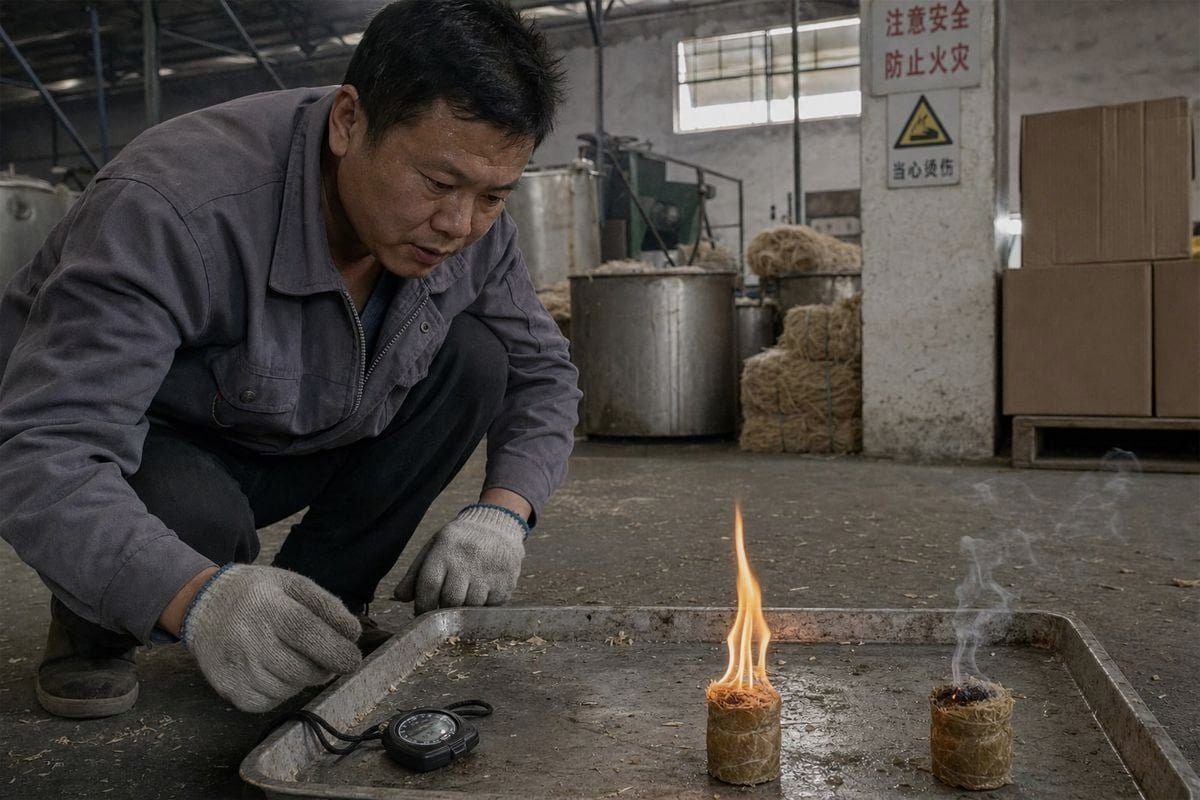
Wood fire starters that will not light can sink a whole retail program. I have watched containers of them fail on arrival, and our factory rebuilt its process to stop that.
Wood fire starters fail to light or stay lit when wax saturation is too low, wood fibers hold excess moisture content, burn time falls short of the ignition window, or surrounding fuel is wet, oversized, or starved of oxygen supply.
Each of those causes is preventable. Below, I break down where failures start in production, how to test a supplier, which materials to demand, and how to pick a factory whose samples match reality.
What Causes My Wood Fire Starters to Fail Quality Control Before They Reach Customers?
A few years back, our QC team pulled a batch off the line in Ningbo because the pucks felt light in the hand. Weight told us the wax ratio had drifted, and drifted wax means weak flames.
Wood fire starters fail quality control mainly due to inconsistent wax-to-fiber ratios, damp or under-dried excelsior, loose winding that unravels, wax degradation from poor storage, and packaging that lets humidity re-enter the product before it reaches shelves.

Most failures are baked in at the factory long before a customer strikes a match. In our 17+ years running production lines, we have traced nearly every complaint back to one of five root causes. Understanding them helps you write a better purchase specification.
The Five Failure Points We Screen For
First, the wax-to-fiber ratio. A starter that is 50% wood fiber and 50% parafina 1, like our standard firelighter cubes and rolls, burns hot and long. If the dip time is too short or the wax bath runs cool, saturation drops. The starter then lights fast but dies fast, like paper.
Second, fiber moisture content. Excelsior 2 must be dried before dipping. If the wood wool goes into wax while damp, moisture gets sealed inside. The starter sputters, smokes, and struggles to hold a flame.
Third, winding tension. Loose rolls unravel in transit. Tight, uniform winding keeps the flame concentrated and the burn predictable.
Fourth, wax quality and storage. Cheap wax blends or hot-warehouse storage cause evaporative loss and surface bloom. The starter looks fine but ignites poorly.
Fifth, packaging. Cardboard boxes without an inner liner let ambient humidity creep back into the fibers during a six-week ocean voyage.
| Punto de falla | Symptom at Retail | Root Cause in Production |
|---|---|---|
| Low wax ratio | Lights, then dies in under 3 minutes | Short dip time or cool wax bath |
| Damp fibers | Sputtering, heavy smoke | Skipped or rushed drying stage |
| Loose winding | Unraveled units, uneven burn | Poor tension control on rollers |
| Degraded wax | Hard to ignite, dull flame | Bad wax blend or hot storage |
| Humidity ingress | Random failures across a batch | No moisture barrier in packaging |
We weigh sample units from every batch and burn-test them against a control. That discipline is why our first sample reflects mass production, not a hand-picked showpiece.
How Can I Verify a Supplier's Burn-Time Consistency Before Placing a Bulk Order?
A German distributor once asked us to burn ten random units on a video call before he confirmed his order. We did it live. Every buyer should demand something similar.
Verify burn-time consistency by requesting units from three different production batches, timing each burn yourself, checking unit weights for variance, asking for SGS or Intertek test reports, and confirming the supplier logs burn tests per batch.

Burn time is the single spec that decides whether a starter bridges the ignition window. A campfire needs eight to twelve minutes of sustained flame so kindling can catch and larger fuel can dry. If half your units burn for four minutes and half for eleven, your returns rate will tell the story. Here is the verification process we recommend to buyers, because it is the same one we run internally.
A Step-by-Step Verification Process
- Request cross-batch samples. Ask for units pulled from at least three separate production runs, not one polished sample pack. Consistency across batches is the real test.
- Weigh every unit. Wax carries the burn. Units of the same size should sit within a tight weight band. Wide variance means the dipping process is not controlled.
- Run timed burns. Light each unit in still air on a non-conductive surface. Record time to full ignition and total flame duration. Look for a narrow spread, not just a good average.
- Test under stress. Burn one unit on a cold slab and one after a night in a humid room. Heat dissipation into cold surfaces and surface condensation both mimic real-world conditions.
- Ask for documentation. A serious factory holds ISO 9001 3 process records and third-party SGS or Intertek reports. If the supplier cannot show batch-level burn logs, they are not measuring what they claim to control.
We keep burn-test records for every batch we ship to the US and Europe. When a purchasing manager asks how unit twelve compared to unit two thousand, we can answer with data, not assurance.
| Prueba | Qué revela | Pass Signal |
|---|---|---|
| Unit weight check | Wax saturation control | Tight weight band across batches |
| Timed burn, still air | Base burn duration | Narrow spread around target time |
| Cold-surface burn | Real-world heat loss resistance | Flame sustains despite heat sink |
| Humidity exposure burn | Packaging and coating integrity | Ignites within seconds, no sputter |
Which Wax and Wood Materials Should I Require to Prevent Weak or Inconsistent Flames?
Choosing materials is a trade-off we weigh on every OEM project: burn temperature versus ignition speed, cost versus consistency, and eco-credentials versus raw performance. The right spec depends on your market, but some rules never bend.
Require food-grade or fully refined paraffin at roughly 50% of unit weight, kiln-dried softwood excelsior below 12% moisture content, uniform fiber thickness for even wicking, and eco-friendly composition free of accelerant chemicals that fail EU and US compliance testing.

Materials decide whether your product lights on the first match or embarrasses your brand. Let me walk through the two halves of the formula, because buyers often specify one and ignore the other.
The Wax Side
Fully refined paraffin is the workhorse. It ignites easily, burns clean, and holds a stable flame in wind. Semi-refined or recycled wax blends cost less but vary batch to batch, and variance is exactly what you are paying to avoid. Some suppliers cut wax content to 30–35% to save cost. The unit still looks identical, but the flame runs cooler and shorter. Insist on a stated wax percentage in your spec sheet and verify it by weight. Our standard is a 50/50 wood fiber and paraffin composition, printed right on the retail box, because retailers and end users increasingly read labels.
The Wood Side
Softwood excelsior from pine or poplar wicks wax well and ignites fast, similar to how natural madera resinosa 4 works with its resin. The fibers must be kiln-dried before dipping. Green or air-dried fiber can trap 15–20% water, and that moisture steals heat from the flame the moment it matters most. Fiber thickness matters too. Overly fine strands flash and burn out; overly thick strands resist ignition. Uniform medium strands give the steady, climbing flame that lights kindling reliably.
| Material Choice | Rendimiento | Riesgo de consistencia | Mejor para |
|---|---|---|---|
| Fully refined paraffin, 50% ratio | Hot, long, wind-resistant burn | Bajo | Retail and outdoor brands |
| Recycled wax blends | Adequate when fresh | High batch variance | Budget lines only |
| Kiln-dried softwood excelsior | Fast wicking, clean ignition | Bajo | All applications |
| Air-dried mixed fiber | Unpredictable ignition | Alto | No recomendado |
One more point for European buyers: avoid chemical accelerants entirely. They may boost first-strike ignition, but they complicate CE compliance and shelf labeling. Eco-friendly wax and wood formulas pass testing cleanly and match what your customers now expect.
How Do I Choose a Manufacturer Whose Samples Truly Match Mass-Production Performance?
The hardest lesson our export team learned early on came from a buyer who had been burned elsewhere: a trading company sent him flawless samples, then shipped a container of duds. He audited us in person before signing. We welcomed it.
Choose a manufacturer with its own production lines, ISO 9001 and BSCI certification, batch-level burn testing, willingness to accept factory audits, cross-batch sample provision, and documented process controls linking sample specs directly to mass-production parameters.

The sample-versus-shipment gap is the biggest hidden risk in this category. Samples are often hand-made by the best technician using the freshest wax. Mass production runs at speed, with different tolerances. Your job is to find a partner whose process closes that gap, and there are clear signals to look for.
Separate Factories from Traders
A trading company cannot control wax bath temperature or fiber drying time, because it does not own the line. Ask direct questions. Where is the plant? Can I visit or send a third-party auditor? Our production sits in Ningbo, with headquarters in Liuyang, and we host audits because a real factory has nothing to hide. If a supplier stalls on an audit request, treat that as your answer.
Demand Process Documentation, Not Promises
ISO 9001 means the factory documents its process and repeats it. BSCI 5 covers social compliance, which large US and European retailers require before listing. Marcado CE 6 and SGS or Intertek 7 reports prove the product itself was tested by an independent lab. Together, these turn "trust us" into a paper trail. For our buyers supplying Home Depot–type channels, this is a hard requirement, not a nice-to-have.
Test the Relationship Before the Bulk Order
Place a small trial order and treat it as a production test. Compare trial units against your original samples on weight, burn time, and winding quality. A capable OEM partner will also handle your private-label packaging, warning labels, and barcodes in that same trial run, so you see the complete shelf-ready product before committing volume. Flexible MOQs on trial orders are a sign the factory is confident its line output matches its samples.
Responsive English communication matters more than buyers expect. When a burn-time question comes in from Frankfurt or Chicago, a same-day technical answer signals that engineers, not just salespeople, sit behind the reply.
Conclusión
Wood fire starters fail when wax ratios, moisture content, or process control slip. Specify materials, test burn times across batches, and partner with a certified factory whose samples match production.
Notas al pie
1. Background on the wax type used as the primary fuel component in fire starters. ↩︎
2. Wikipedia entry for wood wool, the standard term for excelsior. ↩︎
3. Explains the quality management standard that documents and repeats manufacturing processes. ↩︎
4. Explains the resin-rich natural fire starter material used as a comparison point. ↩︎
5. Updated official amfori page for the Business Social Compliance Initiative. ↩︎
6. EU official page explaining the compliance marking mentioned for European market entry. ↩︎
7. Official site of the independent testing lab referenced for verifying product compliance. ↩︎


 English
  Spanish
  German
  French
  Arabic
  Portuguese
Únete a la conversación