






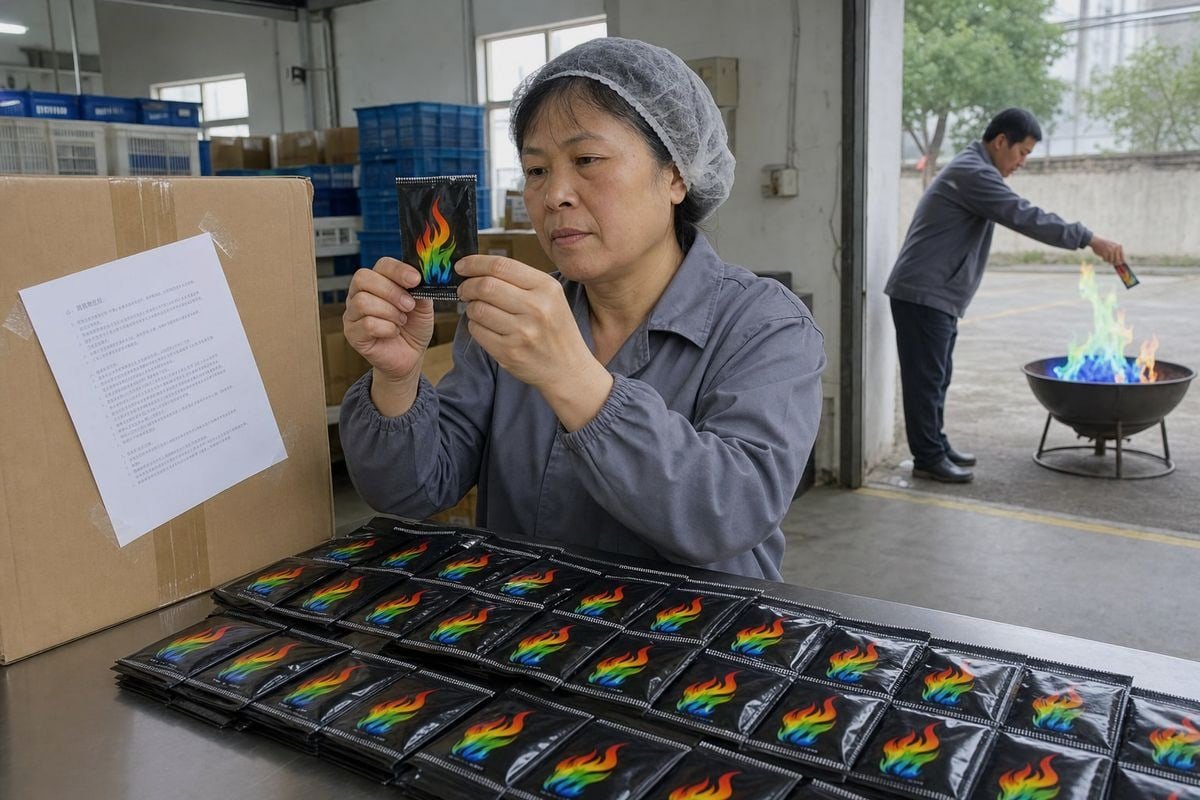
Is Magic Fire Powder edible or harmless? On our production line in Ningbo, we get this question from importers weekly — because their end customers keep asking it, and the answer matters.
Magic Fire Powder is not edible and not fully harmless. It is a flame colorant designed for visual effects only. Swallowing it can cause chemical burns, internal bleeding, and organ damage. Used correctly — unopened, in a fire, never for cooking — it is safe for ambience.
That short answer hides a lot of nuance. Buyers who import color-flame products need to understand the chemistry, the certifications, and the labeling toxicidad del sulfato de cobre 1. Let me walk you through each piece.
What Ingredients Are in Magic Fire Powder, and Are They Truly Non-Toxic?
During a factory audit last year, an SGS inspector spent two hours on one question: what exactly is in our packets? That level of scrutiny taught me buyers deserve the same clarity.
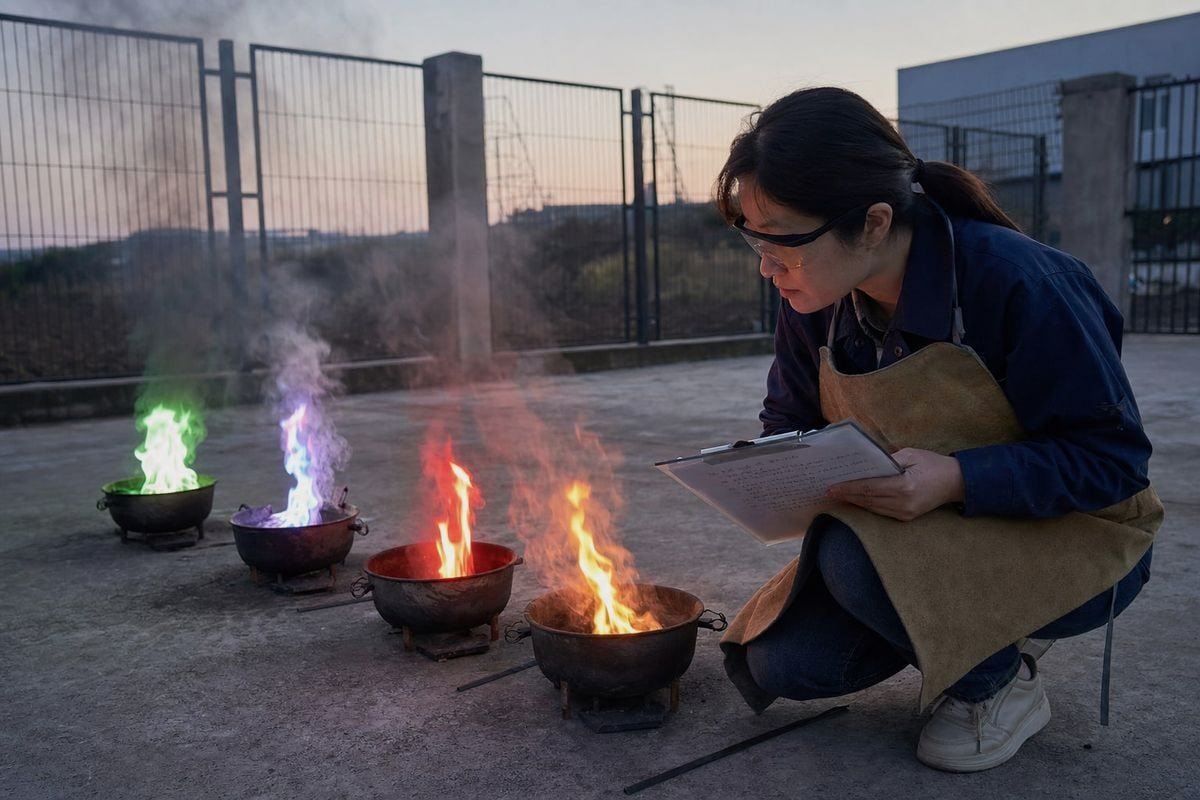
Most Magic Fire Powder products use metallic salts — commonly copper sulfate or copper chloride — to color flames. These flame colorant chemicals are not toxic when burned as directed, but they are poisonous if swallowed, causing burns, internal bleeding, and kidney or liver damage.

The word "non-toxic" is the most abused term in this product category. In our 17-plus years of making color-flame packets, pinecones, and firestarters, I have seen dozens of listings that use "non-toxic" without any context. That wording creates a dangerous mental shortcut. Consumers read "non-toxic" and hear "edible." Those are not the same thing. A product can be safe to use in a fire while still being harmful if you eat it, breathe its concentrated dust, or rub it into your eyes.
La química detrás de los colores
Different metallic salts produce different flame colors. Copper compounds are the workhorses of this industry because they produce the vivid greens and blues customers love. But toxicidad del sulfato de cobre 2 is well documented. Health authorities warn that ingesting flame colourant contents can cause severe internal bleeding, kidney and liver damage, and in serious cases, death. Cupric chloride hazards are similar — it is corrosive to tissue and dangerous when swallowed.
| Common Ingredient | Color de llama | Hazard If Ingested |
|---|---|---|
| El sulfato de cobre | Verde | Caustic burns, vomiting, liver and kidney damage |
| Copper chloride | Azul-verde | Tissue corrosion, internal bleeding |
| Cloruro de potasio | Morado | Stomach upset, electrolyte disruption at high doses |
| Sales de estroncio | Rojo | Gastrointestinal irritation |
Irritation vs. Poisoning vs. Caustic Injury
It helps to separate three different risks. Irritation means temporary discomfort — dust on skin or in eyes. Poisoning means systemic harm, such as heavy metal poisoning affecting organs. Caustic injury means chemical burns to the mouth, throat, or stomach. Swallowed copper salts can cause all three at once. That is why a real Hoja de datos de seguridad 3, not a marketing blurb, is the only trustworthy source on ingredients. At our factory, every formulation ships with SDS documentation, because our B2B buyers in the US and EU cannot legally sell without it.
How Do I Verify Safety Certifications Before Importing Color-Flame Products?
A German distributor once told me he had rejected three suppliers before contacting us — all because their "CE certificates 4" turned out to be self-declared PDFs with no lab behind them. His caution was justified.
Verify safety certifications by requesting original test reports from accredited labs like SGS or Intertek, confirming the report number directly with the lab, checking the Safety Data Sheet matches the actual formulation, and auditing the factory's ISO 9001 and BSCI status before placing orders.

Paperwork fraud is the biggest hidden risk in this category. Because color-flame products sit in a gray zone between novelty goods and chemical products, some suppliers cut corners. In our experience exporting to 30-plus countries, customs authorities and major retailers have tightened their documentation requirements every year. If your paperwork does not hold up, your shipment gets held, or worse, you face a recall after products hit shelves.
Una lista de verificación de verificación práctica
Here is the process we recommend to every purchasing manager who contacts us:
- Request the actual test report, not a certificate summary. A real SGS or Intertek report includes a report number, test dates, tested parameters, and the lab's contact details.
- Verify the report number with the lab directly. Both SGS and Intertek allow verification. A legitimate supplier will encourage this. A fraudulent one will stall.
- Cross-check the SDS against the report. The Safety Data Sheet should list the same chemical composition the lab tested. Mismatches are a red flag.
- Confirm the report covers your specific SKU. Some suppliers test one formulation and apply the report to every product. Packaging changes and formulation tweaks require updated testing.
- Audit the factory, not just the documents. ISO 9001 confirms quality management systems. BSCI confirms ethical production. Ask for audit dates and scores.
What Each Certification Actually Covers
| Por qué es importante para las piñas perfumadas | Lo que verifica | Why It Matters for Import |
|---|---|---|
| ISO 9001 | Sistema de gestión de calidad | Batch-to-batch consistency from sample to mass production |
| BSCI | Cumplimiento social y ético | Requerido por muchas cadenas minoristas de la UE y EE. UU. |
| CE | Conformidad de seguridad del producto de la UE | Legal requirement for EU market access |
| Informes de SGS/Intertek | Chemical composition and safety testing | Proof for customs, retailers, and liability defense |
One more point from our side of the table: a factory with complete production lines and strict QC will always welcome third-party inspection before shipment. If a supplier resists pre-shipment inspection, walk away. We have hosted buyer inspections in Ningbo for years, and it consistently builds the trust that long-term partnerships need.
What Warning Labels Should I Require to Prevent Consumer Misuse?
Packaging design is a trade-off we wrestle with constantly. Bright rainbow graphics sell the product — but they are also the root cause of children mistaking these packets for candy or drink mix.
Require labels stating: not for consumption, keep away from children, do not open the packet, do not cook or roast food over colored flames, use in ventilated areas only, and include poison control contact information. Labels must meet destination-market regulations such as US and EU chemical labeling rules.
The documented incidents in this category almost always trace back to packaging confusion. In one widely reported case, about 25 schoolchildren in Queensland became ill after mistaking a fire colourant 5 for sweets — several were hospitalized with nausea and burning throats. Health Canada has warned that both children and adults have confused these packets with candy or food because of colorful packaging. The crystalline texture does not help; the granules genuinely resemble Pop Rocks or powdered drink mix.
When we develop private-label packaging for our OEM clients, we treat the warning panel as seriously as the branding. Our one-stop customization covers warning labels, barcodes, and display packaging, and we adapt the warning text to each destination market's language and legal requirements.
The Minimum Warning Set
Based on what our buyers in the US, Germany, UK, France, and Canada require, here is the label content we consider non-negotiable:
| Warning Element | Why It Is Required |
|---|---|
| "Not for human consumption" | Directly counters the candy misconception |
| "Do not open packet — toss whole into fire" | Prevents skin and eye exposure to concentrated salts |
| "Do not cook or roast food over colored flames" | Vaporized metallic salts can contaminate food |
| "Mantener fuera del alcance de niños y mascotas" | Children are the highest-risk group for accidental ingestion |
| "Use outdoors or with adequate ventilation" | Reduces inhalation of chemical fumes indoors |
| Poison control center 6 contact guidance | Speeds correct response after accidental exposure |
| "Do not use ash in compost or gardens" | Ash retains concentrated metal residues harmful to soil and wildlife |
Design Choices That Reduce Confusion
Beyond text, the design itself can help. We advise clients to avoid fruit imagery, avoid transparent windows showing the colorful crystals, and place a high-contrast yellow caution band on the front panel — not buried on the back. Child-resistant considerations matter too. A packet that a toddler cannot easily tear open buys critical time. Small design decisions like these have real liability consequences, and retail sourcing teams increasingly audit them before listing a product.
How Can I Address Customer Safety Questions Without Risking Liability?
Early in our export history, a UK buyer forwarded us a customer email asking whether roasting marshmallows over colored flames was fine. His support team had no approved answer. That gap is a liability problem waiting to happen.
Answer safety questions with pre-approved, fact-based statements drawn from your Safety Data Sheet and test reports. Never improvise, never claim the product is edible or food-safe, always direct ingestion cases to a poison control center, and document every safety communication in writing.

Liability in this category rarely comes from the product itself. It comes from what your team says about the product. A support agent who casually writes "it's totally harmless" has just created a document that a lawyer can use against you. The safer path is a standardized safety FAQ, reviewed against your SDS and test reports, that every customer-facing employee uses word for word.
Build Answers Around Three Scenarios
Scenario one: "Can I cook over the colored flames?" The answer is always no. Campfire cooking safety is a real concern here — vaporized metallic salts can deposit on marshmallows, hot dogs, and grill surfaces even when nobody touches the powder. The correct script: "This product is for visual effect only. Wait until the packet has fully burned out and the fire returns to normal flames before cooking, or use a separate fire for food."
Scenario two: "My child swallowed some. What do I do?" Your team should never give medical advice beyond the essentials: do not induce vomiting, rinse the mouth with water, and call a poison control center 7 immediately. Respiratory irritation symptoms — coughing, throat burning, chest discomfort — after inhaling dust or smoke also warrant medical guidance. Have the relevant national poison hotline numbers ready for each market you sell into.
Scenario three: "Is it safe to use indoors?" Indoor fireplace ventilation matters. The product can be used in a fireplace, but only with a properly drafting chimney. Enclosed spaces without airflow raise the risk of inhalation of chemical fumes. Your script should recommend outdoor use or a well-ventilated, properly functioning fireplace — nothing more casual than that.
Document Everything
Keep a log of every safety inquiry and the exact response given. Update your FAQ whenever regulations or formulations change. When we supply OEM clients, we provide the underlying SDS and test documentation precisely so their support teams can answer from evidence, not guesswork. That documentation trail is your best defense if an incident ever occurs.
Conclusión
Magic Fire Powder is for ambience, never for eating or cooking. Verified certifications, clear warning labels, and disciplined safety communication protect your customers — and your business — completely.
Notas al pie
1. Comprehensive toxicological data on copper sulfate, outlining the health risks and physiological effects of ingestion. ↩︎
2. Confirms chemical hazard profile of copper sulfate referenced in flame colorant ingestients. ↩︎
3. Official OSHA guidelines defining the purpose, required sections, and legal importance of Safety Data Sheets for chemicals. ↩︎
4. Official European Union resource explaining CE marking requirements, conformity assessment, and verification procedures for importers. ↩︎
5. Government safety advisory specifically addressing the ingestion risks of fire colourant products and their resemblance to candy. ↩︎
6. Authoritative poison control resource supports guidance for ingestion emergency response. ↩︎
7. National resource providing immediate medical guidance and emergency contact information for accidental poisoning and chemical exposure. ↩︎


 English
  Spanish
  German
  French
  Arabic
  Portuguese
Únete a la conversación