







Verifying open-flame safety warnings on fireplace pine cones sounds simple until a recalled pallet lands on your dock. Our production team has watched buyers learn this lesson the expensive way.
To verify open-flame safety warnings on fireplace pine cones, request third-party certification such as SGS or Intertek test reports, confirm the label language matches your target market's regulations (CPSC, EN standards, Prop 65), review Safety Data Sheets for treated cones, and audit batch-level warning consistency before ordering.
That is the short answer. Below, I break each step down so you can run this verification process yourself, whether you buy from us or from anyone else.
What certifications should I request to confirm fireplace pine cones meet retail safety standards?
A German distributor once asked us for "any certificate" before ordering our color-flame pinecones. We sent him four documents. He needed all four, and here is why.
Request ISO 9001 for quality management, SGS or Intertek flammability testing reports, CE documentation for European markets, and BSCI audit results for ethical sourcing. For treated pine cones, also request Safety Data Sheets and heavy-metal test results confirming colorants are free of lead, cadmium, and arsenic.

Not all pine cone products carry the same certification burden. A plain kiln-dried cone sold as kindling needs less paperwork than a chemically treated color-flame cone. The first thing I tell buyers is to identify the exact product type, then match certifications to it.
Match the certificate to the product type
Plain natural cones need proof of drying and pest treatment. Wax-dipped fire starter cones should align with recognized ASTM safety standards 1 and, in North America, the ANSI/CAN/UL 2115 framework that governs processed fire starters and their volatile fuel content. Color-changing cones treated with sales metálicas 2 need chemical documentation on top of that.
| Especificaciones Comunes del Polvo de Fuego Mágico | Core Certificates to Request | Extra Documentation |
|---|---|---|
| Natural kindling cones | Moisture content report (below 20%), pest heat-treatment record | USDA/APHIS-compliant treatment proof for imports |
| Wax-dipped fire starters | SGS/Intertek flammability testing, UL 2115 alignment | Wax flash-point technical data sheet |
| Color-flame treated cones | Chemical composition report, heavy-metal profiling | Safety Data Sheets, Prop 65 assessment 3 |
| Decorative painted cones | Coating flammability report | Clear "not for burning" label proof |
In our experience exporting to 30+ countries, buyers who skip third-party certification 4 at the sample stage almost always come back requesting it before the retail compliance audit their own customers demand. Big-box channels will not stock fire starter products without traceable test reports. Ask for certificates issued to the actual factory name, not a trading company. If the names do not match, the supplier may not control production at all, and that gap becomes your product liability problem later.
How do I check that warning labels match the regulations in my target market?
When we develop embalaje de marca blanca for US versus EU clients, we maintain two entirely separate warning-label templates. The differences surprised me when I first compared them side by side.
Compare the label against your market's specific rules: CPSC guidance and California Prop 65 for the US, CLP hazard pictograms for the EU, and bilingual requirements for Canada. Confirm the warning names the actual hazards — sparks, flare-ups, toxic fumes — not just generic "keep away from fire" text.

Consumer warning labels fail in two ways. Either they use the wrong regulatory format for the market, or they use vague language that does not match the real hazard. You need to check both.
Run a three-step label audit
First, verify format. US retail packaging for treated cones should reflect CPSC compliance expectations 5, and California-bound goods need a Prop 65 assessment to determine whether a chemical exposure warning applies. EU packaging needs CLP-compliant hazard statements if chemical accelerants or metal salts are present. Canada typically requires English and French.
Second, verify hazard specificity. A compliant fireplace pine cone warning should address the documented risks: popping and sparks, smoke inhalation, acumulación de creosota 6 from burning cones in quantity, and flare-ups when wax-based cones hit an established high-heat fire. A label that only says "use common sense" tells the consumer nothing and offers you no legal cover.
Third, verify use restrictions. Color-flame cones 7 must carry an explicit warning against cooking or roasting food over the treated flames. The label should state indoor versus outdoor use, quantity limits per fire, and whether the product suits wood stoves, open fireplaces, or fire pits. In our label reviews for European clients, the "do not cook over colored flames" line is the single most commonly missing statement on competitor samples we are asked to benchmark. If it is missing on a sample you receive, treat that as a red flag for the supplier's overall regulatory awareness.
A short checklist you can apply to any sample label:
- Market-correct regulatory format (CPSC/Prop 65, CLP, bilingual Canada).
- Named hazards: sparks, smoke, flare-ups, creosote.
- Explicit cooking prohibition for treated cones.
- Indoor/outdoor use designation and quantity limits.
- Child and pet supervision statement.
What test reports and documentation should my supplier provide before I place a retail order?
The trade-off I weigh most often with new buyers is speed versus documentation depth. Some want to ship in three weeks. Our compliance file takes longer to assemble, and I refuse to shortcut it.
Before ordering, obtain flammability testing reports from SGS or Intertek, Safety Data Sheets for all chemical treatments, wax flash-point data, heavy-metal profiling results, moisture and pest-treatment records for natural cones, and phthalate-free confirmation for any fragrances. Every document should name the producing factory.

Think of the documentation package as your defense file. If a consumer incident ever occurs, these documents show you exercised due diligence. That matters enormously for product liability exposure in the US and for market surveillance authorities in the EU.
El conjunto de documentos principal
| Documento | Lo Que Demuestra | Quién lo emite |
|---|---|---|
| Informe de prueba de inflamabilidad | Burn behavior meets ASTM safety standards or UL 2115 alignment | Laboratorio SGS, Intertek o equivalente |
| Hoja de datos de seguridad | Chemical identity and handling risks of treatments | Número UN y nombre de envío correcto |
| Heavy-metal profile | Colorants are lead-free, no cadmium or arsenic | Laboratorio de terceros |
| Wax flash-point sheet | Binder will not liquefy and migrate out of the firebox | Wax supplier or test lab |
| Pest heat-treatment record | Cones treated per USDA/APHIS norms | Factory, verifiable in audit |
| Phthalate-free statement | Fragrances will not release endocrine disruptors when burned | Fragrance supplier plus lab verification |
I also encourage buyers to raise a common objection here: some suppliers argue that natural pine cones need no testing at all because they are "just wood." That position does not survive scrutiny. Natural cones still carry moisture, resin, and pest risks, and creosote concerns are well documented when pine materials are burned in quantity. Documentation requirements are lighter for natural cones, but they never drop to zero. When we onboard a new retail client, we walk through this exact table together, and the conversation usually surfaces one or two documents their previous supplier never provided.
How can I verify that every production batch consistently meets the same safety warning requirements?
Years ago, we learned a hard lesson when a colorant supplier changed their formulation without notice. Our incoming-material checks caught it, but the incident reshaped how we run batch control.
Verify batch consistency by requiring batch-coded packaging linked to production records, periodic third-party retesting rather than a single pre-order test, incoming-material inspection logs for chemicals and wax, and a supplier agreement that mandates notification before any formulation or label change.
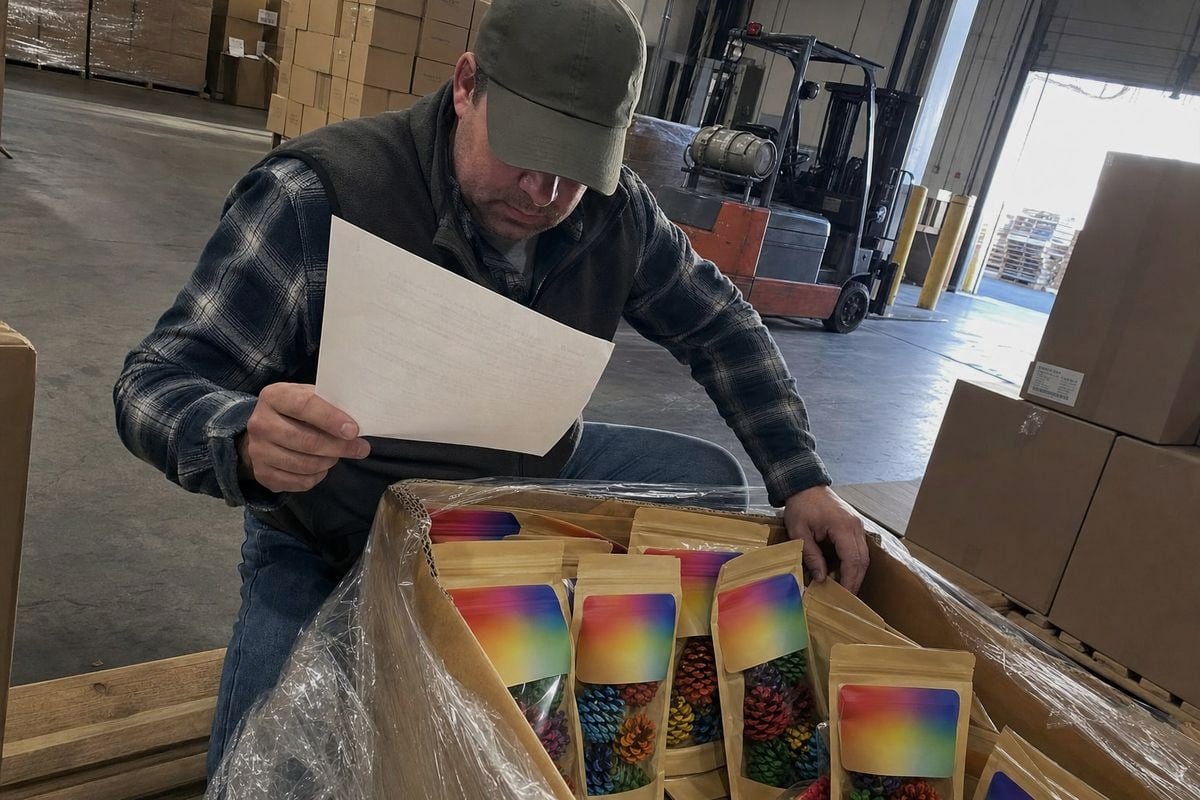
One good test report proves one good batch. Retail programs run for years, so your verification system must cover every batch that follows. At our Ningbo production site, batch-to-batch quality control is the discipline that separates a factory from a trading company reselling whatever arrives that month.
Build a batch verification loop
The loop has four stages, and each one is auditable.
- Materiales entrantes. Every delivery of metal salts, wax, and cones gets checked against the approved specification. Chemical accelerants and colorants are the highest-risk inputs because a silent formulation change can invalidate your Safety Data Sheets overnight.
- In-process checks. Treatment concentration, dip time, and drying are logged per batch. This is what makes the first sample reliably reflect mass-production quality.
- Batch coding. Each retail unit carries a batch code printed near the warning label. If a question ever arises, the code traces back to the exact production records and material lots.
- Periodic retesting. Schedule third-party retests — quarterly or per large production run — instead of relying on a single report from two years ago. Retailers running a retail compliance audit will ask for the most recent report, not the oldest.
| Verification Stage | Frecuencia | Evidencia a solicitar |
|---|---|---|
| Incoming-material inspection | Every delivery | Inspection logs, supplier CoAs |
| In-process treatment checks | Cada lote | Batch production records |
| Label and warning check | Cada lote | Printed sample retained per batch |
| Third-party retest | Quarterly or per major run | Updated SGS/Intertek report |
Also insist on a change-notification clause in your supplier agreement. If the factory alters colorant chemistry, wax grade, or label artwork, you must know before goods ship. Fire starter safety at retail depends less on any single test and more on this ongoing discipline.
Conclusión
Weak verification invites recalls and liability claims. Strong verification is simple: match certificates to product type, audit labels per market, demand full documentation, and enforce batch-level consistency.
Notas al pie
1. ASTM provides the primary safety standards for fire-related consumer products in North America. ↩︎
2. Metal salts are the primary chemical agents used to produce colored flames in treated pine cone products. ↩︎
3. OEHHA manages Proposition 65, which dictates chemical exposure warning requirements for products sold in California. ↩︎
4. Official .gov resource from NIST explaining the principles and importance of third-party conformity assessment. ↩︎
5. CPSC is the federal agency regulating consumer product safety and labeling requirements in the United States. ↩︎
6. Creosote is a byproduct of wood combustion that poses significant fire hazards in chimneys and fireplaces. ↩︎
7. Pyrotechnic colorants explain the chemical basis for color-changing flames and associated safety considerations. ↩︎



 English
  Spanish
  German
  French
  Arabic
  Portuguese
Únete a la conversación