






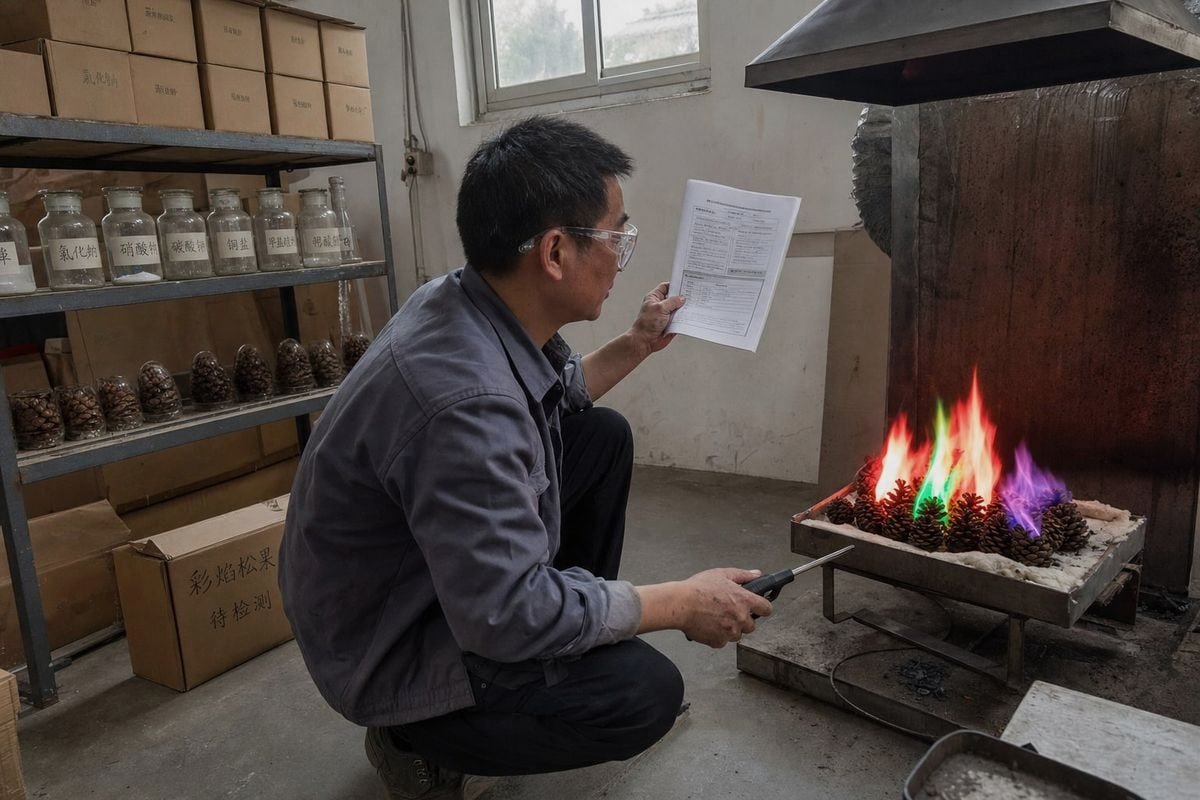
Verifying fireplace colored pine cone ingredients against appliance fuel restrictions is a question our export team hears weekly. Buyers worry one wrong chemical could ruin a whole retail season.
To verify fireplace colored pine cone ingredients against appliance fuel restrictions, request the full ingredient list with CAS numbers, obtain the Safety Data Sheet, cross-check every metal salt colorant against your appliance manual's prohibited additives, and demand third-party test reports before purchase.
That is the short answer. But the details matter, because colored pine cones are chemistry products, not simple crafts. Let me walk you through the full verification process, step by step.
What certifications should I request to confirm compliance with fuel appliance regulations?
A German distributor once told me his previous supplier sent "certificates" that turned out to be photoshopped scans. That conversation shaped how we present documentation at our Ningbo facility today.
Request SGS or Intertek chemical test reports, an ISO 9001 quality certificate, CE conformity documentation for the EU, a full Safety Data Sheet with CAS numbers, and a BSCI social audit report. Verify each certificate number directly with the issuing body before trusting it.

Certifications fall into three groups, and you need all three. The first group covers the product itself. The second covers the factory. The third covers the market you sell into. Missing any one of them creates a gap in your compliance chain.
Las tres capas de certificación
| Capa | Documento | Lo que prueba |
|---|---|---|
| Seguridad del producto | Informe de prueba SGS o Intertek | The actual chemical composition matches the declared ingredient list |
| Sistema de fábrica | ISO 9001 1, BSCI | Consistent production quality and ethical manufacturing |
| Market entry | CE (EU), SDS per GHS/OSHA (US) | The product meets regional labeling and hazard-communication law |
In our experience exporting to 30+ countries, US buyers focus hardest on the Hoja de datos de seguridad 2 and third-party lab reports. European buyers add CE conformity and often ask for REACH-relevant substance declarations. Both markets increasingly want proof that the colorantes de sal metálica 3 inside the pine cones exclude prohibited compounds.
Here is a practical tip. Every legitimate SGS or Intertek report carries a report number. You can contact the lab and confirm it is genuine. We encourage our buyers to do exactly this, because it takes ten minutes and eliminates the fake-certificate risk entirely. Also check the report date. A test report older than two or three years may not reflect the current formulation, especially if the supplier changed raw material sources. Ask when the formula was last tested, and ask whether the report covers the exact SKU you are ordering, not a "similar" product. Suppliers sometimes stretch one report across an entire catalog. That is a shortcut you should never accept, because a colored pine cone tested with one wax carrier tells you nothing about a different batch soaked in a different salt solution.
Which chemical ingredients in colored pine cones could violate my local fireplace fuel restrictions?
During product development on our color-flame line, we deliberately rejected several traditional hobby-chemistry recipes. Some classic colorants simply carry too much appliance risk, no matter how pretty the flame looks.
Copper sulfate, strontium chloride, boric acid, borax, and any nitrate or chlorate oxidizer are the most likely violators. Chloride salts corrode chimney liners, metal salts poison catalytic combustors, and most appliance manuals ban all chemical additives outside plain seasoned wood.

Colored pine cones work because metal salt colorants change flame color when they burn. The chemistry is old and well documented. The appliance compatibility question, however, is modern and much stricter. Here is what the common ingredients do, and where the risks sit.
Common colorants and their risk profile
| Químico | Color de llama | Appliance risk level |
|---|---|---|
| Cloruro de sodio (sal de mesa) | Amarillo | Moderate — chloride corrosion over time |
| Magnesium sulfate (Epsom salt) | Blanco | Lower — but still a foreign additive |
| Potassium chloride (salt substitute) | Violeta | Moderate — chloride corrosion |
| Borax / ácido bórico | Yellow-green | Moderate — banned as an additive in many manuals |
| El sulfato de cobre | Verde / verde azulado | High — heavy metal residue, toxic ash |
| Cloruro de estroncio | Rojo | High — corrosive chloride plus metal residue |
| Nitrates / chlorates | Cualquiera | Never acceptable — strong oxidizers, fire hazard |
One old hobby source puts it bluntly: use only the chemicals shown, and do not accept nitrates or chlorates as substitutes. I agree completely. Oxidizers accelerate combustion unpredictably and have no place in a consumer fire product.
Three failure modes buyers overlook
Primero, catalytic combustor damage. EPA-certified wood stoves often use a precious-metal catalyst 4. Metal salt vapor coats that catalyst and permanently deactivates it. Replacement is expensive, and the manufacturer warranty void is almost automatic once chemical additives are detected.
Second, chloride-induced liner corrosion. Chloride-based colorants react with combustion moisture 5 to form hydrochloric acid. That acid pits stainless steel flue liners, which makes chimney flue maintenance costlier and shortens liner life.
Third, appliance-type mismatch. Colored pine cones belong only in open chimeneas de leña 6, fire pits, and campfires. Gas fireplace inserts, pellet stoves, and bio-ethanol units should never receive them. Pellet stoves in particular use optical flame sensors, and colorant vapor can fog those sensors into ignition failure. Also, never cook food over colored flames, and dispose of the ash in landfill-bound waste rather than a garden, since metal salts harm soil and plants.
How can I request test reports before placing a bulk order with a manufacturer?
The best purchasing manager I ever worked with sent us a one-page document checklist before she even asked for pricing. Her trial order went smoothly because every compliance question was answered up front.
Email the supplier a written request listing the exact SKU, and ask for the SDS, third-party test report with report number, full ingredient list with CAS numbers, and a batch-specific certificate of analysis. Set document delivery as a condition of your purchase order.
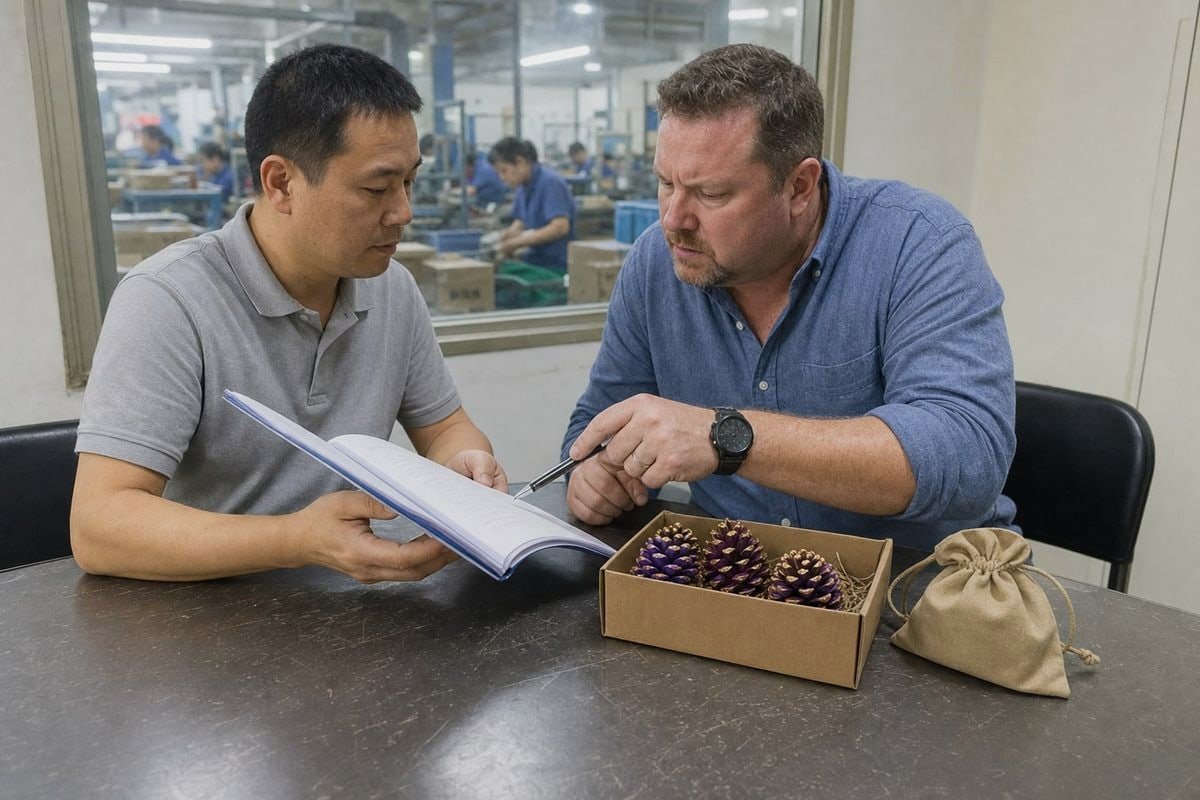
Getting documents before a bulk order is a process, not a favor. Serious factories expect these requests. When a supplier hesitates or stalls, that hesitation is itself an answer. Here is the sequence I recommend to every buyer who contacts our team.
The five-step document request process
- Identify the exact SKU and formulation. Ask whether the pine cones are salt-soaked, wax-coated, or both. The carrier matters, because some appliances permit untreated wood but ban wax-coated starters.
- Request the Safety Data Sheet. A proper Material Safety Data Sheet lists every hazardous ingredient with its CAS number. números CAS 7 let you cross-reference technical restriction lists precisely, instead of guessing from marketing names like "eco-friendly" or "fireplace safe."
- Request the third-party test report. Insist on SGS or Intertek, with a verifiable report number and a test date within the last two years.
- Ask for a batch certificate of analysis. This confirms the shipment you receive matches the tested formula. At our factory, batch-to-batch QC records exist for exactly this reason.
- Put documents into the purchase order terms. Make delivery of the SDS and test report a contractual condition. Add a clause requiring notification if the formulation changes.
Red flags during the request
Watch for suppliers who send only a marketing sheet instead of an SDS. Watch for reports covering a "similar product" rather than your SKU. Watch for refusal to disclose CAS numbers on "trade secret" grounds — hazard communication law does not allow hiding hazardous ingredients from an SDS. And watch for vague claims like "no harmful chemicals" with zero paperwork behind them. When our buyers ask us for documentation, we send it within one business day, because we know the documents are the product as much as the pine cones are.
Why does working with a certified factory reduce my compliance risk versus a trading company?
Seventeen-plus years in this industry have taught me one uncomfortable truth: many "suppliers" of fire products have never seen the production line their goods come from. That distance creates compliance blind spots.
A certified factory controls the formulation, sources its own raw materials, and holds test reports for products it actually makes. A trading company resells goods it cannot verify, so ingredient changes, substitutions, and batch drift happen without its knowledge or yours.
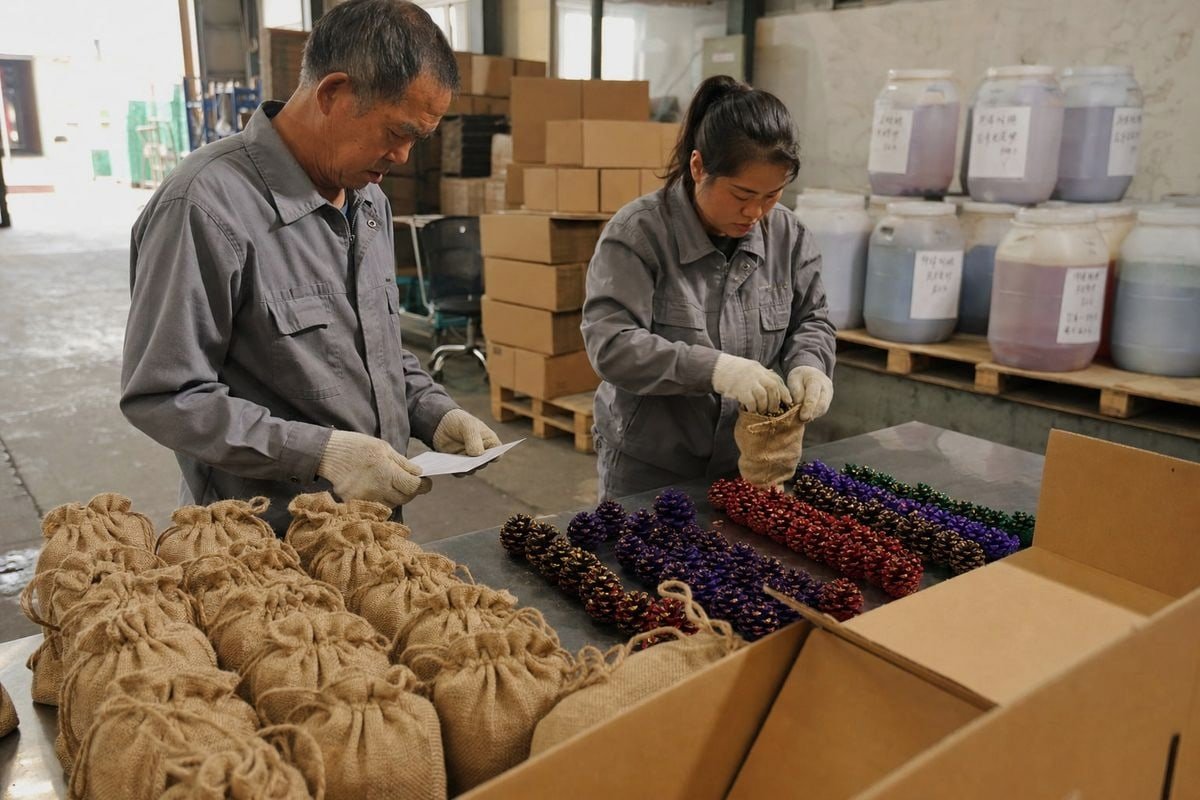
The difference is not about price or politeness. It is about traceability. When you sell a chemical flame product into the US or EU, you carry legal responsibility for what is inside it. Your supplier's ability to prove what is inside determines your real risk exposure.
Factory versus trading company on compliance
| Factor de cumplimiento | Certified factory | Empresa comercial |
|---|---|---|
| Knows the exact formulation | Yes — it created the recipe | Often no — depends on its source |
| Controls raw material sourcing | Direct, with incoming QC | Indirect, subject to substitution |
| Holds valid SDS and test reports | For its own products | Frequently borrowed or generic |
| Can notify you of formula changes | Yes, contractually enforceable | Rarely, changes pass silently |
| La consistencia lote a lote | Documented QC records | No visibility into production |
| Accepts factory audits (BSCI, ISO) | Práctica estándar | Cannot offer its subcontractor's floor |
Our operation is headquartered in Liuyang, Hunan — China's fireworks and pyrotechnic-chemistry cluster — with production in Ningbo, Zhejiang. That matters because flame-color chemistry knowledge lives in the region, and because buyers can audit our actual lines under ISO 9001 and BSCI frameworks. A trading company can show you a showroom. It cannot show you the mixing station, the soaking tanks, or the QC lab that keeps copper sulfate and strontium chloride out of a formulation that claims to exclude them.
There is a second, quieter risk with intermediaries: silent substitution. If a trading company's source factory swaps a colorant to cut cost, the trading company usually never learns of it. Your old test report then describes a product you are no longer receiving. With a factory partner, the formula is locked in your OEM agreement, and any change requires your written approval and fresh testing. For private-label buyers, that traceability extends into packaging too — warning labels, barcodes, and market-specific hazard text all stay aligned with the actual chemistry inside the bag.
Conclusión
Colored pine cones are chemistry products. Verify ingredients with CAS numbers, demand real test reports, match everything against your appliance manual, and partner with a certified factory — not an intermediary.
Notas al pie
1. Reliable, accessible overview of the ISO 9001 quality management standard. ↩︎
2. Authoritative OSHA landing page for Hazard Communication and SDS requirements. ↩︎
3. Explains how specific metal salts are used to produce colored flames in pyrotechnic applications. ↩︎
4. Explains how wood stove catalysts work and why they are sensitive to chemical contamination. ↩︎
5. Explains the composition of flue gas, including moisture and acids produced during the combustion process. ↩︎
6. Defines the structural and functional requirements for traditional wood-burning heating systems. ↩︎
7. Explains the unique identifier system for chemical substances used in safety documentation. ↩︎



 English
  Spanish
  German
  French
  Arabic
  Portuguese
Únete a la conversación