






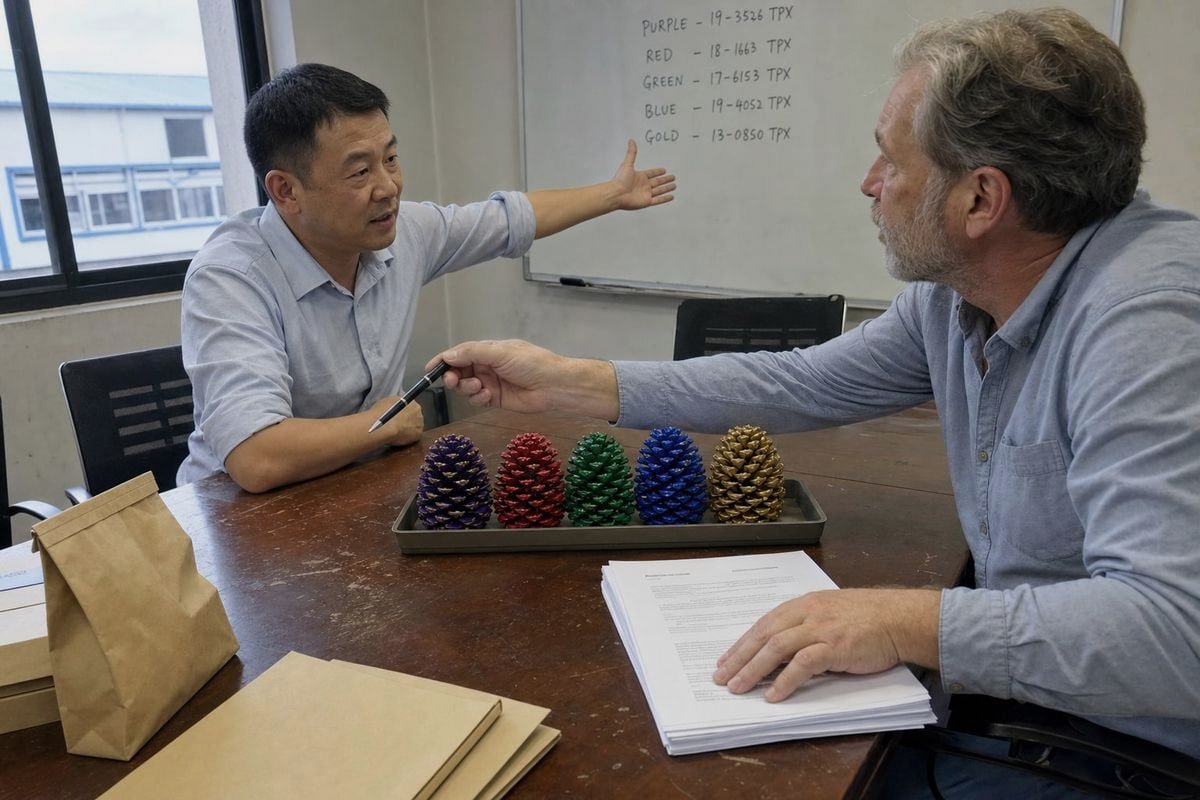
Negotiating an exclusive flame color palette for colored pine cones sounds simple until buyers visit our production line and realize how many things can go wrong. Colors overlap. Recipes leak. Competitors copy. One vague contract clause, and your "exclusive" holiday palette shows up under a rival's private label next season. The fix is a structured negotiation: lock the chemistry, the certifications, the MOQ, and the legal scope before you commit.
To negotiate an exclusive flame color palette for colored pine cones, define 3–5 target hues with tolerance ranges, require SGS or Intertek test reports, agree on a realistic MOQ per color, and sign a manufacturing supply contract with formulation, packaging, and territorial exclusivity clauses.
Each of those steps has traps hidden inside it. Below, I walk through the four questions buyers ask us most often, in the order they should be settled.
What certifications should I request before locking in an exclusive color palette?
A German distributor once asked us to develop a custom teal-to-violet burn profile. His first question was not about price. It was about test reports, and he was right to start there.
Before locking in an exclusive flame color palette, request ISO 9001 factory certification, SGS or Intertek burn and toxicity test reports for each color, CE compliance for the EU market, BSCI social audit results, and safety data sheets covering every metal salt additive used.
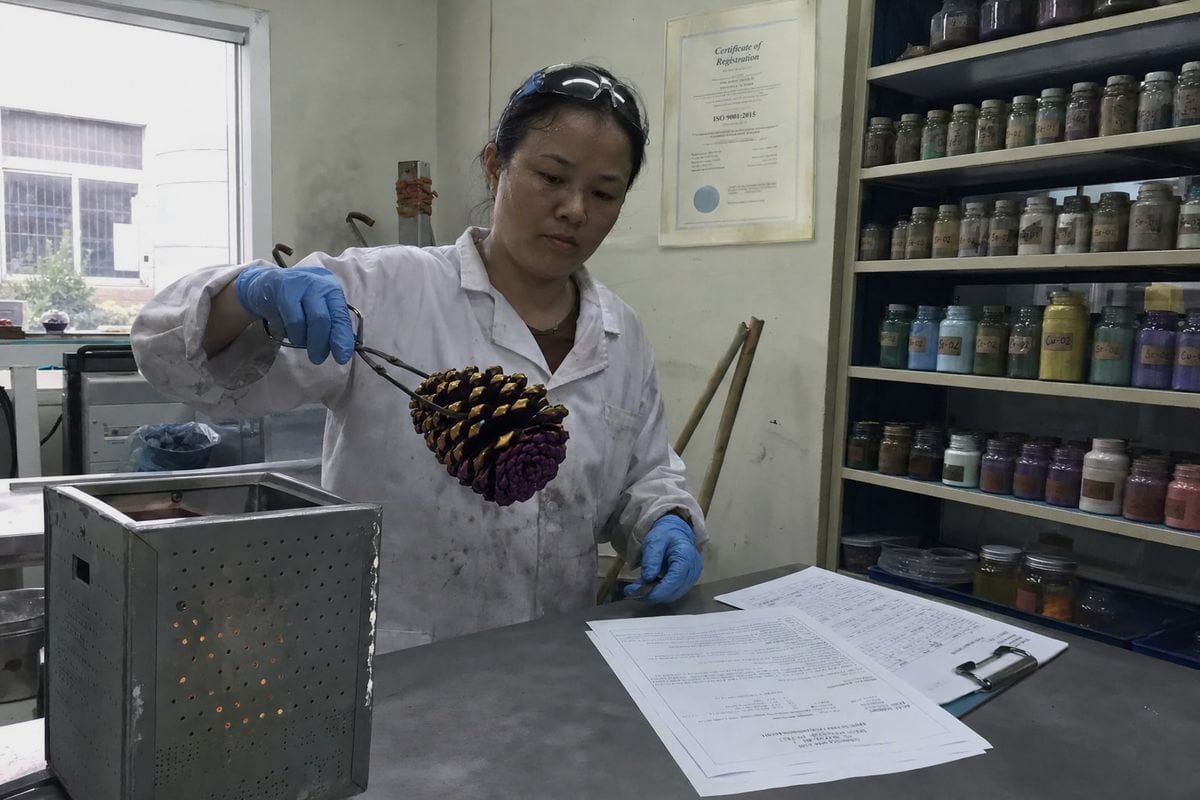
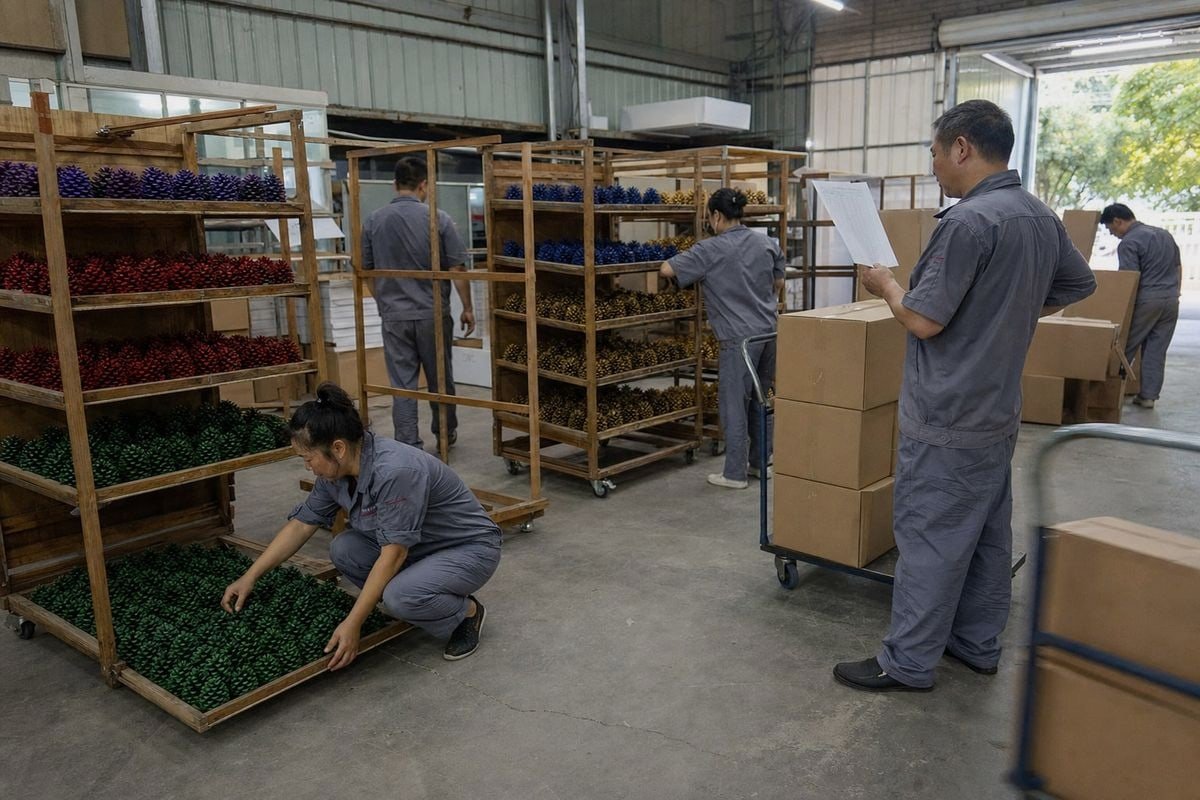
Certifications matter more for color-flame pine cones than for most hearth products. The reason is chemistry. Flame colors come from aditivos de sales metálicas 1 soaked into the cone: copper sulfate for green, cloruro de estroncio 2 for red, potassium salts for violet. Some DIY guides even suggest nitrates or chlorates. Those are oxidizers, and no serious retailer will stock a product containing them. When we formulate colorants at our Ningbo facility, we exclude harmful oxidizers entirely and rely on non-toxic fire colorants that pass third-party review.
The certification stack you should demand
| Por qué es importante para las piñas perfumadas | Lo que prueba | Why it matters for exclusivity |
|---|---|---|
| ISO 9001 | Gestión de calidad constante | Your exclusive colors stay consistent batch to batch |
| Informes SGS / Intertek | Burn behavior and toxicity per color | Retailers require these before shelf placement |
| Cumplimiento CE | Legalidad del mercado de la UE | No exclusivity value if the product cannot ship |
| Auditoría BSCI | Condiciones éticas de fábrica | Requerido por la mayoría de los grandes canales de abastecimiento minorista |
| SDS per formulation | Divulgación de la composición química | Anchors your exclusivity clause to a documented blend |
Why test reports protect your exclusivity, not just your compliance
Here is the point many buyers miss. A test report describes the exact formulation behind your palette. That document becomes evidence in your manufacturing supply contract. If your supplier later sells a near-identical blend to a competitor, the report gives you a documented baseline to compare against. In our experience exporting to 30+ countries, buyers who tie certifications to their exclusivity clause resolve disputes far faster than buyers who only negotiated price. Ask for color-specific reports, not one generic report for the whole product line. Green from sulfato de cobre 3 and red from strontium chloride burn differently and should be tested separately.
How many colors can I realistically negotiate for exclusivity without limiting my order flexibility?
There is a trade-off we walk every buyer through: each exclusive color adds a dedicated soaking bath, a separate drying schedule, and its own chemical inventory. More colors means more locked-up capacity on both sides.
Most buyers can realistically negotiate exclusivity on 3–5 flame colors without hurting order flexibility. Exclusive single hues like a signature teal work for premium branding, while broader palettes of 6+ colors raise MOQs sharply and reduce your ability to adjust reorder ratios mid-season.
The math is straightforward. Every exclusive color requires its own bulk chemical procurement 4, its own soak tanks, and its own quality checks. Cones soak for hours to a full day, then dry for two to three days before packing. If you lock six colors, your supplier must reserve six parallel production streams just for you. That reservation cost gets priced into your MOQ.
A practical framework for choosing your palette size
- One signature color. Cheapest exclusivity to hold. Ideal for a hero SKU, like a branded "Midnight Aurora" blue-green blend built on a proprietary copper ratio.
- Three-color core palette. The sweet spot. Enough visual variety for retail packaging, low enough to keep per-color MOQs manageable.
- Five-color seasonal palette. Works for holiday gifting lines. Expect the supplier to ask for a full-season volume commitment.
- Six or more colors. Only justified for large retail sourcing channels with proven sell-through. Flexibility drops fast at this level.
Keep flexibility with ratio clauses
One tactic we recommend from our OEM work: negotiate exclusivity on the palette, but keep the color ratio within each order flexible. If purple outsells green in November, you should be able to shift December's mix without a contract amendment. We build this into most agreements as a reorder ratio clause. It costs the supplier little and saves the buyer from sitting on slow-moving inventory. Also consider a sequential burn profile as a single "color" — one cone that shifts hues as it heats gives you multi-color appeal with single-formulation logistics.
What MOQ and lead time should I expect when requesting a custom flame color palette?
Last autumn, a Canadian fireplace distributor asked us why a custom palette needed six weeks when standard colored cones ship in three. The honest answer sits in the drying room, not the paperwork.
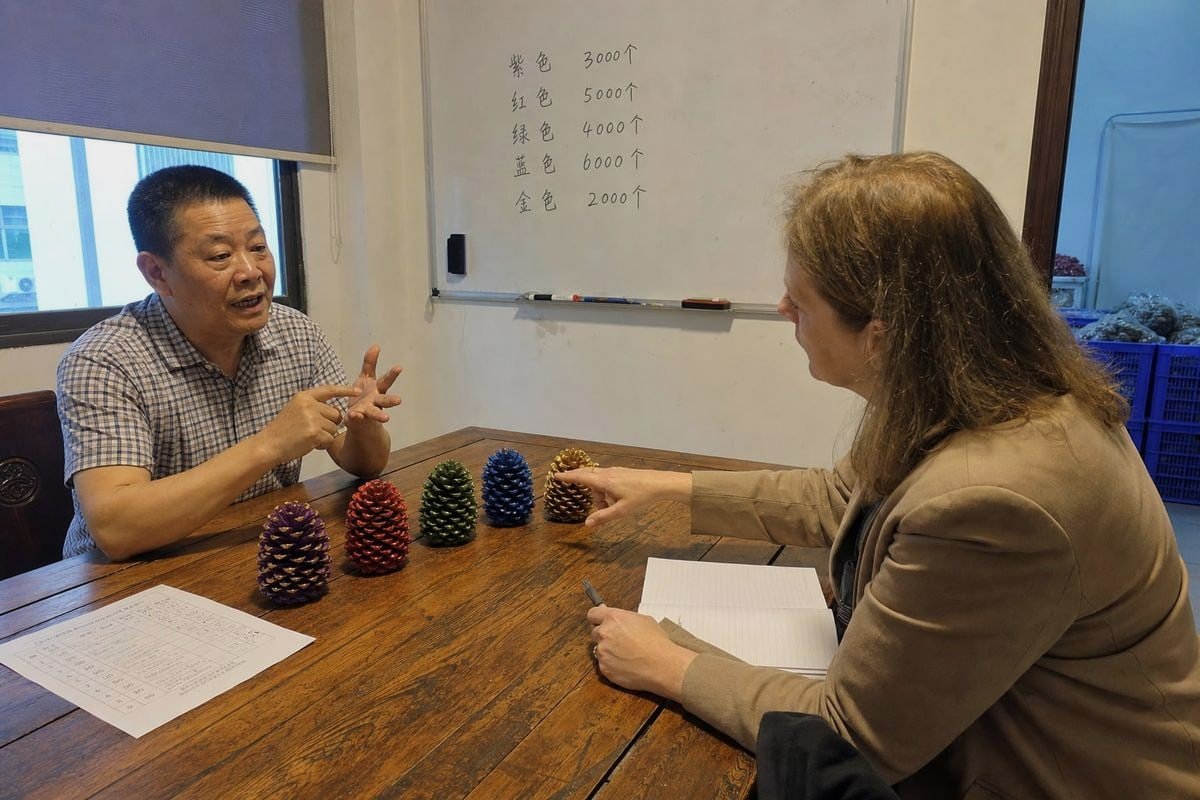
Expect an MOQ of roughly 3,000–5,000 units per exclusive color for colored pine cones, with 30–45 days lead time for standard custom palettes and 45–60 days when new formulations require lab testing, burn trials, and custom private label packaging approval.
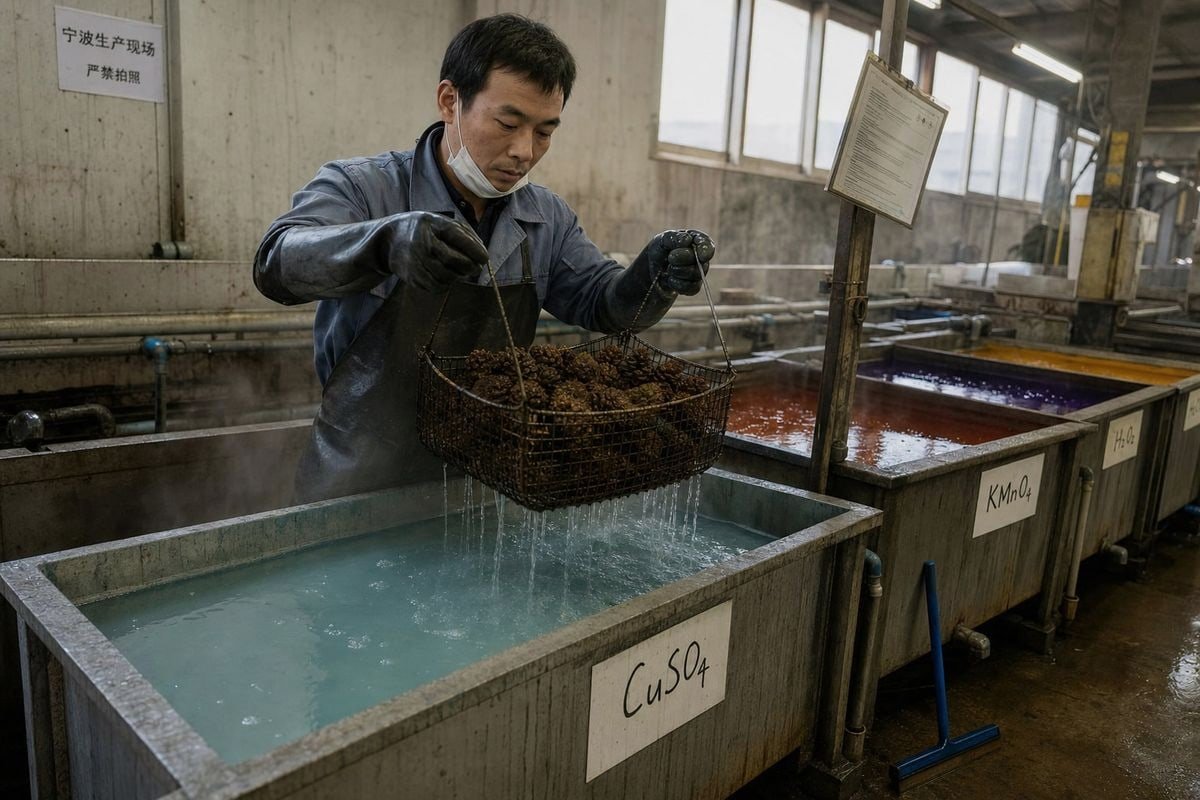
Custom palettes take longer because the process cannot be rushed. Raw cones are cleaned and heat-treated at around 200°F to remove sap, moisture, and insects. Then each color batch soaks in its metal salt solution — often overnight for deep saturation — and dries fully for two to three days. Wax coating, if you want a dual-purpose fire starter version, adds another dipping and curing stage. Skipping drying time produces weak color and sputtering burns, and no reputable factory will cut that corner.
Typical timeline breakdown for a custom exclusive palette
| Etapa | Standard colors | New exclusive formulation |
|---|---|---|
| Chemical sourcing and blending | 3–5 días | 7–14 días |
| Cone prep, soaking, drying | 7–10 días | 7–10 días |
| Burn testing and color verification | 2–3 días | 7–10 días |
| Private label packaging production | 7–10 días | 10–15 días |
| QC, packing, export documentation | 5–7 días | 5–7 días |
| Total | 30–35 days | 45–60 días |
How to negotiate the MOQ down for a trial
You do not need to accept the headline MOQ blindly. In our own OEM program, we regularly approve smaller trial runs for first-time buyers when three conditions are met: the palette uses existing approved colorants, the packaging is a simple kraft pouch or drawstring sack rather than fully custom boxes, and the buyer commits to a follow-on order target. Ask your supplier for the same structure. A trial of 1,000–2,000 units per color proves sell-through before you lock a full-season commitment. Also confirm whether the quoted lead time includes color verification burns. A factory with genuine manufacturing depth photographs and documents test burns per batch, so your first sample truly reflects mass production.
How do I protect my exclusive palette rights when working with an overseas manufacturer?
The hardest lesson I have watched buyers learn is this: the chemistry alone cannot be owned. Basic recipes for green, red, and violet flames are published all over the internet.
Protect your exclusive palette rights through a written manufacturing supply contract covering formulation exclusivity for your specific proprietary chemical blends, territorial palette rights by region or channel, a chemical exclusivity period during peak seasons, registered packaging and brand trademarks, and audit rights.
Because copper sulfate, borax, and Epsom salts are common consumer chemicals, a competitor can always make a green or white flame. What they cannot legally copy is your documented blend ratio, your named palette, your packaging trade dress, and your channel position. So the negotiation must move from "what chemical makes what color" to "what combination of hue, safety, branding, and distribution rights can only my product deliver." That is where real exclusivity lives in wholesale fireplace accessories.
The five layers of exclusivity protection
| Protection layer | Confirma que el proceso de dosificación de fragancias está controlado y es repetible | How to enforce it |
|---|---|---|
| Formulation exclusivity | Your exact salt ratios and sequential burn profiles | SDS and test reports referenced in the contract |
| Chemical exclusivity period 5 | Supplier cannot sell your blend to others during peak months | Time-bound clause, typically September–January |
| Territorial palette rights | Your named palette in your region or channel | Defined territories in the supply agreement |
| Brand and packaging IP | Trademarked names, custom pouch and box designs | Register trademarks in your home market first |
| Audit and verification rights | Factory-level confirmation of compliance | Annual audit clause plus batch documentation |
Practical steps that actually get signed
Start with a time-bound chemical exclusivity period rather than demanding permanent exclusivity. Factories agree to seasonal windows far more readily, and holiday months are when hearth product distribution peaks anyway. Second, register your palette names and packaging designs as trademarks before sharing final artwork. Third, insist that all custom molds, artwork files, and printed packaging materials belong to you contractually. We include this ownership language by default in our private label manufacturing agreements 6 because it removes the single biggest source of buyer anxiety. Finally, choose a real factory over a trading company. A trading company cannot honestly promise formulation exclusivity, because it does not control the production line. A factory can — and a factory with BSCI and ISO audits 7 has every incentive to honor written commitments, since its certifications depend on documented process discipline.
Conclusión
An exclusive flame color palette



 English
  Spanish
  German
  French
  Arabic
  Portuguese
Únete a la conversación