






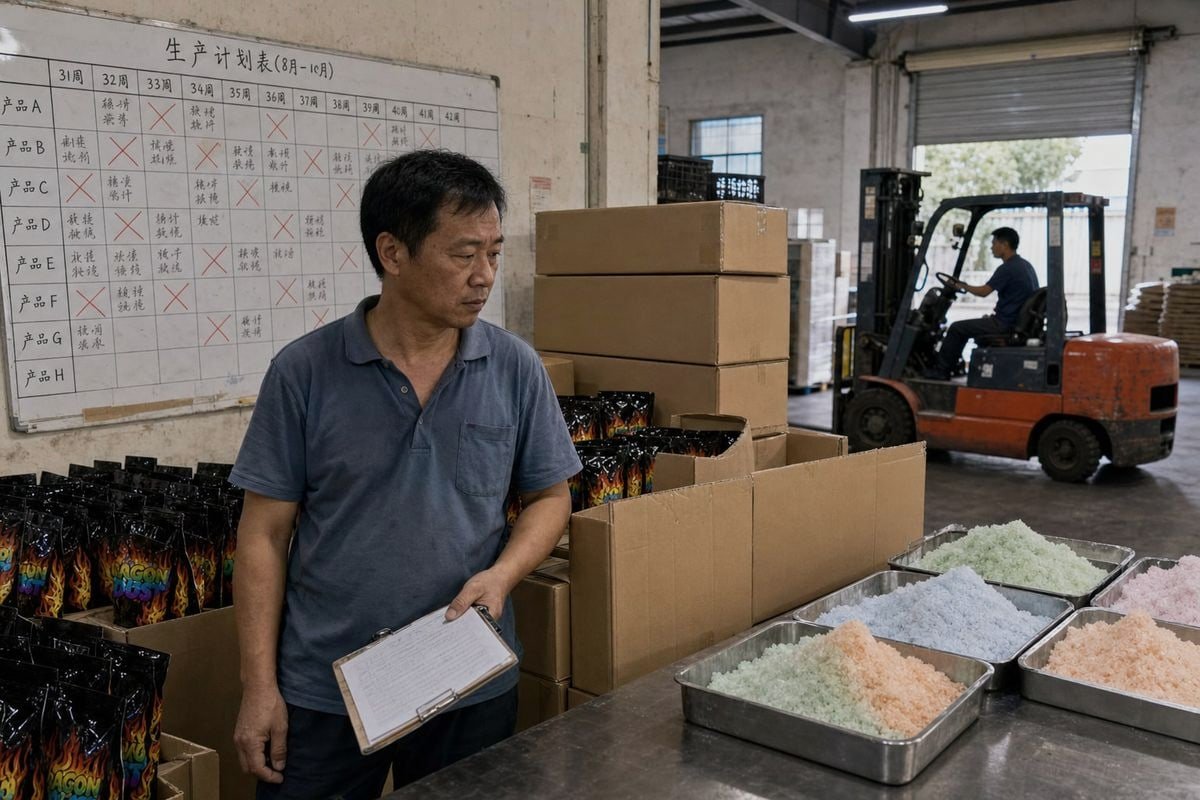
Supplier capacity constraints hit Magic Fire powder buyers hardest right before peak season. Every autumn, our Ningbo production line fields urgent calls from importers whose orders arrived too late.
Handle supplier capacity constraints for Magic Fire powder by booking production 12–16 weeks before peak season, reserving capacity with contracts, verifying factory output through audits, holding 4–8 weeks of buffer stock, and pre-qualifying a compliant backup supplier before shortages appear.
That is the short answer. The longer answer explains why delays happen, how to verify real capacity, and how to build a backup plan that protects both compliance and quality. Let's go through each part.
What causes most Magic Fire powder supplier delays before peak season?
Last October, a German distributor asked us to rescue an order after their previous vendor missed a six-week window. That failure started months earlier, not at the port. Here is why.
Most Magic Fire powder delays come from four causes: buyers placing purchase orders too late, factories overselling limited seasonal capacity, single-sourced supply chains with no fallback, and freight forwarding delays during congested Q4 shipping windows. The root problem is a missed capacity window, not slow production.

Color-flame powder is a strongly seasonal product. Demand for campfire, fireplace, and fire-pit items compresses into a narrow ordering window from late summer through early winter. When hundreds of brands order in the same eight weeks, even a small slip becomes a stockout on the shelf.
Capacity problems vs. lead time problems vs. inventory problems
Many buyers lump all delays together. In practice, they are three different problems with three different fixes. In our 17 years of exporting fire products to more than 30 countries, we have seen buyers "solve" the wrong one repeatedly.
| Problem type | Cómo se ve | The real fix |
|---|---|---|
| Capacity constraint | Factory accepts the PO but ships short or late | Reserve production slots earlier; split volume across vendors |
| Lead time problem | Production is fine, but total cycle is 10–14 weeks | Order earlier; optimize freight booking; pull orders forward |
| Inventory problem | Demand spikes beyond forecast mid-season | Stock de seguridad 1 management; buffer inventory for core SKUs |
A capacity constraint is a time-phased limit. A factory can produce a fixed quantity per week. If your order lands after that week's capacity is sold, no amount of pressure creates more output. Unused capacity in July cannot help you in November unless your PO consumed it back in July. That is why "asking the supplier to rush" rarely works once the season is underway.
Production scheduling constraints get worse when a factory also serves other seasonal categories. Add customs documentation gaps, hazmat-adjacent labeling reviews, and carrier shortages, and a two-week production slip becomes a two-month commercial disaster. The lesson we share with every new buyer: delays are usually a capacity-allocation problem decided months before shipment, not a shipping problem decided at the port.
How can I verify a supplier's true production capacity before placing my order?
A US camping brand once toured our Ningbo facility and counted filling machines 2 before signing anything. Smart move. Many "factories" quoting Magic Fire powder are actually trading companies reselling someone else's capacity.
Verify true production capacity by requesting a factory audit or live video tour, checking business licenses and export records, reviewing certifications like ISO 9001 and BSCI, asking for weekly output data by SKU, and testing responsiveness with a trial order before committing peak volume.

Verification is where good procurement teams separate themselves. A supplier's claimed capacity means little. What matters is capacity available to you, in the weeks you need it, at the quality level your market requires.
Una secuencia de verificación práctica
- Confirm they are a real factory. Ask for the business license, factory address, and production photos with your inquiry details visible. We are headquartered in Liuyang, Hunan — China's fireworks cluster — with production in Ningbo, and we expect buyers to check both.
- Audit or video-tour the line. Count blending, filling, and sealing stations. Ask for cycle rates. An hour on video reveals more than fifty emails.
- Verifique las certificaciones con informes de prueba. ISO 9001 and BSCI audits verify management systems and social compliance. informes de prueba SGS o Intertek 3 verify the actual powder. Ask for report numbers you can validate directly with the lab.
- Request time-phased capacity data. A serious supplier can tell you weekly output per SKU and how much is already committed for September through November.
- Place a trial order. Flexible MOQs for first orders exist precisely so you can compare the sample batch against the production batch. If batch-to-batch quality drifts, walk away before peak season.
Red flags that predict capacity failure
| Señal | Por qué importa |
|---|---|
| Vague answers on weekly output | Suggests a trading company, not a producer |
| No third-party test reports | Compliance risk at customs and retail |
| Sample quality differs from production batch | Weak process control under pressure |
| Slow PO acknowledgment in the off-season | Will be worse when demand spikes |
Fuerte promedio plano 4 on your side help too. Sharing your forecast with the factory lets both parties plan honestly, and honest capacity conversations are the best early-warning system you can buy.
What lead times should I expect and how far ahead should I book peak season production?
Every June, our production planner blocks out the autumn calendar, and every August someone calls hoping November slots still exist. They usually do not. Timing is the single biggest lever buyers control.
Expect 30–45 days of production plus 30–40 days of ocean freight for Magic Fire powder, so book peak season production 12–16 weeks ahead. For Q4 retail programs, confirm purchase orders by late June or July to secure capacity and avoid freight congestion.

Lead time optimization starts with mapping the full cycle, not just factory days. Buyers often plan around production time and forget everything wrapped around it.
The real end-to-end timeline
| Etapa | Duración típica | Notas |
|---|---|---|
| Sampling and private-label artwork approval | 1–3 semanas | Longer for custom boxes and display packaging |
| Raw material procurement | 1–2 semanas | Mineral salt colorants can tighten in peak months |
| Producción y control de calidad por lotes | 4–6 semanas | Depends on order size and slot availability |
| Compliance docs, labels, barcodes | Parallel, 1–2 weeks | Pre-clear warning labels to avoid customs holds |
| Flete marítimo a EE. UU./UE | 4–6 semanas | Freight forwarding delays spike in Q4 |
| Inland delivery and receiving | 1–2 semanas | Add buffer for warehouse cutoffs |
Add it up and a first-time custom order can run 14–18 weeks door to door. Repeat orders with approved artwork run faster, but the freight window does not care how experienced you are. Carrier space around Semana Dorada 5 and pre-Christmas peaks disappears early, so we advise buyers to secure logistics capacity months in advance, not weeks.
Reserving capacity, not just placing orders
One trend we encourage: capacity reservations. Some of our long-term distributors pay for or contractually commit to production slots during the low season. In exchange, they get guaranteed weekly output in September and October, plus defined escalation terms if anything slips. This mirrors what sophisticated planning teams do — treat capacity as a scarce, time-bound resource. Unused capacity today only protects your season if your commitment consumes it early. A rolling forecast shared quarterly, even a rough one, lets us hold material and line time against your name. That single habit prevents more stockouts than any expedite fee ever will, and it strengthens supply chain resilience for both sides.
How do I build a backup sourcing plan without sacrificing compliance or quality?
A UK buyer once told me their backup plan was "search Alibaba in a crisis." That is not a plan. Procurement contingency planning must be finished before the shortage starts, not during it.
Build a backup plan by pre-qualifying a second compliant supplier in the off-season, cross-approving artwork and test reports with both vendors, splitting trial volume 80/20, holding 4–8 weeks of buffer stock for core SKUs, and defining clear allocation rules for shortages.

A backup source that fails compliance is worse than no backup at all. Color-flame products face retail chemical scrutiny 6, labeling requirements, and customs checks. If your emergency supplier ships powder without valid informes SGS o Intertek 7, you trade a stockout for a recall. So build the fallback with the same standards as the primary.
The four-layer backup framework
- Vendor diversification, done early. Qualify a secondary supplier during the off-season when factories have time for audits and trial runs. A multi-sourcing strategy works only if the backup is already approved, with artwork, barcodes, and warning labels on file, before demand spikes.
- Keep the backup warm. Route 10–20% of regular volume to the secondary vendor. A supplier who has not produced your SKU in a year is not a real backup. Small recurring orders keep tooling, packaging films, and QC criteria current.
- Inventory as a deliberate hedge. An inventory buffer strategy is not wasted cash; it is purchased flexibility. Segment your range: build 4–8 weeks of safety stock for your highest-velocity and highest-margin SKUs, and accept leaner cover on slow movers. Some buyers also pre-position stock in regional warehouses near major markets to cut final-mile time.
- Pre-agreed allocation rules. When a shortage still happens, quantify the gap, map which customers feel it, and allocate remaining supply to protect priority retail programs first. Deciding this in a calm week beats deciding it in a panicked one.
We support this openly. When a buyer tells us we are their primary source and asks for documentation their secondary vendor can be measured against, we see a professional partner, not a threat. Long-term supply relationships survive on transparency, consistent batch quality, and honest capacity conversations — not on locking buyers into a single point of failure.
Conclusión
Peak-season stockouts are painful, avoidable, and usually self-inflicted. Book capacity 12–16 weeks early, verify factories properly, hold targeted buffers, and pre-qualify a compliant backup. Plan the season before the season plans you.
Notas al pie
1. Background on the inventory concept used to hedge against supplier shortages. ↩︎
2. Wikipedia entry explaining the function and types of industrial filling machines used in manufacturing. ↩︎
3. Links to a leading third-party inspection body that issues verifiable product test reports. ↩︎
4. Harvard Business Review guide on choosing effective forecasting techniques for business planning. ↩︎
5. Explains the Chinese holiday period causing the carrier congestion mentioned in the text. ↩︎
6. Wikipedia page discussing chemical safety and regulatory scrutiny for consumer products. ↩︎
7. Authoritative chemical testing services from SGS to verify product safety and regulatory compliance. ↩︎



 English
  Spanish
  German
  French
  Arabic
  Portuguese
Únete a la conversación