






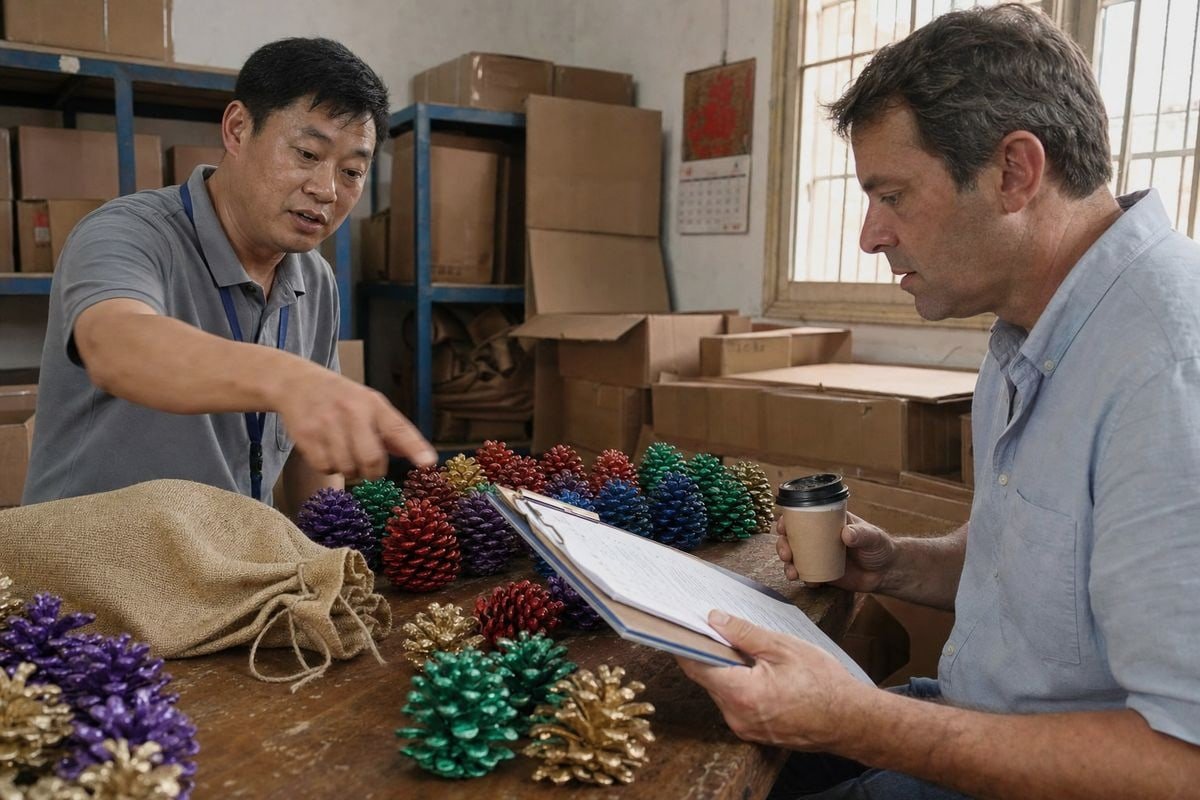
Una hoja de especificaciones vaga para piñas de colores para chimenea causa daños reales. En nuestra línea de producción, he visto especificaciones poco claras del comprador convertirse en envíos disputados, lanzamientos retrasados y paletas devueltas. Un campo faltante —duración de la combustión, tamaño de la piña o tipo de colorante— puede arruinar un pedido completo de temporada. La solución es una hoja de especificaciones estructurada que defina el efecto del color, el tamaño físico y el rendimiento de la combustión en términos medibles.
Una hoja de especificaciones para piñas de colores para chimenea debe definir los colores de la llama (típicamente azul verdoso), la duración del color (5-12 minutos por piña), el rango de tamaño de la piña (3-6 pulgadas por especie), el peso y la cantidad del paquete, el contenido de humedad, el tipo de recubrimiento, las advertencias de seguridad y las certificaciones de cumplimiento como los informes de prueba SGS.
Abajo, divido la hoja de especificaciones en cuatro partes prácticas. Cada parte se corresponde con una sección que puedes copiar en tu propio documento de abastecimiento. Empecemos por el color y el tiempo de combustión.
¿Qué detalles de color y tiempo de combustión debo incluir en mi hoja de especificaciones de piñas de colores?
Durante una revisión de control de calidad el invierno pasado, detectamos un lote en el que la llama verde se desvaneció después de tres minutos en lugar de ocho. La hoja de especificaciones del comprador nos salvó: definía la duración del color con precisión, por lo que sabíamos exactamente qué arreglar.
Su hoja de especificaciones debe enumerar los colores de llama dominantes (azul, verde o multicolor), el nivel de intensidad visual, el tiempo de inicio del color, la duración del color activo por cono (objetivo de 5 a 10 minutos), los colorantes químicos de llama utilizados y una tolerancia de consistencia del lote para que cada cono en la bolsa funcione de manera similar.

El color es la razón principal por la que su cliente compra este producto. Por lo tanto, merece la sección más detallada de su hoja de especificaciones. En nuestros 17 años fabricando paquetes Magic Fire y piñas de llama de color, hemos aprendido que "llamas de arcoíris hermosas" es una frase de marketing, no una especificación. Necesita campos medibles.
Mapear colorantes a colores de llama esperados
Diferentes colorantes químicos para llamas 1 producen diferentes tonalidades. Su hoja de especificaciones debe nombrar la familia de colorantes para que su proveedor no pueda sustituir compuestos más baratos. Aquí está el mapeo estándar con el que trabajamos:
| Color de llama | Colorante típico | Notas para la Hoja de Especificaciones |
|---|---|---|
| Azul-verde | Compuestos de cobre (por ejemplo, cristales de sulfato de cobre) | La afirmación comercial dominante; el efecto visual más fuerte |
| Verde | Ácido bórico / bórax | Verde más suave; a menudo mezclado con cobre |
| Rojo | Cloruro de estroncio | Vívido pero se desvanece más rápido en fuegos calientes |
| Morado | Sales de potasio | Sutil; necesita un fuego establecido para mostrarse bien |
| Amarillo-naranja | Sales de sodio | A menudo no deseado; puede enmascarar otros colores |
Una advertencia que siempre doy a los compradores: las mezclas de productos químicos pueden atenuarse o cancelarse mutuamente. Si desea un efecto multicolor, especifique que los colores provienen de piñas tratadas por separado en una bolsa, no de una piña empapada en todo.
Definir la duración honestamente
Las listas comerciales se agrupan alrededor de 5-10 minutos de color activo por piña, o 10-12 minutos para dos o tres piñas. Su hoja de especificaciones debe separar tres números: inicio del color (qué tan rápido aparece el color una vez que la piña se enciende), duración del color pico y duración total de la combustión. Una piña a menudo sigue ardiendo después de que el color visible se desvanece, porque el recubrimiento se quema antes que la madera. Tenga en cuenta también que los fuegos más calientes acortan el efecto del color. Especificar "mínimo 8 minutos en un fuego de leña moderado y establecido" es comprobable. "Color duradero" no lo es.
¿Cómo especifico los requisitos de tamaño y embalaje para pedidos a granel consistentes?
Hay un compromiso que evalúo en cada pedido de piñas: la clasificación estricta por tamaño aumenta el costo y rechaza piñas utilizables, mientras que la clasificación laxa corre el riesgo de quejas del comprador sobre "piñas pequeñas". La hoja de especificaciones es donde resolvemos ese equilibrio de antemano.
Especifique un rango de tamaño de cono (por ejemplo, de 3 a 6 pulgadas por especie de pino nombrada), peso del paquete (1 lb, 2 lb o 5 lb), recuento mínimo por paquete, un porcentaje máximo de contenido de humedad del 8-10% y una tolerancia escrita para la variación natural del tamaño.
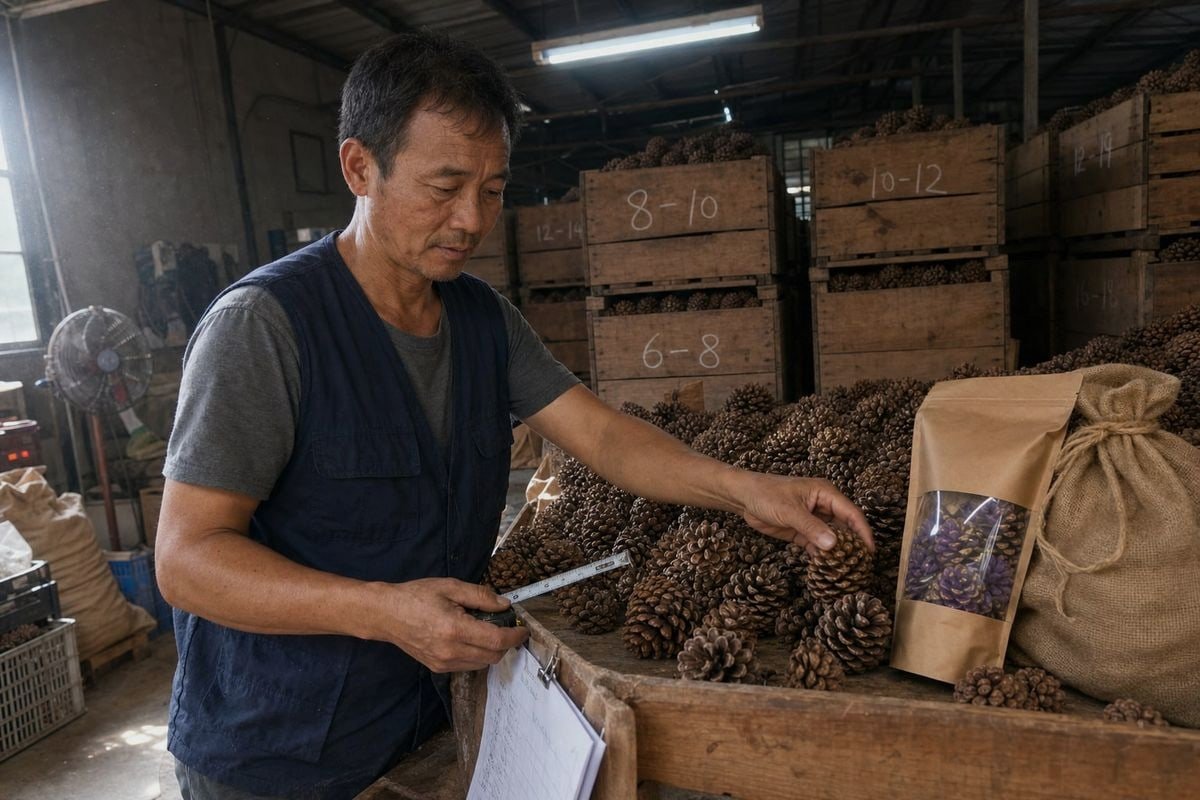
Las piñas son productos naturales. No hay dos idénticas. Eso es normal, pero su hoja de especificaciones debe decirlo por escrito, o un comprador minorista medirá diez piñas con una regla y presentará una reclamación. En nuestra experiencia de exportación en los EE. UU. y Europa, la sección de tamaño previene más disputas que cualquier otra parte del documento.
Los campos físicos centrales
Comience con la especie de piña. Las piñas Loblolly y Ponderosa son más grandes, típicamente de 3 a 6 pulgadas, y ofrecen una fuerte presencia en el estante. Las piñas decorativas más pequeñas pueden medir de 1.2 a 1.6 pulgadas (3-4 cm). Nombrar la especie fija la clase de tamaño antes de que comience la clasificación. Luego defina la humedad. Un porcentaje máximo de contenido de humedad 2 del 8-10% mantiene las piñas estables en el estante en empaques minoristas sellados y previene la pudrición interna durante el transporte marítimo.
| Campo de Especificación | Valor de ejemplo | Por qué importa |
|---|---|---|
| Especie | Loblolly o Ponderosa | Controla el tamaño base y la estructura de la escala |
| Rango de longitud de la piña | 3-6 pulgadas (o 3-4 cm para piñas pequeñas) | Establece el impacto visual y la duración de la combustión |
| Tolerancia de variación de tamaño | ±15% dentro del rango indicado | Reconoce la variación natural honestamente |
| Contenido de humedad | ≤ 8-10% | Previene moho, pudrición y fallo de ignición |
| Peso del paquete | 1 lb / 2 lb / 5 lb | Formatos minoristas estándar |
| Recuento mínimo | por ejemplo, ≥30 piñas por caja de 1 lb | Protege contra bolsas con contenido insuficiente |
| Tipo de embalaje | Bolsa kraft resellable, saco de arpillera o frasco | Afecta la protección contra la humedad y la apariencia en el estante |
Embalaje que sobrevive al transporte
También recomendamos especificar una proporción química-ligante estandarizada y, cuando se utilice, una dureza de cera adecuada para su ruta climática. Esto evita el polvo químico dentro de la bolsa durante el transporte y la floración de cera en rutas de contenedores calientes. En nuestra línea OEM personalizamos el material de la bolsa, la impresión de marca privada, las etiquetas de advertencia y los códigos de barras, pero solo después de que la hoja de especificaciones del comprador fije primero el producto físico. Las decisiones de embalaje basadas en una especificación de producto inestable siempre te muerden. recubrimiento de cera de parafina 3 Un distribuidor alemán me dijo una vez que su proveedor anterior se quedó en silencio cuando la aduana solicitó documentos de prueba. Su contenedor estuvo en el puerto durante cinco semanas. Esa conversación es la razón por la cual el cumplimiento lidera cada cotización que enviamos.
¿Qué certificaciones de seguridad y cumplimiento debo solicitar a mi proveedor de piñas?
Los productos de fuego de colores se encuentran en una categoría sensible. Arden en interiores, cerca de las familias, en las salas de estar. Los reguladores y los grandes minoristas los tratan en consecuencia. Para nuestros compradores en los Estados Unidos, Alemania, el Reino Unido y Francia, la certificación es un requisito estricto, no algo deseable, y su hoja de especificaciones debe indicarlo como una condición de aceptación, no como una solicitud educada.
Solicitar certificación de fábrica ISO 9001 y BSCI, marcado CE cuando corresponda, informes de prueba de terceros SGS o Intertek, una Hoja de Datos de Seguridad para el recubrimiento colorante, resultados de pruebas de metales pesados y emisiones de VOC, y cumplimiento de etiquetas de advertencia específicas del mercado antes de realizar cualquier pedido a granel.
Documentos a exigir, en orden de prioridad.
Cada recubrimiento químico necesita uno. Identifica los colorantes, los riesgos de manipulación y los pasos de primeros auxilios. Ninguna fábrica seria duda en proporcionarlo.
- Hoja de datos de seguridad. Los compradores modernos esperan formulaciones libres de metales pesados.
- las normas se vuelven cada vez más estrictas, especialmente en la UE. Los informes de terceros de. tienen mucho más peso que la afirmación de la propia fábrica. CO/CO₂, COV, PM2.5 4 Certificados del sistema de fábrica. SGS o Intertek 5 , que los grandes canales de abastecimiento minorista ahora auditan rutinariamente.
- Marcado CE cuando corresponda. Revisión de la etiqueta de advertencia. cumplimiento social 6, Las piñas de pino de colores son solo para chimeneas de leña, fogatas y hogueras, nunca para chimeneas de gas, unidades sin ventilación o fuegos utilizados para cocinar. Su hoja de especificaciones debe exigir que este lenguaje esté impreso en el paquete.
- Aborde las objeciones de frente para el mercado europeo.
- Algunos compradores preguntan si estos productos empeoran. en las chimeneas. Un recubrimiento debidamente formulado, libre de metales pesados y utilizado en la dosis recomendada —una a tres piñas por fuego— agrega un residuo insignificante en comparación con la propia madera. Otros se preocupan por la calidad del aire interior. Esa es exactamente la razón por la que especifica formulaciones ecológicas y probadas por escrito en lugar de confiar en una foto de un anuncio. En nuestra planta de Ningbo, mantenemos informes de prueba actualizados precisamente porque los gerentes de compras los solicitan antes de que se envíe la primera muestra.
Las piñas de pino de colores están destinadas solo para fuegos de leña, nunca para chimeneas de gas o sin ventilación
Los aparatos de gas están diseñados para combustible limpio; la introducción de piñas con recubrimiento químico puede dañar los componentes y crear peligros, por lo que cada producto de buena reputación lleva esta advertencia. acumulación de creosota 7 Los resultados de pruebas internas de un proveedor son prueba suficiente de la seguridad del producto.
¿Cómo puede una hoja de especificaciones clara ayudarme a evitar problemas de calidad durante la producción en masa?
Etapa de producción.
Una hoja de especificaciones clara convierte las afirmaciones subjetivas en criterios de aprobación/fallo comprobables — duración del color, tamaño del cono, humedad, peso del recubrimiento — para que el control de calidad entrante, las comprobaciones en línea y la inspección previa al envío midan todos contra los mismos números, asegurando que la producción en masa coincida con la muestra aprobada.
Riesgo sin una especificación.
Lo que arregla la hoja de especificaciones
| Especie incorrecta, escamas cerradas, contaminación por plagas | Nombre de la especie; horneado previo a 200 °F durante una hora | Tratamiento químico |
|---|---|---|
| Abastecimiento de piñas crudas | Colorante definido, tiempo de remojo (por ejemplo, saturación de 24 horas), proporción química-ligante | Polvo, cera desigual |
| Peso del recubrimiento de cera de parafina por piña; método de aplicación | Color débil o inconsistente | Moho en bolsas selladas |
| Recubrimiento | Umbral máximo de contenido de humedad | Embalaje |
| Secado | Bolsas con poco relleno, piñas aplastadas | Recuento mínimo, peso del paquete, requisito de prueba de caída de cartón |
| Almacenamiento y envío | Floración de cera, deliquescencia de sal en humedad | Tolerancias de temperatura y humedad de almacenamiento |
| Haga de la muestra el estándar | La cláusula más valiosa que recomiendo a cada gerente de compras es simple: "La producción en masa coincidirá con la muestra dorada aprobada dentro de las tolerancias establecidas en esta hoja de especificaciones". Luego adjunte | criterios de prueba de combustión |
— por ejemplo, cinco piñas por lote quemadas en un fuego de leña estándar, cada una mostrando un color visible azul verdoso durante al menos seis minutos. En nuestra línea, los controles en proceso ocurren en el tratamiento, secado y empaque, y fotografiamos las pruebas de combustión para los registros del comprador. Debido a que realizamos la producción completa internamente en lugar de comerciar, la primera muestra predice de manera confiable lo que llega en el contenedor. Una hoja de especificaciones clara es lo que hace que esa promesa sea verificable en lugar de una cuestión de confianza.
La cláusula más valiosa que recomiendo a todos los gerentes de compras es simple: "La producción en masa coincidirá con la muestra dorada aprobada dentro de las tolerancias indicadas en esta hoja de especificaciones". Luego, adjunte criterios de prueba de quemado — por ejemplo, cinco conos por lote quemados en un fuego de leña estándar, cada uno mostrando un color azul verdoso visible durante al menos seis minutos. En nuestra línea, las comprobaciones en proceso ocurren en el tratamiento, secado y empaque, y fotografiamos las pruebas de quemado para los registros del comprador. Debido a que ejecutamos la producción completa internamente en lugar de externalizar, la primera muestra predice de manera confiable lo que llega en el contenedor. Una hoja de especificaciones clara es lo que hace que esa promesa sea verificable en lugar de una cuestión de confianza.
Conclusión
Una especificación vaga invita a disputas; una precisa las previene. Defina el color, la duración, el tamaño, la humedad, el embalaje y el cumplimiento en términos medibles, luego elija una fábrica certificada que acepte esos números.
Notas al pie
Explica la química de las sales metálicas que producen llamas de colores referenciadas en la hoja de especificaciones. ↩︎
La guía de la EPA apoya las afirmaciones de control de humedad relacionadas con la calidad del aire interior y la prevención de moho. ↩︎
Referencia de fondo sobre las propiedades de la cera de parafina utilizada en el proceso de recubrimiento de conos. ↩︎
La EPA es la fuente autorizada de estándares de calidad del aire interior relevantes para la quema de productos recubiertos en interiores. ↩︎
Intertek es un laboratorio de pruebas líder independiente nombrado para la verificación independiente de productos. ↩︎
Amfori administra la auditoría de cumplimiento social BSCI mencionada como requisito del proveedor. ↩︎
Referencia de fondo que explica qué es la creosota y por qué la acumulación en la chimenea es importante. ↩︎



 English
  Spanish
  German
  French
  Arabic
  Portuguese
Únete a la conversación