







Child-resistant packaging and CCCR 2001 compliance questions land in my inbox weekly. Our Ningbo lines pack Magic Fire color-flame pouches daily, so I know where buyers get burned.
To confirm child-resistant packaging and CCCR 2001 compliance for Magic Fire Powder, request an SDS matching the actual formulation, accredited lab test reports to ISO 8317 or ASTM D3475, a declaration of conformity, bilingual Canadian labeling artwork, and batch-specific QC records proving production matches the certified design.
That is the short answer. The rest of this article walks through each document, each test, and each production check in detail, so you can verify a Chinese supplier before you commit to mass production.
What certifications should I request to verify CCCR 2001 compliance?
A German distributor once emailed us a supplier's "CCCR certificate" for review. It was a generic ISO 9001 scan with the product name typed in. That taught me buyers need a real checklist.
Request an SDS confirming the powder's chemical composition, an accredited third-party lab test report (SGS, Intertek, or Bureau Veritas) covering CCCR 2001 schedules, a child-resistant closure test certificate to ISO 8317, a declaration of conformity, and bilingual English/French label artwork approval.

Let me be clear about one thing first. CCCR 2001 stands for the Consumer Chemicals and Containers Regulations, 2001. It is a Canadian regulation under the Ley de Seguridad de Productos de Consumo de Canadá 1 (CCPSA). It is not a certificate a factory "holds." No single stamp proves compliance. Instead, compliance is demonstrated through a stack of documents that fit together. If your market is the US, the equivalent frame is the Poison Prevention Packaging Act 2 and 16 CFR 1700 under CPSC. Do not assume one country's paperwork covers the other.
The document stack, explained
Empieza con la Hoja de datos de seguridad 3. Magic Fire Powder products typically use copper, strontium, or boron-based colorants. CCCR 2001 only mandates child-resistant containers when a listed substance exceeds the hazard thresholds in its schedules. So the SDS is the trigger document. Without an accurate SDS, nobody can even say whether CR packaging is legally required. Our own color-flame packets use eco-friendly formulations, and we still provide full SDS documentation because Canadian and EU buyers will not clear customs confidently without it.
| Documento | Lo que prueba | Quién lo emite |
|---|---|---|
| SDS (Hoja de datos de seguridad) | Actual chemical composition and hazard class | Fabricante, verificado por laboratorio |
| CCCR schedule assessment | Whether CR packaging is legally required | Third-party lab or regulatory consultant |
| ISO 8317 / ASTM D3475 test report | The closure passed child and senior panel tests | Accredited lab (SGS, Intertek, BV) |
| Declaration of conformity | Supplier formally claims compliance | Fabricante |
| Bilingual label artwork | Hazard symbols and warnings meet CCPSA | Manufacturer, reviewed by buyer |
| COA (Certificate of Analysis) | Batch matches the declared formulation | Manufacturer QC lab |
One more caution. Cross-reference your supplier against Health Canada's Recalls and Safety Alerts 4 database. A past enforcement record is a red flag that no shiny certificate can offset.
How can I confirm my Magic Fire Powder packaging is truly child-resistant before mass production?
Heat-sealed foil sachets look impossible to open. During one pre-production review at our factory, a colleague's five-year-old tore a sample pouch open in under a minute. Looks deceive.
Confirm child resistance before mass production by sending the exact production packaging to an accredited lab for ISO 8317 or ASTM D3475 panel testing, where at least 85% of children under five must fail to open it within five minutes and 80% within ten minutes.

The core principle is simple. "Hard to open" is not a legal standard. Child resistance is proven only through a formal panel test with real children and real adults. Under the CPSC and Canadian protocols, a package qualifies when at least 85% of tested children cannot open it Comisión de Seguridad de Productos del Consumidor 5 in the first five minutes, and at least 80% cannot open it during the full ten-minute test. The same protocols also require that normal adults, including seniors, can open the package without difficulty. Child-resistant packaging is a balance, not an absolute child-proof guarantee.
Single-use versus reclosable formats
Magic Fire Powder typically ships in two formats, and they follow different test paths. A single-use heat-sealed foil sachet is tested as unit packaging. A resealable zip pouch or a plastic jar with a closure is tested as reclosable packaging, and it must stay child-resistant after repeated opening and closing over its shelf life. Regulators may also look at whether the outer retail box or the individual unit sachet is the child-resistant layer. Suppliers sometimes certify the wrong component. A child-resistant display box means little if a child can access a loose sachet inside it.
A practical pre-production sequence
- Freeze the packaging specification: film structure, seal width, closure type, resin.
- Produce pilot samples on the actual production line, not hand-made mockups.
- Send those exact samples to an accredited lab for panel testing.
- Confirm the test covers the right format: unit or reclosable.
- Only after a pass report, release the design for mass production.
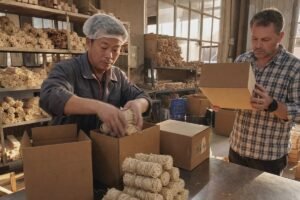
At our Ningbo facility, we run this sequence for every new pouch or jar format before a private-label buyer commits to tooling. It adds a few weeks up front. It saves months of repackaging later.
What testing and lab reports should my supplier provide for compliance proof?
Buyers often ask me why we invest in SGS and Intertek testing when our color-flame formulas already avoid harmful chemicals. The answer is simple: claims without reports are worthless at customs.
Your supplier should provide an accredited lab report for ISO 8317 or ASTM D3475 child-resistance testing on the exact production packaging, a chemical analysis verifying the SDS, a lot-specific COA, and a written declaration linking the test report to the shipped batch.

Here is the objection I hear from factories all the time: "Our zip pouch is child-resistant because it is hard to open." That is a supplier's opinion, not compliance proof. The regulatory view is strict. A child-resistant claim must trace back to a recognized standard, a competent lab, and a documented test on the same package you will actually sell. FDA guidance 6 for drug packaging shows how regulators expect this documented: firms verify in writing that the closure meets CPSC standards and record the standard in their submissions. Consumer chemical importers should hold themselves to the same documentation discipline, even when nobody demands it at the border.
How to read a lab report critically
Do not just check the pass/fail line. Check these fields:
| Report field | Qué verificar | Señal de alerta |
|---|---|---|
| Descripción de la muestra | Matches your exact pouch, film, and closure | Generic wording like "foil bag" |
| Test standard | ISO 8317, ASTM D3475, or 16 CFR 1700 as applicable | An unrelated or expired standard |
| Lab accreditation | ISO/IEC 17025 7 accredited or CPSC-recognized | No accreditation number listed |
| Report date | Recent, and predates your production run | A report older than the current mold or film |
| Applicant name | Your actual manufacturer | A different trading company's name |
| Fotos | Show the tested package clearly | Photos missing or mismatched |
Also request the supplier's historical failure-rate data across multiple test batches, not a single pass report. One pass tells you a design can work. A multi-batch record tells you the factory can repeat it. When our team runs export documentation for the US, Germany, and Canada, we keep test reports, SDS versions, and COAs filed by batch precisely so a buyer can audit that chain on request.
How do I ensure every production batch stays consistent with the certified packaging design?
Seventeen years of production have taught our QC team one hard lesson: certification fails quietly. A film supplier swaps resin, a seal temperature drifts, and yesterday's certificate no longer describes today's pouch.
Ensure batch consistency by freezing a controlled packaging specification, requiring written change notification from the supplier, conducting incoming inspections against the certified sample, demanding lot-specific COAs and traceability codes, and re-testing whenever any material, closure, or process parameter changes.

This is where importers face the most exposure, because the risk is invisible on paper. Your certificate stays valid-looking forever. Your packaging does not. Any change to resin type, film thickness, seal type, closure torque, or opening mechanism can invalidate a prior child-resistance test. A switch from PET to HDPE, or from a push-turn cap to a squeeze-turn cap, is a new package in the eyes of the standard. The SERP data confirms this is one of the most common failure points with China-sourced packaging: suppliers reuse outdated or unrelated certification data tied to an old mold.
Build a change-control agreement into the purchase order
Do not rely on goodwill. Put it in writing. Your PO or quality agreement should require the supplier to notify you before changing any packaging material, subcomponent supplier, mold, or sealing parameter. At our factory, this is standard practice for private-label buyers: the golden sample is signed, sealed, and referenced in every subsequent order, and our batch QC compares each run against it.
Batch verification checklist
| Comprobar | Frecuencia | Evidence to keep |
|---|---|---|
| Golden sample comparison | Cada ciclo de producción | Signed sample, inspection photos |
| Seal strength / opening force test | Cada lote | In-house QC record |
| Film and closure material verification | Every material lot | Supplier COA, material spec sheet |
| Lot code and traceability | Cada lote | Batch numbers linked to test reports |
| Label artwork match (bilingual, warnings) | Every artwork revision | Approved artwork file |
| Third-party re-test | After any design or material change | New accredited lab report |
One practical tip from our export experience: tie the lot code printed on each pouch to the specific COA and CR test report in your files. If a retailer, marketplace, or Health Canada inspector ever asks, you can produce the full chain in minutes instead of weeks. That traceability is also what separates a real factory partner from a trading company forwarding someone else's paperwork.
Conclusión
Verify CCCR 2001 compliance through documents, not promises: SDS, accredited CR test reports, bilingual labels, and batch traceability. Partner with a factory that proves consistency, and your Magic Fire Powder reaches shelves safely.
Notas al pie
1. Provides background on the legal framework underlying CCCR 2001 compliance requirements. ↩︎
2. Explains the US equivalent regulation referenced for comparison with CCCR 2001. ↩︎
3. Background concept explaining the document type central to chemical hazard verification. ↩︎
4. Official government database for checking supplier enforcement history and recalls. ↩︎
5. US federal agency overseeing child-resistant packaging enforcement and panel test protocols. ↩︎
6. Official FDA source referenced for documentation standards on child-resistant closures. ↩︎
7. Official ISO standard page defining lab accreditation requirements mentioned in the report table. ↩︎


 English
  Spanish
  German
  French
  Arabic
  Portuguese
Únete a la conversación