






Every autumn, buyers call our factory asking why their fireplace colored pine cones are stuck at port interrupciones en la cadena de suministro 1. The answer hurts: they ordered on the retail calendar, not the freight calendar.
To align your fireplace colored pine cones ordering schedule with peak-season shipping, work backward from your target in-stock date, place purchase orders in Q2 or early Q3, book ocean freight 3–4 weeks before cargo-ready date, and add a 1–2 week buffer for congestion and customs.
That single sentence hides a lot of moving parts. Let me break each one down, using what we see from our production floor and the shipping lanes we use each season.
How Far in Advance Should I Place My Order to Avoid Peak-Season Shipping Delays?
A German distributor once emailed us in mid-September asking for a full container of color-flame pinecones by Halloween. We had to say no, and it cost him his season.
Place orders for fireplace colored pine cones at least 90–105 days before your required in-stock date. For Q4 holiday selling, that means confirming purchase orders in June or July, so goods arrive by late September and skip the November–December shipping bottleneck entirely.

Peak-season shipping is not one fixed date. It is a moving window that starts earlier than most buyers expect. Ocean freight capacity 2 begins tightening in late July or August. Holiday parcel pressure builds from October into January. Peak season surcharges typically run from October through January, with the heaviest pricing hitting mid-November through December. If your cones are still on the water in November, you are paying more and waiting longer at the same time.
The Backward-Planning Method
We advise our long-term buyers to set the retail display date first, then count backward. Here is a realistic breakdown for an ocean shipment from our Ningbo production facility to a US East Coast warehouse:
| Etapa | Duración típica | Notas |
|---|---|---|
| Muestreo y aprobación | 2–3 semanas | Do this 1–2 quarters before stock is needed |
| Producción | 3–5 semanas | Longer if custom private-label packaging is added |
| Ocean freight booking | 3–4 weeks before cargo-ready | LCL takes 7–10 days longer than FCL |
| Tránsito marítimo | 4–6 semanas | Congestion adds time from August onward |
| Customs and DC receiving despacho de aduana 3 | 1–2 semanas | Peak season slows both |
| Buffer | 1–2 semanas | Weather, blank sailings, carrier delays |
Add it up and you land near 105 days for a peak Christmas-season order. That matches the SERP guidance to place orders by late September at the absolute latest, and to leverage early-bird summer pricing in July and August. Early orders also get first pick of inventory, which matters when everyone wants the same red, green, and gold cones.
Some buyers push back: earlier ordering ties up cash. That is a fair objection, and I address it in the MOQ section below. But in our 17 years of exporting, we have never seen a buyer regret arriving early. We have seen many regret arriving late.
What Lead Times Should I Expect for Fireplace Colored Pine Cones During Q3 and Q4?
Our production scheduler keeps a wall chart that turns red every August. That is when Q4 orders stack up and inventory lead times stretch for anyone who has not yet booked a slot.
Expect total lead times of 10–15 weeks in Q3 and Q4: 3–5 weeks for production, 4–6 weeks for ocean transit, plus customs, receiving, and delay buffers. In Q1 and Q2, the same order often completes in 8–10 weeks.

Lead times are not a single number. They are a stack of components, and each one stretches under peak-season pressure. Understanding which component stretches, and by how much, lets you plan with confidence instead of hope.
Where the Time Actually Goes
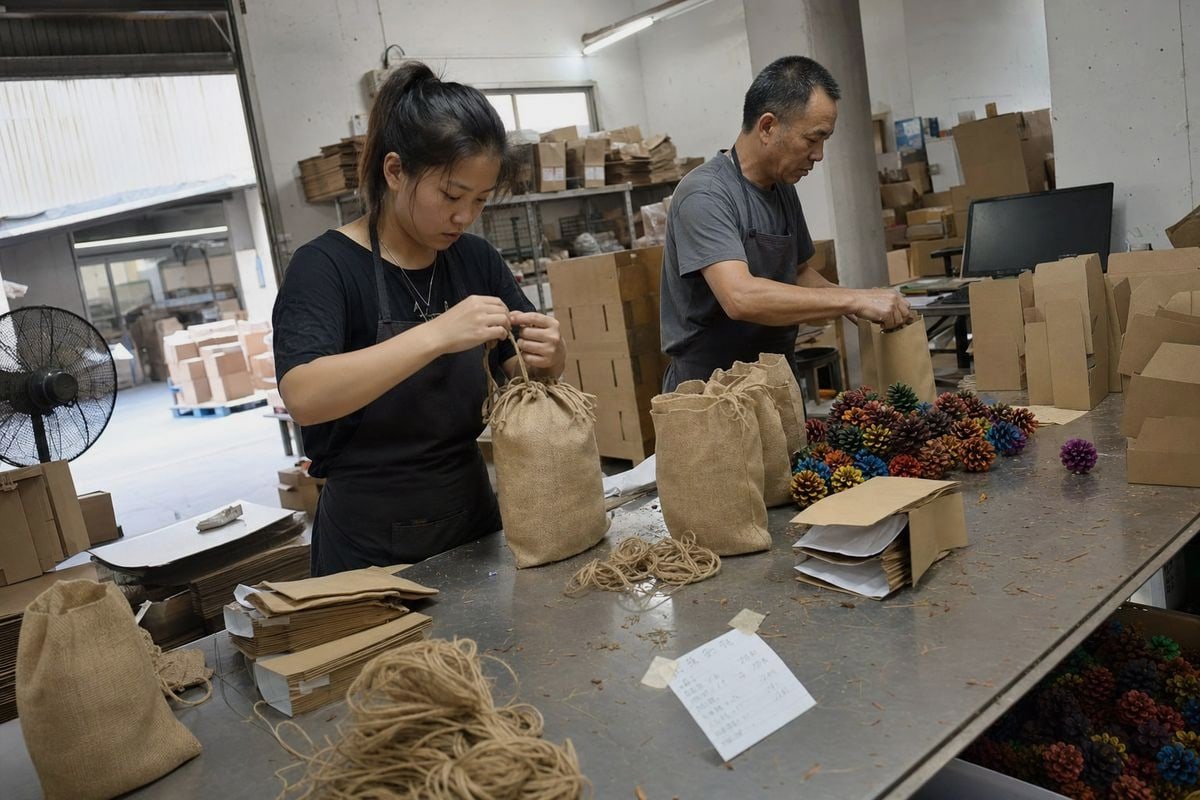
Production is the most controllable stage. On our lines, color-flame pinecones move through cone selection, flame colorant chemical treatment, drying, painting or coating, quality checks, and packing. Standard bulk packing is fast. Custom kraft pouches, drawstring burlap sacks, display boxes, barcodes, and warning labels add one to two weeks, because printed packaging materials have their own suppliers and their own lead times.
Transit is the least controllable stage. From August through October, blank sailings, rolled bookings, and atasco de puertos 4 become common. Supply chain disruptions that would cost you two days in March can cost you two weeks in October.
| Impulsor de la demanda | Producción | Tránsito marítimo | Total Realistic Lead Time |
|---|---|---|---|
| Q1–Q2 | 3–4 semanas | 4–5 semanas | 8–10 weeks |
| Principios de T3 | 3–5 semanas | 4–6 semanas | 10–12 semanas |
| Late Q3–Q4 | 4–6 semanas | 5–7 weeks | 12–15 weeks |
Two practical notes from our export experience. First, pine cones are low-density but high-volume, so carriers charge on el peso volumétrico 5, not actual weight. This makes air freight disproportionately expensive as a backup plan. Second, humidity during long ocean transit can cause natural cones to close up. We use protective packaging with desiccant inserts on request, and we heat-treat cones so they stay open and pest-free in warm indoor environments. Ask any supplier for the same, and ask for the informes de prueba SGS o Intertek 6 that prove it. Compliance documents take time too, so request them at the quoting stage, not at the port.
How Can I Coordinate Production Schedules with Ocean Freight Booking Windows?
One trade-off we weigh constantly at our Ningbo facility is whether to finish an order early and let it sit, or time completion to a confirmed sailing. Cargo that misses its vessel waits; cargo that finishes early ties up warehouse space.
Book ocean FCL 3–4 weeks before your cargo-ready date, and airfreight 6–7 days before. Confirm production start dates with your supplier first, then reserve the vessel against the promised completion date, keeping a few days of slack between the two.

The core skill here is synchronization. Production and freight run on separate calendars, and the buyer who links them wins. Here is the sequence we walk new distributors through:
- Lock the retail in-store date and count backward to a required port-arrival date.
- Confirm the production completion date in writing with your factory, including packaging.
- Book FCL 3–4 weeks ahead of that cargo-ready date; earlier in August–October.
- Build 3–5 days of slack between production completion and the container loading date.
- Track production milestones weekly so a delay triggers a rebooking early, not at the last minute.
FCL, LCL, or Air: Which Fits a Seasonal Pine Cone Launch?
| Modo | Booking Window | Relative Speed | Riesgo de temporada alta |
|---|---|---|---|
| FCL marítimo | 3–4 weeks ahead | Base | Moderate; rates rise but schedules hold better |
| LCL marítimo | 3–4 weeks ahead | 7–10 days slower than FCL | High; consolidation absorbs delays first |
| Transporte aéreo | 6–7 days ahead | El más rápido | Costly; volumetric weight punishes bulky cones |
Para a seasonal launch, FCL is usually the safest bet if your volume supports it. LCL works for trial orders, but add extra buffer, because LCL absorbs more delay risk during congestion. Air freight should be your emergency valve, not your plan, because peak season surcharges and volumetric pricing can erase the margin on a low-ticket decor item.
One more coordination tip from our side of the table. Tell your factory your booked vessel date. When we know a buyer's sailing, we sequence their order on our lines to hit it, and we flag risks two weeks out instead of two days out. Suppliers cannot protect a deadline they have never seen. Good last-mile delivery logistics start with good first-mile communication.
What MOQ and Reorder Strategy Helps Me Avoid Stockouts During Peak Season?
A UK fireplace distributor taught me a lesson years ago. He split his season into two orders instead of one big gamble, and he has never had a stockout or a January overstock since.
Use a two-order strategy: place a primary bulk order in Q2 sized to roughly 70–80% of forecast demand, then a smaller reorder in early Q3 once early sell-through data arrives. Negotiate flexible MOQs and bulk-buy tiers upfront to make the split affordable.
The honest tension in seasonal buying is this: ordering early cuts stockout risk but raises carrying cost and overbuy risk if demand softens after the holidays. Ordering late protects cash but exposes you to carrier capacity constraints and expedited rates exactly when consumers are buying most. Neither extreme wins. A structured split does.
Structuring the Two-Order Approach
Your first order is the foundation. It travels by ocean during the cheap, calm window and covers the demand you are confident about. Base that confidence on seasonal previsión de la demanda 7 from last year's sell-through, not on optimism. Your second order is the correction. By early September, early fall sales tell you whether the season is running hot or cold. If hot, the reorder tops you up before holiday shipping deadlines close in. If cold, you simply skip it, and your exposure was never more than the base order.
Bulk wholesale procurement tiers make this workable. Larger primary orders typically unlock better unit pricing and better freight economics per case, and bulk-buy tiers help mitigate the impact of rising carrier surcharges during the Q4 peak window. At our factory, we deliberately keep trial MOQs flexible for new buyers, then scale tiers as the relationship grows, because a distributor who tests properly in year one reorders confidently in year two.
Two more tactics round out a solid retail fulfillment strategy. First, watch long-range weather. A forecast cold snap reliably triggers a demand spike about ten days out, so a fast domestic reorder from your own warehouse can capture it. Second, plan a secondary-peak restock for early January. Fireplace usage stays high between New Year's Eve and the late-winter freeze, and most competitors are empty by then. Batch-to-batch consistency matters enormously here; your January stock must match your November stock in color, flame effect, and packaging, which is exactly why we run strict batch QC on every production run.
Conclusión
Order fireplace colored pine cones months before you sell them. Reverse-plan from your in-store date, book freight early, split orders wisely, and peak season becomes profit, not panic.
Notas al pie
1. Wikipedia page detailing the management of disruptions and risks in supply chains. ↩︎
2. Background on container shipping capacity dynamics referenced in the peak-season discussion. ↩︎
3. US government trade resource explaining customs clearance procedures affecting import timelines. ↩︎
4. Authoritative Wikipedia overview of supply chain logistics and common bottlenecks. ↩︎
5. Defines the freight pricing concept used to explain pine cone shipping costs. ↩︎
6. SGS is a recognized third-party testing authority mentioned for compliance verification. ↩︎
7. Authoritative Wikipedia entry defining demand forecasting and its methodologies. ↩︎



 English
 Spanish
 German
 French
 Arabic
 Portuguese
Únete a la conversación