






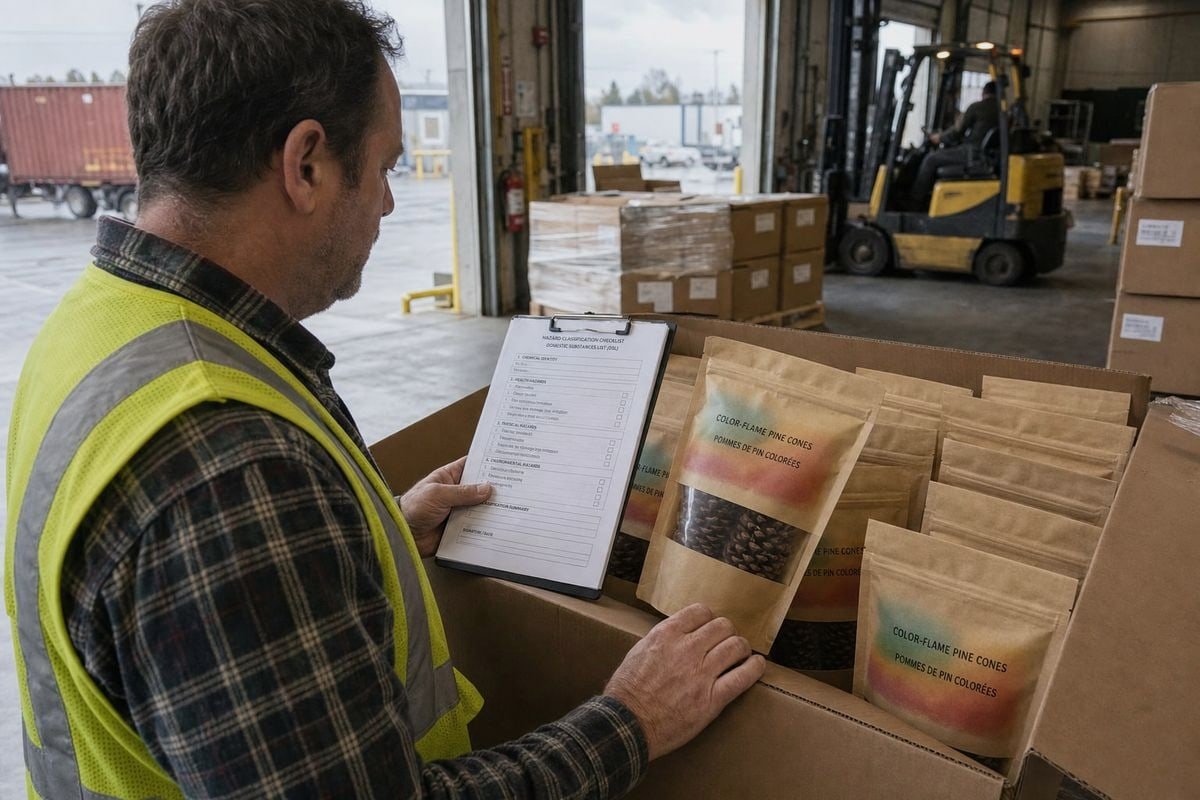
Fireplace colored pine cones can get stuck at Canadian customs over one packaging question oral LD50 values 1. I have watched buyers lose whole seasons this way, which is why our export team treats CCCR classification as step one.
Fireplace colored pine cones do not automatically need child-resistant packaging under Canada's CCCR. Child-resistant containers are only mandatory if the product's chemical classification—based on toxicity, corrosivity, or related hazard data—meets specific CCCR thresholds. Classification, not the pine cone form, decides the requirement.
That short answer hides real complexity. Below, I break down what the CCCR actually says, how classification works, and what you should demand from your supplier before importing.
What Does Canada's CCCR-2001 Actually Require for Color-Flame Pinecone Packaging?
A Canadian distributor once asked us to "just add a child-proof lid" to be safe. We had to explain why that shortcut can create new labeling problems instead of solving compliance.
The CCCR-2001 requires child-resistant packaging only for consumer chemical products classified into triggering hazard sub-categories, especially the toxic sub-category. Color-flame pinecones must first be classified by their chemical formulation; the classification result then determines packaging, labeling, and warning obligations.

La Consumer Chemicals and Containers Regulations 2, 2001 (SOR/2001-269) apply a hazard-based system. The regulation does not name product types like "fire colorants" or "pinecones." Instead, it looks at what the chemicals inside can do to a person. That is the single most important idea to grasp.
The Classification-First Logic
Health Canada's framework works in a fixed order. First, you classify the product using toxicological and physical hazard data. Second, the classification tells you which packaging and labeling rules apply. Marketing language plays no role. Calling a product "decorative" or printing "not for ingestion" does not exempt it from anything.
When Child-Resistant Packaging Is Triggered
Products falling into the toxic sub-category must be packaged in a child-resistant container that meets specified performance standards. Health Canada's reference manual adds a detail many importers miss: the child-resistant function must remain effective throughout the useful life of the product. A one-time tamper seal that stops working after first opening does not satisfy this rule for a product used over many fires.
| CCCR Element | What It Means for Colored Pinecones |
|---|---|
| Clasificación de peligros | Based on the metal-salt formulation, not the pine cone |
| Toxic sub-category | Triggers mandatory child-resistant packaging 3 |
| Flammable/combustible category | Triggers labeling and warnings, usually not CRP |
| Useful-life rule | CRP must survive repeated open-close cycles |
| Marketing claims | Irrelevant to whether CCCR applies |
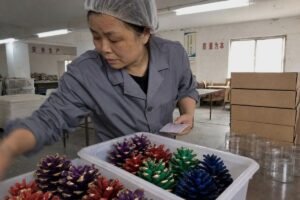
Our own color-flame pinecones use eco-friendly formulations with no harmful chemicals, which is exactly why classification results—not assumptions—drive our packaging recommendations for each destination market.
How Do I Know If My Product Falls Under the Restricted Chemicals List?
During formulation reviews at our Ningbo facility, the first document we pull is the Safety Data Sheet. Without it, any compliance opinion is just a guess.
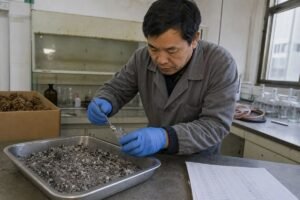
You determine CCCR status by reviewing the product's Safety Data Sheet and toxicological data—especially oral LD50 values, corrosivity, and irritancy—against CCCR Schedule thresholds. If the metal-salt formulation meets a toxicity threshold, child-resistant packaging becomes mandatory regardless of intended use.
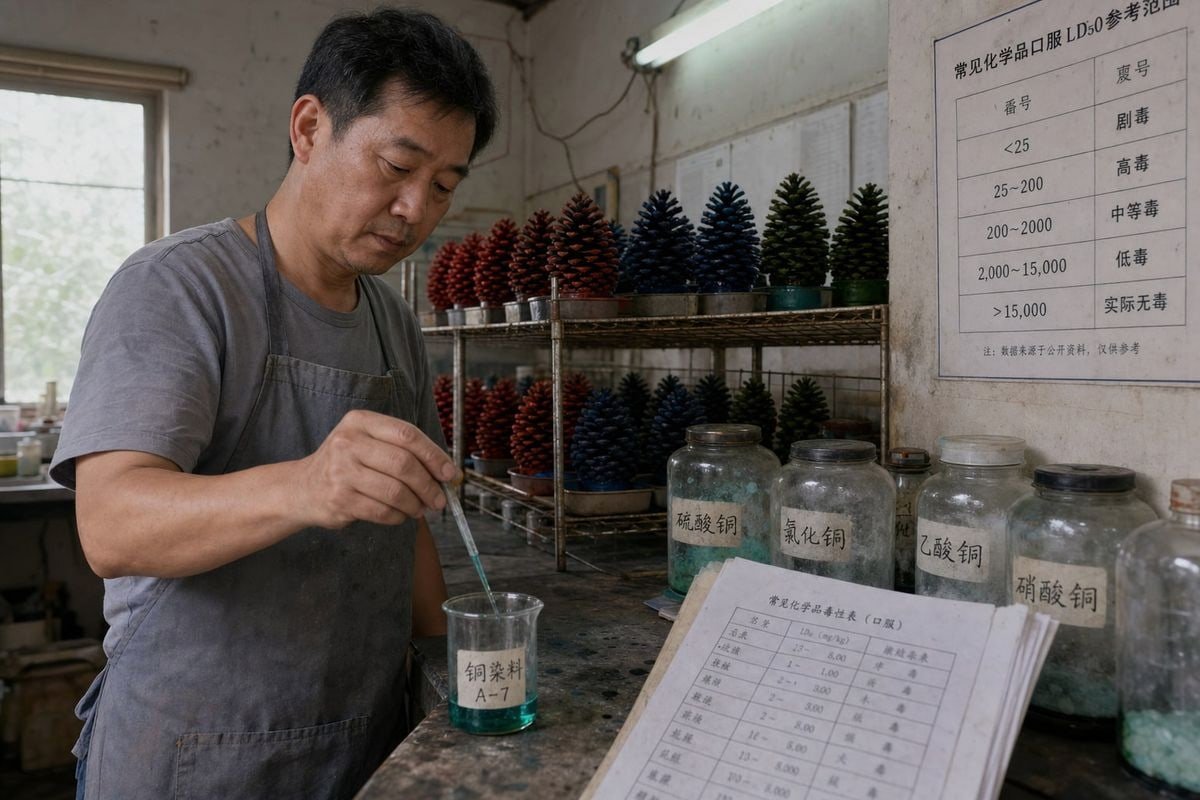
Colored flames come from sales metálicas. Copper compounds produce blue and green. Strontium and lithium produce red. Each compound carries its own toxicity profile, and the profile is what the CCCR measures. A "natural" looking pinecone can still trigger child-resistant packaging if it is treated with a salt like copper chloride, because some copper compounds have acute oral toxicity data 4 that meets CCCR thresholds even in small quantities.
Un proceso de verificación práctico
Here is the sequence we walk Canadian-bound buyers through:
- Obtain the full ingredient list and exact concentrations from the supplier.
- Request an SDS prepared for the finished product, not just raw materials.
- Compare oral LD50, dermal, and irritancy data against CCCR classification criteria.
- Classify the product into its hazard category and sub-category.
- Map the classification to packaging and labeling duties.
- Document everything in a compliance file for Health Canada scrutiny.
Common Formulation Outcomes
| Tipo de Formulación | Likely Classification Path | CRP Likely Required? |
|---|---|---|
| Copper chloride based | May meet toxic thresholds | Possibly yes |
| Copper sulfate based | Depends on concentration and data | Case-by-case |
| Low-toxicity proprietary blends | Often flammable/combustible only | Generalmente no |
| Untested or undisclosed blends | Cannot be classified | Treat as high risk |
Notice the last row. If your supplier cannot disclose the formulation, you cannot classify the product, and the conservative view says you should treat it as a regulated consumer chemical until proven otherwise. Some sellers argue these are just novelty fire accessories outside strict packaging rules. That optimistic view only holds up when actual toxicity data confirms it. Health Canada's Consumer Product Safety Directorate can request testing evidence during enforcement, and "the listing said décor" is not a defense.
Can My Manufacturer Supply CCCR-Compliant Packaging and Test Reports?
A UK wholesaler once forwarded us a competitor's "compliance declaration"—a single unsigned paragraph with no test data attached. That document would collapse under any real audit, and it taught us why buyers now ask harder questions.
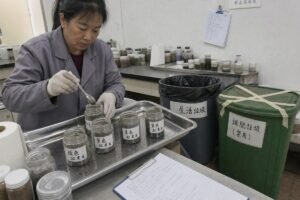
A capable manufacturer should supply the finished-product SDS, hazard classification rationale, third-party test reports from labs like SGS or Intertek, and packaging validated to CCCR-referenced standards such as ISO 8317 or CSA-Z76.1 where child-resistance applies. Verify documents; never rely on bare declarations.
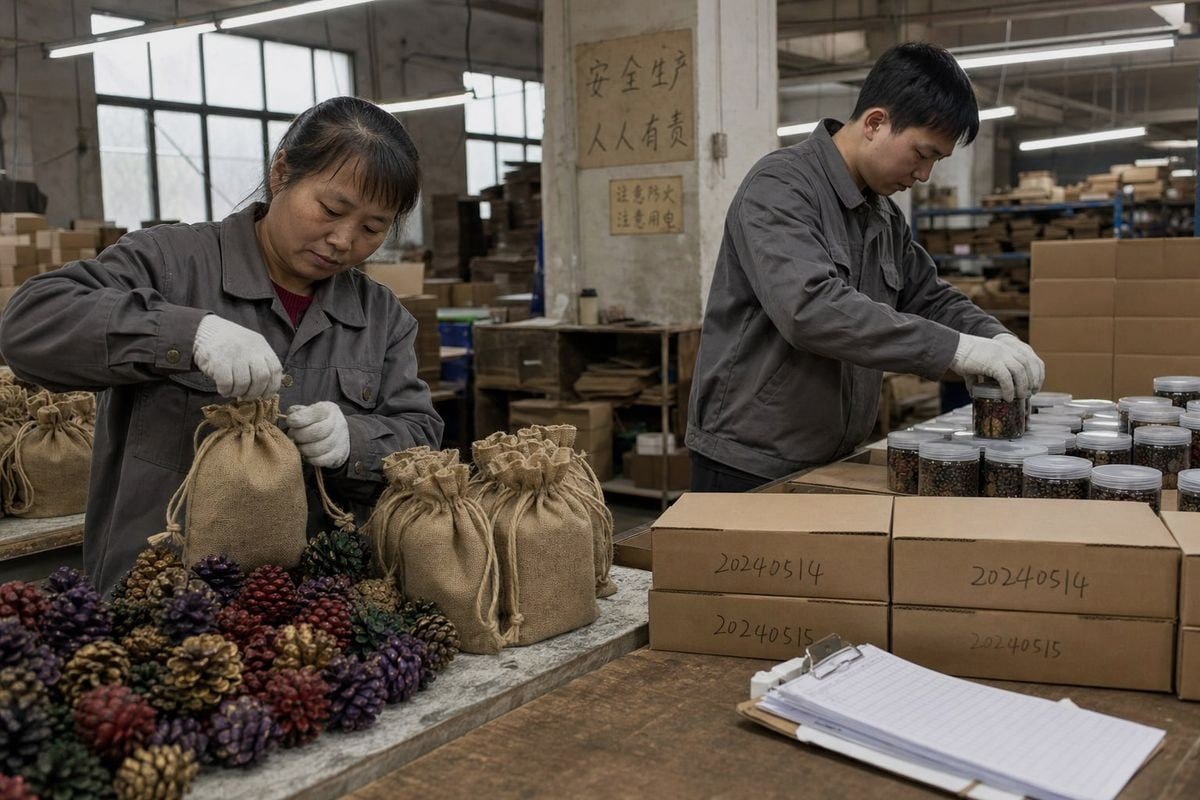
Retailers selling private-label pinecone fire color kits often rely solely on supplier declarations without independent verification. That creates real supply-chain liability during a CCCR enforcement audit, because the importer of record carries the obligation in Canada—not the overseas factory. So the question is not just "can my manufacturer supply documents" but "can those documents survive scrutiny."
What Acceptable Child-Resistant Packaging Looks Like
If your classification does trigger child-resistant packaging, the CCCR accepts two routes. The container can be constructed so it opens only by operating, puncturing, or removing a functional part with a tool not supplied with the container. Or it can pass an accepted child test protocol: CSA-Z76.1, ISO 8317 5, or the US 16 CFR 1700.20 6 procedure. Either way, the protection must hold through shipping, retail handling, and normal repeated use.
Documents to Demand Before You Order
| Documento | Por qué lo necesitas | Señal de alerta si falta |
|---|---|---|
| Finished-product SDS | Basis of CCCR classification | Supplier hides formulation |
| Informe de prueba de terceros | Independent proof of hazard data | Only self-declarations offered |
| Packaging test evidence | Proves CRP performance if required | "Child-proof" claim with no protocol named |
| Certificaciones de fábrica | Signals process control (ISO 9001, BSCI) | No audit trail at all |
| Registros de control de calidad del lote | Ensures samples match mass production | First article differs from bulk |
In our 17-plus years exporting fire products to more than 30 countries, including Canada, we have built our documentation around SGS and Intertek 7 testing precisely because buyers' compliance teams reject anything weaker. Batch-to-batch quality control matters here too: a compliant formulation is worthless if production drifts and batch five contains a different salt concentration than the tested sample. Ask your supplier how they control that drift. The answer tells you more than any certificate.
What Warning Labels and Certifications Do I Need Before Importing Into Canada?
One lesson our packaging team learned early: a label that clears US review can still fail in Canada. The two systems look similar from a distance, but they diverge in the details that customs officers actually check.
Before importing, you need CCCR-compliant bilingual English-French labeling with the correct hazard symbols, signal words, and first-aid statements matching your product's classification, plus supporting test reports. US PPPA compliance does not transfer; Canadian packaging may require separate testing to CCCR-referenced standards.
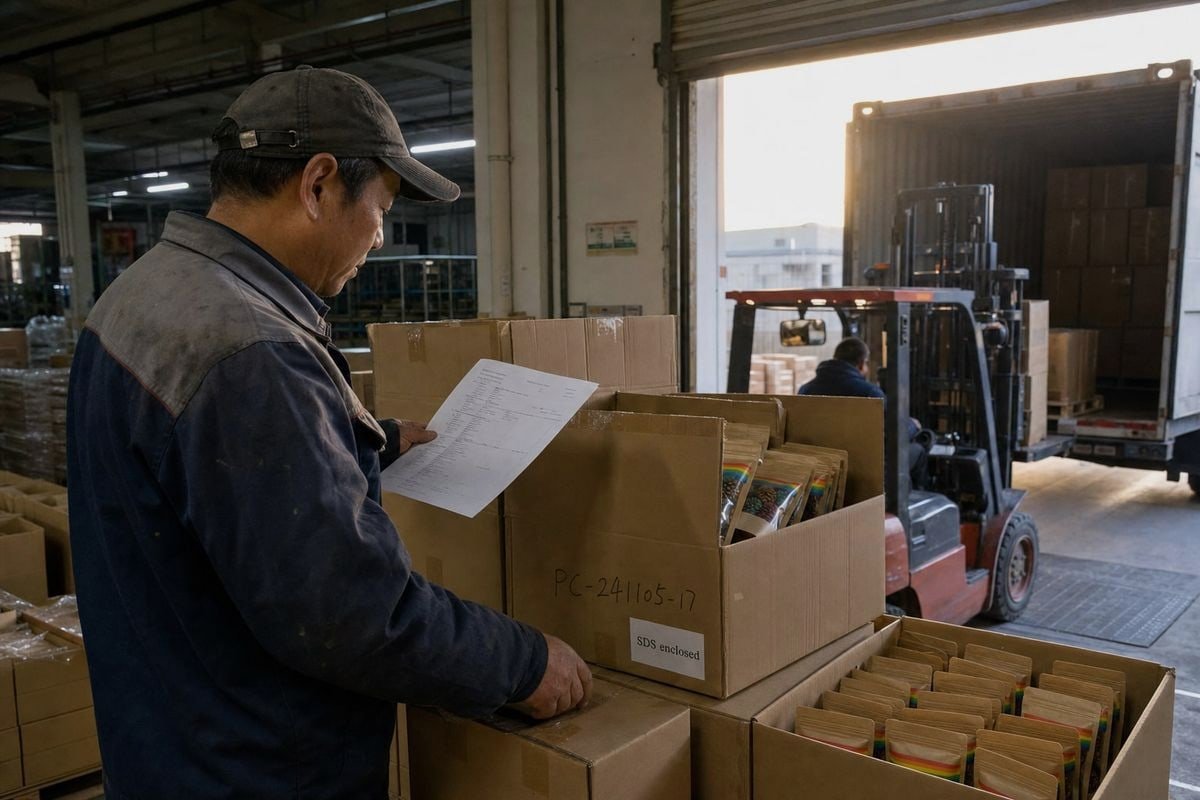
Most colored pinecone products, when they avoid the toxic sub-category, still land in flammable or combustible classifications. Those categories do not usually trigger child-resistant packaging, but they absolutely trigger labeling duties: hazard symbols, signal words, primary hazard statements, negative instructions, and first-aid statements, all sized and positioned per the regulation, all in both English and French.
Canada vs. the United States: Do Not Assume Equivalence
This is the trap I see most often with North American buyers. The US Poison Prevention Packaging Act (PPPA) also mandates child-resistant packaging for many household substances, but it is a separate legal framework. A product packaged to 16 CFR 1700.20 may satisfy part of the Canadian test-protocol option, yet CCCR compliance still requires Canadian-specific classification, bilingual labeling, and its own documentation trail. You cannot infer Canadian compliance from a US Amazon listing or a US-market package.
Key differences to keep straight:
- CCCR labeling must be bilingual; PPPA-regulated products are labeled in English.
- CCCR uses its own hazard classification schedules, not US FHSA categories.
- CCCR accepts ISO 8317 and CSA-Z76.1 in addition to the US child-test protocol.
- Enforcement in Canada runs through Health Canada's Consumer Product Safety Directorate.
Building Your Pre-Import Checklist
Before your first container ships, assemble one file: the SDS, the classification rationale, lab test reports, label artwork proofs in both languages, and packaging test evidence if child-resistance applies. Our OEM/ODM service handles warning labels, barcodes, and display packaging as part of the private-label build, because a shelf-ready product for Canada must be compliance-ready before it is design-ready. Getting the label wrong means relabeling an entire shipment in a bonded warehouse—an expense that dwarfs the cost of doing it correctly at the factory.
Conclusión
Fireplace colored pine cones need child-resistant packaging only when their chemical classification triggers CCCR thresholds. Verify the SDS, demand real test reports, and partner with a factory that builds compliance in from day one.
Notas al pie
1. Explains LD50 toxicity measurement referenced for CCCR classification thresholds. ↩︎
2. Official Canadian regulation text defining CCCR hazard classification and packaging rules. ↩︎
3. Background concept explaining how child-resistant packaging design and testing works generally.
 English
  Spanish
  German
  French
  Arabic
  Portuguese
Únete a la conversación