







Exclusive colored pine cone patterns look tempting in a supplier catalog, but the surcharge makes buyers hesitate. I see that hesitation weekly on our factory's quotation desk. Pay for uniqueness, or stick with standard? Guess wrong, and you either overspend on novelty or lose shelf appeal to a competitor who did pay. After 17+ years producing color-flame pinecones for 30+ countries, our team has a clear framework for deciding.
Extra fees for exclusive colored pine cone patterns are worth it when the product is a branded, shelf-facing item where visual distinctiveness drives sales — such as retail gift packs or private-label fireplace lines. They are rarely worth it for bulk, unbranded, or filler applications where standard colors perform identically.
That is the short answer. The longer answer depends on what the fee actually covers, your order size, and your market position. Let me walk you through each part.
What Extra Costs Should I Expect for Custom Color-Flame Pinecone Patterns?
During a recent production run in our Ningbo facility, a German distributor asked why his exclusive purple-and-gold colorway cost more per unit than our standard rainbow-flame cones. The breakdown surprised him — most of the fee had nothing to do with pigment.
Expect three cost layers for custom color-flame pinecone patterns: a one-time development fee for formulation and flame-color testing, a per-unit premium of roughly 10–30% for extra labor and small-batch handling, and packaging costs for custom pouches, labels, and compliance markings.
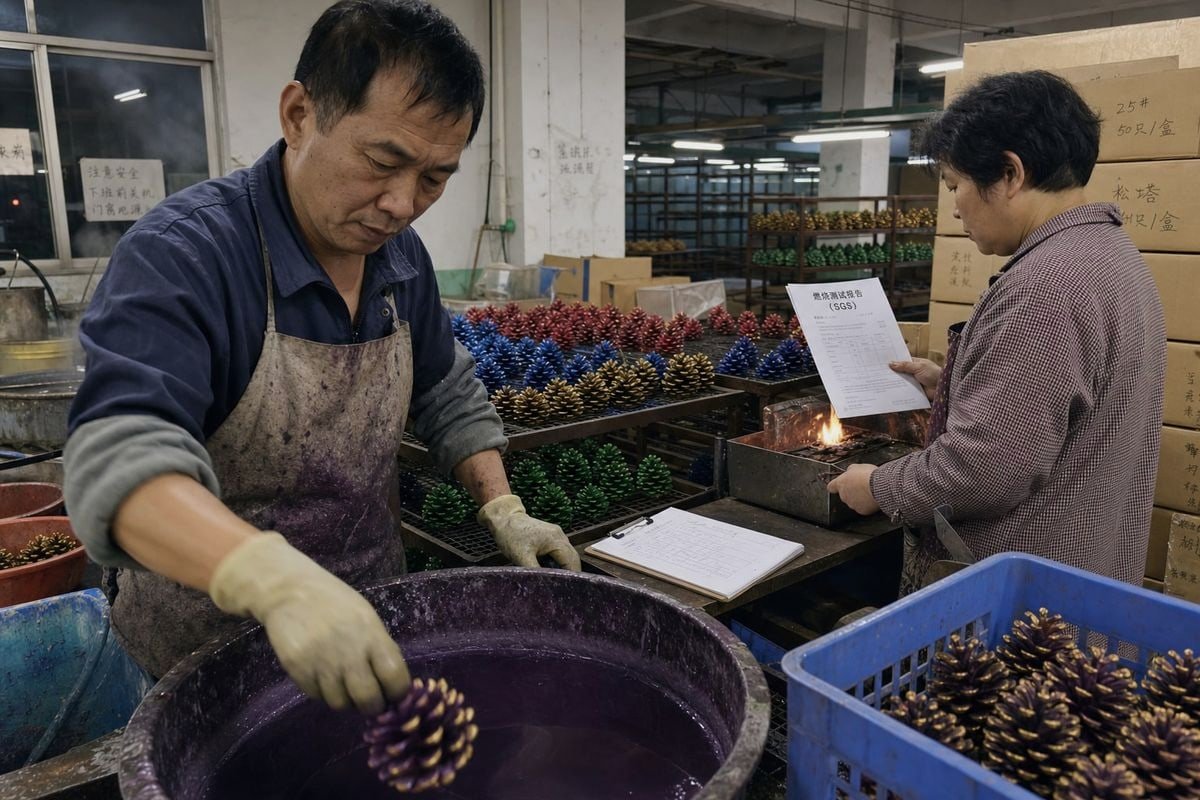
The material itself — pine cones and sales minerales 1 — is cheap. What you actually pay for is engineering, labor, and compliance. Here is how the costs typically break down on our production line.
The Three Cost Layers Explained
| Capa de costo | Qué cubre | Rango Típico |
|---|---|---|
| Development fee | Flame-color formulation, burn tests, SGS/Intertek verification of the new mix | One-time, often waived at volume |
| Per-unit premium | Hand-dipping or hand-painting, extra drying cycles, batch QC checks | 10–30% over standard SKUs |
| Packaging & labeling | Custom kraft pouches, drawstring burlap sacks, warning labels, barcodes | Depends on print run size |
A custom flame color is not just paint. When we develop an exclusive pattern — say, a cone that burns blue at the base and green at the tips — our engineers must reformulate the eco-friendly mineral coating, run repeated burn tests, and confirm the new mix still passes CE and SGS requirements 2. That testing time is real cost. So is the paperwork: every new formulation gets fresh test reports because our EU and US buyers treat compliance as a hard requirement, not a nice-to-have.
Labor is the second driver. Standard cones run through an efficient dipping line. Exclusive visual patterns — metallic gold tips, two-tone scales, ombre effects — need hand-finishing and longer drying. Small batches also interrupt line efficiency, which is why per-unit premiums shrink as volume grows.
Finally, packaging. Most buyers who pay for an exclusive pattern also want exclusive packaging: printed stand-up pouches, burlap gift sacks 3, retail display boxes. We provide these as part of one-stop OEM 4, but print runs have their own minimums. Ask for the full cost sheet up front, with each layer itemized, and you avoid surprises later.
Will Exclusive Pinecone Designs Really Give Me a Competitive Edge in My Market?
A trade-off I weigh with buyers all the time: exclusivity costs money, but sameness costs shelf space. Two importers selling identical rainbow-flame cones in the same market end up competing on price alone — and nobody wins that race.
Exclusive pinecone designs create a real competitive edge in gift, holiday, and branded retail channels, where visual uniqueness prevents direct price comparison. In commodity channels — bulk camping supply or unbranded firewood add-ons — exclusivity adds cost without changing buyer behavior.
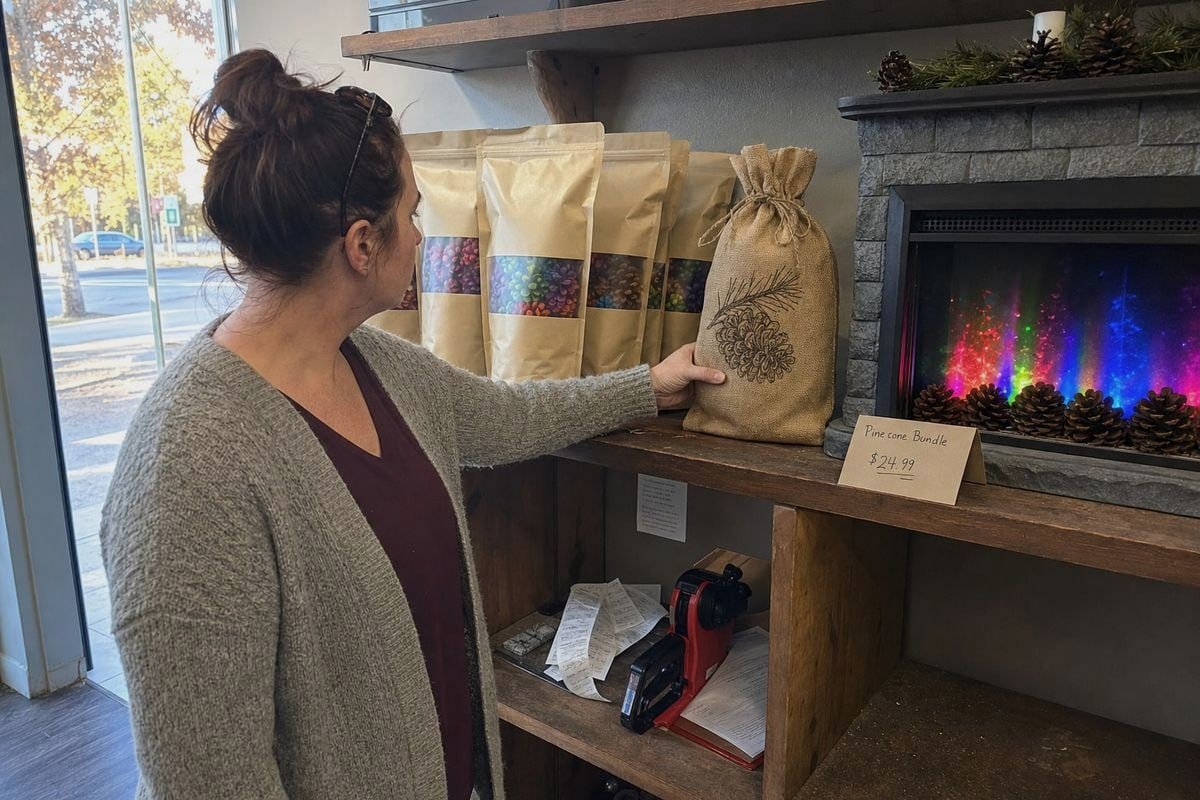
The honest answer is that exclusivity is a channel question, not a product question. Let me break down where it pays and where it does not.
Where Exclusivity Earns Its Fee
Retail shelves reward differentiation. When a US fireplace distributor carries our standard cones and a competitor carries the same SKU, the only lever left is price. But when one of them holds an exclusive colorway — a signature purple-gold cone in a branded burlap sack — the products are no longer comparable. Shoppers see a curated, artisanal item, not a commodity. This mirrors the wider décor market, where handmade and limited-edition positioning consistently supports higher price points than mass-produced equivalents.
Gifting channels amplify this further. Festival gift traders and holiday retailers tell us that presentation drives the purchase. A distinctive flame pattern plus custom packaging turns a consumable into a giftable object.
Where It Does Not
Some buyers raise a fair objection: consumers can DIY colored fire effects 5, and free vs paid patterns of home tutorials set a psychological price ceiling. That objection holds for basic novelty. It collapses for retail, though, because DIY chemical mixes carry safety risks and no certification. Our eco-friendly, tested formulations with CE and SGS/Intertek reports are precisely what a homemade version cannot replicate — and what large retail sourcing channels demand before listing anything.
If your channel is unbranded bulk — cones tossed into firewood bundles, campground resale, or filler for mixed kits — skip the exclusivity fee. Standard colors burn just as beautifully, and your customer never compares patterns anyway.
How Do I Know If a Custom Pattern Fee Is Fair for My Order Size?
A UK buyer once emailed me a competitor's quote with a flat custom fee that ignored volume entirely — the same charge for 500 units as for 50,000. That is the clearest red flag I know. Fair custom pricing always scales.
A custom pattern fee is fair when the one-time development cost amortizes to under 5% of order value, the per-unit premium falls as volume rises, and the supplier waives or credits fees at defined reorder thresholds. Flat fees that ignore quantity signal a trading company, not a factory.
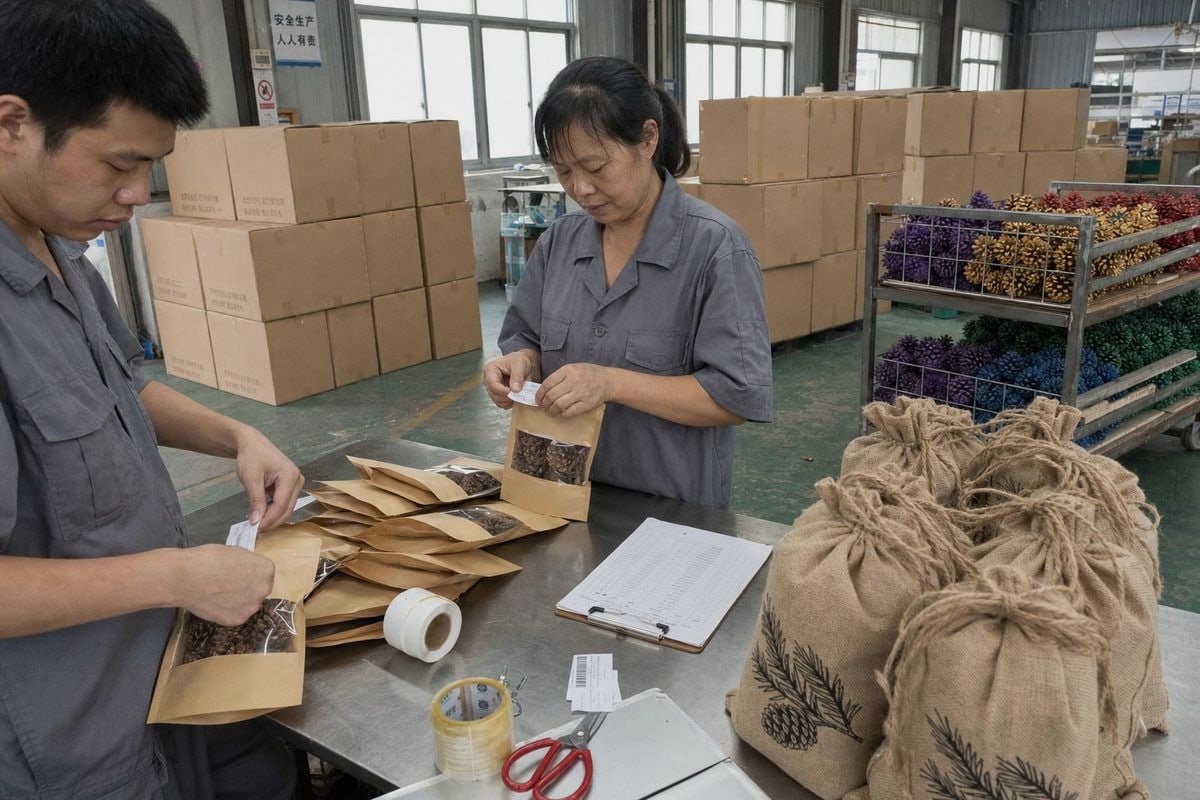
Fairness is math, not feeling. Because we run our own lines in Ningbo, I can show you exactly how a factory thinks about this — and how to audit any quote you receive.
A Simple Fairness Benchmark
| Tamaño del pedido | Reasonable Development Fee Treatment | Reasonable Per-Unit Premium |
|---|---|---|
| Trial order (small MOQ) | Charged once, credited against first reorder | 20–30% over standard |
| Mid-volume seasonal order | Partially waived | 10–20% over standard |
| Annual program / large retail | Fully waived, exclusivity agreement included | Under 10% over standard |
Run this three-step check on any quote:
- Divide the one-time fee by your order value. If development costs exceed roughly 5% of the total, either the fee is inflated or your order is too small for customization — consider a semi-custom option instead.
- Ask what the fee physically buys. A legitimate factory can itemize it: formulation hours, burn tests, lab reports, plate charges for printed pouches. Vague "customization fees" with no breakdown usually hide a middleman margin.
- Confirm reorder economics. Development work happens once. If reorders carry the same fee, you are being charged twice for the same engineering.
One more thing worth negotiating: usage rights. Just as digital craft sellers attach a commercial use license to a digital download PDF, your exclusivity agreement should state in writing that the colorway and packaging design are reserved for you in your territory. We put this into our OEM contracts 6 because our positioning is long-term partnership, not one-off transactions. A supplier who resists documenting exclusivity is telling you the "exclusive" pattern may not stay exclusive.
Can I Test Exclusive Pinecone Patterns Before Committing to a Full Production Run?
Early in our export history, we learned a hard lesson: a sample approved by email photos alone led to a dispute over flame-color intensity on delivery. Since then, physical burn samples have been non-negotiable in our process — and they should be in yours.
Yes. Reputable factories offer a staged path: physical burn samples first, then a paid pilot batch at a flexible MOQ, then full production. Approve flame color, coating durability, and packaging in hand before committing, and confirm the mass-production batch matches the approved sample.
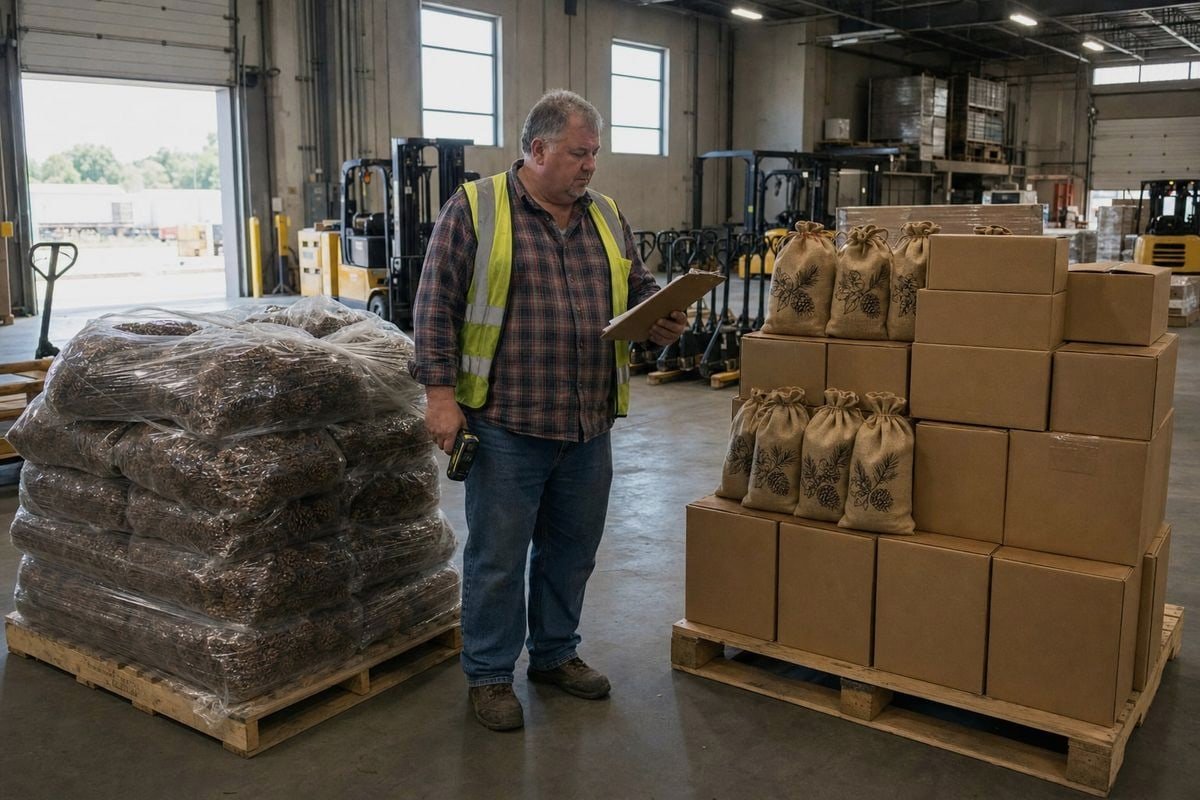
Testing is where genuine manufacturing depth shows. A factory with real control de calidad lote a lote 7 can promise that the first sample reflects mass-production quality. A trader reselling from multiple workshops cannot. Here is the staged process we run with new buyers.
The Four-Stage Testing Path
| Etapa | Qué recibe | What to Evaluate |
|---|---|---|
| 1. Burn sample | 3–10 finished cones | Flame colors, burn duration, smoke, residue |
| 2. Documentation pack | Test reports, spec sheets, often as a digital download PDF | CE/SGS results, ingredient safety, labeling compliance |
| Lote piloto | Small paid run at trial MOQ | Consistency across units, packaging quality, transit durability |
| 4. Golden sample sign-off | Sealed reference sample | The QC benchmark every future batch is checked against |
A few practical tips from our side of the table. First, burn the samples in the same setting your end customer will — fireplace, fire pit, or campfire — because draft and fuel affect how vividly colors present. We include step-by-step instructions with every sample pack for exactly this reason, and we can provide video tutorial access showing correct usage for your retail staff or product pages. Second, stress-test the packaging: shake the pouch, check whether coated scales flake, and leave a cone in a humid room to see if the finish holds. Third, treat ongoing pattern support as part of the deal — if a future batch drifts from the golden sample, your supplier should correct it at their cost. Skill level difficulty for the end user should be zero: toss the cone in, enjoy the color. If your samples need fussy handling, the formulation is not retail-ready yet.
Conclusión
Paying blindly for exclusivity wastes margin; avoiding it entirely surrenders shelf appeal. The fix is simple: match exclusive colored pine cone patterns to branded channels, verify fees scale with volume, and always burn-test before committing. Partner with a certified factory, and the premium becomes an investment, not a gamble.
Notas al pie
1. Explains how metal salts produce distinct flame colors, relevant to colored pinecone chemistry. ↩︎
2. Official EU source explaining CE marking compliance requirements referenced for pinecone flame-color certification. ↩︎
3. Authoritative Wikipedia entry for Hessian fabric, the technical term for burlap used in gift packaging. ↩︎
4. Background on OEM manufacturing arrangements mentioned for packaging and production services. ↩︎
5. Explains chemistry behind pyrotechnic colorants used to create colored fire effects safely. ↩︎
6. Alibaba is a major manufacturing trade platform relevant to OEM contract sourcing practices. ↩︎
7. Authoritative Wikipedia entry explaining how batch production facilitates specific quality control standards and process changes. ↩︎



 English
  Spanish
  German
  French
  Arabic
  Portuguese
Únete a la conversación