







Fireplace colored pine cones can earn glowing five-star reviews—or sink a product line Raumluftqualität 1. On our production line in Ningbo, I have seen both outcomes start at the factory door.
Common negative reviews for fireplace colored pine cones include short-lived or weak flame color, chemical odors, safety fears about toxic fumes, sticky or damp cones, and inconsistent batches. Buyers avoid them by sourcing deep-saturated, lab-tested, compliant cones with clear labeling and strict batch quality control.
Every one of those complaints has a root cause. Most of them trace back to the supplier, not the end user. Below, I break down each complaint cluster and show you exactly how to screen it out before you place a purchase order.
What quality complaints should I watch for before placing a bulk order?
A distributor in Poland once forwarded me a one-star review that read, simply, "the color lasted five seconds." That single sentence taught our team more than any spec sheet ever did.
Watch for five quality complaints: color that fades within seconds, weak or yellow-only flames, sticky cones caused by moisture absorption, strong chemical odors, and chalky chemical residue. Each traces back to shallow saturation, poor flame colorant formulation, or careless storage and packing at the factory.
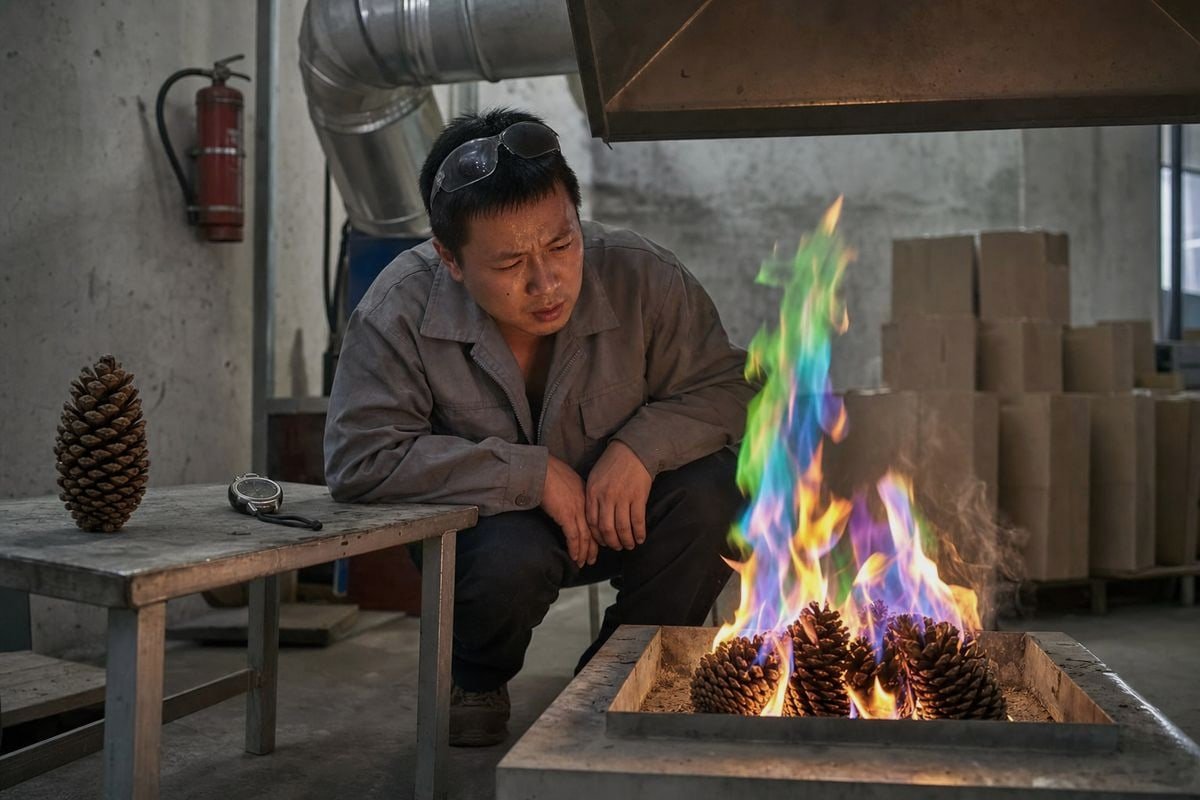
The most damaging review theme, by far, is short burn duration of the color effect. Customers expect a lasting rainbow fire. When the color flashes and disappears, they feel cheated—and they say so publicly. The cause is almost always a shallow surface dip or spray coating. At our facility, cones go through an extended saturation process so the flame colorant penetrates deep into the scale structure, not just the surface. When the outer layer burns off, the color keeps going.
The second theme is weak or inconsistent color. Some reviews report nothing but a normal yellow flame. This usually means the colorant concentration was too low, or the mineral salts were unevenly distributed across the batch. Compounds like Kupfersulfat 2 produce vivid blue-green flames only at the right concentration and at the right fire temperature. If the factory cuts the chemical loading to save cost, the visual effect collapses.
The five complaint clusters and their factory-side causes
| Negative review theme | Grund | What to demand from your supplier |
|---|---|---|
| Color lasts only seconds | Surface dip instead of deep saturation | Documented saturation process and burn-time video per batch |
| Weak or yellow-only flame | Low colorant concentration | Colorant loading spec plus live burn demo |
| Sticky, damp, "weeping" cones | Hygroscopic salts absorbing moisture | Moisture-barrier inner bags, desiccant packs |
| Chemical odor complaints | Cheap fillers or scented additives | Eco-friendly formulation, odor test on samples |
| Chalky chemical residue | Excess unbonded surface coating | Residue check after sample burn |
The hygroscopic issue deserves special attention. Some mineral salts pull moisture from the air. Cones then arrive at retail sticky, clumped, or dripping. We solve this with sealed inner liners and silica gel, but many low-cost suppliers skip that step entirely. Always burn samples yourself and inspect samples that have sat in a humid room for two weeks. That simple test predicts most of your future one-star reviews.
How can I verify a supplier's compliance and safety testing to avoid customer complaints?
When we started exporting fireplace colored pine cones to Germany seventeen-plus years ago, our first lesson was blunt: European buyers do not negotiate on compliance. They walk away.
Verify compliance by requesting current SGS or Intertek test reports, heavy metal screening results, CE documentation, and ISO 9001 and BSCI audit certificates. Confirm the reports match the exact product formula, check issue dates, and validate certificate numbers directly with the testing laboratory.

Safety anxiety is a core driver of negative reviews. Customers worry about toxic fumes, heavy metal exposure, and risks to children and pets. Some of that worry is justified—when the product is made badly. Older or unregulated formulations sometimes used barium or lead compounds, which have no place in a consumer fireplace product. Modern, responsible formulations rely on safer mineral salts, and some suppliers use Borsäure 3 derivatives for green tones. Your job as a buyer is to prove which category your supplier falls into before the goods ship.
Here is the verification process I recommend, based on what our most careful buyers actually do:
- Request the full test report, not a summary page. A real SGS or Intertek report lists the tested substance, method, and detection limits. Check that Schwermetall-Screening 4 covers lead, cadmium, mercury, and barium.
- Gleichen Sie den Bericht mit dem Produkt ab. A common trick is showing a report for one SKU while shipping another formula. Compare batch codes and product descriptions line by line.
- Validate the certificate number. Both SGS and Intertek let you confirm report authenticity. Two minutes of checking prevents months of liability.
- Ask about emissions and indoor air quality. Colored flame products produce combustion byproducts. A supplier who cannot discuss fume behavior, ventilation guidance, or wood-burning stove safety has not thought the product through.
- Audit the factory system, not just the product. ISO 9001 5 tells you quality is managed as a process. BSCI tells you the factory is socially audited. Together they signal a partner, not a workshop.
Ein weiterer Punkt, den Käufer oft übersehen: catalytic wood stoves 6. Metal ions can coat and deactivate catalytic combustors in high-efficiency stoves. A responsible supplier states this limitation on the label rather than hiding it. If your supplier resists adding that warning, that resistance itself is your answer.
What packaging or labeling issues lead to negative reviews, and how do I prevent them?
A UK camping brand once sent us their previous supplier's returned stock: kraft pouches with no reseal zipper, no warnings, and cones fused together by absorbed moisture. The reviews wrote themselves.
Packaging failures that trigger negative reviews include non-resealable bags that let cones absorb moisture, missing food-safety and cooking warnings, unclear usage instructions, absent fireplace-type guidance, and no child-safety labeling. Prevent them with sealed moisture-barrier liners, compliant warning labels, and clear instructions.

Packaging is not decoration. It is your first line of defense against bad reviews. Every complaint about sticky cones, confusing use, or accidental misuse can be traced to a packaging or labeling decision made months earlier at the factory.
Moisture protection comes first
Colorant salts are hygroscopic. Once a bag is opened, unsealed cones start pulling moisture from the air and can turn tacky within weeks. We build our pouches with resealable zippers and add desiccant packs inside the liner. For humid destination markets like Brazil or the Gulf states, we upgrade to heavier barrier film. Ask your supplier what liner spec they use for your climate. If they have never considered destination humidity, they will learn that lesson using your brand name.
Labeling that prevents misuse
Many negative reviews come from misuse the label failed to prevent. The critical warnings are:
| Etikettenelement | Complaint it prevents |
|---|---|
| "Not for cooking fires" warning | Food contamination fears, marshmallow-roasting incidents |
| Fireplace type guidance (wood-burning only) | Failure in gas, electric, or ventless units |
| "Use one at a time in an established fire" | Weak color complaints from cold or overloaded fires |
| Ventilation and flue-open reminder | Odor and indoor air complaints |
| Child and pet safety warning | Ingestion scares and safety-related returns |
| Ash disposal note (trash, not garden) | Complaints about soil use and chemical residue in ash |
There is also a usage-education angle. The color effect works best in a hot, stable ember bed—too cool and the color is faint; too fierce and high heat can wash out the wavelengths. Excess smoke also matters, because heavy soot can coat cones and mask the reaction, and it accelerates chimney Kreosotablagerungen 7 regardless of what you burn. A short "how to get the best color" panel on the back of the bag converts confused users into repeat buyers. As a one-stop OEM/ODM partner, we design these panels, warning icons, and barcodes for each destination market, because a shelf-ready product is a review-ready product.
How do I choose a manufacturer with consistent batch quality to protect my brand's reputation?
The hardest promise in this business is not the first sample. It is the tenth container looking exactly like that first sample. Our QC team in Ningbo lives by that standard.
Choose a manufacturer with 17+ years of production history, documented batch-to-batch quality control, in-house burn testing, ISO 9001 systems, and retained batch samples. Verify with a factory audit, repeated sample orders across time, and written tolerance specs for colorant loading and burn duration.

Inconsistency is the silent killer of private-label brands. Your first shipment earns great reviews. The third shipment—made with a different colorant lot, rushed before a holiday—burns weak. Your reviews average down, your retail buyer notices, and your listing never recovers. Trading companies are especially risky here, because they may source each order from a different workshop. You need a real factory with a real quality system.
A practical vetting checklist
| Vetting step | Wie gutes Aussehen aussieht | Rote Flagge |
|---|---|---|
| Factory ownership | Owns production lines; welcomes video or on-site audit | Vague about factory location, audit refused |
| Chargen-QC-Aufzeichnungen | Written burn-test logs per batch, retained samples | "We check everything" with no documents |
| Colorant sourcing | Fixed, tested raw material suppliers | Buys colorant on spot price each order |
| Sample-to-production match | Written guarantee; pre-shipment burn video | First sample great, mass goods differ |
| Tolerance specs | Defined ranges for colorant loading and color duration | No measurable specs at all |
| Zertifizierungen | ISO 9001, BSCI, CE, current SGS/Intertek reports | Expired or borrowed certificates |
Test the supplier over time, not once
One sample proves nothing about consistency. Place a small trial order, then a second one two or three months later, and burn-test both side by side. Compare color intensity, odor, and residue. A supplier confident in their process will support flexible trial MOQs precisely because they know the results will match. We keep retained samples from every batch for exactly this reason: when a buyer questions a shipment, we burn the retained sample on camera and settle it with evidence.
Communication matters as much as chemistry. When a problem appears—and in seventeen years, problems always appear somewhere—you need a partner who answers in clear English within hours, traces the batch, and ships a corrective plan. Price differences of a few cents per cone are invisible next to the cost of a recall or a wave of one-star reviews.
Schlussfolgerung
Negative reviews for fireplace colored pine cones follow patterns: fading color, safety fears, packaging failures, inconsistent batches. Source deep-saturated, certified, well-labeled cones from a proven factory, and those reviews never get written.
Fußnoten
1. EPA guidance relevant to combustion byproducts and ventilation concerns raised in the article. ↩︎
2. Explains the mineral salt chemistry behind flame coloration mentioned in the article. ↩︎
3. Background on the compound used for green flame tones referenced in the text. ↩︎
4. Authoritative regulatory context for heavy metal testing like lead and cadmium screening. ↩︎
5. Official standard reference for the quality management certification discussed throughout. ↩︎
6. Background on stove technology and catalytic combustors mentioned as a compatibility concern. ↩︎
7. Background on the chimney byproduct referenced regarding smoke and soot accumulation. ↩︎



 English
  Spanish
  German
  French
  Arabic
  Portuguese
Diskutieren Sie mit