






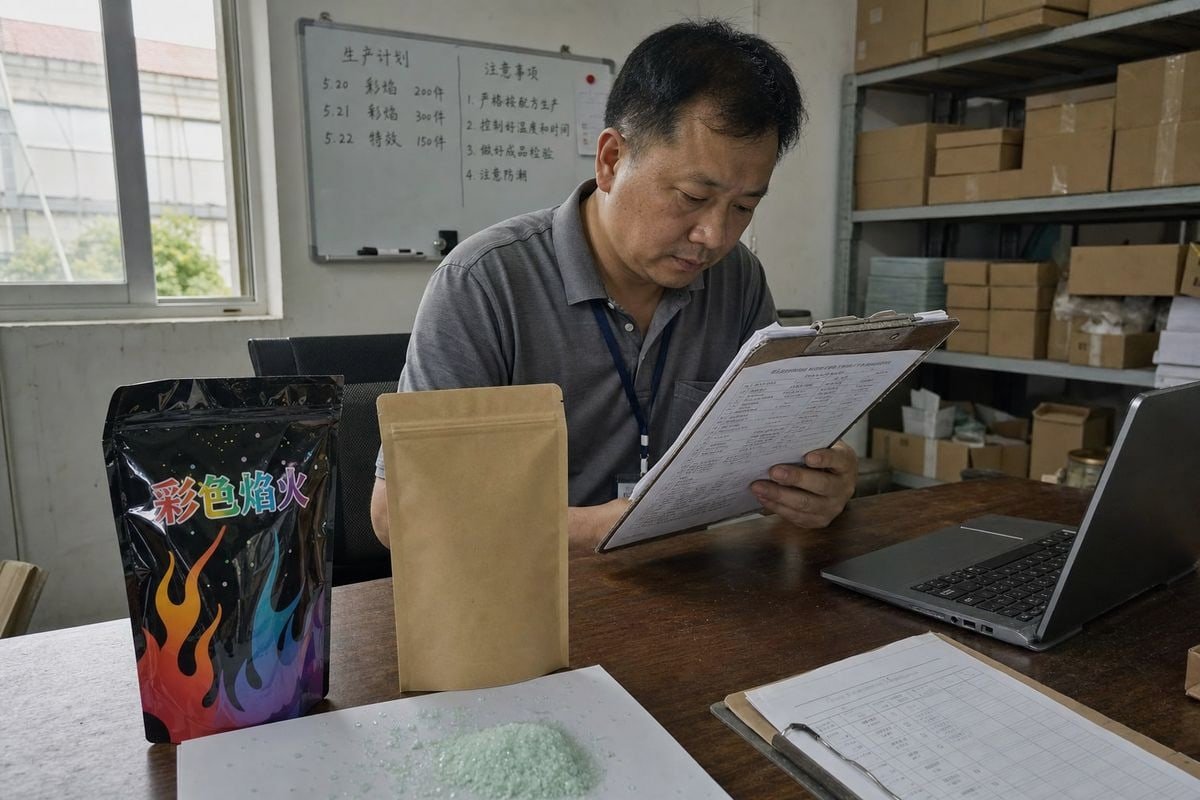
[Finding magic fire powder suppliers in China](https://sunrichfire.com/what-channels-help-find-reliable-magic-fire-powder-suppliers-china/) looks easy online UN, IATA, or IMDG rules 1. But our Liuyang factory sees buyers burned by fake "manufacturers" every year—wrong colors, seized shipments, missing certificates. Here is how to source safely.
Online B2B platforms are faster for finding magic fire powder suppliers in China, while trade shows are safer for verifying legitimacy and compliance. The best approach combines both: shortlist suppliers online for speed, then verify finalists face-to-face or through audited factory visits before ordering.
That short answer hides a lot of detail. Safety means three things: transaction safety, product safety, and business safety. Speed also splits into discovery speed and decision speed. Let me walk you through each question.
How can I verify a magic fire powder supplier's certifications before committing online?
Last spring, a German distributor sent us a competitor's "SGS certificate" to compare against ours. It was expired, issued for a different product, and partially photoshopped. We caught all three issues in ten minutes.
Verify certifications by requesting full original PDFs of ISO 9001, BSCI, CE, and SGS or Intertek reports, then confirm them directly with the issuing body using the report number. Check that the certificate names match the supplier's registered company and the exact product you are buying.
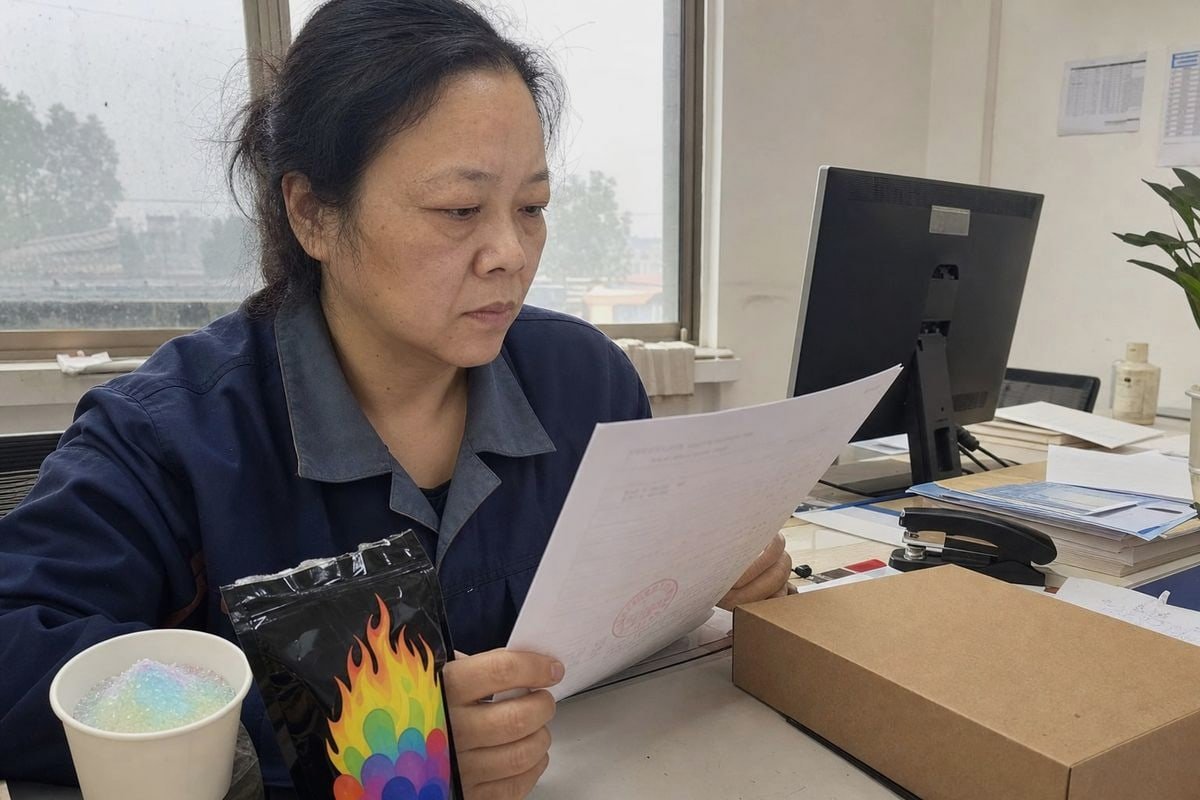
Certificates are the first thing serious buyers ask us for, and the first thing dishonest sellers fake. In our seventeen-plus years exporting color-flame products to more than thirty countries, we have learned that a certificate is only as good as your ability to trace it. A screenshot in a chat window proves nothing. A verifiable report number proves a lot.
The four-step verification process
Follow these steps before you commit any deposit:
- Request the full document, not a crop. Ask for the complete PDF with the report number, issue date, scope, and the tested product description visible.
- Stimmen Sie den Namen der juristischen Person ab. The company on the certificate must match the company on your proforma invoice. Trading companies often borrow factory certificates that do not legally cover them.
- Überprüfen Sie mit dem Aussteller. SGS, Intertek, TÜV, and BSCI all offer verification channels. Enter the report number and confirm it is genuine, current, and issued for the same product category.
- Überprüfen Sie den Testumfang. A general packaging test is not a chemical safety test. For color-flame powder, you want testing that covers the actual flame-coloring compound, labeling, and transport classification.
Which documents matter most for color-flame products
| Dokument | Was es beweist | Rotes Flagge, wenn fehlend |
|---|---|---|
| ISO 9001 | Qualitätsmanagementsystem vorhanden | No consistent batch control |
| BSCI-Audit | Ethische, geprüfte Arbeitsbedingungen | Einzelhandelsketten können das Produkt ablehnen |
| CE / relevant EU compliance | Produkt erfüllt die EU-Marktanforderungen | Customs or retailer refusal in Europe |
| SGS / Intertek Prüfbericht | Third-party chemical and safety testing | Unknown composition, liability risk |
| SDB / SDS | Safe handling and shipping data | Freight forwarders may refuse cargo |
One more point from our own buyer conversations: certification is a filter, not a finish line. Even genuine certificates only tell you the supplier passed a test on one day. Ask how often reports are renewed and whether batch-level QC records exist. When we onboard a new retail sourcing channel, we expect them to grill us on exactly this—and we treat that scrutiny as a good sign about the buyer, too.
Do trade shows really give me faster access to reliable manufacturers than B2B platforms?
Every year at Canton Fair season 2, our booth gets two kinds of visitors: buyers meeting us for the first time, and buyers who found us online months earlier and came to confirm what they saw.
No for discovery, yes for decisions. B2B platforms surface hundreds of magic fire powder suppliers in hours, far faster than any trade show. But trade shows compress vetting, sample comparison, and negotiation into days, so buyers who attend often close reliable deals faster overall.
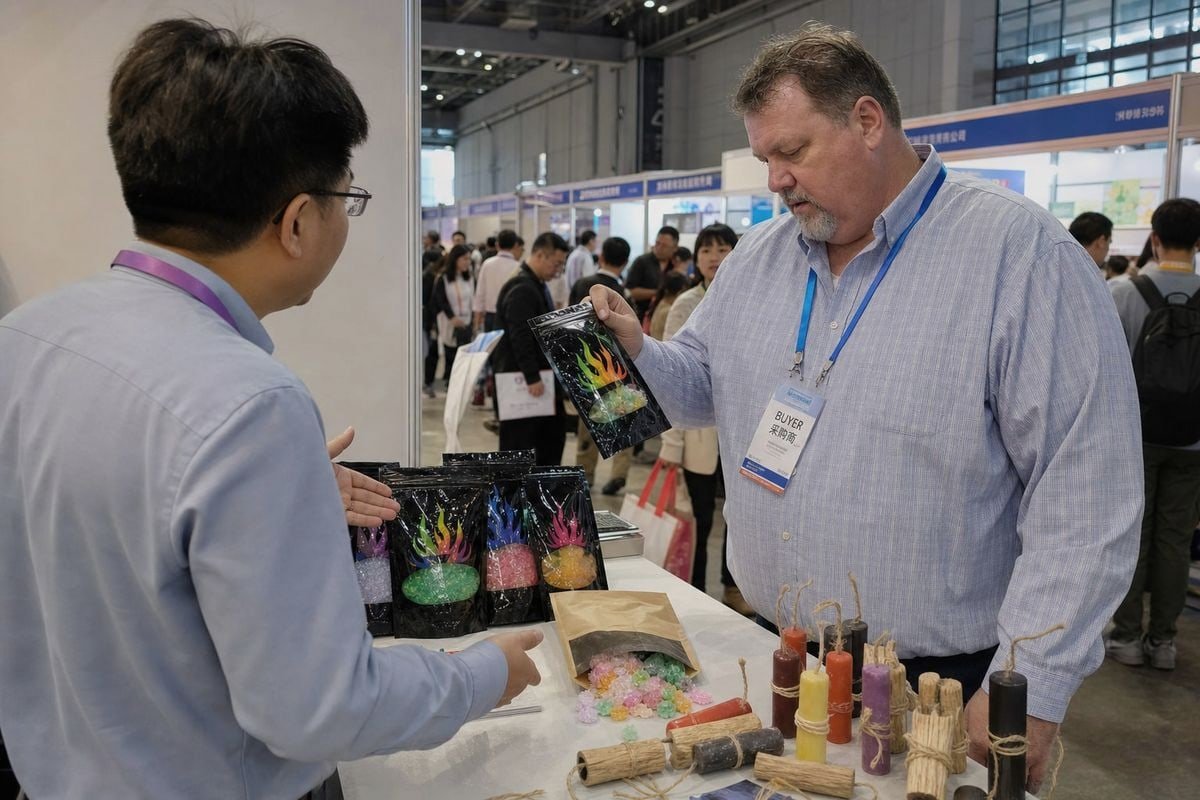
The honest framing is this: online B2B is faster to start, trade shows are faster to decide. On In China hergestellt 3, a single search can return over seven hundred "magic powder" listings. Aggregator tools show tens of thousands of related products and suppliers. No trade show hall on earth matches that breadth. If your goal this week is a shortlist of ten candidates with indicative pricing, the platforms win, and it is not close.
But breadth is not reliability. Those seven hundred listings mix real factories, trading companies, and resellers who have never touched the product. Sorting them through chat takes weeks of back-and-forth. At a show, you compress that cycle. You handle the actual sachet packaging. You watch a flame demo. You ask a technical question and see whether the person answering understands crystallization, granule size, and burn behavior—or just reads a spec sheet.
Speed comparison across the sourcing cycle
| Sourcing stage | Online B2B | Trade show |
|---|---|---|
| Supplier discovery | Stunden | Days, limited to exhibitors |
| Initial quotations | 1–3 Tage | On the spot |
| Legitimacy vetting | Weeks of remote checks | Minutes to hours face-to-face |
| Sample comparison | 1–3 weeks shipping | Side-by-side, same day |
| Trust building | Slow, incremental | Fast, personal |
| Total time to a confident order | Often 2–3 months | Often 2–4 weeks after the event |
There is a real objection here: trade shows cost money. Flights, visas, hotels, and time away from your desk add up, and for a small trial order that math may not work. Fair enough. In that case, replicate the show experience remotely—demand live video factory tours, real-time flame demonstrations on camera, and unedited production footage. We do these calls weekly for buyers in the US and Europe who cannot travel, and a supplier who refuses a live tour is telling you something important.
Also remember geography. China's fireworks and flame-product expertise clusters heavily in Hunan, especially Liuyang, where we are headquartered. Shows and cluster visits put you physically near real production capability. Random platform browsing does not.
What sourcing risks should I watch for when ordering color-flame products sight unseen?
A trade-off we weigh constantly on our own production line is color intensity versus clean-burning, eco-friendly formulation. Cheap suppliers skip that balancing act entirely—and buyers only discover it after the container lands.
The biggest sight-unseen risks are misrepresented supplier identity, quality drift between sample and mass production, non-compliant chemical composition, missing hazard documentation, and shipping failures. Each risk is invisible in an online listing and only surfaces through verification, testing, and batch controls.

Color-flame powder is not a generic party commodity. It sits adjacent to the fireworks and pyrotechnics 4 category, which means the diligence bar must be much higher than for, say, camping mugs. Some flame-coloring products on the market are formulated as safe, eco-friendly additives—that is exactly the category we manufacture. Others are sold by fireworks-oriented suppliers using compositions that may trigger hazardous-goods classification 5 under UN, IATA, or IMDG rules. If you cannot tell which one you are buying, you are carrying the risk.
The five risks in detail
Identity risk. Suppliers on the same platform label themselves "Manufacturer/Factory," "Trading Company," or both at once. A trader posing as a factory adds margin, slows communication, and cannot control production quality. Ask for the factory address, Gewerbeanmeldung 6, and live video from the production floor. Our Ningbo facility does these tours routinely; a real factory has nothing to hide.
Quality drift. The classic failure mode: a beautiful sample, then a mass-production batch with weak colors, short burn times, or clumped, moisture-damaged granules. This happens when a supplier subcontracts production or lacks batch-to-batch QC. Ask specifically how batch consistency is controlled and whether the sample comes from a real production run.
Compliance risk. No MSDS, no test report, no destination-market labeling. The product may work fine and still be unsellable to a major retailer, or worse, illegal to import.
Documentation and transport risk. If the composition triggers dangerous-goods classification, you need correct declarations, appropriate packaging, and an experienced forwarder. A wrong declaration can mean customs seizure of the entire shipment.
After-sales risk. When a batch problem appears six months in, a listing-only seller disappears. A real manufacturing partner investigates, replaces, and fixes the root cause.
Risk severity and mitigation
| Risiko | Typische Konsequenz | Best mitigation |
|---|---|---|
| Fake factory identity | Higher price, no quality control | Business license check, live video tour |
| Qualitätsdrift | Returns, brand damage | Production-run samples, batch QC records |
| Non-compliant chemistry | Retailer rejection, liability | SGS/Intertek testing, eco-friendly formulation |
| Wrong shipping declaration | Zollbeschlagnahme | MSDS review, experienced export team |
| No after-sales support | Unrecoverable losses | Long-track-record suppliers, clear contracts |
Which sourcing method helps me secure flexible MOQs and private-label terms more quickly?
A US camping brand once told me they had spent three weeks messaging platform sellers about custom kraft-bag packaging and barcodes—and got copy-paste replies. In one thirty-minute call, we mapped their entire private-label program.
Direct manufacturer relationships—initiated online but confirmed through calls, visits, or trade shows—secure flexible MOQs and private-label terms fastest. Platform listings show standard MOQs only; real OEM/ODM negotiation on packaging, branding, and trial quantities requires talking to the actual factory's decision-makers.
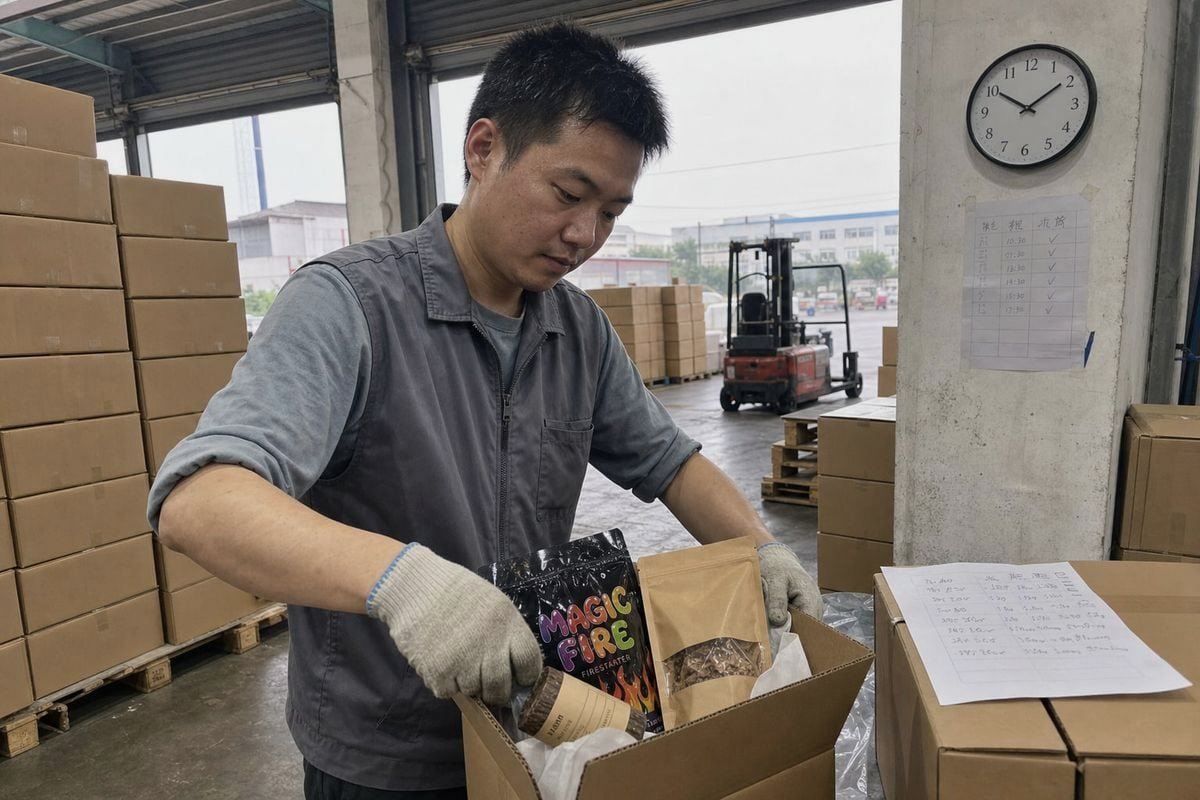
Here is what most buyers miss: MOQ-Flexibilität is not a channel feature, it is a supplier-type feature. A trading company reselling stock cannot lower the factory's minimum. A listing page shows a number, and chat agents rarely have authority to change it. But when you reach the people who actually run production—whether you found them online or at a fair—MOQ becomes a conversation about setup costs, packaging formats, and long-term potential. We regularly structure trial orders for established importers precisely because we control our own lines and can slot smaller runs between larger ones.
Why private label is where channels really diverge
Private-Label-Arbeit 7 is deeper than printing your logo. For our Magic Fire packets, a real OEM/ODM program 8 covers:
- Verpackungsformat: plastic sachet, kraft stand-up pouch, or plastic jar
- Burn time and pouch size tuned to your market's fire-pit habits
- Custom boxes and retail display packaging for shelf-ready presentation
- Warnhinweise und Anleitungen localized for your regulatory environment
- Barcodes and retailer-specific compliance for large chains
- Logistics optimization so carton sizes fit pallets and containers efficiently
Try negotiating that list through a platform chat window with a reseller. It stalls immediately, because the reseller has to relay every question to a factory they may not even name. Now try it face-to-face at a show, or on a video call with the factory's export team. Decisions get made in real time. Artwork feedback comes back in days, not weeks. That is why the fastest path is hybrid: use online B2B to find candidates who claim OEM capability, then use direct, synchronous contact to test whether the capability is real.
One practical test I always suggest: ask the supplier to walk you through a past private-label project—packaging changes, label compliance, timeline. A genuine OEM partner tells a specific story. A middleman gives you generalities.
Schlussfolgerung
Sight-unseen sourcing of color-flame products is risky; slow sourcing loses seasons. Shortlist magic fire powder suppliers online, verify


 English
  Spanish
  German
  French
  Arabic
  Portuguese
Diskutieren Sie mit