






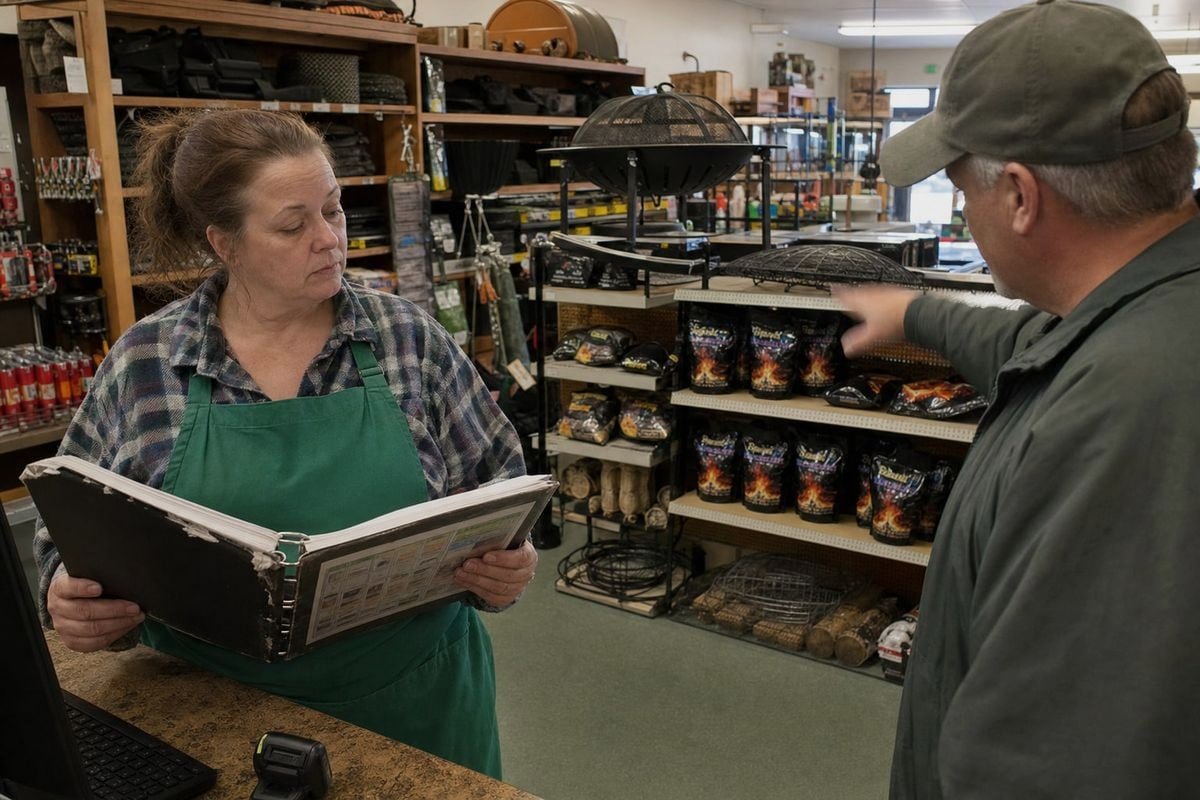
A store Q&A manual for Magic Fire Powder is something our export team gets asked about constantly. Without one, retail staff guess at answers—and guessing with a fire product creates real risk.
A store Q&A manual for Magic Fire Powder should combine a customer FAQ, a safety reference, and a staff training script. Organize it by product basics, usage, safety, storage, compliance, and troubleshooting, with short direct answers built from real camper questions and official product documentation.
Below, I will walk through each part of the manual step by step. I will cover safety concerns, certifications, common camper questions, and the practical structure that makes the document work on a shop floor.
What should I include in a store Q&A manual to address customer safety concerns about Magic Fire Powder?
A few years back, one of our German distributors sent us a photo of our color-flame packet displayed next to candy at a campground shop. That single image reshaped how we write safety guidance.
Your safety section should cover unopened-packet use, a strict no-cooking rule, child and pet precautions, wind and weather limits, treated-ash disposal, and emergency steps for skin, eye, or inhalation contact. Every answer should match the official Safety Data Sheet, never improvised sales language.

Safety questions are the ones your staff will face most often, and they are the ones with the least room for error. In our 17-plus years making flame colorant packets, we have learned that customers do not ask abstract chemistry questions. They ask practical ones: "Can my kid throw this in the fire?" or "Can we roast marshmallows over it?" Your manual needs to anticipate exactly these.
The non-negotiable safety answers
Start with the rules that never bend. The packet goes into the fire unopened. That single instruction prevents skin contact and reduces any chance of toxic fume inhalation from handling loose powder near heat. Next, cooking over colored flames is prohibited—full stop. The Metallzusammensetzung 1 that creates the color effect is not food-safe, so no marshmallows, no hot dogs, no kettle over the treated fire. Train staff to give a mandatory verbal "no-cooking" warning at the point of sale. This protects the customer and reduces store liability.
Then cover children. The glossy pouch with rainbow lettering can look like a drink mix or candy to a small child. Our own packaging carries clear warning labels, but the manual should still instruct stores to merchandise the product in the fire-tool or outdoor fire pit accessories section, away from snack aisles.
A table your staff can memorize
| Safety concern | Correct answer for staff |
|---|---|
| How do I add it to the fire? | Toss the sealed packet in whole; never open it |
| Can we cook over it? | No. Never cook food over colored flames |
| Is it safe near kids? | Store out of reach; packaging can resemble candy |
| What if powder touches skin or eyes? | Rinse with water; refer to the SDS; seek medical help if irritation persists |
| What about the ash afterward? | Let it cool, pack it out; follow Keine Spuren hinterlassen 2 |
Finally, every claim must trace back to the Sicherheitsdatenblatt 3 (SDS) supplied with the product. When we ship Magic Fire packets to our US and EU buyers, the SDS travels with the order for exactly this reason. If a question is not covered in official documentation, the manual should say so and direct the customer to support—never let staff invent an answer for a fire product.
How do I explain compliance certifications like CE and SGS to retail staff so they can answer buyer questions confidently?
Buyers from Home Depot–type sourcing channels have audited our Ningbo production lines more than once. Those audits taught me which certification questions actually come up at retail—and which never do.
Teach staff a one-line meaning for each mark: CE shows the product meets EU safety directives, SGS or Intertek reports confirm independent lab testing, ISO 9001 covers factory quality systems, and BSCI covers ethical production. Staff should cite these plainly and offer test reports on request.

Certifications intimidate retail staff because the acronyms feel technical. In practice, each mark answers one simple customer worry. Your manual should translate every certificate into a single plain-English sentence a clerk can repeat without hesitation. In our experience exporting to 30-plus countries, the stores that sell color-flame products best are the ones whose staff can say "this has been independently tested" and mean it.
Translate each mark into one sentence
| Zertifizierung | What staff should say | Customer worry it answers |
|---|---|---|
| CE | "This product meets European safety requirements." | "Is this legal and safe to sell here?" |
| SGS 4 / Intertek-Bericht | "An independent lab tested this exact product." | "How do I know the claims are true?" |
| ISO 9001 5 | "The factory runs a certified quality system, so every batch is consistent." | "Will the next pouch behave like this one?" |
| BSCI | "The factory passed an ethical and social audit." | "Was this made responsibly?" |
Why this matters for a fire product specifically
For a generic camping gadget, certifications are a nice-to-have. For a flame-effect product, they are the difference between shelf-ready and unsellable. Distributors we work with in Germany, the UK, and the Netherlands treat CE-Kennzeichnung 6 and third-party test reports as hard requirements before a purchase order is even discussed. Your manual should reflect that seriousness. Include a short paragraph explaining that the color effect comes from a controlled metal salt composition, that the formulation contains no harmful chemicals, and that test reports are available for any customer who asks.
One practical tip from our OEM work: print the certificate summary on a laminated card kept at the register. Staff answer faster when the reference is physically in front of them. Also instruct staff on what not to say. They should never claim the product is "non-toxic in all situations" or "completely harmless." The honest, defensible line is: "It is certified, independently tested, and safe when used as directed." That phrasing builds trust without overpromising, which matters to the safety-conscious parents and group leaders who ask these questions most.
What common questions do campers ask about color-flame packets, and how should my store team be trained to respond?
Reviewing pre-sale messages from our overseas distributors is a quarterly ritual for our team. The same fifteen or so camper questions appear again and again, in every market from Canada to Australia.
Campers most often ask what the product is, how long the color lasts, which fires it works in, whether it is safe for kids and cooking, and what to do with the ash. Train staff with scripted, plain-language answers pulled from real support tickets, not assumptions.

The best question list comes from evidence, not brainstorming. FAQ best practice says to mine your last 90 days of support tickets, chat logs, and order emails, then keep the top 15 to 20 questions. When we help private-label clients build their customer FAQ documentation, we hand them our accumulated question bank as a starting point, and they add local questions from their own inboxes.
The starter question set
Here are the questions your team should be drilled on, grouped the way campers actually think:
- What is it? A single-use flame colorant packet. Toss it sealed into an established wood fire for rainbow-colored flames.
- How long does it last? Das duration of color effect is typically 20 to 60 minutes per packet, depending on fire size and wind.
- Which fires work? Wood-burning campfires, fireplaces, and fire pits only. Never propane, gas, or ethanol units—the residue can damage burners.
- Can we cook over it? No. Wait until the treated fire has fully burned out and start a fresh fire for cooking.
- Is it safe for kids and pets? Adults handle the packet; children watch from a normal campfire distance. Store it out of reach.
- What about campfire rules? During fire bans, no fire additives are allowed because no fires are allowed. Check local regulations.
- What do I do with the ash? Cool it completely, then pack it out. Do not scatter treated ash; this respects Leave No Trace and limits environmental impact.
- My stainless fire pit—any care needed? Yes. Once the ash is cool, remove it and rinse the bowl with water to prevent salt-induced corrosion over time.
Training format that actually sticks
Do not just hand staff a document. Run a ten-minute role-play at onboarding: one person plays the skeptical parent, another plays the clerk. In our factory showroom, we do the same exercise with visiting buyers' teams, and the difference in confidence after one session is obvious. Keep each scripted answer under 60 words so it can be delivered naturally, and end every safety answer with "and it's all on the label if you want to double-check."
How can I structure a Q&A manual to help retailers handle packaging, usage, and storage questions for Magic Fire Powder?
Choosing between a foil pouch, a resealable kraft bag, and a plastic jar is a trade-off we walk OEM clients through on nearly every project—and each format changes the storage questions retailers will face.
Structure the manual in seven labeled sections—product basics, usage, safety, storage and transport, restrictions, shipping and returns, troubleshooting—with question-style headings, the most-asked questions first, one self-contained answer per question, and a scheduled monthly or quarterly review to keep content current.

Structure decides whether the manual gets used or ignored. A wall of paragraphs fails on a busy shop floor. Question-style headings, popular items first, and one answer per question is the formula that works, both in print and online. If the store also sells through a website, the same content can carry FAQ schema markup 7 for search visibility—but write for the human reader first.
The seven-section skeleton
| Abschnitt | Core content | Example question |
|---|---|---|
| Product basics | What it is, what's in the pack | "Is this a fire starter or a color additive?" |
| Verwendung | Steps, quantity, compatible fires | "How many packets for a large fire pit?" |
| Sicherheit | Warnings, no-cooking rule, first aid | "What if my dog licks the pouch?" |
| Storage & transport | Product storage requirements, moisture, temperature | "Can it sit in a hot car?" |
| Restrictions | Fire bans, indoor use, age limits | "Is it allowed at my campsite?" |
| Shipping & returns | Gefahrenklassifizierung 8, opened returns | "Can I return an opened packet?" |
| Troubleshooting | Clumping, weak color, damaged seals | "It got damp—will it still work?" |
Packaging and storage answers worth spelling out
Storage generates more post-sale tickets than most retailers expect. The manual should state plainly: keep packets in a cool, dry location, because humidity causes the crystalline powder to clump and can degrade the pouch seal. Our kraft-bag version has a resealable zip top precisely because multi-packet buyers reopen the outer bag repeatedly at camp; the manual should explain that the inner foil sachets stay sealed until they hit the fire. For transport, advise customers to keep the product in a vehicle rather than checked luggage, and to check carrier rules before flying.
Keep it alive
Finally, build in maintenance. Assign an owner, review the manual monthly or at least quarterly, retire questions nobody asks anymore, and add new ones from fresh support tickets. When we update a formulation or packaging spec at our factory, we push a revision note to distributors so their manuals never drift out of date. A Q&A manual that is twelve months stale is worse than none, because staff will confidently deliver wrong answers.
Schlussfolgerung
A good store Q&A manual turns a novelty fire product into a trusted shelf item. Build it from real questions, ground it in the SDS, and review it regularly.
Vague answers about a fire product erode trust fast—one bad interaction can cost a repeat camper customer. The fix is a structured, safety-first Q&A manual backed by certified documentation. In our years supplying color-flame packets to distributors across the US and Europe, the partners who invest in staff-ready Q&A materials consistently see fewer support tickets and stronger reorders. Start with the seven-section skeleton, script the safety answers word for word, and keep the document alive with quarterly reviews.
Fußnoten
1. Correct Wikipedia page for the chemical salts used to create colored fire. ↩︎
2. Background on the outdoor ethics principle cited for ash disposal practices. ↩︎
3. Explains the standardized document format referenced as the authoritative safety source. ↩︎
4. Official SGS company page describing the independent testing and certification body referenced. ↩︎
5. Authoritative Wikipedia overview of the ISO 9001 quality management standard. ↩︎
6. Official EU source explaining what CE marking certifies for product compliance. ↩︎
7. Google's documentation on implementing FAQ schema for search visibility as mentioned.



 English
  Spanish
  German
  French
  Arabic
  Portuguese
Diskutieren Sie mit